

Reimagining Dutch Heritage: Studio RAP’s 3D Printed Ceramic “New Delft Blue” Architecture
In the historic city of Delft, Netherlands, a groundbreaking architectural endeavor by Studio RAP is setting a new precedent for merging traditional craftsmanship with cutting-edge technology. This ambitious project, aptly named “New Delft Blue,” is a profound homage to the iconic Delft Blue pottery, a celebrated Dutch cultural artifact that emerged in the 17th century and has since captivated the world with its distinctive aesthetic. Far from merely replicating historical styles, Studio RAP is reinventing this legacy by integrating advanced clay 3D printing, sophisticated computational design, and artisanal glazing techniques. The result is an awe-inspiring structure featuring an intricate vault composed of an astounding 4,000 individually designed and fabricated ceramic tiles, poised to redefine architectural aesthetics and construction methodologies.
Delft Blue, renowned globally for its unparalleled finesse, intricate designs, and enduring quality, is more than just a decorative item; it’s a testament to Dutch heritage that has profoundly influenced the country’s architectural and interior design landscapes for centuries. Its presence is deeply woven into the fabric of Dutch identity, symbolizing both artistry and innovation. It is therefore a fitting canvas for the transformative power of additive manufacturing, which is increasingly demonstrating its capacity to infuse traditional crafts with new levels of creativity, geometric complexity, and structural possibility. Prior examples, such as the evocative 3D printed vases by Olivier van Herpt, showcased the potential of combining cobalt blue pigments with clay through extrusion, forming unique decorative elements layer by layer. However, Studio RAP elevates this concept to an architectural scale, employing 3D printing technology to craft an entire vaulted passage that will gracefully cover the lush courtyard of a new residential building, seamlessly blending historical reverence with futuristic construction.
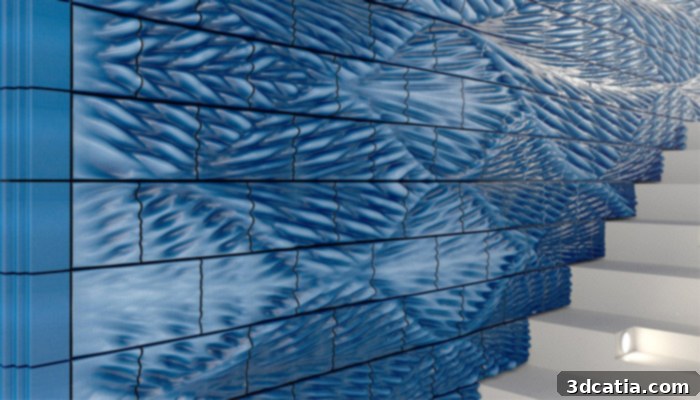
The 3D printed ceramic tiles cover the gates of a new residential building (Image credits: Studio RAP)
Innovating Fabrication: Robotic Precision Meets Algorithmic Design
At the heart of this intricate fabrication process is a KUKA robotic arm, a marvel of modern automation that meticulously executes the 3D printing of each ceramic tile. This robotic precision is critical for achieving the consistency and complexity required for such a large-scale architectural application. Once a tile is formed and allowed to harden, it undergoes a crucial glazing process, where layers of blue and white glazes are expertly applied. This not only imparts the final aesthetic touch, mirroring the classic Delft Blue appearance, but also enhances the tile’s durability and protective qualities. According to the dedicated team at Studio RAP, the carefully selected ceramic material offers a unique combination of high durability and remarkably low maintenance, making it an ideal choice for a lasting architectural installation. Furthermore, the studio adopted a sophisticated algorithmic approach for the 3D design of these thousands of tiles. This computational method allowed engineers and designers to consider and integrate numerous manufacturing constraints directly into the geometry generation process. Factors such as maximum overhang, optimal width, height, and depth, as well as crucial shrinkage constraints during firing and the requirements for internal support structures, were all parametrically defined and optimized. This ensures that each of the 4,000 tiles, which collectively form a magnificent vault spanning 4 meters in width, 8 meters in height, and 12 meters in depth, is structurally sound, perfectly fitted, and visually coherent.
The Art of Glazing: “Painting with Shape”
The glazing method employed by Studio RAP is perhaps one of the most innovative and poetic aspects of the “New Delft Blue” project. The studio eloquently describes their technique as “painting with shape,” a testament to how the intricate 3D printed geometry directly influences the final glazed appearance. Because the tiles are digitally designed and 3D printed, the ability to introduce subtle yet significant variations in their form is both cost-effective and highly adaptable. The process involves applying a carefully formulated, runny glaze onto white-burning clay. The magic happens as the glaze interacts with the sculpted surfaces: convex portions of the tile (the “hills”) naturally shed the thin glaze, allowing the underlying white clay to remain prominent. Conversely, the blue glaze collects and pools in the concave areas (the “valleys”), creating deeper, richer hues of blue. This ingenious method orchestrates a seamless and organic transition between shades of blue and white that would be virtually impossible to achieve through conventional hand-painting or uniform glaze application. The result is a collection of two-colored tiles that, when assembled, form a dynamic, almost living surface, offering a unique visual effect to the future passageway. This digital craftsmanship allows the studio to transcend traditional limitations, blending the fluidity of glaze with the precision of robotic fabrication to create an entirely new aesthetic language. Further comprehensive details about this beautiful and pioneering project can be explored on Studio RAP’s official website, which delves deeper into their design philosophy and technical achievements.
The Architectural Impact and Future of Digital Craftsmanship
Studio RAP’s “New Delft Blue” project is far more than an artistic installation; it represents a significant leap forward in architectural innovation and the practical application of additive manufacturing in construction. The sheer scale of producing 4,000 unique ceramic tiles, each designed and fabricated with robotic precision, demonstrates the transformative potential of combining computational design with digital fabrication. This approach not only allows for an unprecedented level of customization and geometric complexity but also offers practical advantages in terms of material efficiency and waste reduction. Traditional ceramic production often involves significant material loss, but 3D printing can build objects layer by layer, only depositing material where it is needed. The durability and low maintenance characteristics of the chosen ceramic material also align with principles of sustainable construction, ensuring the vault’s longevity and reducing its environmental footprint over time. Moreover, by referencing and reinterpreting such a powerful cultural icon as Delft Blue, Studio RAP highlights how modern technology can be used to preserve and evolve heritage, rather than just replacing it. This project serves as a powerful case study for how bespoke, digitally crafted facades can be integrated into contemporary residential and public spaces, offering rich visual narratives and functional benefits. It opens doors for architects and designers to explore previously unfeasible designs, pushing the boundaries of what is possible in ceramic architecture and urban aesthetics. The harmonious blend of the historical artistry of Delft with the cutting-edge capabilities of robotic 3D printing creates a dialogue between past and future, solidifying Delft’s reputation as a hub of both tradition and innovation. This project exemplifies how digital craftsmanship can unlock new dimensions in material expression and structural integrity, leading to buildings that are not only visually stunning but also embody advanced engineering and ecological consciousness.

The tiles are 3D printed and then covered with varnish. (Image credits: studio RAP)
Engage with Innovation: Share Your Thoughts
What are your impressions of Studio RAP’s beautiful design and its highly innovative manufacturing method? The convergence of ancient art forms with state-of-the-art 3D printing and robotic fabrication presents exciting new possibilities for the future of architecture. We invite you to share your thoughts and perspectives on this pioneering project in the comments section below, or join the conversation on our Facebook and Twitter pages! Don’t miss out on the latest advancements and breaking news in the additive manufacturing industry. Be sure to sign up for our free weekly Newsletter, delivering all the essential updates in 3D printing directly to your inbox, keeping you at the forefront of this rapidly evolving technological landscape!