
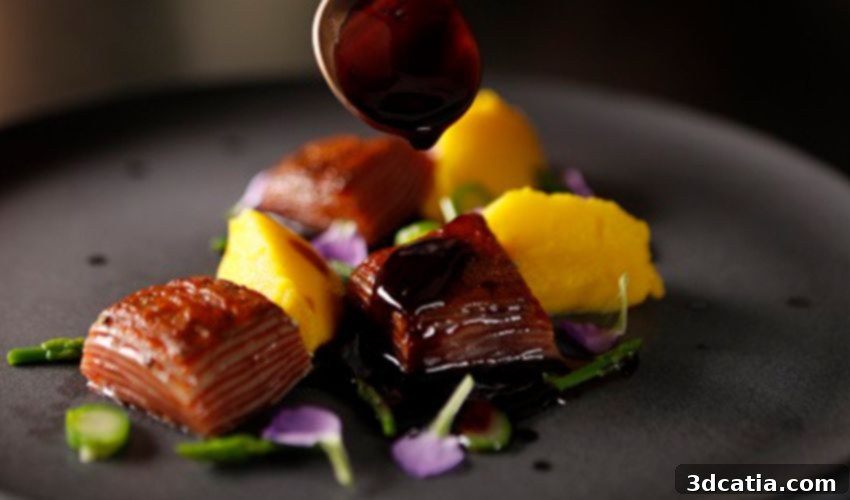
Steakholder Foods Revolutionizes Cultured Meat with 3D Printed Omakase Beef Morsels
In a groundbreaking announcement that marks a significant leap for the alternative protein sector, international deep-tech food company Steakholder Foods Ltd. recently unveiled its latest innovation: the 3D printed Omakase Beef Morsels. This richly marbled, structured meat product stands as the first of its kind, meticulously crafted using a specific 3D bioprinting technology that the company has recently secured a patent for. This development not only underscores Steakholder Foods’ position at the forefront of cellular agriculture but also signals a transformative moment for the entire food industry, pushing the boundaries of what is possible in sustainable and ethical meat production.
The integration of 3D printing into food production has seen a remarkable surge in recent months, continuously expanding its influence across the culinary world. Ever since the food industry recognized the myriad benefits offered by additive manufacturing – from unparalleled precision and customization to the ability to create novel textures and complex structures – companies worldwide have been exploring innovative ways to 3D print food. Among these pioneers, Israel-based Steakholder Foods (formerly known as Meatech) has consistently led the charge, delivering a diverse range of 3D-printed meat products that leverage cutting-edge bioprinting technologies. Their past achievements include the unveiling of a bioprinted 3.67oz (104g) steak last year, which was celebrated as the largest cultured steak globally at the time. The company’s latest triumph, the Omakase Beef Morsels, is an exquisitely structured meat cut, drawing its inspiration from the revered Japanese Wagyu beef, known for its exceptional marbling and tenderness.
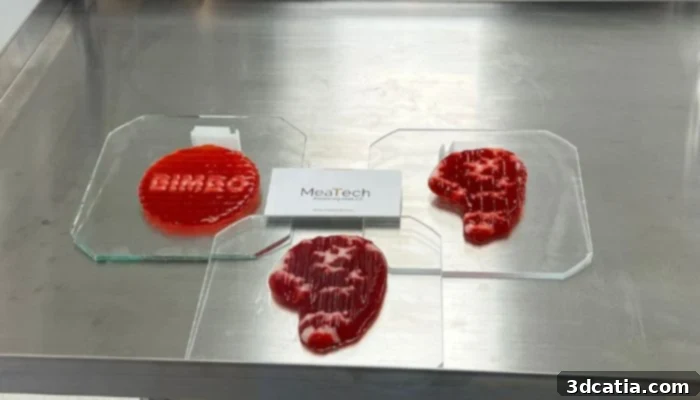
The Meat is created using two kinds of bio-ink
The Breakthrough Technology Behind Cultured Beef
Steakholder Foods employs a proprietary, cutting-edge 3D bioprinting technology to produce its slaughter-free meat products. This advanced system was meticulously developed by an interdisciplinary team comprising the company’s in-house mechanical engineers and cellular biologists, showcasing a harmonious blend of scientific expertise and engineering precision. The innovative process begins with the production of two distinct types of bio-ink, both derived from lab-cultured animal cells. One bio-ink is specifically formulated for muscle tissue, while the other is designed for fat tissue. These cellular components are grown in bioreactors, replicating the natural growth processes of animal cells without the need for animal slaughter.
Once the bio-inks are prepared, the product is printed layer by layer. During this intricate process, the two bio-inks are strategically applied in various sequences and densities. This granular control over the deposition of both muscle and fat cells is paramount. By precisely managing the application of each ink, Steakholder Foods can meticulously optimize key characteristics of the meat cut, such as its juiciness, tenderness, and most importantly, its marbling. This level of control allows for the creation of intricate fat distribution patterns, mimicking the highly sought-after intramuscular fat found in premium cuts of conventional meat. Beyond these qualities, the advanced bioprinting technology also offers unparalleled flexibility, enabling the 3D printing of meat products in virtually any desired shape, width, and marbling ratio. The ultimate result is a delicate, flavorful, and exquisitely textured piece of meat, ready to be transformed into a delicious and ethically conscious meal.
A Visionary Statement from Steakholder Foods’ CEO
Arik Kaufman, Chief Executive Officer of Steakholder Foods, expressed immense enthusiasm for the new product, emphasizing its significance for the company and the broader cultured meat sector. He stated, “This product marks a major breakthrough for us and for the cultured meat sector in general. It is the result of a lot of hard work and our desire to attain the highest standard of meat possible through bioprinting and cell cultivation processes. It also marks a significant milestone in our quest to perfect the “holy grail” of meat — steak. We see Omakase Beef Morsels at the intersection of food, technology and fine art. We want to inspire chefs around the world to create mouthwatering culinary masterpieces and unforgettable dining experiences.” Kaufman’s words highlight not just a technological achievement, but a philosophical one, positioning cultured meat as an art form that merges scientific innovation with gourmet culinary potential. This vision is not merely about replicating meat but elevating it, offering unparalleled control over taste, texture, and presentation, which opens new avenues for fine dining and gastronomic creativity.
The “Omakase” designation itself is carefully chosen. In Japanese cuisine, “Omakase” signifies a meal where the chef chooses the dishes, entrusting the culinary artistry to their expertise. By naming their product Omakase Beef Morsels, Steakholder Foods conveys the premium quality and the bespoke nature of their 3D printed meat, suggesting that it can inspire chefs to create truly unique and exquisite dishes. This strategic naming also resonates with the product’s inspiration from Wagyu beef, a cornerstone of high-end Japanese gastronomy. The ability to precisely control marbling and structure allows chefs to experiment with textures and flavors in ways previously unimaginable with conventional meat, offering a consistent and high-quality ingredient for culinary innovation.
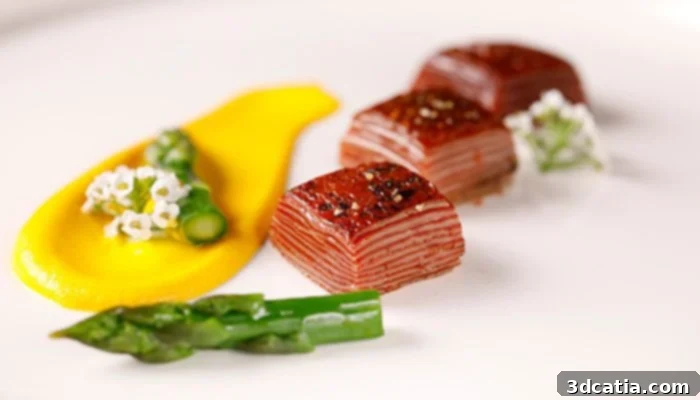
The Omakase Beef Morsels on a plate
Paving the Way for a Sustainable and Ethical Food Future
Beyond the impressive technological feat and culinary aspirations, Steakholder Foods’ overarching mission is deeply rooted in sustainability and ethical food production. By developing and offering innovative products like the Omakase Beef Morsels, the company aims to provide high-quality, slaughter-free foods that serve as a viable and superior alternative to the products of industrialized farming and fishing. The environmental footprint of traditional animal agriculture is substantial, contributing significantly to greenhouse gas emissions, deforestation, land degradation, and water pollution. Industrialized farming also raises significant ethical concerns regarding animal welfare, health risks associated with antibiotics, and the sheer scale of animal slaughter.
Steakholder Foods is committed to addressing these critical issues head-on. By eliminating the necessity to raise and slaughter animals for meat consumption, the company is actively working to reduce the food industry’s immense impact on the environment. Cultured meat offers a pathway to drastically lower resource consumption – requiring less land, water, and energy compared to conventional meat production. Furthermore, it presents a more humane approach to feeding a growing global population, offering a clean, safe, and consistent protein source that doesn’t compromise on taste or culinary versatility. This shift towards sustainable food production is not just about environmental protection; it’s about reimagining our entire food system to be more resilient, ethical, and capable of meeting future demands without depleting our planet’s resources.
The release of Omakase Beef Morsels is more than just a product launch; it’s a testament to the potential of deep-tech innovation in solving some of humanity’s most pressing challenges. Steakholder Foods continues to push the boundaries of cellular agriculture, setting new standards for quality, sustainability, and ethical considerations in the meat industry. As the world grapples with climate change and food security, companies like Steakholder Foods offer a promising vision for a future where gourmet dining and environmental responsibility can coexist harmoniously. To learn more about Steakholder Foods and their pioneering work in the cultured meat revolution, please visit the company’s official website HERE.
What are your thoughts on Steakholder Foods’ revolutionary 3D printed meat? Share your insights and join the conversation by leaving a comment below or engaging with us on our LinkedIn, Facebook, and Twitter pages! Don’t miss out on the latest advancements in additive manufacturing – subscribe to our free weekly Newsletter here to receive 3D printing news directly in your inbox! You can also explore all our insightful videos on our YouTube channel.
*All Photo Credits: Steakholder Foods