

Revolutionizing Maritime Manufacturing: SPEE3D’s Cold Spray 3D Printing and Advanced NAB Materials
The vast expanse of the ocean, with its relentless salt water, powerful roaring waves, and ever-changing weather patterns, has long been a source of inspiration for countless tales of adventure and human endurance. This harsh environment, however, also presents formidable challenges for the maritime industry. From commercial shipping and naval operations to offshore energy and port infrastructure, the sector constantly grapples with issues ranging from corrosive conditions and extreme wear to the complexities of managing global supply chains. In today’s dynamic global landscape, these challenges are more pronounced than ever, demanding innovative solutions for unstable logistics and the efficient production of large, resilient parts.
Additive manufacturing, commonly known as 3D printing, emerges as a transformative technology offering a compelling answer to many of these maritime dilemmas. By enabling on-site and on-demand production, 3D printing significantly mitigates the vulnerabilities associated with extended, fragile supply chains. A growing array of 3D printing technologies is now available, and an increasing number of manufacturers are strategically positioning themselves within the maritime market. Among these innovators, SPEE3D stands out as a company with a significant track record in the sector. The Australian firm provides a comprehensive range of materials specifically tailored for demanding maritime applications, coupled with an exceptionally fast and efficient cold spray additive manufacturing process for creating critical metal replacement parts.

SPEE3D Delivers Robust On-Board Additive Manufacturing Solutions
At the forefront of SPEE3D’s offerings for expeditionary and on-site manufacturing is their patented Expeditionary Manufacturing Unit (EMU). This flagship product is designed for unparalleled versatility, capable of deployment in almost any location where it’s needed most – whether at forward operating bases, on bustling docks, or crucially, directly onboard vessels at sea. The EMU is a self-contained manufacturing powerhouse, comprising the innovative XSPEE3D 3D metal printer and the integrated SPEE3Dcell post-processing unit. The SPEE3Dcell enhances the system’s capabilities with two industrial furnaces, a high-precision CNC machine for finishing, and essential testing equipment. This comprehensive, open system allows for the processing of a diverse range of materials, enabling the rapid and efficient production of parts vital for urgent maintenance and repair tasks, significantly reducing downtime and operational costs.
Understanding Cold Spray Additive Manufacturing (CSAM)
The core technology powering SPEE3D’s printers is Cold Spray Additive Manufacturing (CSAM), a revolutionary process that sets it apart from conventional 3D printing methods. Unlike fusion-based techniques that melt metal, CSAM operates at significantly lower temperatures. In this groundbreaking process, metal powder particles are propelled at supersonic speeds—up to three times the speed of sound—onto a substrate. The kinetic energy of these high-velocity particles causes them to deform and bond instantly upon impact, forming a dense, solid part with remarkably low porosity. The deposition speed of 100 grams per minute is truly exceptional, allowing for the rapid production of industrial-grade metal components.
This rapid, cold deposition process offers distinct advantages over traditional manufacturing methods like casting. CSAM is considerably faster, drastically reducing lead times that can often stretch for weeks or even months with conventional approaches. Furthermore, by enabling on-demand production, it virtually eliminates the need for large, costly inventories of spare parts, thereby simplifying logistics and significantly reducing overall operational expenses. The resultant components boast superior material integrity due to the absence of melting and solidification cycles, minimizing issues such as thermal distortion, residual stresses, and cracking commonly associated with high-temperature processes.

SPEE3D Validates Two New NAB Material Systems for Maritime Additive Manufacturing
While metals generally possess superior mechanical properties compared to polymers for demanding applications like shipbuilding, they remain susceptible to the relentless forces of corrosion and wear, especially in the challenging marine environment. For critical maritime components, extreme durability and resistance to harsh elements are non-negotiable. This is where Nickel Aluminum Bronze (NAB) emerges as an indispensable material. Renowned for its exceptional anti-fouling, antimicrobial properties, and inherent strength, NAB is highly valued in the maritime sector and has historically been a preferred material for cast parts, such as propellers, valves, and pump components.
Recognizing the vital role of NAB and the inefficiencies of traditional casting processes – which are plagued by long lead times, complex logistics, and high minimum order quantities – SPEE3D embarked on a mission to develop a Nickel Aluminum Bronze alloy specifically optimized for additive manufacturing. Through extensive research, rigorous testing, and subsequent trials in real-world scenarios, SPEE3D has successfully validated two distinct NAB powders, both compatible with their high-speed CSAM technology. This significant achievement rounds off SPEE3D’s comprehensive additive solution offering to the maritime sector, addressing a critical need for robust, on-demand component production.
The SPEE3D NAB powder exhibits an outstanding array of characteristics crucial for marine applications, including superior corrosion resistance, excellent lubricity, and remarkable resistance to cavitation damage and stress cracking. This new NAB material, developed in close collaboration with the US Naval Sea Systems Command (NAVSEA), represents a significant leap forward in material science. It is engineered to be substantially tougher than SPEE3D’s traditional aluminum bronze material. The alloy rigorously meets NAVSEA’s stringent C958 specifications, making it an exclusive material available for the creation of safety-critical parts for both surface and underwater hulls within the naval fleet. It consistently ensures the production of flawless components characterized by a high degree of hardness and reliability, vital for military readiness and operational effectiveness.
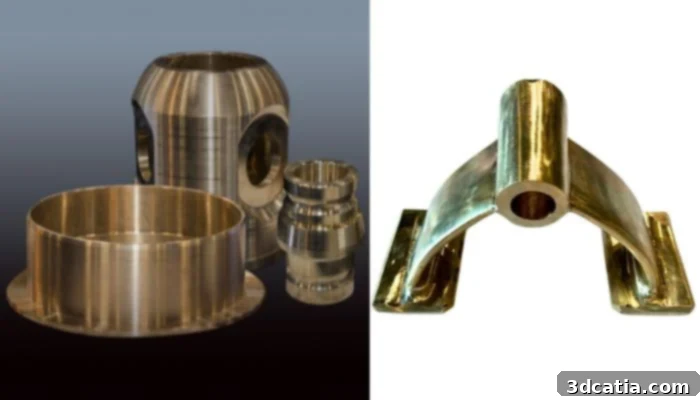
Beyond its military-grade offering, SPEE3D has also launched a commercial version of the material, known as Expeditionary NAB. This variant closely aligns with the NAVSEA material, exhibiting approximately 97% of its properties, but crucially, it does not necessitate the use of hot isostatic pressing (HIP) for post-processing. Instead, a simplified heat treatment process is sufficient for parts produced with Expeditionary NAB. This streamlined post-processing makes it exceptionally well-suited for the on-board production of ship parts using the Expeditionary Manufacturing Unit. This commercial NAB variant also achieves exceptionally high strength, boasting 58 ksi (390 MPa) Ultimate Tensile Strength (UTS), making it an ideal solution for a wide array of transition parts and general marine components where high performance and rapid availability are paramount.
Both NAB grades leverage the inherent advantages of CSAM technology. By kinetically spraying metal particles onto a substrate using compressed air at supersonic speeds, the process avoids extreme temperature fluctuations. This key attribute minimizes common issues such as residual stress, cracking, and deformation that can plague components manufactured with high-heat processes. The quality of the material and the promising synergy between NAB and CSAM for the maritime sector are unequivocally demonstrated by numerous successful implementations to date, validating their effectiveness in real-world marine environments.
Diverse Applications and Future Prospects in Maritime and Beyond
SPEE3D has already proven the sea-worthiness of parts produced with their NAB materials and CSAM technology. Practical examples include critical components such as a propeller strut, a robust bushing, and a camshaft lock, all demonstrating the material’s integrity and performance under operational conditions. More broadly, the material is perfectly suited for producing a wide array of essential ship components, enhancing the resilience and operational readiness of both commercial fleets and naval vessels. This includes vital parts like rudders, various types of valves, propellers, pipe fittings, and complex engine infrastructure, all of which are continuously exposed to the corrosive and mechanically demanding marine environment.
Looking ahead, SPEE3D is not limiting the application of its advanced NAB materials solely to the maritime domain. The company identifies significant potential for this highly robust and versatile alloy in other demanding industrial sectors. This includes the mining industry, where machinery faces extreme abrasive wear; the defense sector, which requires durable and rapidly deployable components for various military applications; and the oil & gas industries, where equipment operates in highly corrosive and high-pressure environments. These strategic diversifications underscore the broad applicability and innovation inherent in SPEE3D’s additive manufacturing solutions.
Ultimately, these continuous innovations firmly establish SPEE3D’s capability to meet and exceed the high demands of the maritime sector, driving forward the adoption and advancement of additive manufacturing in this critical area. To delve deeper into SPEE3D’s cutting-edge printing solutions and their revolutionary NAB materials, visit their website HERE. Alternatively, you can meet the SPEE3D team in person and witness their technology firsthand at Formnext 2024 in Frankfurt, located at booth C.01, Hall 12.0.
What are your thoughts on SPEE3D’s groundbreaking ventures into the maritime sector and the potential of cold spray technology? Share your insights and comments below or engage with us on our LinkedIn, Facebook, and Twitter pages! Don’t forget to sign up for our free weekly newsletter here for the latest 3D printing news delivered straight to your inbox! You can also find all our compelling videos on our YouTube channel.
*All Photo Credits: SPEE3D