
BIOLIFE4D: Pioneering 3D Bioprinting to Solve the Global Organ Shortage Crisis
The rapid advancements in 3D printing technology are profoundly transforming numerous critical sectors, with the medical industry standing out as one of the most promising frontiers. This innovative technology is opening unprecedented possibilities and solutions to some of humanity’s most pressing health challenges. Among these, the persistent and critical shortage of organ donations remains a major global issue. Every year, countless lives are tragically lost due to the vast disparity between the number of organs needed for transplant and the limited supply available. In the United States alone, a staggering figure of over 100,000 individuals languish on transplant waiting lists, with many succumbing before a compatible organ can be found. This dire situation underscores an urgent need for revolutionary alternatives that can truly address the immense gap in organ availability.
Addressing this monumental challenge head-on is BIOLIFE4D, a visionary biotech company dedicated to leveraging cutting-edge science to redefine the future of medicine. Through their groundbreaking work in 3D bioprinted tissues and organs, BIOLIFE4D is actively researching and developing innovative methods to provide viable organs for transplantation, alongside developing advanced platforms for crucial applications like future drug testing. Their pioneering efforts are not merely incremental improvements but represent a monumental leap towards a future where organ scarcity is a relic of the past. By focusing on personalized, patient-specific solutions, BIOLIFE4D aims to deliver a transformative impact on global healthcare. To delve deeper into their mission and the progress they are making, we had the distinct opportunity to interview their esteemed CEO, Steven Morris, who shared invaluable insights into BIOLIFE4D’s ambitious goals and significant achievements.
3DN: Can you please introduce yourself and BIOLIFE4D?
 My name is Steven Morris, and I am honored to be the Founding Partner and CEO of BIOLIFE4D. Our company stands at the forefront of biotechnological innovation, pioneering advancements in tissue engineering with the ultimate goal of 3D bioprinting fully functional human organs that are viable for transplant. Our core mission is driven by a profound commitment to tackling two of the most critical healthcare dilemmas facing humanity today: the devastating global scarcity of donor organs and the tremendous, often life-threatening, challenges that even those fortunate enough to receive donor organs currently endure. We believe that our unique approach, centered on patient-specific solutions, holds the key to fundamentally transforming the landscape of organ transplantation, offering hope and extending lives in unprecedented ways by eliminating the need for traditional donor organs and the subsequent lifelong immunosuppressive therapies.
3DN: Tell us more about the projects you are working on?
At the heart of our ambitious endeavor is the ultimate mission to successfully 3D bioprint human hearts that are entirely viable for transplantation. This breakthrough would effectively resolve the severe and pervasive issue of donor organ supply that plagues healthcare systems worldwide. What makes our approach truly revolutionary is our unwavering commitment to using the patient’s own cells as the foundational “bio-ink.” This innovative method completely eliminates the critical problem of organ rejection, a pervasive and dangerous complication associated with traditional organ transplants where foreign tissue is introduced. Consequently, patients would no longer require the immensely undesirable and often debilitating immunosuppressant therapy, a rigorous regimen that current donor recipients must adhere to for the rest of their lives, and which itself can lead to severe health complications, increased susceptibility to infections, and even life-threatening circumstances. This patient-specific, rejection-free solution represents a profound paradigm shift in transplant medicine, promising a future of better outcomes and significantly improved quality of life for recipients.
While our long-term vision is centered on whole organ bioprinting, we have strategically identified and are actively pursuing several shorter-term opportunities that address less advanced forms of heart disease. Each of these intermediary projects has the potential to profoundly impact current heart disease treatments and offers immediate clinical relevance. Our very first significant achievement in this pathway has been the successful development of a 3D bioprinted cardiac patch. This patch is not merely a scientific milestone; it possesses incredible practical applications and holds immense promise for improving the quality of life for countless individuals suffering from cardiac conditions, such as those recovering from heart attacks or dealing with weakened heart tissue. For BIOLIFE4D, the successful bioprinting of this human cardiac tissue was equally vital as it definitively demonstrated the efficacy and sophistication of our proprietary bioprinting process and technology, proving our fundamental capability to create functional biological structures using patient-derived cells.
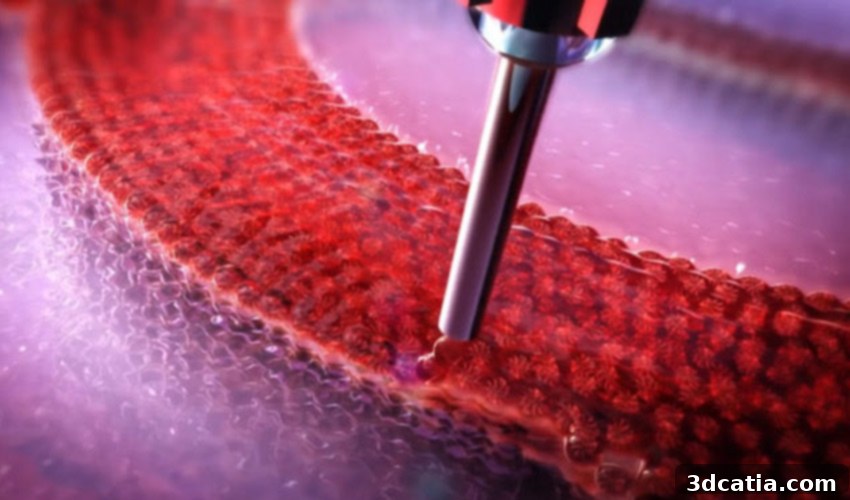
Heart cells in a hydrogel
Our process for each of these bioprinting opportunities, whether a cardiac patch or ultimately a full heart, follows a carefully engineered yet fundamentally natural approach. We meticulously 3D bioprint living human cells, which are first derived and re-engineered from the patient’s own cells, ensuring perfect biological compatibility. These cells are then precisely laid down one layer at a time, guided by a sophisticated 3D model, effectively building the desired organ or tissue from the bottom up with unparalleled accuracy. Unlike conventional 3D printing techniques that rely on fusing layers with heat or curing materials with UV light – methods that would unfortunately destroy living cells and biological integrity – our innovative approach utilizes a specialized biodegradable support scaffolding. This scaffolding serves to maintain the cells in their precise, predetermined positions during the initial stages of construction. Crucially, we then allow the normal biologic self-assembly process to take over and complete the formation of the tissue or organ. This method exquisitely mimics the inherent processes that occur naturally within the human body, a process refined over millions of years of evolution, where cells instinctively recognize their roles, differentiate, join together, and begin performing specific biological functions. This profound reliance on nature’s wisdom and self-organization is central to our success in creating viable, living structures. A comprehensive description of this intricate process, along with an illustrative video, is available on our website at https://biolife4d.com/process/. In essence, BIOLIFE4D creates the optimal biomimetic conditions outside the body to facilitate the exact same natural biological assembly that occurs internally, allowing nature to ultimately finish the complex process of organ development for us.
3DN: What are the hopes for the end result of the projects and the timeline set?
Our ultimate hope and driving force is to save lives – an immense number of them. The statistics are truly sobering and highlight the urgency of our mission: nearly one out of every three people in the developed world, and indeed globally, succumbs to cardiovascular disease, making it the leading cause of death. With billions of people alive today, this represents an enormous and devastating health burden. Despite this widespread prevalence, the number of heart transplants performed worldwide last year was astonishingly low, barely reaching around 5,000, a number dwarfed by the global need. In the United States alone, a mere 2% of individuals on the heart transplant waiting list received a donor heart last year, highlighting the profound inadequacy of current solutions. We are at a pivotal moment where remarkable advances in life sciences, bioengineering, and 3D bioprinting technology have converged, finally enabling us to embark on the complex yet achievable process of bioengineering a human heart. This heart would be 3D bioprinted using a patient’s own cells as the “bio-ink,” making it perfectly suited for transplantation without the devastating risk of rejection. The introduction of this transformative technology to the market promises to have an unparalleled and profound impact on the healthcare industry and humanity as a whole, revolutionizing how we approach cardiac care and organ replacement for generations to come.
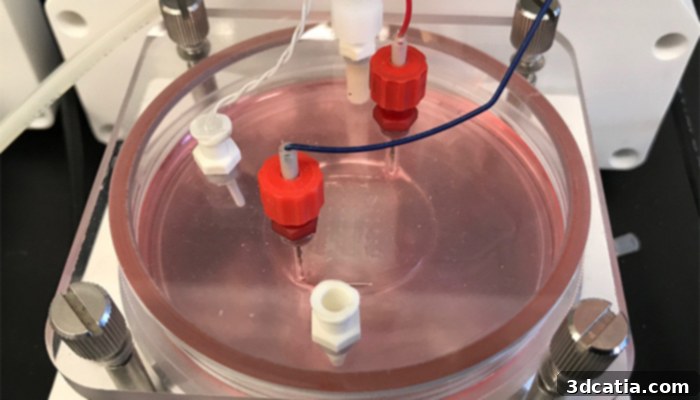
Bio printer
Beyond saving countless human lives through organ transplantation, we are also diligently working on our next significant milestone: providing an innovative alternative to certain forms of animal testing. This initiative holds the potential to spare millions of animal lives, as our bioprinted tissues and miniature organs could eventually serve as sophisticated, physiologically relevant models for pharmaceutical companies. This would allow them to conduct essential drug and therapy testing for human use with greater accuracy and ethical integrity, without the need for traditional animal subjects, representing a compassionate and scientifically advanced approach to drug development.
Regarding a definitive timeline, it is inherently challenging to provide precise dates when navigating the complexities of scientific discovery and attempting to recreate in a lab what nature has perfected over millions of years. The unknown variables and potential scientific obstacles make exact predictions difficult. However, we have demonstrated incredible momentum; for example, we successfully 3D bioprinted human cardiac tissue over a year ahead of our initial projections, which strongly indicates we are on an accelerated and correct path. By the end of this year or early next, we anticipate unveiling our “mini-heart,” a miniature version of a human heart, roughly the size of a mouse heart. This mini-heart is poised to be a game-changer in its own right, not only serving as a crucial proof-of-concept for our capability to 3D bioprint a full-sized human heart but also representing our first large potential commercial opportunity for research and drug discovery, offering an unprecedented platform for studying cardiac function and disease. Recognizing the immense stakes and the potential to help so many, BIOLIFE4D has meticulously assembled a preeminent team of experts. These highly focused individuals bring unparalleled backgrounds from world-renowned institutions such as Harvard, MIT, Carnegie Mellon, UVA, and Johns Hopkins, all united by a singular vision. Their collective expertise is dedicated to bringing this incredible, life-saving technology to market in the shortest possible timeframe. While scientific progress is by nature unpredictable, it is our earnest hope that with appropriate resources and continued breakthroughs, we will have very exciting news to share within the next few years, bringing us closer to a future where organ shortages are a thing of the past.
3DN: How did BIOLIFE4D start?
The genesis of BIOLIFE4D was a deeply considered and inspired journey. After successfully selling my previous business ventures, my initial intention was to embark on a new enterprise within the dynamic 3D printing sector. My preliminary concept revolved around establishing a rapid prototyping company specifically for the medical industry, an area I recognized as ripe for innovation. However, as I delved deeper into the burgeoning fields of life sciences, advanced computing technology, bioengineering, and other related disciplines, it became increasingly clear that these critical areas were finally reaching a convergence point. This unique alignment of scientific and technological progress suggested that the monumental task of bioengineering a human organ viable for transplantation was no longer a distant dream but a tangible possibility – provided the right team could be assembled. Simultaneously, I became acutely aware of the staggering global toll that cardiovascular disease inflicts upon humanity, tragically claiming the lives of one out of every three individuals in developed countries worldwide. Understanding that the very technology BIOLIFE4D is now developing held the potential to directly combat this devastating disease, I made the resolute decision to pivot my focus. Thus, BIOLIFE4D was founded with the explicit and urgent mission to bring this life-saving technology to market as rapidly and efficiently as possible, addressing one of the most critical health crises of our time and offering a beacon of hope to millions suffering from heart disease.
BIOLIFE4D bio-printer
3DN: Where do you see Bioprinting going in the future?
The trajectory of 3D printing in general is already demonstrating a profound and far-reaching impact across both research and clinical applications. For instance, pediatric cardiac surgeons are currently utilizing 3D printing to create highly accurate simulated heart models derived from scans of a child’s heart. These models provide invaluable tools, allowing surgeons to meticulously practice complex surgical procedures before ever operating on the actual patient, thereby significantly enhancing preparation, reducing risks, and improving patient outcomes. Our focus at BIOLIFE4D is on bioprinting, a highly specialized form of 3D printing that employs living biological material, such as human cells, as the “ink” to construct intricate biological structures. In our specific application, we re-engineer a patient’s own cells to serve as this bio-ink, enabling us to 3D bioprint living tissues and, ultimately, entire functional organs like a heart.
The potential applications for bioprinting are virtually limitless and extend far beyond cardiac tissue. Once we have perfected the intricate technology and processes for bioprinting a human heart, we will be able to leverage that foundational knowledge and methodology towards the bioengineering of numerous other vital organs. Imagine a future where we can bioprint kidneys, lungs, livers, and more, each tailored precisely to a patient’s unique physiological needs, completely eliminating rejection and the agonizing donor waiting lists. The transformational effect of being able to bioprint these various organs on humankind will be immeasurable. Consider, for example, the potential for a complete cure for Type 1 diabetes: for individuals whose pancreas is unable to produce adequate levels of insulin, a healthy, bioengineered pancreas transplant could offer a complete end to their dependence on insulin injections, revolutionizing their quality of life and freeing them from chronic disease management. Furthermore, healthcare applications, such as the organ bioprinting we are intensely focused on, represent just one facet of the broader bioprinting revolution. The technology’s scope extends to personalized medicine, rapid drug discovery platforms, advanced regenerative therapies for damaged tissues, and even the creation of intricate disease models for research. Clearly, bioprinting is not merely an incremental advancement; it is fundamentally aligned to have a profound, disruptive, and enduring impact on the well-being and future of humanity.
To further understand the innovative process at BIOLIFE4D, watch this illustrative video:
BIOLIFE4D’s groundbreaking research and ambitious goals hold immense promise for the future of medicine. What are your thoughts on their pioneering work in 3D bioprinting and its potential to solve the global organ shortage? We encourage you to share your perspectives in a comment below or join the conversation on our Facebook and Twitter pages! For all the latest news and developments in 3D printing and bioprinting, don’t forget to sign up for our free weekly Newsletter, delivered straight to your inbox!