
HETEROMERGE: Pioneering Multi-Material Micro 3D Printing for Advanced Functional Structures
Additive manufacturing, often known as 3D printing, has emerged as a transformative production tool, rapidly democratizing across various industries. However, its widespread adoption still faces specific hurdles, particularly when it comes to the demand for extreme precision in end-use parts. This precision becomes critically important for applications at the micro- and nanoscale, where even minute deviations can compromise functionality. To address this escalating industrial need, we are witnessing a rapid evolution in micro 3D printing solutions designed to achieve unparalleled accuracy and resolution. Among the innovative companies at the forefront of this technological advancement is Germany-based HETEROMERGE. We recently had the opportunity to speak with its visionary founder and CEO, Robert Kirchner, to delve deeper into HETEROMERGE’s groundbreaking multi-material micro 3D printing technology and its potential to revolutionize the fabrication of microscopic functional structures.
3DN: Could you introduce yourself and elaborate on your connection to 3D printing and advanced manufacturing?

Robert Kirchner
I am Robert Kirchner, the co-founder and CEO of HETEROMERGE GmbH, a company proudly rooted in Dresden, Germany. My academic and professional journey began in electrical engineering, culminating in a PhD in polymer microsystems fabrication, which I completed in 2011. Throughout my doctoral research and subsequent professional roles—including significant contributions at institutions like the Fraunhofer Institute for Photonic Microsystems (IPMS) and the Paul Scherrer Institute—my work consistently focused on cutting-edge research in micro- and nanofabrication. This involved extensive exploration into areas such as nanoimprint lithography, grayscale lithography, and crucially, 3D printing utilizing 2-photon absorption-based laser writing techniques.
The unifying theme and driving force behind all this research has always been the precise fabrication of incredibly small, yet highly functional, structures. Our efforts were dedicated not only to creating advanced original microstructures but also to exploiting innovative polymer replication techniques to enable high-volume production capabilities for these intricate designs. A notable example of our achievements in this area is the fabrication of complex waveguide structures, which are fundamental components enabling today’s sophisticated augmented reality (AR) glasses. It was back in 2013, leveraging the capabilities of a 2-photon 3D printer, that we achieved a significant breakthrough: the ability to produce extremely small, yet simultaneously highly precise, 3D free-form structures. This initial success with 2-photon printing experiments ignited a passion that has stayed with me ever since, shaping my professional trajectory and ultimately leading to the foundation of HETEROMERGE.
3DN: What is HETEROMERGE, and what inspired the creation of the company?
My enduring passion for functional 3D fabrication, which began during my PhD, ultimately guided me toward the realm of fully additive manufacturing. This journey culminated in the development of our multi-material printhead designed specifically for 2-photon laser printing, which is the core of HETEROMERGE’s innovation today. As part of my research group at the Technische Universität Dresden, we identified a critical need and ambition: the desire to print multi-material composite microstructures. The rationale behind this was inherently straightforward yet profoundly impactful: different materials possess distinct physical properties. By constructing structures from multiple materials, it becomes possible to imbue them with functionalities that far surpass what a single material could achieve on its own. This synergistic approach allows for the creation of components with tailored mechanical, electrical, optical, or biological characteristics.
Among a multitude of potential application fields, we strongly believe that this multi-material approach can make a pivotal contribution to the future of manufacturing for electronic and optical systems. However, a significant limitation with existing 2-photon laser printers was their inability to process more than one material at a time. This meant that whenever a material change was required, we faced a challenging “realignment problem.” The inherent advantage of high-precision 2-photon micro-printing, which offers sub-micron resolution, was effectively undermined at that point because a suboptimal, often manual, material exchange routine had to be employed. Such a routine invariably introduced alignment errors, compromising the overall precision and quality of the final multi-material structure. Furthermore, these material exchanges were often quite time-consuming if not fully automated, leading to decreased throughput and increased production costs. Recognizing this critical bottleneck, we dedicated ourselves to developing a sophisticated solution: our patented multi-material printhead. This advanced printhead facilitates perfect realignment immediately after a rapid and automated material exchange, ensuring seamless transitions between different materials without sacrificing precision. It was with the clear objective of commercializing this revolutionary printhead technology that we founded HETEROMERGE, aiming to empower researchers and industries with truly functional micro-printing capabilities.
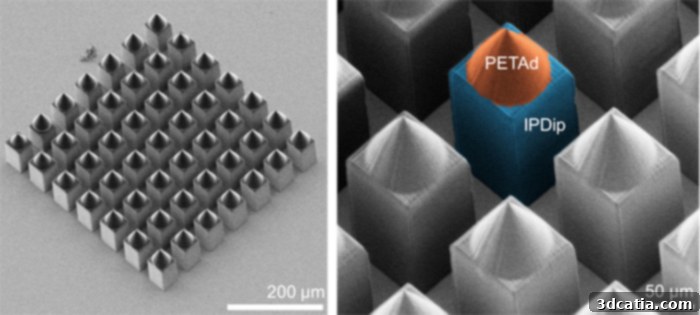
3D printed micro-needles made with the patented technology (photo credits: HETEROMERGE)
3DN: Can you elaborate on the unique capabilities of HETEROMERGE’s multi-material micro 3D printing solutions?
At the heart of our innovation is our patented printhead technology, which fundamentally transforms multi-material microfabrication. Primarily, it enables automated, on-site material exchange, a feature that completely resolves the long-standing problem of lateral realignment errors after switching materials in 2-photon laser printers. With HETEROMERGE’s solution, the issue of misalignment between regions composed of different materials is entirely eliminated. This capability is absolutely crucial for producing high-quality, high-performance micro-optics, where even minuscule misalignments can drastically degrade optical performance. Moreover, beyond precision, our solution significantly streamlines the entire exchange process, making it considerably faster and far more convenient than previous manual or semi-manual methods, thereby boosting productivity.
Another substantial advantage of our printhead solution is its unparalleled independence from the print substrate. This means users are not restricted to printing on passive substrates like glass or silicon; they can print directly onto active components such as LEDs or lasers. This remarkable versatility stems from the fact that we employ an open fluidic solution, making our printhead inherently independent of the substrate’s properties and imposing virtually no limits on the printing surface. This open architecture allows for unprecedented freedom in design and integration. In principle, this technology allows for printing at the module level or even directly onto wafers, achieving a deep level of integration that is essential for advanced electronic and optical systems. This substrate independence opens up entirely new avenues for creating integrated devices and complex systems that were previously unfeasible with conventional microfabrication techniques.
3DN: What are the primary advantages of this technology, and what are its key applications?
Our printhead technology offers a significant leap forward for anyone currently utilizing a 2-photon laser printer system, or even future generations of comparable techniques. It empowers them to implement vastly more functionality into their microstructures. In this sense, our solution is largely technology-agnostic, designed to enhance the capabilities of existing and emerging high-precision additive manufacturing platforms. We refer to this transformative capability as “functional 3D micro-printing,” and we anticipate that it will initially inspire researchers and developers who are driving this new wave of technology alongside us. The potential fields of application are incredibly diverse and far-reaching.
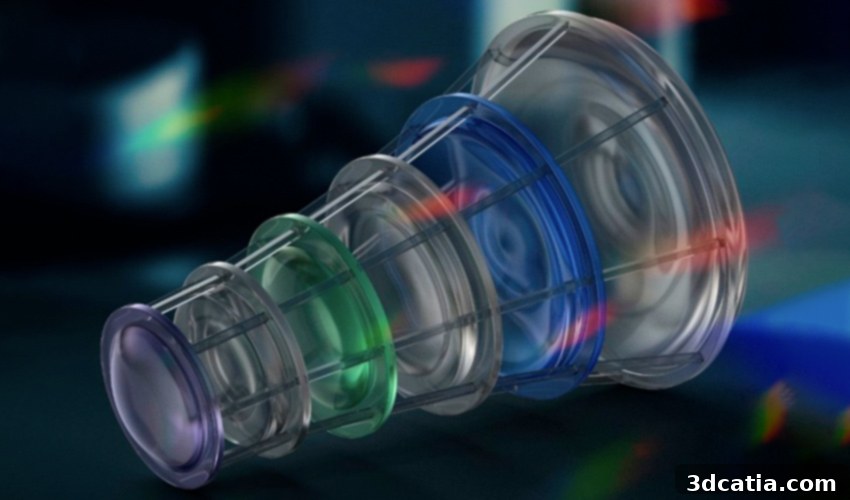
Indeed, by observing current trends in the commercial utilization of 2-photon laser writing, we identify distinct advantages for multi-material structures, particularly within the domains of micro-optics, advanced photonics, robust photonics packaging, innovative medical devices, and sophisticated tissue engineering. To provide a concrete example: imagine tiny lens stacks that can be 3D printed where each individual lens within the stack is fabricated from a different material, each with carefully chosen refractive indices and dispersion characteristics. This multi-material approach allows micro-optics to achieve significantly higher image quality, superior aberration correction, and broader spectral performance compared to what is currently possible with single-material lenses. We are profoundly convinced that our printhead technology will play a crucial role in enabling 2-photon laser writing to find a wider array of commercial applications not only in the aforementioned areas but also in numerous other fields yet to be fully explored. Furthermore, while we developed and optimized our printhead technology as an add-on for our Photonic Professional GT2 system from Nanoscribe, we are actively working on future developments to ensure our add-on can be adapted and utilized with other commercial printing systems and even self-built 2-photon lithography systems, maximizing its accessibility and impact across the industry.
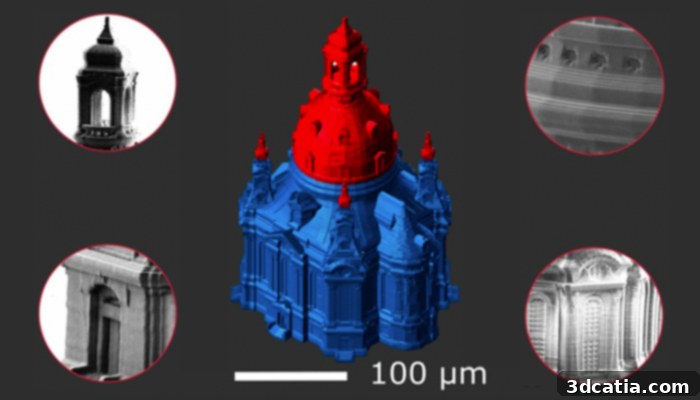
Photo Credits: HETEROMERGE
3DN: Where do you envision additive manufacturing heading in the next 10 years, and what role will HETEROMERGE play in that future?
In a broader sense, 3D printing has already firmly established itself across numerous sectors for the industrial production of larger structures, demonstrating its versatility and efficiency. We are now seeing 2-photon laser printing, as a specialized solution for micro additive fabrication, rapidly approaching a similar level of maturity and widespread acceptance. We anticipate that this technology will become an invaluable contributor to what is often referred to in electronics fabrication as “low volume and high mix” applications, where 3D printing can provide incredibly flexible and customized production capabilities, minimizing tooling costs and lead times.
Specifically for HETEROMERGE and the field of functional microstructures, we foresee additive manufacturing being initially deployed in the creation of exceptionally high-quality micro-optical elements and integrated components. Our ambitious goals include seeing the realization of advanced, minimally invasive medical imaging systems, enabled by our additively fabricated micro-optics. We are striving to develop optical components so powerful and compact that augmented reality (AR) glasses will soon be indistinguishable from normal eyewear, seamlessly integrating digital information into our daily lives. Furthermore, we aim to contribute to significantly more efficient information processing in data centers by enabling optical fibers to be coupled into chips with unprecedented precision and minimal loss, all through our printed functional micro-optics. The advent of the first truly optical chips, where our functional structures will play a foundational role, is also within our sights. However, we are also firmly convinced that many of the most impactful applications cannot even be fully imagined today. New markets and revolutionary products will undoubtedly emerge as the full potential of functional 3D micro-printing becomes more widely recognized and explored. We truly believe we are only at the very beginning of this exciting and transformative journey.
3DN: Do you have any final words or messages for our readers?
First and foremost, I would like to express my sincere gratitude for providing me with this valuable opportunity to briefly introduce HETEROMERGE and our innovative work. We genuinely hope that this interview will help us reach your diverse readership, particularly those who are actively working with 2-photon laser writing systems and are looking to push the boundaries of what’s possible by printing structures with multiple, distinct materials. Beyond those already equipped with printing systems, we warmly invite anyone who may not possess their own printing setup but has a potential application or a challenging problem that could benefit from functional 3D microstructures to contact us directly. We are always eager to discover new applications that can truly challenge and push the limits of our technology, fostering collaborative innovation. For readers interested in learning more about HETEROMERGE, our technology, and our vision, you can find comprehensive information about the company by visiting our website HERE.
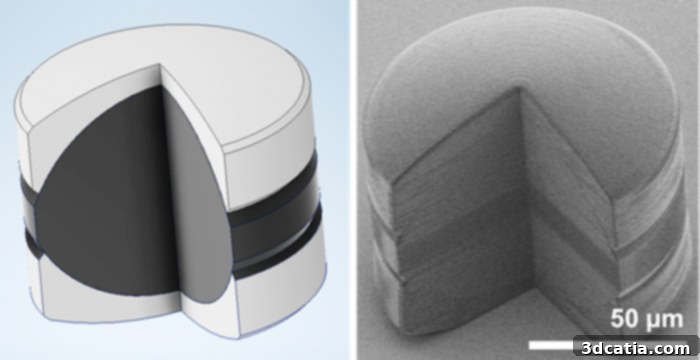
Multi-material micro-lens stack (photo credits: HETEROMERGE)
What are your thoughts on the groundbreaking multi-material micro 3D printing solution developed by HETEROMERGE? We invite you to share your perspectives and feedback in a comment below, or engage with us on our social media channels: LinkedIn, Facebook, and Twitter! Don’t forget to sign up for our free weekly Newsletter here to receive the latest 3D printing news directly in your inbox. You can also explore all our insightful videos and interviews on our dedicated YouTube channel.
*All Photo Credits: HETEROMERGE