
Exploring the Cosmos Up Close: NASA’s Revolutionary 3D Printable Models of Stars and Supernovae
The aerospace industry stands at the forefront of technological innovation, constantly pushing boundaries in research, development, and manufacturing. Central to this relentless pursuit of progress are advanced 3D technologies, which have become indispensable tools for accelerating prototyping, facilitating intricate research, and even fabricating critical end-use components. Among the leading pioneers in leveraging these cutting-edge tools is NASA, where technologies like 3D scanning and additive manufacturing (3D printing) are paramount for engineers and key stakeholders across various missions. A compelling example of this integration is NASA’s groundbreaking work in creating complex, tangible 3D models of celestial bodies, including distant stars and remnants of spectacular cosmic explosions, to significantly advance astronomical research and public engagement.
Harnessing the immense wealth of data gathered by the venerable Chandra X-Ray Observatory, a dedicated team of NASA researchers has achieved a remarkable feat: transforming abstract astronomical observations into visually stunning and physically tangible representations of deep space objects. These unprecedented models are not merely artistic interpretations; they are meticulously crafted based on the latest theoretical astrophysical models, sophisticated algorithms, and direct observational data from the observatory. Recently, NASA proudly unveiled four new, intricately detailed 3D models that are set to revolutionize how astronomers and space enthusiasts alike interact with the cosmos. What makes this announcement even more exciting is that these models are fully 3D printable, offering an unparalleled opportunity to study complex stellar phenomena and supernova remnants with a depth and interactivity previously unimaginable. This innovative approach allows scientists to explore distant objects in the starry sky up close, fostering new insights and sparking curiosity among a wider audience.
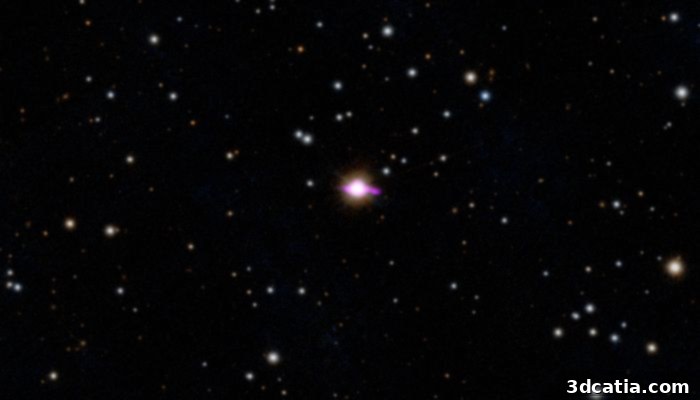
A telescopic image of the young star BP-Tau. The corresponding 3D model is showcased in the video below, revealing even greater detail.
So, which awe-inspiring cosmic entities were chosen for this innovative 3D modeling project? The Chandra X-Ray Observatory team selected one fascinating young star, BP Tau, and three dramatic supernova remnants: Cassiopeia A, G292.0+1.8, and the Cygnus Loop. Each of these models has been meticulously rendered to unveil surprising details and structural complexities that often remain elusive even through the most powerful telescopic observations, providing a new dimension for scientific analysis and public appreciation.
Delving into the Cosmic Phenomena: What the 3D Models Reveal
Cassiopeia A: The “Green Monster” Unveiled
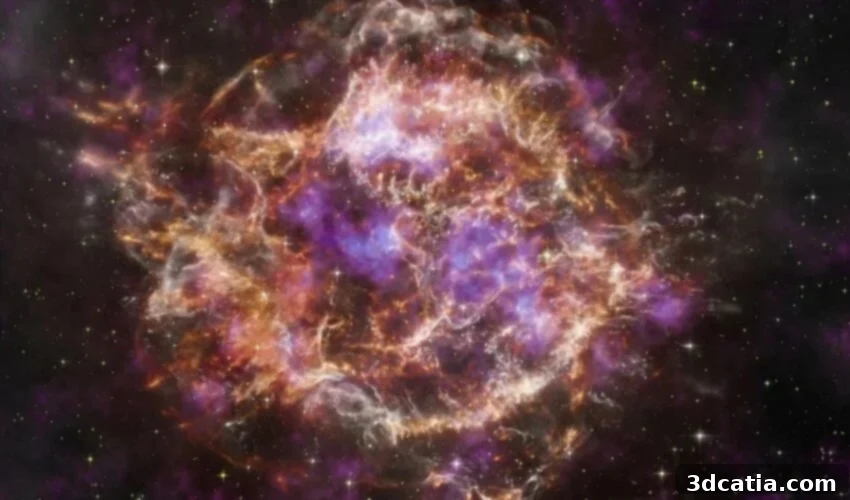
One of the most captivating objects among the newly released models is Cassiopeia A, a relatively young supernova remnant that researchers affectionately dubbed the “green monster.” This moniker comes to life through the 3D model, which allows scientists to scrutinize its properties with unprecedented detail. By analyzing its complex structure, researchers have gained profound new insights into its explosive origin and the cataclysmic event that created Cassiopeia A nearly 340 years ago. The 3D model transcends its scientific utility by also offering remarkable aesthetic appeal; it presents as a dynamic, roughly spherical purple gas cloud, through which streams of golden light brilliantly shine, painting a vivid picture of cosmic violence and beauty.
BP Tau: A Young Star’s Intricate Disk
BP Tau represents a crucial stage in stellar evolution – a young, still-growing star, estimated to be “only” 10 million years old. From Earth’s perspective, observations typically reveal a relatively simple disk shape around the star’s luminous center. However, the sophisticated 3D model dramatically redefines our understanding of this object. It demonstrates that the circumstellar disk surrounding BP Tau is far more intricate and dynamic than previously believed, showcasing a complex interplay of gases and dust. The model highlights prominent concave surfaces that extend gracefully around the star’s glowing core, punctuated by striking green flares that indicate regions of intense activity. Given the star’s youthful nature, the model also reveals orange and pink flower-like outgrowths, making BP Tau appear like a vibrant, multi-layered orchid in its tangible 3D form. These intricate details offer invaluable clues about the early stages of star and planetary system formation.
G292.0+1.8 and the Cygnus Loop: Unpacking Supernova Remnants
While specific intricate descriptions for G292.0+1.8 and the Cygnus Loop were not as detailed in the initial release, these 3D models of supernova remnants are equally significant. Supernova remnants are the expanding clouds of gas and dust left behind after a star explodes. G292.0+1.8, like Cassiopeia A, provides a window into the aftermath of massive stellar deaths, allowing researchers to study the distribution of elements forged in the supernova and the shockwaves propagating through interstellar space. The Cygnus Loop, another spectacular remnant, is known for its intricate filaments and stunning visual complexity, stretching across a vast region of space. The 3D models enable astronomers to untangle these complex structures, mapping out the multi-layered gas distributions, understanding the dynamics of the blast wave, and identifying regions where new stars might eventually form from the enriched material. Each of these models, with their vibrant and complex shapes, can now be explored in a truly tactile way, thanks to the accessibility afforded by 3D printing technologies. These incredible visualizations are the culmination of many years of dedicated research by scientists like Salvatore Orlando, whose work is frequently published in prestigious specialist journals such as Astronomy & Astrophysics.
The Broader Impact of 3D Printing in Space Exploration and Research
The advent of additive manufacturing has profoundly transformed various sectors, and its impact on scientific research, particularly in aerospace and astronomy, cannot be overstated. As this groundbreaking NASA initiative vividly illustrates, 3D printing does not merely streamline the strictly technical aspects of research or production, such as rapid prototyping of spacecraft components or specialized tools. On the contrary, it injects fresh impetus into exploring concrete theoretical questions, enabling scientists to visualize and manipulate complex data in ways previously confined to digital screens. The ability to hold a physical representation of a distant cosmic object, to feel its contours and complexities, fundamentally changes the interaction with scientific data. It fosters a deeper, more intuitive understanding and can spark new hypotheses and discoveries. Moreover, these tangible models serve as powerful educational tools, allowing students and the public to grasp astronomical concepts that are often abstract and challenging to visualize. Beyond the scientific community, the sheer wonder of holding a star or a supernova remnant in one’s hand fulfills a long-held dream for any space enthusiast, bridging the vast distances of the cosmos with human touch.
Additive manufacturing’s utility extends far beyond these specific cosmic models. In the broader context of aerospace, 3D printing facilitates the creation of lighter, stronger, and more complex parts for rockets, satellites, and planetary probes. It enables rapid iteration of designs for mission-critical components, significantly reducing development cycles and costs. From printing custom tools on the International Space Station to developing next-generation rocket engines with intricate cooling channels, the technology is continuously expanding the horizons of what’s possible in space exploration. The ability to manufacture on demand, potentially even in extraterrestrial environments, holds immense promise for future long-duration missions and sustainable space colonies. These 3D models from NASA are a testament to how this revolutionary technology can transform abstract data into concrete objects, not only enriching scientific understanding but also making the wonders of the universe more accessible and inspiring to everyone.
To delve deeper into these fascinating models and the intricate research results that underpin them, we encourage you to explore the official NASA release by clicking HERE.
What are your thoughts on NASA’s innovative 3D models and their potential to transform astronomical research and education? We invite you to share your perspectives in a comment below or engage with us on our LinkedIn, Facebook, and Twitter pages! Don’t miss out on the latest advancements in additive manufacturing by signing up for our free weekly Newsletter here, delivering the most relevant 3D printing news straight to your inbox! You can also find all our compelling videos and interviews on our YouTube channel. For more insightful news and updates specifically concerning 3D printing applications within the aerospace and defense sectors, be sure to visit our dedicated page HERE.
*All Photo Credits: NASA