
Solo 8: Revolutionizing Robot Dog Development with Open-Source 3D Printing
In the rapidly evolving landscape of modern technology, the powerful synergy between robotics and 3D printing consistently yields groundbreaking innovations. This dynamic combination provides an unparalleled advantage: robotics brings sophisticated automation and operational capabilities, while additive manufacturing significantly reduces production time and costs, all while enabling complex geometries and rapid prototyping. This makes their integration an exceptionally efficient solution across a multitude of application areas, from industrial manufacturing to advanced research. A prime example of this success is the Solo 8 robot dog, a remarkable four-legged robotic model meticulously designed and fabricated by visionary researchers from New York University’s Tandon School of Engineering (NYU Tandon) and the esteemed Max Planck Institute in Stuttgart. What truly sets the Solo 8 apart, beyond its advanced functionality, is the staggering reduction in development costs achieved through its innovative approach, coupled with its completely open-source design. These two factors are poised to democratize access to advanced robotics research and development on a global scale.
The concept of utilizing additive manufacturing for creating robotic canines isn’t entirely new; we’ve witnessed similar endeavors in the past, such as the Astro project, a device envisioned to assist in law enforcement and public safety applications a few years prior. However, the Solo 8 robot dog represents a significant leap forward, primarily due to its emphasis on accessibility and affordability. Its development paves the way for research teams, even those operating with modest budgets, to delve into sophisticated robotics, fostering innovation and continuously refining the design of these mechanical companions. The architecture of Solo 8, characterized by its rapid assembly process and inherent ease of modification, positions this advanced prototype within the reach of virtually any small company, specialized laboratory, or educational institution that possesses fundamental 3D printing capabilities. This level of accessibility is crucial for accelerating progress in robotics by enabling wider participation and collaborative development.
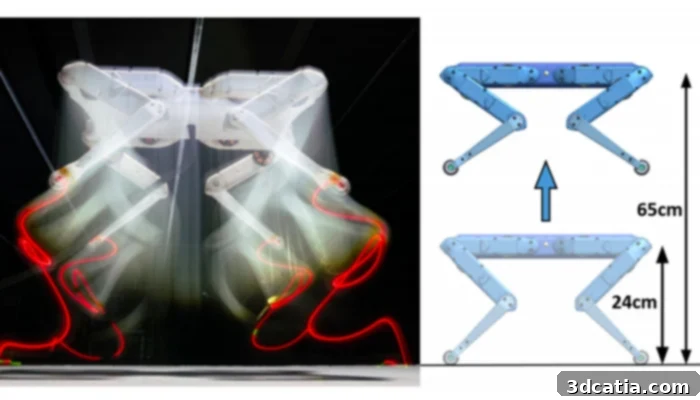
The project team wanted a lightweight prototype for better dynamic locomotion, crucial for advanced robotic studies.
The Pivotal Role of 3D Printing in Solo 8’s Creation: Democratizing Advanced Robotics
At the heart of the Solo 8 project was a clear and ambitious objective: to engineer a robot dog that was not only lightweight but also capable of dynamic locomotion. This design philosophy was driven by the need to significantly expedite test cycles and facilitate more agile, high-performance robotic studies. Achieving dynamic locomotion in robots often requires a delicate balance of robust mechanics and minimal mass, allowing for quicker movements, higher efficiency, and reduced energy consumption. Furthermore, the team was committed to making the Solo 8 as widely accessible as possible. This commitment necessitated a strategic approach to design and manufacturing that would minimize the number of individual components and leverage the cost-effectiveness and versatility of additive manufacturing technologies.
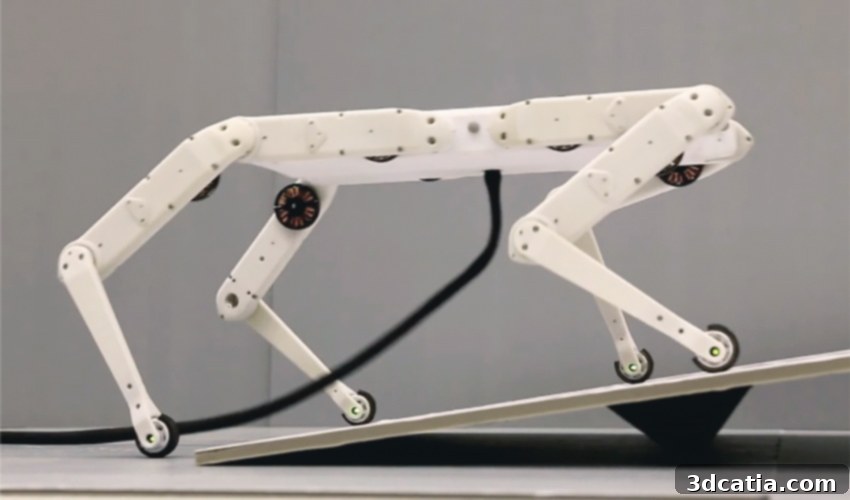
In this context, Fused Deposition Modeling (FDM) thermoplastic technology emerged as the optimal choice. FDM, a widely adopted and accessible form of 3D printing, stood out for its affordability, reliability, and the broad availability of compatible materials. It allowed the researchers to rapidly iterate on designs, testing various configurations and making swift adjustments without incurring prohibitive costs or long lead times associated with traditional manufacturing methods. The modular design of Solo 8 is a testament to the effectiveness of this approach. Each of the robot’s four extremities was ingeniously constructed by combining two identical actuator modules. This modularity not only simplified the design process but also streamlined assembly and potential repairs. Ultimately, the Solo 8 robot dog was assembled from these four identical 3D-printed legs and a central body structure, all produced using FDM technology. The resulting device boasted an impressive low weight of just 2.2 kg, with a body length of 42 cm and a width of 33 cm. Its operations and movements were precisely controlled by integrated electronic boards and sophisticated information technology (IT) systems, all meticulously housed within its lightweight, 3D-printed chassis.
One of the most innovative aspects of the finished Solo 8 prototype is its integrated design, where all electronic and robotic components are neatly encapsulated within the 3D-printed body. This intelligent internal routing eliminates any exposed wiring, contributing to a clean aesthetic, enhanced durability against environmental factors, and improved safety during operation. Such an integrated and simplified approach to robot dog development makes the process remarkably achievable for a broader demographic, moving advanced robotics beyond the exclusive domain of highly specialized and well-funded laboratories. Alexander Badri-Spröwitz, the accomplished leader of the research group behind Solo 8, eloquently highlights the impact of this open-source initiative: “For a research group to develop such a robot from scratch, four years of dedicated work are easily required, in addition to a wealth of accumulated experience. Our platform, however, represents the combined knowledge and synergistic efforts of several dedicated teams. The beauty of this open-source model is that now, any laboratory around the world can simply log on, download the meticulously documented open-source files, print the necessary parts using accessible 3D printing technology, and procure the remaining standard components directly from commercial catalogs.” This statement underscores the profound potential of Solo 8 to revolutionize robotics research by fostering collaboration and significantly lowering entry barriers.
The implications of the Solo 8 robot dog extend far beyond its immediate functionality as a research platform. Its advanced behavioral capabilities, coupled with its accessible design and open-source nature, are set to profoundly benefit both the robotics and 3D printing communities. By demonstrating how complex robotic systems can be developed cost-effectively and shared openly, Solo 8 is a catalyst for future innovations and improvements in these types of devices. This project serves as a compelling proof-of-concept for the democratization of advanced technology, showcasing that cutting-edge robotics is no longer solely the purview of multi-million dollar corporate labs but can be collaboratively developed and iterated upon by a global network of researchers and enthusiasts. The open-source blueprint encourages customization, modification, and the integration of new sensors or actuators, ensuring that Solo 8’s design principles will continue to evolve and inspire new generations of roboticists.
Ludovic Righetti, an associate professor at NYU Tandon and a key figure in the Solo 8 project, confirms the palpable excitement surrounding their creation: “Already many universities have approached us and want to make a copy of our robot and use it as a research platform.” This enthusiastic response highlights the pressing need for such accessible tools in academic and research settings. Solo 8 empowers educational institutions to provide hands-on robotics experience to students without massive investments, fostering practical skills and theoretical understanding simultaneously. For researchers, it offers a robust, well-documented, and easily modifiable platform to test novel control algorithms, explore new locomotion strategies, or integrate advanced artificial intelligence modules. The impact could lead to breakthroughs in areas such as agile manipulation, robust navigation in unstructured environments, or even human-robot interaction. The future enhancements for platforms inspired by Solo 8 are limitless, from incorporating more sophisticated sensor arrays to exploring advanced materials for further weight reduction and enhanced durability, pushing the boundaries of what these compact, dynamic robots can achieve.
What are your thoughts on the groundbreaking Solo 8 robot dog, meticulously developed using advanced 3D printing technologies? We invite you to share your insights and engage with us! Let us know your opinions in a comment below or join the conversation on our Facebook and Twitter pages! And to stay at the forefront of additive manufacturing, don’t forget to sign up for our free weekly Newsletter. Receive all the latest news on technological progress, cutting-edge research, and inspiring entrepreneurial ventures in the world of 3D printing, delivered directly to your inbox every week!