
Clean2Antarctica: Pioneering a Zero-Waste Future with the 3D-Printed Solar Voyager in Antarctica
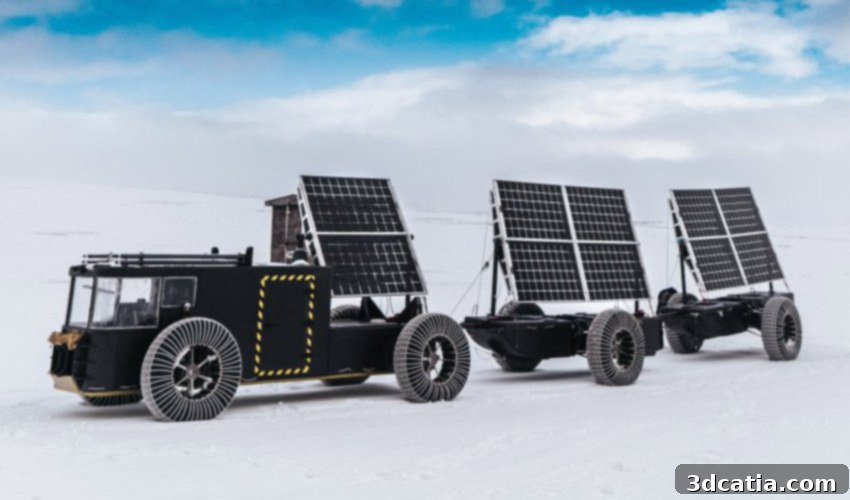
In a world grappling with escalating environmental challenges, the urgency for innovative and sustainable solutions has never been more pronounced. At the forefront of this crucial movement is Clean2Antarctica, a visionary Dutch association dedicated to championing the circular economy and inspiring global shifts towards sustainable living. Through their extraordinary expeditions and groundbreaking projects, they aim to motivate both organizations and individuals to embrace environmentally conscious alternatives to our prevailing consumption patterns. Their most ambitious undertaking to date involved an intrepid journey to the South Pole in Antarctica, aboard a revolutionary vehicle known as the Solar Voyager – an electric marvel constructed almost entirely from 3D-printed components made from recycled plastic, powered exclusively by solar energy.
Founded by the dynamic duo, Edwin and Liesbeth ter Velde, the Clean2Antarctica association is built upon the fundamental principles of a zero-waste lifestyle. This ethos aligns perfectly with the transformative potential of 3D printing technologies, which inherently minimize waste generation by precisely utilizing only the material required for each print. Unlike traditional manufacturing methods that often involve significant material removal and scrap, additive manufacturing builds objects layer by layer, resulting in unparalleled material efficiency. Furthermore, the rapid advancements in additive manufacturing have paved the way for the adoption of increasingly eco-friendly materials. A significant portion of these innovative filaments are now derived directly from recycled plastic waste, transforming what was once considered trash into valuable resources. This sustainable approach is exemplified by systems like the ProtoCycler machine, which brilliantly converts used plastics into high-quality 3D printing filaments, thereby closing the loop on plastic consumption and promoting a truly circular material flow.
The decision by Edwin and Liesbeth to undertake their pioneering expedition to Antarctica was multi-faceted and deeply symbolic. They eloquently explain their rationale: “Antarctica holds 90% of the world’s freshwater ice and is, by international treaty, a continent that belongs to no one. It is also, by law, a zero-waste zone, making it the quintessential destination for a zero-waste adventure. Our journey aims to learn from Antarctica’s pristine environment and highlight the critical importance of preserving it.” Beyond its environmental significance, the expedition serves as a powerful platform to raise global awareness about the Antarctic Treaty. This vital international agreement, which governs the continent’s use and protection, is due for review in 2048. Without its extension, Antarctica faces the grave risk of being opened to commercial exploitation, threatening its delicate ecosystems and vast scientific potential. By embarking on this challenging voyage, Clean2Antarctica seeks to underscore the fragility of this unique continent and the urgent need for its continued protection.
The Solar Voyager: A 3D-Printed Marvel for Sustainable Exploration
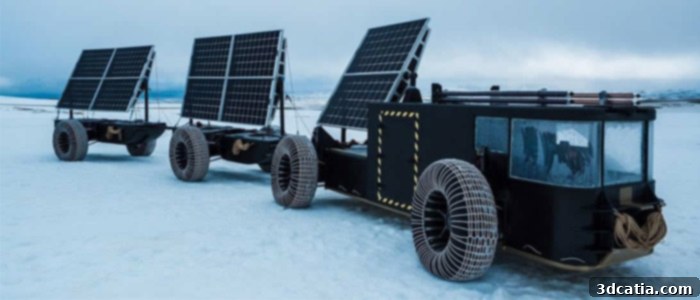
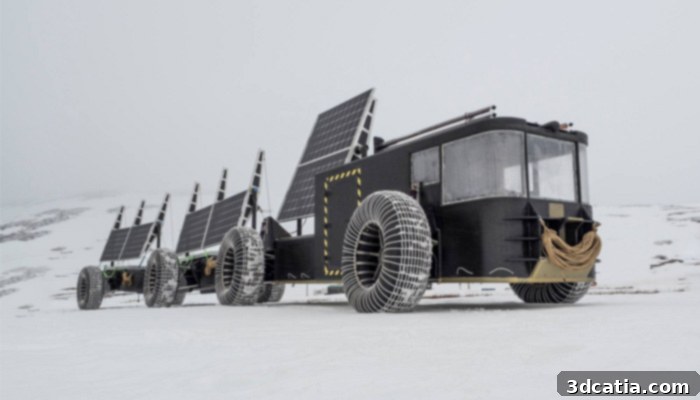
To navigate the formidable Antarctic landscape, the Clean2Antarctica team engineered the Solar Voyager, an extraordinary electric vehicle designed through a collaborative and highly innovative 3D printing process. This impressive vehicle measures 16 meters in length, weighs 1,485 kilograms, and is built for extreme endurance, capable of carrying food supplies for 47 days. While it moves at a modest speed of 8 km/h, its true innovation lies in its construction: the Solar Voyager is composed of approximately 4,000 distinct 3D-printed hexagonal blocks. Dubbed HexCore, these blocks feature a honeycomb-like internal structure, a design celebrated for its exceptional strength-to-weight ratio. This biomimetic design ensures the vehicle is both remarkably light for energy efficiency and incredibly robust to withstand the harsh Antarctic conditions.
The process of creating these HexCore blocks truly embodies the circular economy principles championed by Clean2Antarctica. The team meticulously shredded plastic waste, which was then melted down and extruded into high-quality 3D printing filament. This filament subsequently fed a fleet of 40 specialized 3D printers, working tirelessly to produce the thousands of modular components. The sheer scale of this endeavor is astonishing: an estimated 200 pounds of recycled plastic were utilized solely for the chassis blocks, demonstrating the immense potential of transforming waste materials into functional, high-performance parts. This innovative approach not only diverts plastic from landfills but also proves that advanced manufacturing can be inherently sustainable.
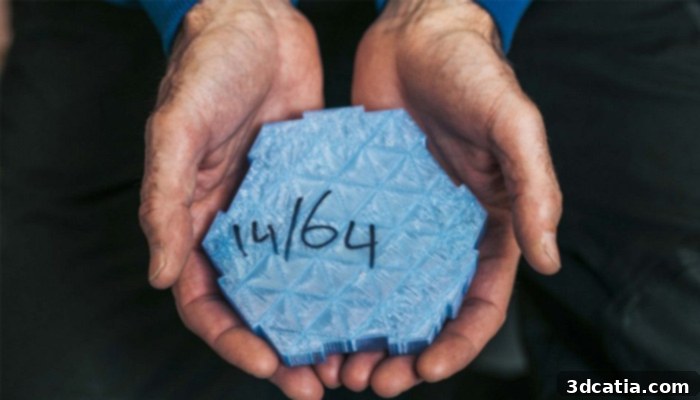
HexCore 3D printed blocks forming the Solar Voyager’s structure.
The Solar Voyager’s self-sufficiency is a testament to sustainable engineering. Its primary power source consists of 10 advanced solar panels, each measuring 1.7 square meters and weighing 25 kilograms. These panels are strategically positioned to maximize energy capture from the Antarctic sun, providing the necessary electricity for propulsion and onboard systems. For critical situations and as a backup, the vehicle is equipped with two robust 60-kilogram batteries, offering a combined total power of 10 kWh. Ingeniously, the Solar Voyager does not carry a water supply. Instead, it incorporates highly efficient vacuum solar tubes designed to melt snow and ice, converting it into safe, potable drinking water for the crew. This eliminates the need to transport heavy water provisions, significantly reducing the vehicle’s overall weight and energy consumption. Furthermore, infrared interfaces are strategically installed within the cabin to actively absorb sunlight, ensuring the interior remains warm and habitable even in the continent’s extreme sub-zero temperatures, thus enhancing crew comfort and safety.
The Expedition: A Journey of Discovery and a Message of Hope
The arduous journey began on November 28th, with Edwin and Liesbeth departing from their base camp at Union Glacier, situated in the far south of the Antarctic continent. From this remote starting point, they embarked on the challenging expedition towards the geographic South Pole. The ambitious round trip covers an astonishing distance of 2,400 kilometers, a feat the team optimistically aimed to complete within a mere 30 days. This demanding expedition is more than just an engineering marvel; it’s a powerful statement. Edwin and Liesbeth articulate their profound message: “This endeavor is not solely about showcasing advanced technology, but rather about initiating practical experiments and uncovering the vast possibilities that emerge when we choose to innovate with waste materials. To truly achieve a circular society, we must fundamentally alter our approaches and practices. Our expedition serves as a tangible example of the incredible progress one can make by simply beginning to do things differently, rather than merely engaging in abstract discussions about theoretical solutions.”
This resounding message resonates deeply, capturing global attention and inspiring countless individuals to reconsider their relationship with consumption and waste. The successful completion of the initial leg of the solar voyage, marked by the first communication back to base camp, underscores the viability of their sustainable vision. For those eager to follow the ongoing progress of this remarkable expedition and gain deeper insights into their journey, comprehensive updates and additional information are available on the Clean2Antarctica official website, accessible HERE.
The Clean2Antarctica expedition and the Solar Voyager project are more than just an adventure; they represent a beacon of hope for a sustainable future. By demonstrating that cutting-edge technology, particularly 3D printing, can be harnessed to repurpose waste into functional, high-performance products, Edwin and Liesbeth ter Velde are paving the way for a truly circular economy. Their journey to the South Pole with a vehicle built from recycled plastic and powered by the sun challenges conventional thinking and encourages a global rethink of how we produce, consume, and innovate. This initiative highlights the critical role of individual action and collective innovation in tackling some of the planet’s most pressing environmental issues, proving that a zero-waste lifestyle and a sustainable future are not just ideals but achievable realities.
What are your thoughts on the groundbreaking Solar Voyager and Clean2Antarctica’s mission to promote a circular economy through pioneering expeditions? We invite you to share your perspectives and engage in the conversation by leaving a comment below, or by connecting with us on our social media channels, including Facebook and Twitter! Don’t miss out on the latest advancements and inspiring stories in the world of additive manufacturing; make sure to sign up for our free weekly Newsletter, delivering all the essential 3D printing news directly to your inbox!