

Revolutionizing Sustainable Construction: Twente Additive Manufacturing’s Fibonacci-Inspired 3D Printed Homes
Twente Additive Manufacturing (TAM), a pioneering Dutch company, is at the forefront of transforming the construction industry through its innovative concrete 3D printing method. This groundbreaking technology allows for the rapid and efficient construction of future homes, specifically focusing on building their foundational walls. What sets TAM apart is its unique conceptual approach: leveraging the intrinsic beauty and efficiency of the famous Fibonacci sequence to design and realize captivating spiral-shaped constructions. This method not only offers structural integrity but also promotes a natural progression of space within the architectural design. Following the successful completion of its first project in Canada this year, TAM has firmly established itself as a significant player in the burgeoning market of additive concrete manufacturing, a sector that has witnessed remarkable growth in recent years. To delve deeper into their revolutionary projects and the technology underpinning them, we engaged with the Twente Additive Manufacturing team, who graciously shared insights into their ambitious vision and future endeavors.
The Genesis of Twente Additive Manufacturing: Pioneering 3D Concrete Printing
The foundational ideas for Twente Additive Manufacturing were first conceptualized by our esteemed President and Co-founder, Ian Comishin, in the autumn of 2018. His observations stemmed from a critical analysis of the traditional construction industry, which, despite technological advancements, has historically been slow to adopt new and more efficient building methods. Simultaneously, Ian recognized the significant potential of emerging 3D concrete printing technology, which was already beginning to take root in various regions, including the Netherlands, where Ian and several other co-founders were based. Our primary objective from the very outset was clear: to apply our collective expertise in automation and digital fabrication to the complex challenge of propelling the construction industry into the 21st century. The initial motivations were deeply rooted in the promise of achieving substantial improvements in efficiency, alongside a serious commitment to reducing construction waste and minimizing carbon emissions. However, another crucial aspect that has increasingly demonstrated its immense merits is the unparalleled “freedom of design” that 3D concrete printing offers, often with little to no additional costs compared to conventionally designed versions. This ability to create complex, organic shapes that were once prohibitively expensive or structurally challenging opens up entirely new architectural possibilities, enabling the creation of truly unique and functional spaces that cater to modern living needs while also being sustainable.
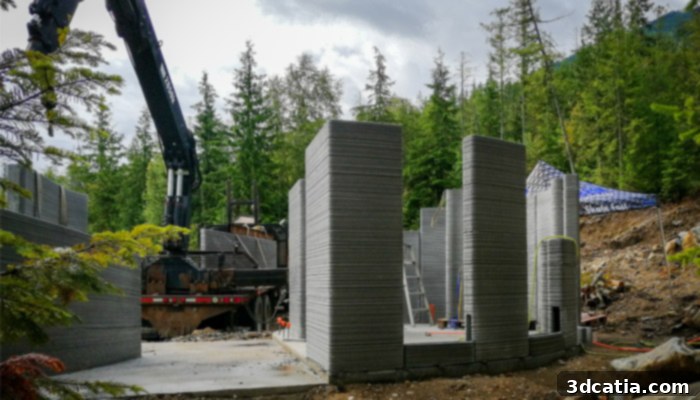
Twente Additive Manufacturing has developed a solution to 3D print the walls of a house (photo credit: TAM)
Embracing the Fibonacci Sequence for Architectural Innovation and Sustainable Housing
Our decision to incorporate the Fibonacci sequence into the design and 3D printing of our houses was driven by several compelling advantages, most notably in demonstrating the unique capabilities of additive manufacturing. The initial goal behind constructing the Fibonacci house was to vividly illustrate the process differences inherent in building structures with non-linear walls, a design complexity that conventional construction struggles with. When the public typically evaluates the value added by additive manufacturing, they often make direct comparisons to the simplest forms of conventional construction, leading to a misconception that the 3D printed version might not be competitive on cost. However, the true strength of the additive manufacturing method of construction begins to shine and becomes highly competitive as complexity increases. This is where the Fibonacci spiral truly excels. If one were to attempt to compare a traditionally wood-framed version of a Fibonacci spiraled building with its 3D printed counterpart, the economic and practical advantages overwhelmingly point towards the layered mortar bead approach offered by additive manufacturing. The cost and labor involved in creating such intricate, non-linear forms with traditional methods would be astronomical, whereas 3D printing handles this complexity as a standard feature, without significant cost escalation. Furthermore, a second, equally profound benefit of the Fibonacci spiral design lies in the natural and intuitive progression of spaces it creates within the home. This organic flow transitions seamlessly from expansive, open exterior-facing areas, ideal for living rooms and communal activities, to more intimate, enclosed, and warmer spaces, such as a cozy shower area located in the tightest part of the spiral. This thoughtful spatial arrangement enhances both functionality and comfort, offering a unique living experience that feels inherently connected to natural patterns and principles, promoting a sense of harmony and well-being within the inhabitants.
A Closer Look at Twente Additive Manufacturing’s Fibonacci House
The Fibonacci house, with its thoughtfully designed 28m² ground level surface, epitomizes the concept of a “tiny house” – a growing trend emphasizing minimalist living and reduced environmental impact. Despite its compact footprint, the house is remarkably spacious and functional, featuring a cleverly integrated mezzanine level that comfortably accommodates sleeping space for up to four people. This innovative design maximizes vertical space, proving that small homes can still offer ample living areas. The core structural elements, particularly the printed walls, are predominantly crafted from a high-quality, single-component print material supplied by Laticrete. This material ensures robust construction and excellent adhesion, critical for the layered printing process. For more specialized structures, such as the elegant 4.5m high columns that support the patio roof, a two-component material from Baumit was utilized. These slender yet strong elements demanded a material capable of exceptionally high build rates, reaching up to an impressive 20 meters in height per hour, showcasing the advanced capabilities of TAM’s printing technology. A significant feature of the insulated walls is their thoughtful design to house all the essential HVAC conduits and other infrastructure, ensuring a clean aesthetic and optimal energy performance. Beyond the 3D printed components, the house integrates a strong commitment to sustainability. Non-printed elements, including doors, windows, and the roof, are either carefully refurbished elements or constructed from locally sourced wood. This strategic choice is made with the explicit purpose of reducing the overall CO² footprint of the construction as much as possible, aligning with contemporary eco-friendly building practices. The interior finishing work is currently in its final stages and is anticipated to be completed very soon, bringing this innovative and sustainable home to full realization and demonstrating the immense potential of 3D printing in creating practical, beautiful, and environmentally conscious living spaces.
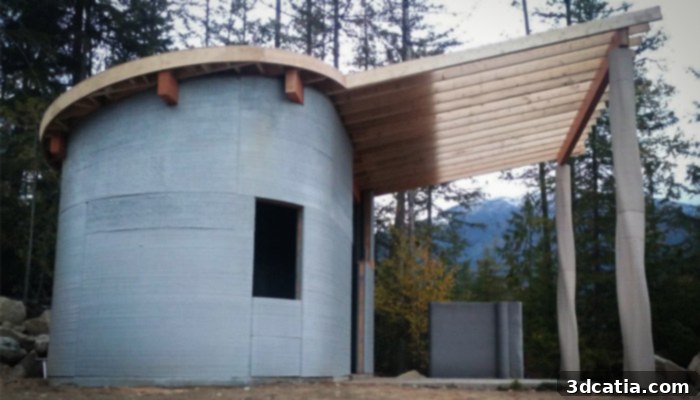
The 3D printed house (photo credit: TAM)
The Future of Additive Manufacturing in Construction: A Five-Year Outlook
Looking ahead, we envision the additive manufacturing segment of the construction industry experiencing exponential growth over the next five years. This acceleration will be fueled by an increasing number of successful building constructions and a surge in innovative projects that come to fruition globally. As more architectural firms, developers, and governments recognize the transformative potential of 3D concrete printing, its adoption will undoubtedly expand from niche applications to more mainstream construction. However, a significant hurdle that the industry must collectively overcome is actively engaging the public and fostering widespread acceptance. This crucial step can truly only be achieved when individuals from the general public have the opportunity to directly experience and interact with these 3D printed structures firsthand. Seeing, touching, and understanding the quality, durability, and aesthetic appeal of these buildings is paramount to dispelling skepticism and building confidence. Therefore, as more projects are completed and a greater number of people are exposed to the tangible benefits and diverse applications of this cutting-edge technology, the demand for 3D printed homes and infrastructure will naturally increase. We anticipate advancements in material science, improved printing automation, and the development of robust regulatory frameworks to further streamline the integration of additive manufacturing into conventional building practices, paving the way for a more efficient, sustainable, and design-flexible future in construction.
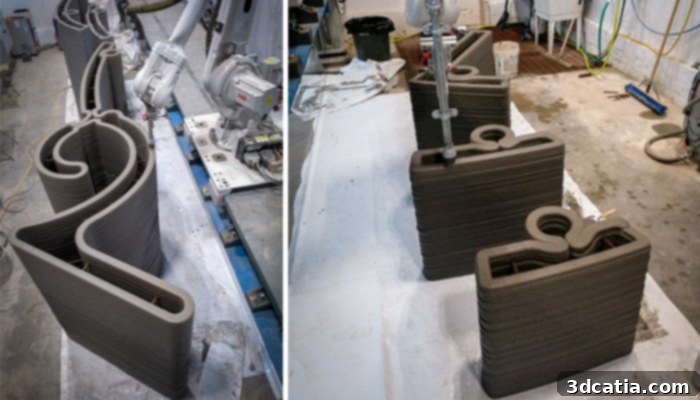
TAM was inspired by the Fibonacci sequence when designing the shapes of its house (photo credits: TAM)
Twente Additive Manufacturing’s Vision: Upcoming Projects and Technological Advancement
At Twente Additive Manufacturing, our forward momentum is constant, driven by a commitment to innovation and pushing the boundaries of what’s possible in 3D concrete printing. We are enthusiastically working on another ambitious house project, which is scheduled to be printed in 2021. This new venture aims to build upon the successes and learnings from our inaugural Canadian project and the Fibonacci house, further refining our techniques and demonstrating new architectural possibilities. In parallel with our construction projects, a significant portion of our efforts is dedicated to continuous machinery development. This involves enhancing the capabilities and reliability of our 3D concrete printing systems. We are focused on engineering more advanced and robust printers, improving automation features, and developing proprietary software solutions to optimize the printing process. Our goal is to not only advance our own projects but also to contribute actively to the broader 3DCP community by making our technology more accessible, efficient, and user-friendly. By doing so, we aim to empower other innovators and builders to achieve even more reliable and impressively complex printing feats, collectively driving the industry forward. These developments include improving print speeds, refining material extrusion systems for greater precision, and integrating advanced sensors for quality control, all designed to ensure superior structural integrity and aesthetic finish in every printed element. We believe that by investing in both tangible projects and the underlying technology, we can foster a more innovative and sustainable construction ecosystem for everyone.
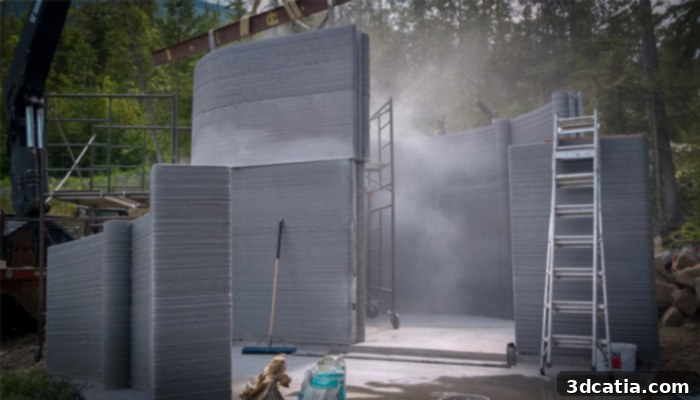
Photo Credit: Twente Additive Manufacturing
Engaging the Community: A Call to Imagine the Future of 3D Printing
As our readers are already well-versed and experienced in the dynamic field of additive manufacturing, we are always eager to spark discussions and discover new ideas. We would be particularly curious to know what imaginative applications you would pursue, or what unique structures you would print, if you had access to a large-format 3D printer. The realm of new applications for this technology is truly boundless and always incredibly exciting for us to explore. We firmly believe that the collective creativity of the additive manufacturing community will unlock unprecedented possibilities. Furthermore, we strongly encourage everyone, whether seasoned professionals or curious newcomers, to delve deeper into understanding this transformative technology. Explore its current capabilities, acknowledge its existing limitations, and appreciate the immense potential it holds. The future promised by 3D printing, especially in construction, is nothing short of revolutionary and offers a thrilling landscape of innovation. We invite you to be a part of this journey, envisioning and shaping a future where sustainable, custom-designed, and rapidly constructed buildings become the norm, driven by the power of 3D printing. Let your imagination be your guide as we collectively look forward to a very exciting 3D printed future!
To learn more about Twente Additive Manufacturing’s cutting-edge projects and their innovative technologies, please visit their official website. What are your thoughts on utilizing additive manufacturing for building houses? We invite you to share your insights and opinions by leaving a comment below or engaging with us on our Facebook and Twitter pages! For the very latest updates and groundbreaking news in 3D printing, remember to sign up for our free weekly Newsletter here, delivering all the essential information straight to your inbox!