

Sustainable 3D Printing: Transforming Used Coffee Pods into Valuable Filament
As the global climate crisis intensifies and environmental concerns become paramount, humanity is actively seeking innovative solutions to address pressing ecological challenges. A major focal point of this search is the escalating issue of waste management. The World Bank forecasts a staggering increase in global waste, projecting it to reach 3.40 billion tonnes annually by 2050. In light of this alarming prediction, concepts like recycling and, more comprehensively, the circular economy have gained significant traction as vital strategies for environmental preservation and resource efficiency. A groundbreaking project, developed through a collaborative effort by researchers from the Federal University of São Carlos (USFCar) and the State University of Campinas (UNICAMP) in Brazil, alongside Manchester Metropolitan University (MMU) in the United Kingdom, is at the forefront of this innovation. This initiative ingeniously merges the principles of the circular economy with the widespread use of coffee pods and the transformative capabilities of 3D printing technology. The research teams have successfully pioneered a method to convert used coffee capsules into a raw material suitable for producing high-quality 3D printing filaments, thereby offering a creative and sustainable pathway for waste valorization.
The focus on coffee pods within this project is particularly noteworthy, as these single-use capsules have been a consistent source of environmental debate in recent years. The global coffee pod market is experiencing rapid expansion, with projections from Straits Research indicating a growth to approximately $50 billion by 2030, driven largely by consumer demand in the United States and Europe for convenient daily caffeine fixes. However, this convenience comes at a significant environmental cost. The “sustainability” of coffee pods has been a contentious issue, primarily due to the difficulties associated with their recycling and the low rates of actual recycling. Even Nespresso, a leading supplier in the market, acknowledges that only about 30% of its pods are recycled, meaning a vast majority ultimately end up in landfills, contributing to plastic pollution and resource depletion. This troubling reality has spurred a global search for effective solutions to manage coffee pod waste, with this latest research venture presenting a particularly promising and innovative approach to mitigate the environmental impact of these popular products.

The project involves recycling coffee pods (like those pictured) and turning them into 3D printing filament (photo credits: Nespresso)
Innovating with Waste: Creating 3D Printing Filaments from Recycled Coffee Pods
Despite the availability of reusable coffee pods and the efforts by some manufacturers to promote the recycling of aluminum versions, the unfortunate reality is that most plastic coffee capsules are still discarded after a single use. This widespread practice has catastrophic environmental implications. A study conducted by the Institute for Research in Technology (IPT) highlighted the severity of this issue, concluding that “using a coffee capsule can be up to 14 times more harmful to the environment than using a paper filter.” This stark comparison underscores the urgent need for viable alternatives and sustainable end-of-life solutions for these prevalent items. The question then becomes, what practical steps can be taken to effectively challenge this environmentally detrimental consumption pattern and transform it into a more sustainable model?
Envision a paradigm where the waste generated by economic activities is not merely viewed as an environmental burden, but rather as a valuable raw material capable of fueling new innovations and economic opportunities. This fundamental principle is the driving force behind the “circular economy,” and the research project concerning coffee pods serves as a compelling demonstration of its potential. Instead of relegating spent capsules to landfills, these researchers have devised a method to grant them a valuable second life. Specifically, their investigations revealed that the polymeric base material of these single-use capsules can be repurposed to create high value-added products. This means that from what was once considered waste, new materials with immense potential can be extracted and utilized in the manufacturing of innovative, high-quality products. This transformation not only diverts waste from ecological harm but also embeds sustainability deeply into the product lifecycle, from consumption to regeneration, thereby maximizing resource utility and minimizing environmental footprint.
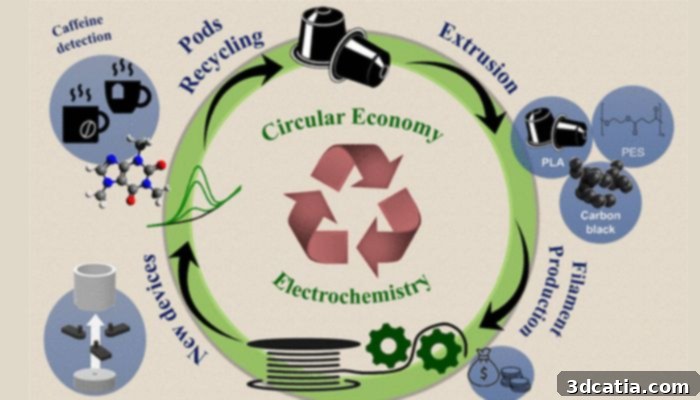
This image shows the process that the researchers sought to produce
To address the challenge of coffee pod waste, the research team embarked on developing novel applications for the repurposed polymers. Their work led to the creation of electrochemical cells using non-conductive Polylactic Acid (PLA) filaments derived from the capsules. Furthermore, they innovated by producing electrochemical sensors utilizing conductive filaments, which were engineered by incorporating carbon black. Carbon black, a form of paracrystalline carbon, is obtained through the incomplete combustion of hydrocarbons and imparts conductive properties to the material. Bruno Campos Janegitz, coordinator of the Laboratory of Sensors, Nanomedicine and Nanostructured Materials (LSNano) at UFSCar in Araras and a co-author of the scientific article, elucidated the practical application of these newly developed electrochemical sensors. He explained that these sensors were successfully employed to accurately determine the percentage of caffeine present in both green tea and arabica coffee samples, showcasing a tangible, high-value use for the recycled materials.
“Our process for obtaining the non-conductive material is straightforward, involving the washing and drying of the PLA pods, followed by a hot extrusion process. The extruded material is then cooled and spooled to produce the desired filament. To create the conductive material, we introduce carbon black into the mixture before the heating and extrusion stages. This enables us to manufacture filaments with tailored properties for various advanced applications,” explained Bruno Campos Janegitz, detailing the precise methodology behind their innovative approach.
This pioneering development of a new filament created from used coffee capsules represents a profound shift in our approach to waste management and resource utilization. It transforms the perception of waste from an environmental liability into a valuable resource, capable of being re-engineered into useful and beneficial products. This innovative practice offers multiple significant advantages: it not only dramatically reduces the volume of waste destined for overflowing landfills, but also promotes the optimal utilization of existing resources. By repurposing materials that would otherwise be discarded, the need for virgin raw materials is significantly diminished, consequently lowering the overall environmental impact associated with extraction and production. Furthermore, this initiative fosters the growth of a robust circular economy, where materials are kept in use for as long as possible, extracting maximum value from them, and then recovering and regenerating products and materials at the end of each service life. The potential for this research to inspire similar ventures across different waste streams is immense, paving the way for a more sustainable and resource-efficient future, especially within the rapidly evolving landscape of 3D printing. For those interested in the full technical details, the complete study is accessible HERE.
What are your thoughts on this innovative approach of transforming coffee pods into functional 3D printing filament? Share your insights and opinions in a comment below or join the conversation on our LinkedIn, Facebook, and Twitter pages! Don’t forget to sign up for our free weekly Newsletter here to receive the latest 3D printing news directly in your inbox! You can also find all our engaging videos on our YouTube channel, offering a visual dive into the world of additive manufacturing.