
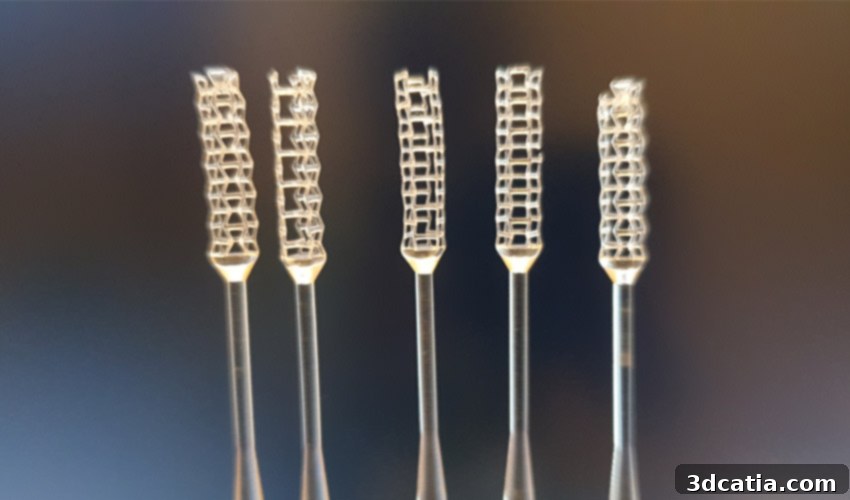
Revolutionizing COVID-19 Testing: University of Wolverhampton’s 3D Printed Self-Adjusting Auxetic Swabs Enhance Patient Comfort
The global COVID-19 pandemic brought with it unprecedented challenges, not least in the realm of diagnostic testing. While essential for tracking and containing the virus, many individuals found the primary method of virological testing, specifically the RT-PCR test, to be quite uncomfortable, and in some cases, even painful. This discomfort largely stems from the procedure itself: a long nasal swab must be inserted deep into the nasal cavity to obtain a nasopharyngeal sample. This invasive technique, while effective for viral detection, has been a significant barrier for many, particularly children or those with sensitive nasal passages, contributing to apprehension and potentially delaying necessary testing. Recognizing this critical issue, a dedicated team of engineers from the School of Engineering at the University of Wolverhampton embarked on an ambitious project to redesign these standard swabs, aiming to transform a notoriously unpleasant experience into a more tolerable one for patients worldwide.
Leveraging the cutting-edge capabilities of 3D printing technology in conjunction with advanced meta-materials, these innovative researchers have successfully engineered a truly smart, miniature medical device. This novel swab possesses a unique ability to self-adjust to the specific anatomical contours of each patient’s nasal cavity, a breakthrough design intended to dramatically mitigate the discomfort and potential pain traditionally associated with nasopharyngeal swabbing. While this groundbreaking development currently sees its use confined to laboratory settings for further refinement and validation, its potential implications for future diagnostic procedures, extending far beyond the immediate context of COVID-19, are immense and represent a significant stride forward in patient-centric healthcare innovation. The very essence of this invention lies in its ability to adapt, promising a future where vital medical testing is less daunting and more accessible.
The role of additive manufacturing, commonly known as 3D printing, during the global health crisis cannot be overstated. From the earliest days of the pandemic, this transformative technology proved to be an indispensable ally, demonstrating unparalleled agility and speed in responding to critical supply chain shortages. It played a pivotal role in supporting healthcare workers, equipping hospitals, and aiding patients by rapidly designing and producing a vast array of essential items. This included life-saving respirators, crucial ventilator components, protective face visors for frontline staff, and numerous other vital pieces of personal protective equipment (PPE). The inherent flexibility of 3D printing allowed for localized, on-demand production, circumventing conventional manufacturing bottlenecks and ensuring that critical supplies reached those who needed them most, often within hours rather than weeks.
Beyond PPE and critical care equipment, additive manufacturing also made profound contributions to the diagnostic landscape, actively participating in and accelerating testing procedures. The ability to quickly and efficiently produce components for testing kits proved invaluable. For example, prominent 3D printing companies like Carbon and Formlabs stepped up to the challenge, collectively 3D printing thousands of crucial nasopharyngeal swabs every single day, dramatically increasing testing capacity when it was most needed. Now, building on this foundation of innovation, the University of Wolverhampton has emerged with its own innovative solution, further pushing the boundaries of what’s possible in the fight against COVID-19 and other infectious diseases. Their contribution involves specifically designed 3D printed swabs, distinguished by a fascinating and highly strategic choice of material: advanced meta-materials, artificial composites engineered to exhibit exceptional electromagnetic or mechanical properties not found in natural materials. This material selection is central to the swab’s unique self-adjusting capabilities.
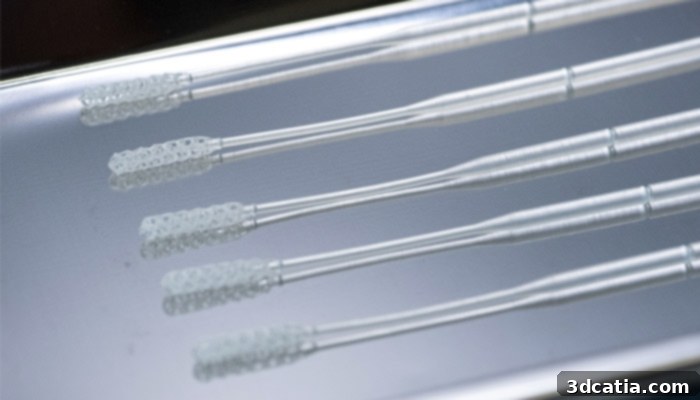
Many companies have been actively 3D printing thousands of swabs for COVID-19 testing. (Image credits: Origin)
The team at the University of Wolverhampton chose to harness the specific properties of a subclass of meta-materials known as auxetic materials. These remarkable materials possess a unique characteristic: unlike most conventional materials which thin out when stretched, auxetic materials actually become thicker perpendicular to the applied stretching force. This counter-intuitive property is defined by a negative Poisson’s ratio, a phenomenon that has profound implications for mechanical design and medical applications. In the context of the novel 3D printed swab, this auxetic behavior is key to its self-adjusting mechanism. Dr. Arjunan, one of the lead researchers on the project, elaborated on the significance of their approach: “This research is the first step in starting an open and collaborative process to drastically improve the existing concepts in nasopharyngeal swabs using the principles of digital fabrication and meta-materials.” This statement underscores a broader vision of utilizing advanced manufacturing techniques to fundamentally rethink and enhance traditional medical devices, moving beyond incremental improvements to truly transformative designs.
The power of digital fabrication, combined with the capabilities of 3D printing, grants designers an unprecedented level of control over complex geometries and material structures. As Dr. Arjunan further noted, “The opportunity to digitally conceive and 3D print swabs allows for the incorporation of geometrical features that can potentially reduce patient discomfort.” This means the team wasn’t just working with a novel material; they were also meticulously designing the swab’s physical structure at a micro-level to optimize its interaction with biological tissues. By precisely controlling the internal architecture of the swab, they could engineer specific responses to external forces, ensuring that the device would adapt harmoniously rather than aggressively within the delicate nasal cavity. This level of customization and functional integration is a hallmark of advanced additive manufacturing and represents a significant departure from the limitations of traditional mass-production methods, which often prioritize cost-efficiency over patient-specific comfort and performance.
Consequently, the researchers successfully developed a unique 3D printed auxetic swab that is capable of retracting or becoming thinner under the effect of axial resistance—the very pressure encountered during insertion into the nasal passage. This ingenious design allows the swab to navigate through the intricate and often sensitive nasal cavity with significantly less stress exerted on the surrounding tissues. The implications for patient comfort are enormous, as this inherent adaptability minimizes friction and pressure points, making the entire experience far less invasive. To provide a clear contrast, a traditional swab, made from conventional materials, tends to expand laterally under axial load as it is pushed forward, thereby causing increased discomfort, pressure, and stress in the surrounding tissue. The auxetic swab fundamentally reverses this problematic interaction, actively working with the body’s natural resistance rather than against it, thus paving the way for a more humane and patient-friendly diagnostic process.
The ability of an auxetic material to possess a negative Poisson’s ratio means that when it is stretched along one axis, it becomes thicker in the perpendicular direction. Conversely, when compressed or pushed, it can become thinner. This counterintuitive behavior, harnessed through sophisticated 3D printing techniques, is precisely what grants these innovative swabs their remarkable retraction and adaptation properties. While the team remains discreet about the intricate specifics of the design phase for this self-adjusting swab, the results speak volumes about their ingenuity. We do know that the development process involved a crucial partnership with Formlabs, a leading manufacturer of 3D printing systems, which facilitated the initial testing and prototyping phases. This collaboration underscores the interdisciplinary nature of modern innovation, where expertise in material science, engineering design, and advanced manufacturing converge to solve complex real-world problems. Ultimately, it is the synergistic combination of the auxetic material’s intrinsic properties and the precise control offered by 3D printing that underpins the swabs’ groundbreaking performance.
Despite the promising initial results and the demonstrated efficacy of the design, the research team emphasizes that there is still significant work to be done before these novel swabs can transition from controlled laboratory environments to large-scale production and widespread clinical use. The path from innovative concept to commercially viable medical device is often lengthy and rigorous, involving extensive validation, regulatory approvals, and optimization for mass manufacturing. Dr. Arjunan provided an estimation regarding the timeline: “The study is likely to take another six months before it can be used in test centres.” This period will undoubtedly involve further clinical trials, safety assessments, and perhaps even slight modifications to the design or material composition to ensure maximum effectiveness, patient safety, and scalability. Such diligence is paramount in the medical field, where precision and reliability are non-negotiable.
However, the benefits and long-term impact of this pioneering work extend far beyond the immediate context of the COVID-19 crisis. As Dr. Arjunan aptly highlighted, “these smart swabs are superior to traditional swabs because they significantly reduce patient discomfort and can be printed on demand.” This statement encapsulates the profound, lasting value of the University of Wolverhampton’s innovation. Reducing patient discomfort is a universal goal in healthcare, applicable to any diagnostic procedure requiring swab samples, such as those for influenza, strep throat, or other respiratory illnesses. By making these routine, yet often unpleasant, tests more bearable, these auxetic swabs could encourage higher rates of compliance and testing, ultimately leading to better public health outcomes and earlier disease detection. This patient-centric approach to medical device design holds the potential to significantly improve the overall healthcare experience for millions globally.
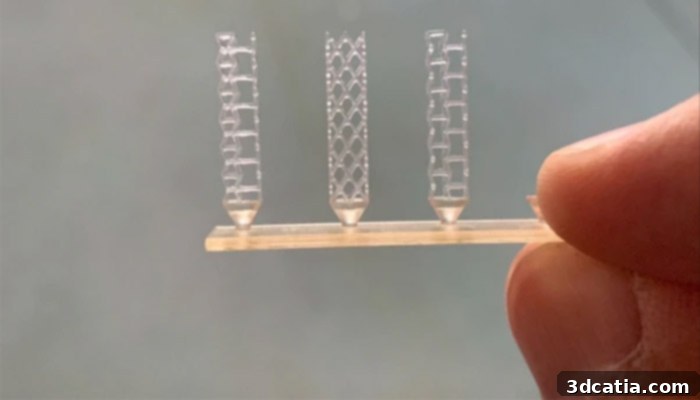
A unique material allows swabs to retract. (Image credits: University of Wolverhampton)
Furthermore, the “print on demand” capability facilitated by 3D printing represents a paradigm shift in medical supply chain management. In an era where global crises can rapidly disrupt traditional manufacturing and distribution networks, the ability to produce essential medical tools locally and as needed offers unparalleled resilience and efficiency. It means healthcare providers could potentially customize swab designs for specific patient populations or clinical needs, and scale production up or down instantaneously in response to demand fluctuations, avoiding wasteful overproduction or crippling shortages. This agility holds the promise of significant cost savings, reduced logistical complexities, and a more responsive healthcare infrastructure. Overall, the researchers are highly optimistic that they will be able to make these revolutionary 3D printed swabs available for on-demand production as soon as the rigorous validation processes are complete, marking a new chapter in medical diagnostics where patient comfort and technological adaptability go hand-in-hand.
The innovative work by the University of Wolverhampton engineers, utilizing 3D printing and auxetic meta-materials, represents a significant leap forward in making medical diagnostic procedures less intimidating and more patient-friendly. By addressing the fundamental issue of discomfort in nasopharyngeal swabbing, they have not only improved a critical COVID-19 testing method but also set a new standard for future medical device design. This blend of material science and digital fabrication highlights the transformative potential of additive manufacturing in healthcare, promising a future where diagnostics are not only efficient and accurate but also remarkably gentle. This innovative approach could redefine our experience with routine medical tests, making them more accessible and less of a barrier to essential care for everyone.