

SLA vs. MSLA: A Comprehensive Guide to Resin 3D Printing Technologies
Within the dynamic realm of resin 3D printing, a diverse array of additive manufacturing methods has emerged, each offering unique advantages for various applications. Leading the charge are foundational processes such as Stereolithography (SLA), Digital Light Processing (DLP), and Masked Stereolithography Apparatus (MSLA). These technologies primarily differ in their light source and the specific mechanism by which they solidify photopolymer resins. Beyond these established methods, numerous industry giants have innovated and developed proprietary resin additive manufacturing solutions. These often incorporate slight modifications to core principles, allowing them to be patented as unique technologies. Notable examples include BCN3D with its innovative VLM 3D printing process, Prodways with its high-performance MovingLight technology, and Carbon with its DLS (Digital Light Synthesis) method. Each of these proprietary systems seeks to optimize specific aspects like speed, material properties, or multi-material capabilities.
While the landscape of resin 3D printing is vast and continuously evolving, this article will delve into a detailed comparison of two particularly prominent and often confused methods: Stereolithography (SLA) and Masked Stereolithography Apparatus (MSLA). Although their names sound strikingly similar and they both operate on the principle of photopolymerization, they employ fundamentally different light-curing mechanisms. We will meticulously examine the operational principles of each technology, highlight their commonalities, and, most importantly, delineate their key differences, helping you understand which might be more suitable for your specific 3D printing needs.
Understanding Stereolithography (SLA)
Stereolithography (SLA) stands as the pioneering technology in the field of 3D printing, invented by Charles “Chuck” Hull in the mid-1980s. It revolutionized manufacturing by enabling the creation of complex three-dimensional objects from digital designs. At its core, SLA technology employs a precise UV laser beam that strategically draws and solidifies successive layers of liquid photopolymer resin within a transparent resin tank. The process typically begins with a build platform submerged just below the surface of the resin. The laser then traces the cross-section of the first layer, selectively curing the liquid resin into a solid. Once a layer is complete, the build platform precisely descends by a single layer thickness, allowing a fresh layer of resin to flow over the previously cured section. The laser then repeats the process for the next cross-section. This meticulous layer-by-layer solidification continues until the entire object is formed, suspended upside down from the build plate. The precision of the laser allows SLA printers to achieve exceptionally fine details and incredibly smooth surface finishes, making them a preferred choice for applications requiring high aesthetic quality and accuracy, such as dental models, jewelry prototypes, and intricate artistic pieces.
Understanding Masked Stereolithography Apparatus (MSLA)
Masked Stereolithography Apparatus (MSLA), often simply referred to as LCD-based resin printing, represents a significant evolution from traditional SLA and DLP technologies. While it adheres to the fundamental principle of using a light source to cure photopolymer resin, MSLA introduces a distinct approach to layer solidification. Instead of a single laser tracing each layer or a projector flashing the entire image (as in DLP), MSLA printers utilize a large array of ultraviolet (UV) LEDs as their primary light source. This light is then projected through a high-resolution liquid crystal display (LCD) screen, which acts as a dynamic mask. This LCD screen displays a black-and-white image of each layer’s cross-section, effectively blocking the UV light in areas that should remain liquid and allowing it to pass through where the resin needs to be cured. This masking process cures an entire layer simultaneously, significantly accelerating the printing process compared to laser-based SLA, especially when printing multiple objects or large, intricate parts on the build plate. MSLA technology has rapidly gained popularity due to its impressive speed and increasing affordability, making high-resolution resin printing accessible to a wider range of users, from hobbyists to professional workshops. The resolution of MSLA prints is directly tied to the pixel density of the LCD screen, with modern printers featuring 4K, 6K, and even 8K screens delivering increasingly fine details.
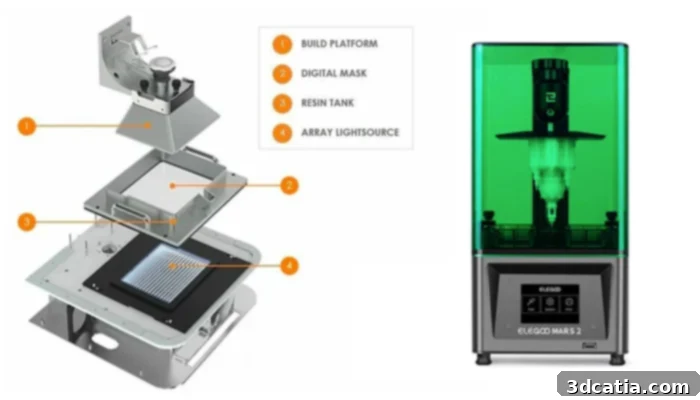
The internal composition and light-curing mechanism of an MSLA 3D printer differ significantly from its SLA counterpart.
Key Characteristics: SLA vs. MSLA Technologies
The primary differentiator between SLA and MSLA 3D printing lies in their light-curing process and the specific light source employed. This fundamental difference dictates the internal composition, mechanical components, and overall performance characteristics of each 3D printer. Consequently, the distinct methods of exposing each layer to UV light profoundly impact printing speed, production times, and achievable resolution.
Printing Speed and Efficiency
One of the most significant advantages of MSLA technology over traditional SLA is its superior printing speed, particularly for batch production or larger parts. While traditional SLA 3D printers rely on a laser tracing the outline and infill of each layer, making print time dependent on the complexity and volume of material within that layer, MSLA technology cures an entire layer simultaneously. The UV light passes through the LCD mask, solidifying the entire cross-section of the part (or multiple parts) in one flash. This means that the print time for an MSLA machine is predominantly determined by the number of layers required for the object’s height, rather than the complexity or quantity of objects on the build plate. This operational difference provides MSLA solutions with a considerable speed advantage per layer, especially beneficial when printing multiple identical or different objects at once, significantly boosting throughput and efficiency for certain applications.
Horizontal (X/Y) Resolution
The horizontal resolution, which dictates the finest details an object can achieve in the X and Y axes, varies considerably between these two processes, even though the layer height (Z-axis resolution) can be identical. In SLA machines, the X/Y resolution is primarily determined by the diameter of the laser beam and the precision of the galvanometers (mirrors) that direct it. A smaller laser spot can achieve finer details. Since the laser draws continuous lines, SLA typically produces very smooth surfaces with no visible “steps” or pixelation in the X/Y plane. Conversely, in MSLA, the horizontal resolution is dictated by the individual pixels of the LCD screen. Each pixel represents a discrete point where light can either pass through or be blocked. Although high-resolution LCD displays, such as 4K, 6K, and even 8K screens, are now commonplace and increasingly affordable, the resolution is fundamentally pixel-based. This pixelated nature means that MSLA solutions can exhibit subtle “voxel” or “stair-stepping” effects on curved or angled surfaces, particularly if the pixel density is not high enough. While anti-aliasing techniques are often employed in software to mitigate these effects, SLA often maintains a slight edge in absolute X/Y surface smoothness due to its continuous laser tracing, especially for very fine curvatures.
Printer Cost and Accessibility
The cost of entry for MSLA technology is generally much lower than that of industrial SLA systems. This difference is largely due to the components involved. SLA printers, especially professional-grade ones, incorporate sophisticated laser systems and high-precision galvanometer mirrors, which are inherently expensive to manufacture and maintain. MSLA printers, on the other hand, leverage more readily available and mass-produced components, primarily high-resolution LCD screens and UV LED arrays. This makes MSLA printers significantly more accessible to hobbyists, small businesses, and educational institutions, democratizing high-quality resin 3D printing. While both technologies offer a range of machines from entry-level to industrial, the price performance ratio for MSLA often makes it a more attractive option for many users seeking precision without the premium cost of laser-based systems.
Maintenance and Durability
Maintenance considerations also vary between SLA and MSLA. SLA printers require careful calibration and maintenance of their laser and optical systems, which can be complex and may necessitate specialized technicians. The resin tank’s bottom, usually coated with a non-stick FEP film, is also a consumable that needs periodic replacement. For MSLA printers, the primary consumable component in terms of the light system is the LCD screen itself. LCD screens have a finite lifespan, measured in hours of exposure, and will eventually degrade and require replacement. While replacing an LCD screen is generally straightforward and relatively inexpensive, it is a regular maintenance item to factor into the operational cost. Both technologies, however, share common maintenance requirements related to resin handling, cleaning the build platform, and maintaining a clean printing environment.
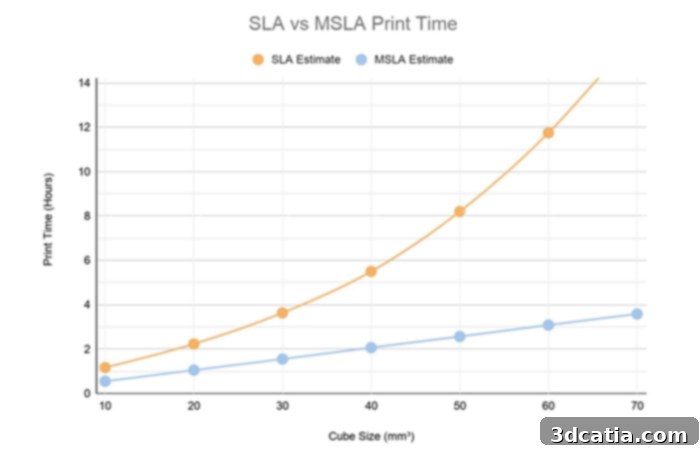
A visual comparison highlighting the differences in 3D printing speed between SLA and MSLA technologies (photo credits: Satori).
Commonalities: Part Design, Slicing, and Post-Processing
Despite their distinct curing mechanisms, SLA and MSLA share several crucial aspects, particularly concerning part design, slicing, and post-processing. These commonalities mean that many principles for preparing a model for resin printing apply across both technologies.
Part Design and Slicing Parameters
When it comes to preparing a 3D model for printing, the lamination steps in the slicer software are remarkably similar for both SLA and MSLA. Users must pay special attention to the orientation of the parts on the build plate. Proper orientation is critical for minimizing support structures, ensuring structural integrity, and achieving desired surface quality. Moreover, the printing time, especially for SLA, is often influenced by the height of the part, as it directly correlates with the number of layers that need to be cured. For both technologies, parameters such as layer height, exposure time (for MSLA) or laser power/speed (for SLA), lift speed, and anti-aliasing settings need to be carefully calibrated according to the specific resin being used and the desired print quality. Hollowing models and adding drain holes are also common practices in both to save resin and facilitate post-processing.
Post-Processing Steps
The post-treatment workflow is virtually identical for parts produced by both SLA and MSLA methods, comprising three typical and essential steps: cleaning, curing, and surface finishing. Each step is vital for achieving the final mechanical properties and aesthetic quality of the printed object.
- Cleaning: After printing, parts are typically still covered in uncured, liquid resin. This excess resin and any temporary support structures must be removed. This is usually achieved by soaking and rinsing the part in isopropyl alcohol (IPA) or a specialized resin cleaner. Agitation, sometimes with an ultrasonic cleaner, helps to dissolve and wash away residual resin. During support removal, careful handling is crucial for both technologies, as the surface where the support structure was attached can be delicate and prone to damage if supports are removed aggressively.
- Post-Curing: Following cleaning, the parts undergo a post-curing process. While initial polymerization occurs during the 3D printing process, this secondary curing step exposes the printed object to concentrated UV light, often in a dedicated curing station. This ensures that any remaining uncured resin fully polymerizes, significantly enhancing the part’s mechanical properties, such as hardness, tensile strength, and heat deflection temperature, bringing them to their optimal state as specified by the resin manufacturer.
- Surface Finishing: The final step often involves surface finishing to achieve the desired aesthetic and tactile qualities. This can include light sanding to smooth out minor imperfections, removing any nubs left by support structures, and potentially applying paint, polish, or clear coats. The high resolution of both SLA and MSLA prints means that often minimal finishing is required compared to other 3D printing technologies, but it remains an important step for truly professional results.
It is also important to note that due to the chemical nature of photopolymer resins and IPA, proper safety precautions, including wearing gloves and working in well-ventilated areas, are essential for both SLA and MSLA post-processing.
Conclusion: Choosing Between SLA and MSLA
After this detailed analysis, it becomes clearer which resin 3D printing technology might be most suitable for your specific projects. While SLA, as the original resin 3D printing method, continues to offer unparalleled precision and extremely smooth surface finishes, especially for delicate and aesthetically critical parts like jewelry masters or dental prosthetics, MSLA has emerged as a formidable contender, offering an almost seamless improvement in terms of speed and accessibility for many applications.
The significant reduction in manufacturing times, achieved by curing entire layers simultaneously, is a tremendous advantage of MSLA over traditional laser-based SLA, particularly when batch printing or producing larger models. This speed, combined with the continuously dropping prices of MSLA printers and the increasing resolution of their LCD screens (with 4K, 6K, and 8K displays becoming standard), suggests that MSLA solutions will likely continue to gain popularity. Standard SLA printers may see their market share shift, especially in the prosumer and small-to-medium business sectors, as MSLA offers a more cost-effective and faster alternative for many prototyping and production needs.
However, it’s crucial to understand that neither technology is definitively “better” than the other; rather, their suitability depends on the application. SLA printers might still be the go-to choice for applications demanding the absolute highest precision, extremely fine details with no pixelation artifacts, and when a smooth, continuous surface finish is paramount. MSLA, on the other hand, excels in scenarios where speed, throughput, and affordability are key drivers, making it ideal for rapid prototyping, functional part creation, and scaling production with multiple parts. As technology advances, both SLA and MSLA will continue to evolve, offering even greater capabilities to the diverse world of additive manufacturing.
What are your thoughts on SLA and MSLA technologies? Which do you find more advantageous for your projects? Let us know in a comment below or connect with us on our LinkedIn, Facebook, and Twitter pages! Don’t forget to sign up for our free weekly Newsletter here, bringing the latest 3D printing news straight to your inbox! You can also find all our insightful videos on our YouTube channel for more visual content and expert discussions.
*Cover Photo Credits: Carbon