
Formlabs Unveils Experimental Ceramic Resin: Making Advanced 3D Printing More Accessible
Six years ago, the landscape of additive manufacturing began to shift with the introduction of Formlabs’ groundbreaking first stereolithography (SLA) 3D printer. Designed with accessibility in mind, this pioneering machine offered professional-grade 3D printing at a relatively affordable price, democratizing a technology previously confined to industrial behemoths. Since that pivotal launch, Formlabs has experienced rapid growth, consistently expanding its portfolio of 3D printers and advanced materials. Their journey has been marked by successful fundraising rounds and a steadfast commitment to innovation, culminating most recently in the official launch of an experimental Ceramic Resin for their extensive user base across Europe and North America.
The realm of 3D ceramic printing is rapidly gaining traction, attracting significant interest from a growing number of innovators within the additive manufacturing sector. Companies like Kwambio, which recently announced a new industrial ceramic 3D printer, and the Israeli firm XJet with its cutting-edge Carmel range, are testament to the burgeoning demand for ceramic additive solutions. However, despite these advancements, the technology has largely remained inaccessible to many, primarily due to its high cost and the inherent complexities involved in handling ceramic materials and the specialized printing processes they often require. Formlabs, true to its founding mission of accessibility, aims to disrupt this status quo. The introduction of their Ceramic Resin is a strategic move to lower the entry barrier, making sophisticated ceramic 3D printing capabilities compatible with their popular and relatively affordable Form 2 3D printer.
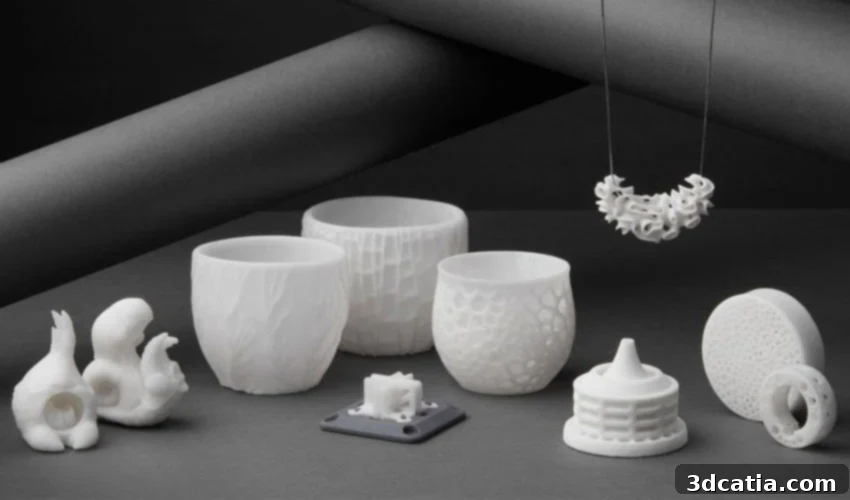
Intricate parts 3D printed with Formlabs’ new Ceramic Resin (Photo credits: Formlabs)
While Formlabs previously expanded the color palette for their SLA resins last year, this latest innovation represents a more significant leap into advanced material functionality. Their focus now shifts to a ceramic solution, unlocking a wealth of new opportunities for engineers, designers, artists, and researchers across various fields. There is a palpable and growing interest from internal R&D departments and in-house production laboratories in leveraging the unique advantages of ceramic 3D printing. The exceptional properties of ceramic materials make them indispensable in numerous high-performance applications. For instance, the military sector utilizes ceramic composites to engineer lightweight yet incredibly robust shields and protective gear, offering superior ballistic resistance without compromising mobility. Similarly, electronics manufacturers extensively employ alumina ceramics for critical components such as insulators, resistors, and semiconductors, primarily due to their outstanding thermal stability, excellent electrical insulation properties, and controlled electrical conductivity. The ability to 3D print these complex ceramic geometries on demand is a game-changer for rapid prototyping, customized production, and pushing the boundaries of material science.
Delving into Formlabs’ Ceramic Resin: Material Science and Post-Processing
The newly introduced Ceramic Resin is a sophisticated silica-filled photopolymer, representing a blend of traditional ceramic properties with modern additive manufacturing techniques. In its initial, pre-fired state, parts printed with this innovative material exhibit a smooth, porcelain-like finish, offering a glimpse into their final aesthetic. The true transformation occurs during the post-processing “cooking” or firing stage. This crucial step involves subjecting the printed object to high temperatures, which meticulously burns away all the photopolymer binders, leaving behind a purely ceramic part. This fully ceramic component can then be glazed or varnished, allowing for further customization in terms of finish, color, and protective coatings, opening up a world of artistic and functional possibilities.
Beyond its aesthetic versatility, the Ceramic Resin boasts impressive functional characteristics. It offers high thermal resistance, capable of withstanding extreme temperatures of up to 1000°C, making it suitable for applications in high-heat environments. Furthermore, parts produced with this resin demonstrate excellent resistance to wear and corrosion, significantly extending their lifespan and reliability in demanding conditions. However, Formlabs cautions users that this material, given its experimental nature and unique composition, may present a slightly higher degree of complexity in handling compared to their standard range of resins. To ensure successful prints and achieve optimal results, the manufacturer strongly recommends extensive testing and experimentation before attempting to print final, desired parts. This iterative approach allows users to fine-tune printing parameters, understand material behavior, and master the specific post-processing requirements unique to ceramic additive manufacturing.
A closer look at a 3D printed ceramic component (Photo credits: Formlabs)
Innovative Collaboration: Nervous System and the Porifera Collection
To rigorously test and validate their new Ceramic Resin, Formlabs embarked on a significant collaboration with Nervous System, a renowned generative design studio. Over several months, this partnership allowed for comprehensive experimentation, pushing the boundaries of what could be achieved with the novel material. Nervous System seized this unique opportunity to launch their inaugural collection of 3D printed ceramic jewelry, aptly named Porifera. The studio’s core objective was to seamlessly blend the intricate capabilities of 3D printing with the timeless elegance and robust qualities of ceramics, thereby creating complex geometric shapes and designs while maintaining the highest standards of quality and finish.
Jessica Rosenkrantz, co-founder of Nervous System, articulated the studio’s enthusiasm for the material, stating, “Ceramic materials are really beautiful and have nice qualities. They’re inexpensive and strong, and they have this nice tactile feel; they can be glossy or more earthy.” Her words encapsulate the multifaceted appeal of ceramics – their aesthetic charm, inherent strength, cost-effectiveness, and the diverse tactile experiences they offer, ranging from a lustrous gloss to an organic, earthy matte finish. Through this collaboration, Nervous System successfully crafted exceptionally intricate parts, designs that would have been utterly unattainable using conventional manufacturing methods. The inherent fragility of such complex geometries often makes them impossible to produce through traditional techniques like molding or carving. However, 3D printing, combined with the structural integrity of fired ceramics, enabled Nervous System to transcend these limitations, opening up new avenues for artistic expression and product design.
Exquisite ceramic jewelry from the Porifera collection, designed by Nervous System (Photo credits: Nervous System)
The Impact and Future of Accessible Ceramic 3D Printing
The introduction of Formlabs’ Ceramic Resin signifies a major step forward in making advanced material 3D printing more accessible. This move is poised to democratize the creation of high-performance ceramic parts, enabling a wider range of industries and individual innovators to experiment with and integrate ceramic components into their products. From custom medical implants and sophisticated electronic enclosures to high-temperature tooling and bespoke architectural elements, the potential applications are vast and diverse. The Form 2, already a popular choice for its reliability and precision, now gains an entirely new dimension of capability, allowing users to leverage the unique properties of ceramics for functional prototypes and end-use parts. This development not only enhances Formlabs’ material ecosystem but also accelerates the adoption of ceramic additive manufacturing, fostering innovation across numerous sectors that demand materials with exceptional thermal, mechanical, and electrical properties.
For those eager to delve deeper into this exciting development, comprehensive information on the Ceramic Resin, including detailed guidance on the printing and post-processing stages, is available directly on the Formlabs website. Additionally, a wealth of further details and visual insights can be found in the insightful video provided below, offering a more dynamic understanding of the material’s potential and workflow.
What are your thoughts on Formlabs’ new Ceramic Resin material and its potential to revolutionize various industries? We invite you to share your insights and predictions in the comments section below, or join the conversation on our Facebook and Twitter pages! Don’t miss out on the latest advancements and news in the world of 3D printing; make sure to sign up for our free weekly Newsletter, delivering all the essential updates straight to your inbox.