
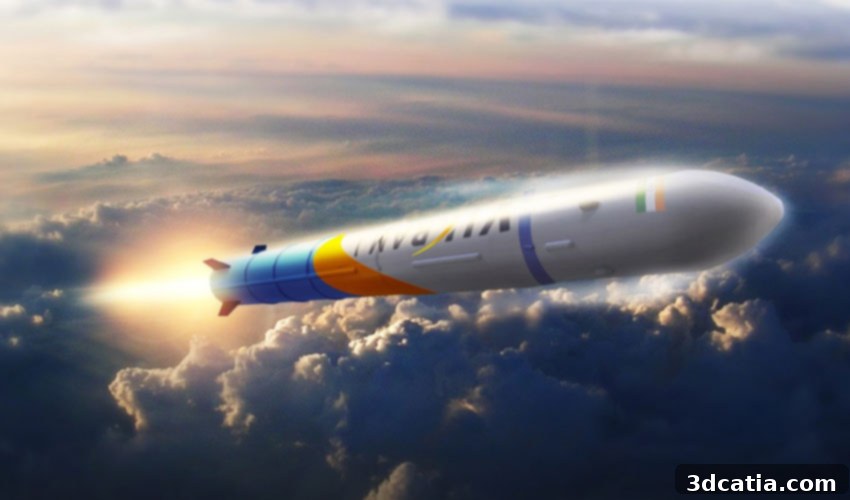
Skyroot Aerospace Unleashes India’s First 3D Printed Cryogenic Rocket Engine: Pushing the Boundaries of Space Exploration
The landscape of space exploration is undergoing a revolutionary transformation, largely driven by innovative private enterprises and groundbreaking technological advancements. At the forefront of this new era, India’s burgeoning private space sector is making significant strides. A prime example is Skyroot Aerospace, an ambitious Indian startup that has recently captured global attention with the unveiling of its first fully 3D printed rocket engine. This remarkable piece of engineering, christened Dhawan-I, is named in tribute to the revered Indian space scientist and engineer, Dr. Satish Dhawan, a figure whose contributions profoundly shaped India’s space program.
The Dhawan-I is not just any rocket engine; it is a cryogenic engine. This classification signifies that it operates using propellants – specifically fuel and an oxidizer – that are stored in a liquid state at extremely low temperatures. While such liquid gases offer superior performance and efficiency, their handling and precise control present significantly greater engineering challenges compared to conventional propellants. The successful development of Dhawan-I represents a monumental leap in Skyroot Aerospace’s capabilities and marks a pivotal moment for India’s independent space endeavors. Following a rigorous series of tests and iterations, where multiple design models were meticulously created and evaluated, the company anticipates positive results, paving the way for its inaugural orbital launch. The first take-off is projected to occur as early as 2021, featuring the Vikram-I model, which is the smallest capacity rocket in Skyroot’s planned fleet. However, the fully 3D printed cryogenic engine, Dhawan-I, is slated to power future missions, specifically onboard the more capable Vikram-II rocket, marking its ultimate conquest of space.
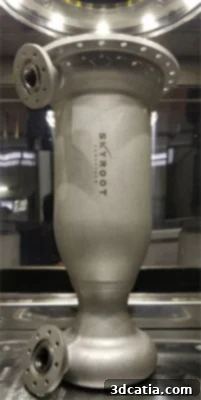
The 3D printed rocket engine.
Additive Manufacturing: A Game-Changer for Aerospace Innovation
The integration of additive manufacturing, more commonly known as 3D printing, within the aerospace sector is not a new phenomenon. For quite some time now, this transformative technology has been extensively utilized across various applications, ranging from intricate components in aircrafts to critical parts in rockets. Its adoption has been particularly impactful in the realm of space exploration, where the demands for precision, efficiency, and robustness are paramount. 3D printing technologies empower manufacturers to design and produce components that are inherently lighter, structurally more optimized, and significantly more efficient. This includes crucial parts like advanced rocket nozzles and combustion chambers, which benefit immensely from the design freedom offered by additive processes.
The overarching goal behind integrating these advanced manufacturing techniques is multi-faceted. Primarily, it aims to drastically reduce production costs and streamline manufacturing timelines. By enabling the creation of complex geometries in a single part, 3D printing minimizes the need for extensive assembly, reduces material waste, and allows for rapid prototyping and iteration. Ultimately, this leads to the development of highly reliable and accessible spaceflight solutions, akin to the reliability and affordability of commercial air travel, thereby opening up the vast frontier of space to a wider audience. This ambitious vision lies at the very core of Skyroot Aerospace’s mission, and their creation of the Dhawan-I, a fully 3D printed cryogenic engine, stands as a testament to this commitment. By leveraging additive manufacturing, Skyroot is not only innovating in engine design but also strategically positioning itself to drive down the cost of access to space, making space travel and satellite deployment more feasible and widespread.
The Complexity and Innovation Behind Cryogenic Engines
The development and operation of a cryogenic engine, such as the Dhawan-I, represent a significantly more complex engineering feat than that of a conventional rocket engine. The primary reason for this heightened complexity lies in the necessity to maintain propellants at extremely low temperatures, often around -150° Celsius or even colder, throughout the entire mission profile, from fueling to ignition. These engines typically utilize a liquid fuel and a liquid oxidizer, both of which must be kept at these intensely cold temperatures to remain in their liquid state and achieve optimal performance.
In the specific case of the Dhawan-I, Skyroot Aerospace has innovatively opted for Liquid Natural Gas (LNG) as its fuel, coupled with liquid oxygen as the oxidizer. This choice of propellants is particularly forward-thinking. According to the company, “This engine is India’s first fully cryogenic engine running on the futuristic LNG fuel. It contains more than 90 percent methane, making it extremely clean and efficient.” The use of LNG is noteworthy not only for its environmental benefits, being a much cleaner-burning fuel compared to traditional kerosene-based propellants, but also for its potential cost advantages and higher specific impulse, meaning it generates more thrust per unit of propellant. The high methane content contributes to a more complete combustion, reducing carbon emissions and minimizing engine residue, which in turn enhances engine lifespan and reliability.
Beyond the innovative fuel choice, Skyroot Aerospace has heavily relied on metal additive manufacturing to conceptualize and construct the Dhawan-I engine. While the startup has remained commendably discreet regarding the precise processes and specific metal alloys employed – likely due to ongoing proprietary testing and optimization – the implication is clear: 3D printing allowed them to achieve geometries and integrated functionalities that would be impossible or exceedingly difficult with traditional manufacturing methods. This secrecy underscores the cutting-edge nature of their work and the competitive advantage they aim to secure in the burgeoning private space sector.
Regenerative Cooling: A Masterpiece of 3D Printing and Thermal Management
A critical innovation integrated into the Dhawan-I is its advanced regenerative cooling system. Naga Bharath Daka, Skyroot’s operations manager, succinctly explains its core feature: “Dhawan-I is a 100% 3D printed cryogenic engine with regenerative cooling.” This technology is fundamental to managing the extreme temperatures generated within the combustion chamber of a rocket engine, which can reach thousands of degrees Celsius. Without an effective cooling mechanism, the engine’s structural integrity would quickly be compromised, leading to catastrophic failure.
In a regenerative cooling system, the cold fuel (in this case, LNG) is ingeniously circulated through a network of precisely designed tubes and channels that run intricately around the combustion chamber walls. As the fuel flows through these channels, it absorbs heat from the super-hot combustion chamber, effectively cooling the engine walls and preventing them from melting. This pre-heated fuel then serves a dual purpose: it is either directed into a special gas generator, where it powers turbopumps that feed propellants into the main chamber, or it is injected directly into the main combustion chamber itself. This process not only safeguards the engine’s hardware but also pre-heats the fuel, enhancing its combustion efficiency. The remarkable aspect here is that it is precisely the capabilities of additive manufacturing technology that allow for the design and fabrication of such an incredibly complex and highly optimized internal structure. Traditional manufacturing methods would struggle, if not fail entirely, to create the intricate, winding pathways and thin-walled channels required for efficient regenerative cooling within a single, monolithic engine component. 3D printing enables engineers to precisely control the internal geometry, wall thickness, and surface roughness of these channels, maximizing heat transfer efficiency and further reducing the engine’s overall weight and complexity by consolidating multiple parts into one.
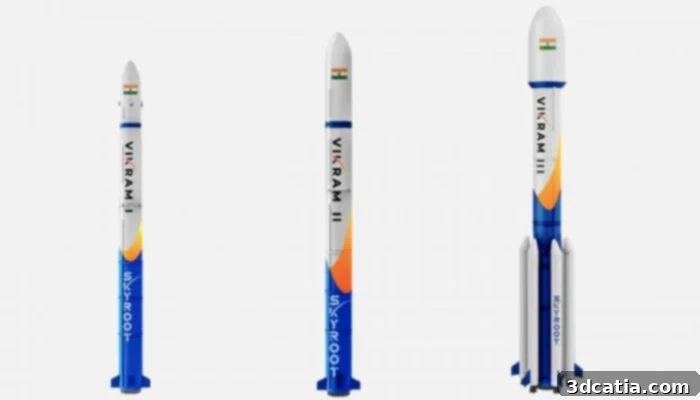
The three rocket models.
The Vikram Rocket Series: Paving the Way for Dhawan-I’s Orbital Debut
Skyroot Aerospace is developing a family of rockets, all named after the founder of India’s space program, Vikram Sarabhai. The immediate focus is on the Vikram-I, a small-lift launch vehicle designed to cater to the growing demand for deploying small satellites. However, the advanced Dhawan-I 3D printed cryogenic engine will not be utilized in the initial Vikram-I missions. The Vikram-I, with its payload capacity of approximately 225 kilograms, is primarily designed for different propulsion systems and cannot yet accommodate the specific mass and operational requirements of the Dhawan-I cryogenic engine. While the Vikram-I’s scheduled take-off in 2021 represents a significant milestone for Skyroot and India’s private space sector, the Dhawan-I is destined for a more powerful platform.
To harness the full potential of the Dhawan-I engine, aerospace enthusiasts and industry observers will need to patiently await the debut of the Vikram-II rocket. This next-generation launch vehicle is engineered to carry a significantly larger payload, estimated at 410 kilograms, providing the necessary capacity to integrate and operate the sophisticated cryogenic engine effectively. The phased approach, starting with Vikram-I and progressing to Vikram-II, demonstrates Skyroot’s strategic roadmap for incrementally building capabilities and validating technologies. This measured strategy not only mitigates risks but also allows for iterative improvements, ensuring that when Dhawan-I finally propels Vikram-II into orbit, it does so with maximum reliability and efficiency. This progression underscores Skyroot’s commitment to advancing India’s private space capabilities and contributing to the global small satellite launch market. For those keen to track the ongoing progress and latest developments from this pioneering Indian startup, further information is readily available on their official website.
The Future of Space Travel: Accessible, Efficient, and Innovative
The successful development and eventual deployment of engines like the Dhawan-I symbolize a new chapter in space exploration. By combining the power and efficiency of cryogenic propulsion with the transformative capabilities of additive manufacturing, Skyroot Aerospace is not merely building rockets; it is actively working to make space more accessible, sustainable, and economically viable. The ability to rapidly prototype, iterate on designs, and produce complex, lightweight components in-house translates directly into reduced costs and faster development cycles. This paradigm shift holds immense promise for the future, enabling more frequent launches, facilitating the expansion of satellite constellations, and potentially opening doors to novel applications in space that were once considered prohibitively expensive. As private companies like Skyroot continue to innovate, driven by ingenuity and advanced manufacturing, the dream of affordable and routine space travel moves ever closer to reality, positioning India as a key player in this exciting new frontier. Skyroot’s achievements are a testament to the power of private enterprise in pushing technological boundaries and redefining what’s possible in the cosmos.
What are your thoughts on Skyroot Aerospace’s fully 3D printed cryogenic rocket engine and its implications for the future of space travel? We invite you to share your insights in a comment down below or join the conversation on our Facebook and Twitter pages! Don’t miss out on the latest advancements and news in the additive manufacturing world. Make sure to sign up for our free weekly Newsletter, delivering all the essential updates in 3D printing directly to your inbox!