
Revolutionizing Pediatric Care: How 3D Printing Transforms Surgical Planning at Children’s Nebraska
The advent of 3D printing technology has fundamentally reshaped numerous fields, and its profound impact on the medical community, particularly in pediatric care, is undeniable. Children present a unique set of challenges in medicine due to their constantly developing and highly variable anatomy, which often necessitates highly specialized and individualized surgical approaches. In such complex scenarios, advanced 3D visualization and physical models offer invaluable insights, drastically improving diagnostic accuracy, surgical planning, and patient education. By leveraging 3D printing, medical teams can create precise surgical models and guides that enable surgeons and families to gain a much deeper and clearer understanding of a patient’s intricate anatomy. For instance, when dealing with a tumor located in an unusual or hard-to-reach area, a dedicated 3D lab can produce a lifelike model of the patient’s specific tumor alongside the surrounding organs. This tangible representation allows surgical teams to meticulously plan their approach, simulate procedures, and anticipate potential complications, ultimately leading to safer and more effective interventions. Both patients and their families, as well as the entire medical staff, benefit immensely from this physical, interactive representation, fostering greater confidence and reducing anxiety during challenging times.
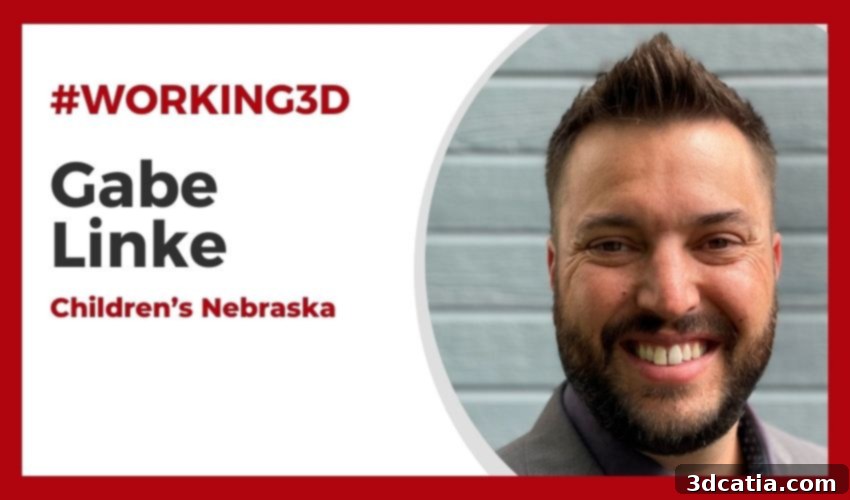
Among a select few pediatric hospitals across the nation, Children’s Nebraska, situated in Omaha, stands out for its cutting-edge, in-house 3D printing lab. This dedicated facility highlights the institution’s commitment to innovation and patient-centered care. To delve deeper into how this pioneering lab harnesses additive manufacturing technology and to understand the intricacies of working within such a specialized environment, we had the privilege of speaking with Gabe Linke. As the Manager of 3D at Children’s Nebraska, Linke played a pivotal role in establishing the hospital’s robust 3D printing operation from its very inception. We were eager to learn about his journey and the foundational efforts that brought this remarkable program to life.
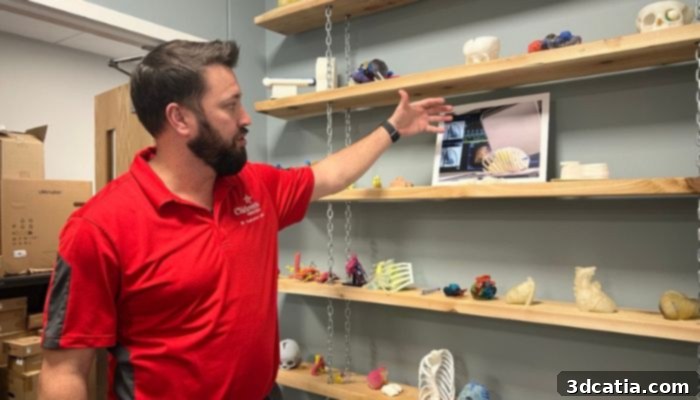
The gallery in the 3D printing lab (Photo Credit: 3Dnatives)
3DN: Could you please introduce yourself and your role at Children’s Nebraska?
Absolutely! My name is Gabe Linke, and I am currently the Manager of 3D at Children’s Nebraska. In this role, I have the incredible opportunity to lead our dedicated team in pioneering the integration of advanced 3D printing and visualization technologies into pediatric care. My passion lies in harnessing innovative solutions to significantly enhance patient outcomes, particularly by creating personalized and patient-specific models and guides for complex medical and surgical challenges. It’s a privilege to contribute to a field where technology directly improves the lives of children and their families.
3DN: How did you first discover additive manufacturing and its potential in medicine?
My initial, transformative experience with additive manufacturing was serendipitous, occurring during my second interview with Children’s Nebraska in 2016. I was interviewing for the Cardiac Imaging Coordinator position with Dr. Scott Fletcher, when he presented me with a heart model that had been purchased from an external vendor. He posed a pivotal question: “Do you think you could figure out how to produce these models in-house?” This question immediately piqued my curiosity. That very night, I went home and immersed myself in researching the applications of 3D printing within the medical field. What I uncovered was a truly fascinating and expansive range of possibilities, particularly in the creation of patient-specific anatomical models for surgical planning and visualization. It was an eye-opening moment, revealing a path where technology could directly translate into tangible improvements in patient care. Unbeknownst to me at the time, Children’s Nebraska had recently received a generous donation that included a Stratasys Eden 260 VS printer and a three-year license for Materialise software, specifically intended to kickstart this very program. Just a month later, I officially began my career at Children’s Nebraska, embarking on what has been an incredibly exciting and rewarding opportunity to help bring the concept of 3D-printed medical models to life, making a real difference for our young patients.
3DN: What is your current role, and what does a typical day look like for you and your team?
I am currently the Manager of The 3D Center of Excellence at Children’s Nebraska. My title, much like the field itself, has been in a constant state of evolution as our program has grown and developed. For simplicity, I often just refer to myself as the “Manager of 3D.” I am incredibly fortunate to lead a team of two other exceptionally talented individuals. Together, we collaborate closely with physicians, medical professionals, and hospital administrators to strategically utilize our 3D resources. Our primary goal is to enhance patient care through various innovative applications, ranging from highly detailed surgical planning to personalized patient education tools. Children’s Nebraska has a robust organizational foundation built on innovation, and my team has had the privilege of being one of the earliest and most impactful resources supporting this pillar within our institution.
A typical day for us is incredibly dynamic and diverse, reflecting the multifaceted nature of our work. It can involve everything from the intricate post-processing of cardiac MRI and CT scans to the precise segmentation of complex tumor cases. These segmented digital models are then prepared for 3D printing, providing surgeons with invaluable physical replicas, or integrated into virtual reality environments for immersive pre-operative planning. Beyond the critical surgical applications, we also engage in heartwarming projects, such as creating customized action figures for our patients who are enduring particularly challenging and lengthy treatment plans. These small gestures often provide immense comfort and a sense of empowerment. Ultimately, we have witnessed firsthand how our work profoundly impacts the lives of our patients. By leveraging advanced 3D technology, we empower our healthcare teams to plan patient care with unprecedented effectiveness and realism. Moreover, patients and their families gain a much clearer, tangible understanding of their medical situations, which significantly helps to alleviate the considerable stress and anxiety often associated with their healthcare journeys. This direct impact on both clinical outcomes and emotional well-being is what truly drives our team.
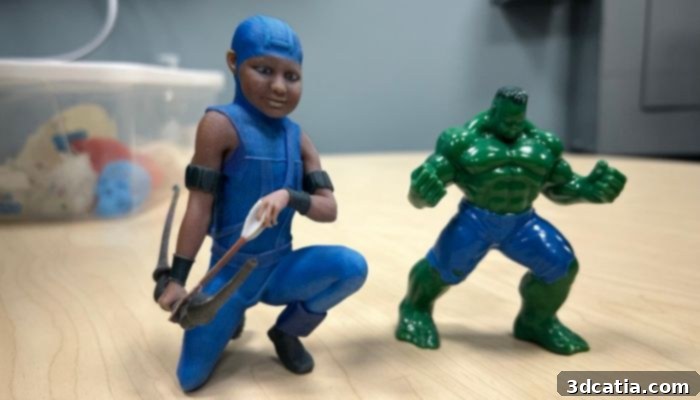
Customized action figures with the faces of patients (Photo Credit: 3Dnatives)
3DN: What qualifications and experience are typically required for your role and those on your team?
Our team members come from a variety of professional backgrounds, which enriches our collaborative environment. While formal degrees can be beneficial, the core components for thriving in our lab revolve around a solid understanding of medical imaging principles and an innate ability to learn rapidly and adapt to the constantly evolving landscape of technology. We are, in many respects, the team responsible for translating the innovative ideas and visions of others into tangible realities. This means transforming digital data into virtual models and then physically producing them through 3D printing. We bridge the gap between abstract medical imaging and concrete, interactive tools. Perhaps one could even argue that the single most important qualification for our role is the ability to communicate effectively and build strong, trusting relationships with all the individuals we engage with – from surgeons and radiologists to nurses and patient families. Our lab, no matter how advanced its equipment, would be incomplete and ultimately ineffective without the invaluable ideas, insights, and needs brought forth by the people we serve.
3DN: What are some of the biggest challenges you face as a 3D visualization specialist in a hospital setting?
One of the most significant challenges I have consistently encountered in this rapidly developing field is the difficulty in finding individuals who possess a very specific blend of expertise. This niche requires a deep understanding of both medical imaging and advanced 3D technologies, coupled with excellent problem-solving skills. Given the nascent nature of dedicated medical 3D printing programs, much of what we have successfully developed and implemented at Children’s Nebraska has been built upon fostering strong, collaborative relationships with exceptional industry partners. These partnerships have been instrumental in helping us establish robust and efficient internal processes, ensuring we maintain a high standard of quality and innovation.
However, our greatest success in overcoming this staffing challenge lies in our unique ability to train and empower existing radiology technologists to become leaders within this specialized domain. Radiology technologists, with their foundational knowledge of medical imaging and patient anatomy, are remarkably well-suited for this transition. Currently, we are incredibly proud to have an outstanding team driving our program to new heights, continually pushing the boundaries of what’s possible. As our program continues its trajectory of growth and expanding applications, we anticipate an increasing need for more skilled staff. The truly remarkable aspect of this challenge, and indeed its inherent beauty, is that it directly contributes to one of our core strengths: our commitment to teaching and training dedicated individuals to excel and innovate in this remarkable and impactful medical field. This internal development pathway not only addresses staffing needs but also cultivates a highly specialized workforce passionate about pediatric care.
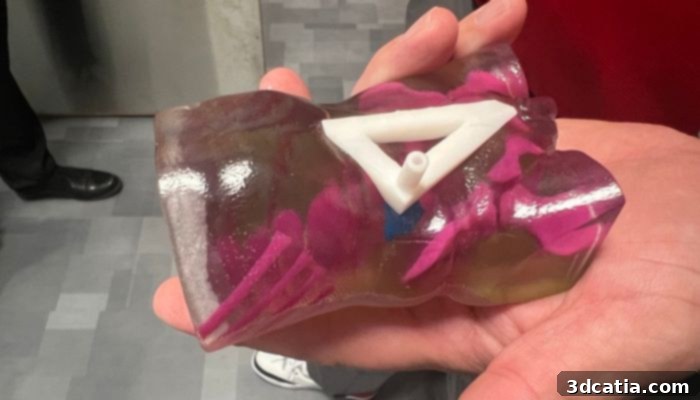
3D printed model (Photo Credit: 3Dnatives)
3DN: What advice would you offer to someone aspiring to work in 3D visualization within a medical setting? Could you also speak to the growing demand for professionals in this niche?
My strongest advice would be to wholeheartedly encourage anyone interested to simply jump in and start exploring. As I’ve mentioned, I’ve observed tremendous success with Radiologic Technologists transitioning into this field. Their inherent knowledge of MRI and CT imaging provides a phenomenal foundation for understanding 3D spatial relationships and anatomical structures, which are critical for effective 3D visualization. However, it’s not limited to them; I have also successfully trained technologists from X-ray, Nuclear Medicine, and Cath lab backgrounds, achieving excellent results. Biomedical Engineers also possess a strong aptitude for this type of work, given their understanding of both biological systems and technological applications. The beauty of this burgeoning niche is the vast potential for self-directed learning and skill development.
You can start right now by utilizing readily available freeware and open-source DICOM data sets to practice segmentation – the process of isolating specific anatomical structures from medical scans. This hands-on experience is invaluable. Furthermore, you can teach yourself 3D design software and techniques to build and modify models. All of these are core skills that we employ daily in our lab. If you have the drive and initiative to self-teach these essential competencies, regardless of your initial professional background, there is significant potential for you to forge a successful career in this exciting field. A few years into our journey at Children’s Nebraska, we often pondered the future trajectory of this groundbreaking technology. The answer has become increasingly evident and compelling: 3D printing and visualization are not just impacting healthcare; they are actively revolutionizing medical practice, enhancing diagnostic capabilities, refining surgical planning, and ultimately improving countless lives in profoundly meaningful ways. The demand for skilled professionals who can bridge the gap between advanced technology and patient care is only set to grow exponentially.
What are your thoughts on Gabe Linke’s impactful work at Children’s Nebraska? Are you inspired by the potential of 3D printing in healthcare and considering a career in medical 3D visualization? We’d love to hear your insights! Let us know in a comment below or join the conversation on ourLinkedIn,Facebook, andTwitter pages! Don’t forget to sign up for our free weeklyNewsletter here, delivering the latest 3D printing news straight to your inbox! You can also find all our compelling videos on ourYouTube channel for more insights into the world of additive manufacturing.
*Cover photo credit: Gabe Linke