

Revolutionizing Resin 3D Printing: MIT and Chinese Academy of Sciences Unveil Single-Drop, Ultra-Efficient Method
Additive manufacturing, commonly known as 3D printing, has transformed numerous industries by enabling the creation of complex geometries with unprecedented speed and customization. Among the diverse array of 3D printing technologies, photopolymerization-based methods, particularly those utilizing liquid resins, stand out for their ability to produce highly detailed and precise parts. However, these techniques have long been challenged by material waste, extensive post-processing requirements, and the associated environmental and economic costs. A groundbreaking development from researchers at the Chinese Academy of Sciences and MIT aims to fundamentally change this landscape. They claim to have developed an innovative 3D printing technique, based on advanced photopolymerization principles, that uses only a single, precisely controlled drop of resin to design and produce an entire part. This novel approach, building upon the Continuous Digital Light Processing (cDLP) method, has already demonstrated remarkable effectiveness through rigorous testing, promising to dramatically reduce material wastage while maintaining the superior characteristics of resin-based prints.
The Challenges of Traditional Resin-Based 3D Printing
Stereolithography (SLA), one of the earliest and most established additive manufacturing methods, has long been celebrated for its exceptional precision and ability to render intricate details. It operates by selectively curing liquid photopolymer resin layer by layer using a UV laser. Despite its advantages, SLA, and indeed many other resin-based processes like Digital Light Processing (DLP), face inherent limitations. A primary concern is the considerable volume of uncured resin that often remains after a print job is completed. This leftover material typically requires careful disposal, contributing to waste and increasing overall operational costs.
The printing volume itself can also be a constraint in traditional SLA, although some manufacturers are actively pushing boundaries in this area. For instance, Azul3D has made significant strides by developing ultra-fast, large-format SLA machines, demonstrating the industry’s continuous drive for innovation. However, even with these advancements, the issue of material waste and post-processing persists. DLP, for example, utilizes a light projector instead of a laser to cure the resin, offering faster print times for certain geometries. Yet, regardless of whether a laser or a projector is employed, a crucial post-processing step is almost always necessary. This involves thoroughly cleaning the newly printed part to remove any residual uncured resin and ensuring the machine’s components are free from contamination. This labor-intensive step not only adds significant manufacturing time but also exacerbates the problem of resin waste, as the discarded uncured material can restrict print resolution and drive up production expenses, impacting both cost-effectiveness and environmental sustainability.
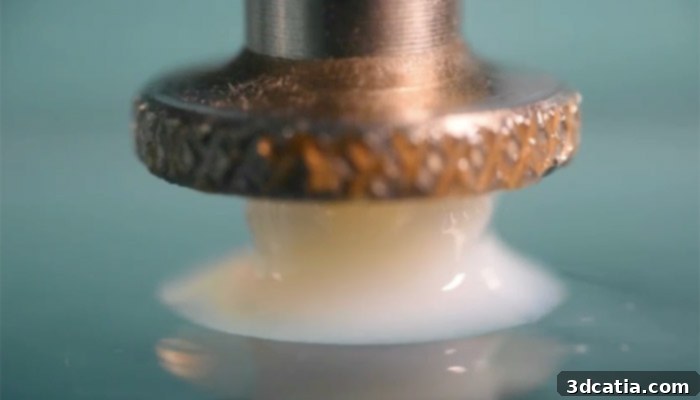
Only one drop of resin would be needed to 3D print the desired piece.
Introducing the Single-Drop 3D Printing Breakthrough
Recognizing the pressing need for a more efficient and sustainable approach, the joint research team embarked on developing a technique that fundamentally rethinks resin consumption. Their innovative method directly addresses the challenges of material waste by utilizing only a single, precisely controlled drop of photopolymer resin for the entire printing process. This represents a monumental shift from conventional methods that typically immerse the entire build platform in a vat of resin, leading to significant material excess.
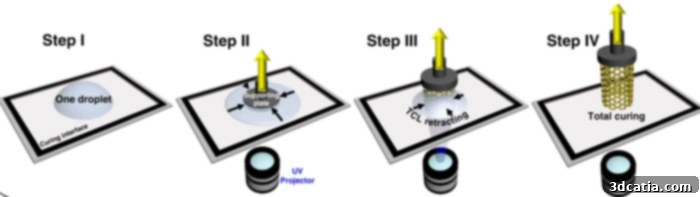
The inspiration behind this ingenious approach draws from the natural world, specifically from the fascinating mechanisms employed by lotus and pitcher plants to collect and manipulate water spheres. These plants exhibit unique surface properties that control liquid adhesion and movement. Applying similar biomimetic principles, the researchers’ method operates through a dynamic process analogous to that of a three-phase contact line (TCL). In this setup, a meticulously measured drop of resin is deposited onto a specialized photopolymerization plate. Directly beneath this plate, an ultraviolet (UV) light source continuously projects light, initiating the curing process. Synchronized with the light exposure, an aluminum print bed, positioned just above the curing interface, delicately lifts off the plate with each subsequent printed layer. This precise choreography ensures that only the intended amount of resin is exposed and cured, layer by layer, minimizing waste and maximizing material utilization.
Unprecedented Efficiency and Material Utilization
The core of this efficiency lies in the design of the light-curing interface. Researchers explain that this interface is engineered to minimize the amount of resin that adheres to it. By precisely controlling the dynamics of the three-phase contact line (TCL) of the projected resin drop, unwanted resin can be effectively removed during the printing process. This ingenious mechanism ensures that only the exact quantity of resin required for the current layer, and ultimately for the entire part, adheres to the plate and becomes part of the final structure. The implications of this are profound: “Thus, only the resin needed to print the piece will adhere to the plate,” the researchers emphasize. They further demonstrated the remarkable success of their method by manufacturing a 24mm long cylindrical grid structure, achieving an astonishing 99.6% wet resin utilization efficiency. This figure represents an industry-leading benchmark, signaling a monumental leap forward in sustainable and cost-effective additive manufacturing.
Real-World Applications and Future Implications
To thoroughly validate the capabilities of this revolutionary single-drop 3D printing technology, the team conducted a series of comprehensive tests. Their experiments successfully demonstrated the versatility and precision of the method across various applications. Notably, they were able to print a detailed dental CT model of a tooth, as well as complex dental crowns, including molar, incisor, and canine designs. The ability to produce such intricate and functionally critical parts, especially in the demanding field of dentistry, underscores the method’s potential for high-precision manufacturing. The results from these tests were overwhelmingly positive, leading the researchers to conclude: “Our method can transform a single drop of resin into a defined structure with high material utilization efficiency by properly adjusting the properties of the light-curing plate, which can minimize costs as well as the resin and provide a benchmark for on-demand 3D printing.”
This breakthrough has far-reaching implications across multiple sectors. For industries where material costs are significant, such as medical device manufacturing, microfluidics, and specialized electronics, the ability to nearly eliminate resin waste translates directly into substantial cost savings. Furthermore, the reduction in chemical waste has a positive environmental impact, aligning with growing demands for more sustainable manufacturing practices. The “on-demand” aspect is particularly exciting, as it suggests a future where highly customized, complex parts can be produced with minimal setup and material overhead, making small-batch production and rapid prototyping more accessible and efficient than ever before. This innovation truly sets a new benchmark for material efficiency and cost reduction in the ever-evolving landscape of additive manufacturing. For those interested in delving deeper into the technical specifics of this remarkable project, more comprehensive information can be found HERE.
Shaping the Future of Sustainable 3D Printing
The development of this single-drop resin 3D printing technique by researchers from the Chinese Academy of Sciences and MIT marks a pivotal moment in additive manufacturing. By addressing the long-standing issues of material waste and post-processing, this method promises to make resin-based 3D printing more economical, environmentally friendly, and efficient. Its potential to enable high-precision, on-demand manufacturing with minimal material input could unlock new possibilities for customized products across various industries, from medicine to consumer goods. As the world continues to seek more sustainable production methods, this innovative approach stands as a testament to human ingenuity and the power of biomimicry in engineering solutions for the future.
What are your thoughts on this newly developed 3D printing method and its potential impact on the industry? We’d love to hear your insights! Share your comments below or engage with us on our Facebook and Twitter pages. To stay updated with all the latest advancements and news in the exciting world of 3D printing, be sure to sign up for our free weekly Newsletter, delivered straight to your inbox!