

Siemens AM Network: Pioneering Industrial Additive Manufacturing for Mass Production and Digital Transformation
The landscape of industrial manufacturing is undergoing a profound transformation, with the adoption of 3D printing, specifically for mass production, experiencing substantial growth. This innovative technology promises unparalleled advantages in design freedom, material efficiency, and production agility. Despite these clear benefits, many companies remain hesitant to fully invest in 3D printing technologies. Their reluctance often stems from uncertainty about the practical steps required to successfully integrate and scale additive manufacturing (AM) within their existing business operations. Recognizing this critical need for guidance and a streamlined approach, Siemens, a global leader in industrial technology, launched its groundbreaking online platform, the AM Network, at the close of last year.
Siemens’ journey with 3D printing began many years prior, demonstrating a forward-thinking commitment to this disruptive technology. Their initial significant investment included the establishment of a specialized center dedicated to metal additive manufacturing. Today, Siemens’ overarching mission is to empower companies across various sectors to accelerate their transition to AM mass production. The Siemens AM Network stands as a testament to this commitment, offering a suite of benefits designed to overcome common adoption hurdles. To gain deeper insights into this transformative platform and its strategic importance, we recently had the opportunity to sit down with its esteemed director, Robert Meshel.
3DN: Could you please introduce yourself and share a bit about your professional connection to 3D printing and additive manufacturing?
“Certainly. I’m Robert Meshel, and I serve as the Director of the AM Network at Siemens. My career has always been fueled by an intense passion for technology and business innovation, constantly seeking out new strategic opportunities that promise significant impact. Over the years, I’ve had the privilege of contributing to both agile startup environments, where I held leadership roles such as CEO and VP of Business Development, and large multinational corporations, where I navigated various management capacities in Strategy, business consulting, as well as portfolio and product management – all predominantly within the manufacturing domain. For the past four years, my focus has been entirely on leading the AM Network at Siemens, a role that truly embodies my dedication to advancing industrial manufacturing.
My academic background includes an MSc in Mechanical Engineering from Tel-Aviv University, an MBA from the prestigious Kellogg School of Management at Northwestern University, and I am also a graduate of the Singularity University executive program. This blend of engineering, business acumen, and future-forward thinking has uniquely positioned me to drive the adoption and industrialization of additive manufacturing, enabling companies to harness its full potential for competitive advantage and sustainable growth.”

Robert Meshel, Director of Siemens’ AM Network
3DN: What was the primary motivation behind Siemens’ substantial investment in Additive Manufacturing (AM) technologies?
“Siemens’ commitment to additive manufacturing stems from its recognition as a Company Core Technology Field – one of five pivotal technological disciplines where we direct significant investments in research and development. This strategic approach highlights AM’s critical role in shaping the future of industrial production. Our engagement with additive manufacturing is multifaceted, spanning various business units where Siemens acts not only as a user of AM technologies but also as a service provider and a leading technology provider. We currently operate over 100 industrial-grade AM machines across our diverse business units, where additive manufacturing is firmly established as a strategic technology integral to our operational and developmental processes.
Beyond internal usage, Siemens operates several specialized service bureaus focusing on both metal and polymer printing. These facilities cater to highly regulated industries such as Power Generation, Automotive, Aerospace, Mobility, and Healthcare, where precision, reliability, and adherence to stringent standards are paramount. This extensive specialization and deep-seated competency place Siemens in a truly unique position to offer comprehensive engineering and consulting services. We guide organizations through their digital transformation journeys, helping them seamlessly integrate and leverage AM technology as a cornerstone of their modernized operations. Our practical experience as a large-scale user gives us an invaluable perspective on the challenges and opportunities involved.
Furthermore, Siemens is at the forefront of providing end-to-end software automation and digitalization solutions specifically tailored for the AM industry. Our advanced software technologies are fundamental components within the new generation of high-end AM machines, enabling the crucial automation layer required to construct truly industrial AM factories. This robust software suite facilitates the creation of comprehensive ‘digital twins’ – virtual replicas of the product, the manufacturing process, and even the entire manufacturing facility. This capability ensures an integrated, end-to-end workflow, encompassing every stage from initial product design and optimization, through manufacturing definition and simulation, to execution, and a full stack of Industrial Internet of Things (IIoT) solutions for real-time monitoring and control. The Siemens Additive Manufacturing Network represents the latest strategic addition to this powerful solution suite, extending our renowned engineering software offerings to seamlessly orchestrate commercial and business processes workflow, thereby closing the loop on a fully digitized AM ecosystem.”
The Siemens Additive Manufacturing (AM) Network is the new addition to the solution suite.
3DN: Siemens recently launched the AM Network. Can you elaborate on its core components and what it aims to achieve?
“The conceptual roots of the AM Network actually blossomed from a vibrant Hackathon held a few years ago at our office in Tel-Aviv, where a talented group of software developers and architects envisioned a better way to connect the AM ecosystem. Additive manufacturing is not just another production method; it’s a powerful catalyst for transforming traditional manufacturing paradigms. It enables the significant rise of ‘Manufacturing as a Service’ (MaaS) models, where manufacturing capabilities are consumed and delivered on-demand, by intelligently leveraging shared resources across a global network of certified suppliers. The Siemens Additive Manufacturing Network is precisely this: an innovative online collaboration platform meticulously designed to streamline and digitalize the entire ‘order to delivery’ business process for the industrial additive manufacturing community.
The AM Network leverages three fundamental concepts to deliver unparalleled value to its users and partners, driving efficiency and innovation:
- **Facilitating Manufacturing-on-Demand Models:** At its core, the platform enables true manufacturing-as-a-service and manufacturing-on-demand business processes. It does this by orchestrating an exclusive, secure network of trusted partners, buyers, and suppliers. This means that businesses can procure the specific parts they need, precisely when they need them, customized to their exact specifications, all by tapping into a robust and reliable global supplier network. This model drastically reduces lead times, optimizes inventory, and provides unprecedented flexibility in production.
- **Enhancing Collaboration and Co-creation:** The network is built to foster seamless collaboration and co-creation models, not only across different functions within a single organization but also across multiple independent organizations. It serves as a centralized hub that brings together the right competencies – from design engineers to material scientists and production managers – ensuring that every project benefits from collective expertise and efficient communication, ultimately getting the job done more effectively and innovatively.
- **Providing Advanced Workflow Orchestration Tools:** To underpin these collaborative and on-demand capabilities, the platform offers a comprehensive set of tools specifically designed for workflow orchestration. These tools cover engineering tasks, production management, and critical commercial functions. They automate routine processes, ensure data integrity, and provide real-time visibility into every stage of the manufacturing lifecycle, from initial design request to final product delivery and payment processing. This integrated approach minimizes manual effort, reduces errors, and significantly accelerates the overall additive manufacturing workflow.”
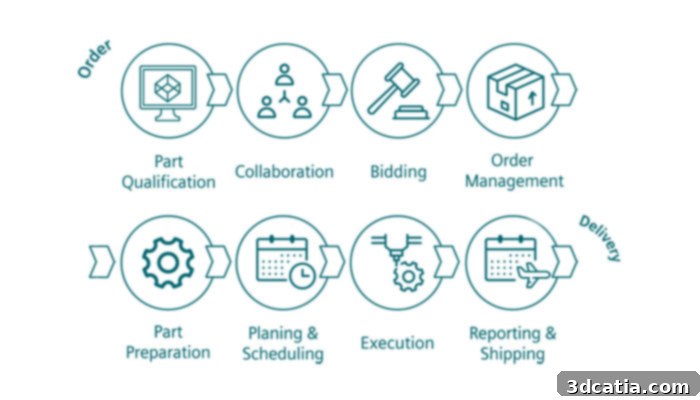
Siemens’ AM Network is a collaboration platform designed to streamline and digitalize the end-to-end business processes for the industrial additive manufacturing community
3DN: How is the industrialization of AM creating this growing demand for such integrated solutions?
“The industrialization of additive manufacturing is indeed driving an urgent demand for integrated solutions like the AM Network, primarily because the technology itself has matured at an incredible pace. Over the past several years, the fundamental science of additive manufacturing has progressed significantly. We’ve seen groundbreaking developments in material science, offering a wider array of high-performance polymers, metals, and composites. Concurrently, 3D printers have become demonstrably faster, more precise, and far more reliable, pushing the boundaries of what’s possible. These advancements are opening entirely new frontiers for innovation, allowing for the creation of complex geometries and functional parts that were previously unachievable or cost-prohibitive with traditional methods.
Coupled with the rapid growth and diversification of the supplier ecosystem, it is now not only possible but also increasingly affordable to produce a much broader range of products, often in significantly higher volumes. The industry is rapidly transitioning from a phase where AM was primarily limited to niche applications like rapid prototyping, to a point where it’s assuming a central and strategic role in manufacturing for an ever-increasing number of industries, from aerospace and automotive to healthcare and consumer goods. This shift from niche to mainstream industrial application is where the challenges and the demand for our solution lie.
While industrial additive manufacturing presents immense opportunities to revolutionize product design and production methodologies, its widespread adaptation can still be slow due to several critical factors. Firstly, the escalating demand for additive manufacturing services necessitates dedicated, robust solutions to facilitate efficient order submission, comprehensive management, and transparent tracking throughout the entire supply chain. Traditional, manual processes simply cannot keep pace. Secondly, there’s a noticeable gap in knowledge and competency within the broader engineering community regarding the optimal utilization and implementation of AM technology. This skills gap can hinder adoption and prevent companies from fully leveraging AM’s potential. Finally, customers consistently expect prices to drop, which exerts significant pressure on suppliers to demonstrate exceptionally high operational efficiency in running their AM factories. To maintain healthy profit margins in a competitive market, suppliers need sophisticated tools to optimize every aspect of their production, from scheduling to material usage. The AM Network directly addresses these pain points, providing the digital backbone needed to overcome these barriers and unlock the full potential of industrial AM.”
3DN: What are the tangible benefits that users can expect from a platform like the Siemens AM Network?
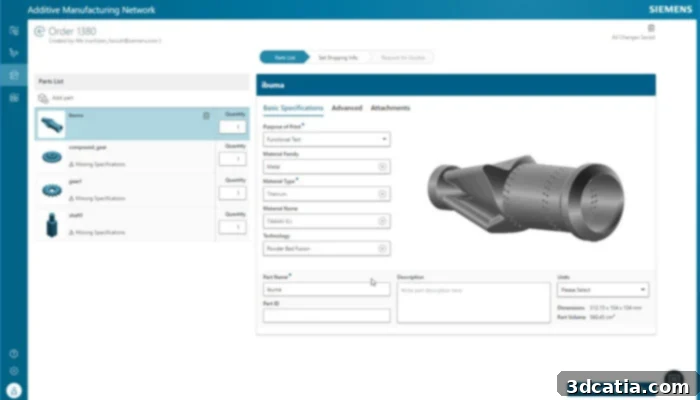
The AM Network platform from Siemens
“The tangible benefits of the Siemens AM Network are substantial and span across the entire additive manufacturing value chain. Our customers utilize the AM Network as their primary hub for engaging with their suppliers, transforming a historically fragmented process into a cohesive and transparent workflow. It provides a centralized platform for organizing all orders, ensuring that designers, procurement teams, and AM experts are continuously informed and perfectly synchronized regarding order status, critical interactions with suppliers (such as proposal exchanges, messaging, quality reports, etc.), and any potential revisions.
Crucially, the platform facilitates a seamless transition of orders directly into production, thereby establishing a fully digitalized process from inception to delivery. This eliminates manual hand-offs, reduces the risk of human error, and accelerates the entire production cycle. Siemens’ AM Network is specifically designed to maximize the business potential for organizations embracing additive manufacturing. It achieves this by rigorously streamlining AM processes, actively eliminating costly errors and unnecessary revisions, and ultimately exploiting the full potential of digital manufacturing. The result is significantly less material waste, fewer production errors, and a dramatic reduction in iteration cycles. By integrating all AM-related systems and stakeholders, the platform profoundly improves communication, enhances planning accuracy, and optimizes execution efficiency, offering a truly integrated and high-performance AM ecosystem that drives profitability and innovation.”
3DN: Who are the primary customers for Siemens’ AM Network?
“Our customer base for the Siemens AM Network is diverse and strategically segmented, reflecting the varied needs within the evolving additive manufacturing ecosystem. We primarily cater to three key groups:
**Enterprises:** These are large organizations that design, develop, and manufacture complex products and systems. They have recently begun integrating AM into their product development cycles and operational workflows. As their demand for AM grows, they typically fulfill it through a combination of in-house AM production facilities and by leveraging instant access to a global network of qualified suppliers via our platform, effectively complementing their internal capacity. These enterprises are actively seeking to enhance their internal engineering competencies in AM and to streamline often disconnected internal functions – from design to procurement and production. Their ultimate goal is to reduce costs, accelerate time-to-market, and forge a significant competitive advantage. Enterprises utilize AM for a wide range of use cases, including rapid prototyping, the creation of on-demand tooling, and establishing digital warehouses for spare parts. The Siemens AM Network provides robust functionality to support all these diverse use cases, uniting design engineers, production departments, procurement teams, and other corporate entities onto one integrated, user-friendly, one-stop system.
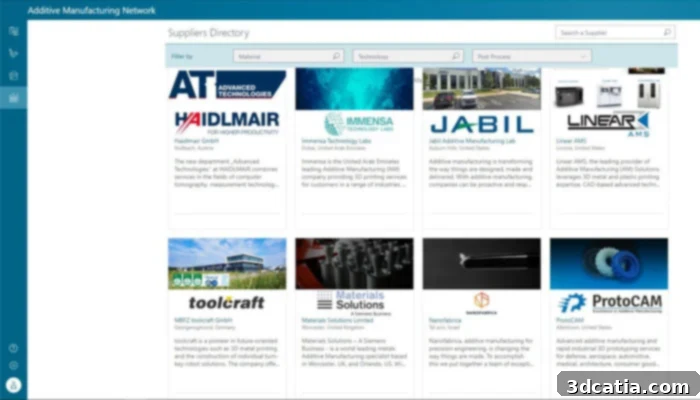
Siemens counts a number of customers from enterprises, service providers to partners
**Service Providers:** These companies specialize in operating AM production facilities and offering engineering services to external clients. They are constantly looking for ways to boost their business opportunities by making their specialized services accessible to new potential customers, significantly increasing their order intake, and providing an enhanced, more transparent service experience for their existing clientele. Furthermore, these service providers need to continuously improve their operational efficiency. This is achieved by gaining comprehensive control over the entire order fulfillment process – from initial order acquisition, through detailed production planning, precise scheduling, efficient execution, and comprehensive reporting – all managed within a single, end-to-end solution. The Siemens AM Network delivers an integrated suite of tools specifically designed to streamline and automate these critical ‘order to delivery’ functions, empowering service providers to operate with unmatched agility and profitability.
**Partners:** This category includes a broad spectrum of vendors, such as machine manufacturers, material suppliers, software developers, and engineering/consulting service providers. For these partners, the Siemens AM Network offers a unique channel to accelerate their market entry, expose their new products and services to a much larger, targeted audience, and directly integrate into their customers’ established workflows. The platform provides them with direct access to powerful tools and connects them with the right experts, facilitating instant, accurate analysis and collaborative problem-solving, thereby fostering a win-win environment for the entire AM ecosystem.”
3DN: Do you have any final thoughts or a concluding message you’d like to share with our readers?
“Absolutely. My key takeaways and observations from actively engaging with the additive manufacturing industry over the past few years are clear and impactful. While additive manufacturing is undoubtedly a cutting-edge production technology, its true power extends far beyond that. It is a major transformational force, poised to fundamentally reshape existing paradigms and enable entirely new business models. The significant and truly disruptive impact of AM will only be fully realized once these innovative business models are widely adopted and scaled across industries. Currently, a substantial portion of AM’s application remains confined to prototyping and highly customized, one-off productions. The critical challenge, and indeed the immense opportunity, lies in the industrialization of additive manufacturing – this is the key to unlocking the full, transformative potential of this technology, moving it from the lab to the factory floor for high-volume, cost-effective production.
Lastly, and perhaps most importantly, AM is a complex, relatively new technology. It demands a deep and nuanced understanding across multiple disciplines: expertise in design for additive manufacturing (DfAM), intricate knowledge of various processes, a thorough grasp of material science, and much more. Successfully leveraging AM and building a sustainable, truly win-win ecosystem for all industry stakeholders – from buyers and suppliers to technology providers and service bureaus – requires a concerted effort to harness the collective intelligence and capabilities of the entire ecosystem. Collaboration, shared knowledge, and integrated platforms like the Siemens AM Network are paramount to navigating this complexity and ensuring the successful adoption and industrialization of additive manufacturing on a global scale.”
What are your thoughts on Siemens’ AM Network and its impact on the industrial 3D printing landscape? Share your insights in a comment below or connect with us on our Facebook and Twitter pages! Don’t forget to sign up for our free weekly Newsletter to receive all the latest news and updates in 3D printing delivered straight to your inbox!