
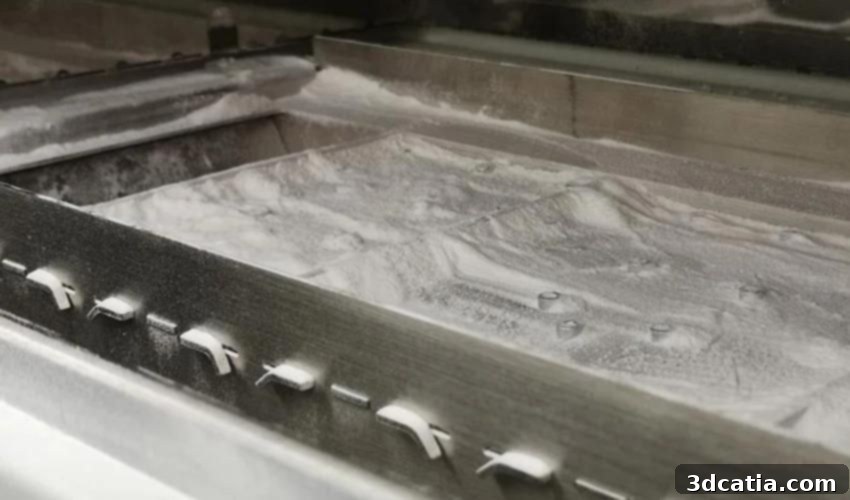
Unlocking New Possibilities: Sharebot SnowWhite2 Introduces Groundbreaking Multi-Material SLS 3D Printing
In a significant leap forward for additive manufacturing, Italian manufacturer Sharebot has unveiled a revolutionary update for its advanced Selective Laser Sintering (SLS) SnowWhite2 3D printer. This groundbreaking enhancement empowers users with the unprecedented ability to combine two distinct polymer powders within a single print job, opening up a new realm of design and functional possibilities. This development is particularly noteworthy within the selective laser sintering (SLS) landscape, where multi-material printing has historically been a formidable challenge. Sharebot’s innovation positions them as one of the pioneers in offering such a capability, poised to dismantle long-standing material constraints faced by professionals and manufacturers across various industries. The ability to intricately blend material properties during a single build cycle represents a paradigm shift, promising to accelerate innovation in product development and customization.
The SnowWhite2, first introduced two years ago as the next evolution of Sharebot’s SLS technology, was designed with a clear vision: to provide a compact, professional, and user-friendly turnkey 3D printing solution. It aimed to bridge the gap between large, expensive, and complex industrial SLS systems and the growing demand for accessible yet powerful additive manufacturing capabilities. With its modest yet efficient build volume of 100 x 100 x 100 mm, the SnowWhite2 has already earned acclaim for its reliability and versatility. Prior to this update, it offered compatibility with a range of high-performance polymer powders, including PA11, PA12, and TPU, enabling the production of durable and flexible components. The machine’s design emphasizes ease of integration into diverse professional environments, making advanced SLS technology more approachable for research institutions, design studios, and small to medium-sized enterprises (SMEs).
The SnowWhite2: A Compact Powerhouse for Professional SLS
Sharebot’s SnowWhite2 has carved a niche for itself as an ideal solution for professionals seeking to leverage the benefits of SLS 3D printing without the substantial investment and operational complexities associated with larger industrial-grade machines. Its compact footprint belies its robust capabilities, offering a professional-grade printing experience that is both intuitive and efficient. This makes it particularly attractive for rapid prototyping, functional part development, and small-batch production where precision and material performance are paramount. The system’s integrated design simplifies the entire SLS process, from pre-processing and printing to post-processing, making it an excellent choice for educational institutions and research facilities looking to explore advanced polymer additive manufacturing.
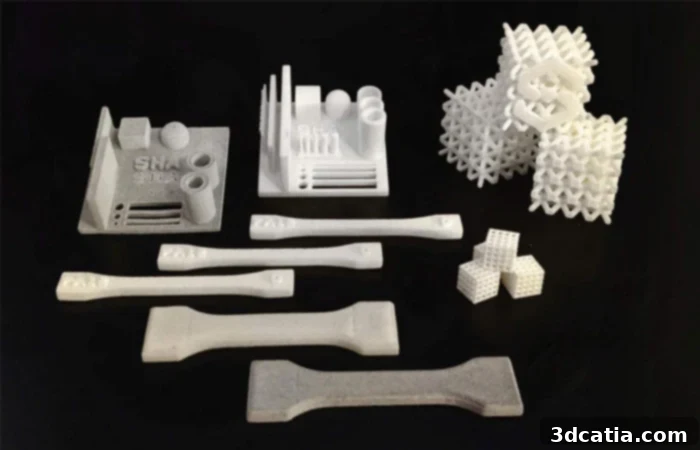
The SnowWhite2 3D printer is now enhanced with multi-material capabilities, compatible with PA12, PA11 and TPU (photo credits: Sharebot)
The versatility of the SnowWhite2 is further amplified by its material compatibility. With support for PA11, PA12, and TPU, users can produce parts ranging from rigid, strong components to highly flexible and elastic structures. PA11 and PA12 are renowned for their excellent mechanical properties, chemical resistance, and biocompatibility, making them suitable for demanding applications in automotive, aerospace, and medical fields. TPU, on the other hand, offers exceptional elasticity and impact absorption, ideal for seals, gaskets, and consumer products requiring flexibility. This diverse material palette, now augmented by the ability to combine these materials, positions the SnowWhite2 as a highly adaptable tool for a wide array of innovative projects.
The Multi-Material Breakthrough: A Game Changer for SLS
The newly released update elevates the SnowWhite2 from a versatile single-material SLS printer to a truly innovative multi-material platform. Users can now strategically integrate two different polymer powders within the same print job, enabling the creation of parts with varying material properties precisely where needed. This capability is particularly transformative in SLS, a technology where the homogeneous powder bed typically limits prints to a single material type. Sharebot’s official statement underscores the significance of this development: “With an update it is now possible to use two different materials for the creation of sintered objects (SLS). Researchers will now have the possibility to control both the movement of the recoater and of each single powder distribution tank through intuitive and easy-to-manage commands, so from today they will have the possibility to test and create multi-material objects in a simple and intuitive way.”
This level of granular control over the recoater’s movement and individual powder distribution tanks is central to the multi-material functionality. It implies sophisticated software and hardware integration that allows for precise deposition of different powders in specific areas of the build platform. For researchers and product developers, this translates into unprecedented freedom to experiment with complex geometries and functional integration. Imagine parts with rigid cores and flexible outer layers, or components with varying degrees of hardness, all produced in a single additive manufacturing process. Such capabilities are crucial for advancing material science, developing advanced prototypes, and creating highly customized end-use parts that meet very specific performance criteria, potentially eliminating the need for multi-part assemblies and subsequent joining operations.
Addressing the Challenges and Future Implications
While Sharebot’s multi-material SLS capability is undeniably exciting, the company has remained somewhat guarded about the finer details of its implementation. Several questions naturally arise as this technology makes its debut. For instance, the full extent of material compatibility between different polymer powders remains to be explicitly defined. While it is strongly implied that the currently supported PA11, PA12, and TPU will be combinable, further clarity on cross-compatibility with future materials would be valuable. The mechanics of powder distribution and, crucially, the post-processing stage, particularly de-powdering and separation of the two polymers, also present areas of inquiry. How effectively can the unused powders be separated and recycled for optimal refresh rates, especially when dealing with two distinct material types? Maintaining a high powder refresh rate is vital for cost-effectiveness and sustainability in SLS, and the ability to do so with mixed materials will be a key factor in the long-term viability and adoption of this technology.
These questions highlight the inherent complexities of multi-material SLS. The post-processing challenge, in particular, is significant. Current SLS workflows rely on the ability to easily recover and refresh unsintered powder for future builds. When two different materials are used in the same print, ensuring their effective separation for reuse without contamination is a technical hurdle that Sharebot must have addressed or is actively refining. The quality and purity of recycled powder directly impact the mechanical properties of subsequent prints. The industry will keenly observe how Sharebot’s solution manages these challenges, potentially setting new standards for efficiency in multi-material additive manufacturing.
Despite these unanswered questions, Sharebot’s proposition is highly compelling because multi-material printing has long been a major limitation in SLS. Historically, achieving parts with varying material properties usually required complex post-processing steps or entirely different manufacturing methods. Other innovators in the field, such as Aerosint, have also been actively developing sophisticated deposition processes to enable multi-material powder bed fusion, demonstrating the industry-wide demand for such solutions. Sharebot’s entry into this specialized domain signifies a maturing of SLS technology and a growing ability to overcome its traditional constraints. This advancement could unlock entirely new applications in fields requiring gradient materials, embedded functionalities, or multi-property components, ranging from advanced prosthetics to specialized industrial tooling. The potential for custom-designed objects with tailored mechanical, thermal, or electrical properties, manufactured in a single process, is immense.
Looking Ahead: The Impact on Additive Manufacturing
The introduction of multi-material capabilities on the Sharebot SnowWhite2 is more than just an incremental update; it represents a significant step towards the democratization of advanced additive manufacturing. By making such a sophisticated capability available on a compact, professional-grade system, Sharebot is empowering a broader range of users – from small businesses to academic researchers – to push the boundaries of what’s possible with 3D printing. We will be closely monitoring this exciting development, observing how the additive manufacturing market responds and how users leverage this newfound freedom in material combination. The innovation promises to accelerate research into new material compositions and functional prototypes, ultimately leading to more advanced, customized, and high-performance products across numerous sectors.
The ability to mix materials directly within the SLS process could revolutionize areas like biomedical engineering, where patient-specific implants might require zones with different stiffnesses or biocompatibility. In robotics, flexible hinges can be integrated directly into rigid robotic components. For consumer goods, aesthetic and tactile qualities can be enhanced through localized material changes. Sharebot’s initiative thus sets a new benchmark for accessible multi-material SLS, inviting a wave of creativity and engineering solutions that were previously impractical or impossible. The future of functional 3D printing is rapidly approaching, and Sharebot’s SnowWhite2 is now at the forefront of this exciting transformation. For those eager to delve deeper into the specifications and existing capabilities of the SnowWhite2 machine, further information can be found HERE.
What are your thoughts on this exciting multi-material SLS 3D printing advancement? We invite you to share your insights and predictions in a comment below or join the conversation on our Linkedin, Facebook, and Twitter pages! Don’t miss out on the latest advancements in additive manufacturing – sign up for our free weekly Newsletter here to receive top 3D printing news directly to your inbox! You can also explore all our compelling videos and content on our dedicated YouTube channel.
*Cover Photo Credits: Additive Manufacturing Germany GmbH & Co. KG