
Revolutionary Self-Healing 3D Printing Materials Promise Unprecedented Durability and Sustainability
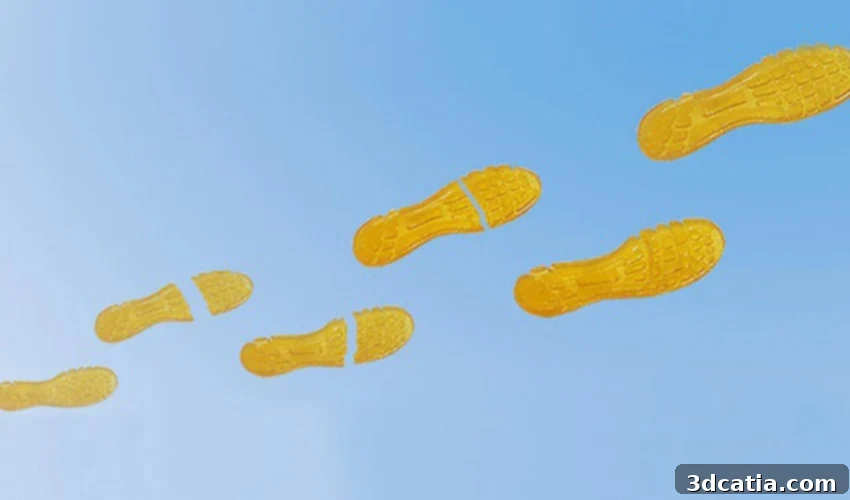
Researchers at the University of Southern California (USC), specifically at the Viterbi School of Engineering, have achieved a groundbreaking feat: developing a 3D printing material that possesses the remarkable ability to repair itself autonomously after experiencing fractures or punctures. This innovation represents a significant leap forward in material science, poised to transform numerous industries by extending product lifespans and reducing waste. These advanced materials hold immense potential across diverse sectors, including the footwear industry, critical components for tires, the rapidly evolving field of soft robotics, and even the intricate world of electronics. The primary objective behind this pioneering research is twofold: to significantly decrease manufacturing time while simultaneously increasing product durability and longevity, thereby paving the way for more sustainable and resilient engineering solutions.
The advent of self-healing materials addresses a critical need in modern manufacturing, where planned obsolescence and material fatigue contribute to substantial environmental waste and economic costs. By enabling products to mend themselves, this technology could drastically reduce the frequency of replacements, leading to a more circular economy. Imagine athletic shoes that repair sole damage after a strenuous run, or vehicle tires that seal punctures on the go, enhancing safety and reducing maintenance. Beyond consumer goods, the implications for complex machinery and critical infrastructure are profound, promising enhanced reliability and a reduced operational footprint. This breakthrough from USC embodies a vision where materials are not merely static components but dynamic entities capable of self-preservation, driving a paradigm shift in how we design, manufacture, and utilize products.
Balancing Printing Efficiency with Robust Self-Healing Behavior
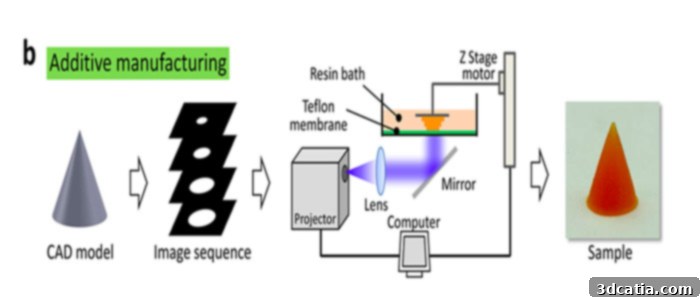
The innovative material developed by the USC team is manufactured using a cutting-edge 3D printing method known as photopolymerization. This sophisticated technique harnesses the power of light to precisely solidify a liquid resin into a desired three-dimensional object. Photopolymerization is a cornerstone of various additive manufacturing processes, including Stereolithography (SLA) and Digital Light Processing (DLP), offering high resolution and intricate detail. However, integrating self-repairing capabilities into these photopolymerizable resins presented a unique challenge. To imbue the printed objects with the ability to self-repair, the research team embarked on a meticulous quest to discover an optimal chemical composition for their resin.
The key to unlocking the material’s self-healing properties lay in the careful introduction of an oxidizer into the resin mixture. This oxidizer plays a crucial role in altering the molecular behavior of the materials, causing them to form part of a specialized group known as disulphides. Disulphide bonds are dynamic covalent bonds that possess the unique characteristic of being able to break and reform under specific conditions, which is fundamental to the self-healing mechanism. When a material containing these bonds is damaged, the disulphide bonds at the fracture interface can reconnect, effectively mending the material. This ingenious chemical manipulation allows the material to literally stitch itself back together at a molecular level, restoring its structural integrity and functionality.
The field of light-based 3D printing is rapidly advancing, with numerous universities and research institutions pushing the boundaries of what’s possible. We have previously highlighted a new 3D printing technique from the University of California, Berkeley, that also solidifies objects using precisely directed rays of light. The USC team’s method shares this fundamental principle, demonstrating a broader trend towards leveraging light for creating complex and functional materials. This convergence of chemical engineering and advanced manufacturing techniques is what makes such innovations possible, showcasing the interdisciplinary nature of modern scientific breakthroughs. The ability to precisely control material properties through light-driven processes opens up vast possibilities for customizing materials for specific applications, from micro-scale components to larger structural elements.
Paper: “Additive manufacturing of self-healing elastomers”, Asia Materials
Qiming Wang, an assistant professor at the University of Southern California and a leading researcher on this project, shed light on the delicate balance required for successful material development. He explained the inherent “competition” between the self-healing properties and the photopolymerization behavior. “When we gradually increase the oxidant, the self-healing behavior becomes stronger, but concurrently, the photopolymerization behavior becomes weaker,” Wang noted. This highlights a classic materials science dilemma: optimizing one desirable trait often comes at the expense of another. The team’s ingenuity lay in finding the precise equilibrium. Wang concluded, “There is a competition between these two behaviors. Eventually, we found the optimal ratio that can enable both high self-healing capabilities and a relatively rapid photopolymerization rate,” demonstrating the meticulous iterative process involved in advanced material discovery.
This delicate balance is crucial for practical applications. A material that heals perfectly but takes an impractically long time to print, or one that prints quickly but offers poor healing, would be of limited use. The USC team’s success in identifying this ‘sweet spot’ is what makes their innovation truly revolutionary. It means that products can be manufactured efficiently using established 3D printing techniques, and then benefit from an intrinsic ability to repair themselves, offering an unprecedented level of resilience. This dual achievement positions their self-healing elastomers at the forefront of smart material development, ready for integration into a wide array of products demanding both rapid production and extended functional life.
Demonstrating a Successful and Robust Self-Healing Method
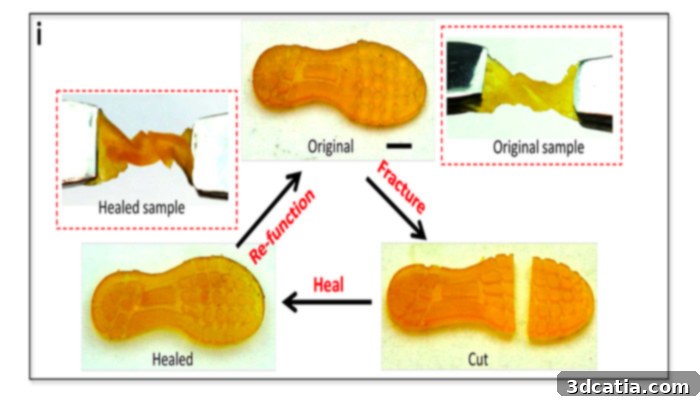
To thoroughly validate their breakthrough material, the research team conducted an extensive series of tests, fabricating a diverse range of objects using their unique self-healing resin. These test objects were carefully chosen to represent potential real-world applications and included a shoe pad, designed to endure repetitive mechanical stress; a soft robot, demonstrating the material’s flexibility and potential for intricate, dynamic systems; a multiphase composite, showcasing its ability to integrate different material properties; and an electronic sensor, highlighting its potential for functional and flexible electronics. This varied selection allowed the researchers to assess the material’s self-healing efficacy across different forms and functions, providing comprehensive data on its performance.
Following their successful printing, the team intentionally damaged these objects by cutting each of them in half. This critical step simulated real-world wear and tear, from accidental tears to structural fatigue. The damaged pieces were then placed under controlled conditions, specifically at 60°C (140°F), and observed over a period of approximately two hours. The results were nothing short of remarkable: most of the objects demonstrated complete self-healing within this timeframe. For instance, an object that initially took 20 minutes to print fully repaired itself within a comparable time scale, showcasing not only the efficiency of the healing process but also its practicality in scenarios where rapid recovery is essential. Crucially, the repaired pieces did not exhibit any significant loss of their original strength or functional integrity, a key indicator of successful and durable self-healing. This preservation of mechanical properties is vital, ensuring that the repaired items can continue to perform their intended functions effectively.
Paper: “Additive manufacturing of self-healing elastomers”, Asia Materials
Kunhao Yu, a structural engineering student and the first author of the study, further elaborated on the material’s impressive healing capabilities and its adaptability to varying environmental conditions. “We actually show that under different temperatures – from 40°C to 60°C – the material can heal to almost 100 per cent,” Yu stated. This finding is significant as it demonstrates the robustness of the self-healing mechanism across a practical temperature range. He added a critical insight: “By changing the temperature, we can manipulate the healing speed. Even under room temperature, the material can still self-heal.” The ability to accelerate healing through moderate heat offers a valuable tool for industrial applications, where controlled environments can be maintained. More importantly, the confirmation of self-healing at ambient temperatures makes the material highly versatile for consumer products and outdoor applications where external heating might not be feasible. This flexibility in healing conditions significantly broadens the potential applications of this innovative material, from consumer electronics to large-scale infrastructure components.
The success of this self-healing material has opened up exciting avenues for future research and development. The team is now actively engaged in expanding their portfolio of self-healable materials, aiming to develop versions with a wider spectrum of stiffness. This ambitious goal includes not only the current soft rubber-like elastomers but also more rigid-hard plastics. Achieving self-healing in harder materials presents a more complex challenge due to their different molecular structures and fracture mechanics, but the potential rewards are immense. Harder, self-healing materials could revolutionize industries requiring robust, long-lasting components. For instance, these materials could be critically useful for vehicle parts, where durability and safety are paramount, reducing the need for frequent replacements and improving vehicle longevity. They could also be integrated into advanced composite materials, enhancing their resilience and extend their functional life in demanding environments. Furthermore, applications in body armors and protective gear could lead to enhanced safety and performance, as the material could repair damage and maintain its protective integrity after impact, offering unprecedented levels of protection and lifespan. This ongoing research underscores a commitment to creating a new generation of materials that are not only stronger and lighter but also inherently more sustainable and resilient.
Transformative Applications and the Path to a Sustainable Future
The development of these self-healing 3D printable materials carries profound implications for a multitude of industries, promising not just extended product life but also significant advancements in safety, efficiency, and sustainability. In the footwear industry, imagine running shoes where micro-tears in the sole or upper material autonomously repair themselves, drastically increasing the lifespan of the shoe and reducing consumer waste. For tires, the ability to self-seal punctures or even small cracks could lead to safer vehicles, fewer roadside emergencies, and a considerable reduction in tire waste, contributing to both environmental preservation and consumer savings. This could transform the tire manufacturing sector by introducing “lifetime” tires that adapt and heal over time.
The impact on soft robotics is particularly exciting. Robots designed for delicate tasks or exploration in harsh environments often suffer damage, limiting their operational time. Self-healing soft robotic components could enable robots to repair themselves on the fly, increasing their autonomy and reliability in challenging applications like medical procedures, disaster relief, or deep-sea exploration. In the electronics industry, the integration of self-healing polymers could lead to truly flexible and durable devices. Wearable electronics, flexible displays, and even internal circuit boards could mend micro-cracks or damage from bending, significantly extending the life of gadgets and reducing electronic waste, which is a growing environmental concern.
Beyond these immediate applications, the potential extends to critical infrastructure and high-performance sectors. Self-healing materials could be used in aerospace components, reducing the need for costly and time-consuming repairs for micro-fractures caused by stress or environmental factors. They could also find applications in biomedical devices, where self-repairing implants or prosthetics could offer enhanced safety and longevity within the human body. The automotive industry stands to benefit greatly, with self-healing polymers used in interior components, exterior coatings, and even structural elements, leading to vehicles that are more resistant to wear and tear, reducing maintenance costs and extending vehicle lifespans.
The broader societal and economic benefits of this research cannot be overstated. By creating materials that can repair themselves, we are moving towards a truly circular economy, where products are designed for durability and longevity rather than planned obsolescence. This reduces the demand for raw materials, decreases manufacturing energy consumption, and minimizes the volume of waste sent to landfills. For consumers, it translates to products that last longer, saving money and offering greater value. For industries, it means reduced warranty claims, lower maintenance costs, and a smaller environmental footprint, enhancing corporate social responsibility and creating new market opportunities for sustainable products. While challenges remain in scaling production and further refining material properties, the USC team’s work represents a pivotal step towards a future where materials are intelligent, adaptive, and inherently sustainable.
Find out more about their research HERE.
What are your thoughts on this revolutionary new material and its potential to reshape various industries? We invite you to share your insights in a comment below or join the conversation on our Facebook and Twitter page! Don’t forget to sign up for our free weekly Newsletter, packed with all the latest news and advancements in 3D printing delivered straight to your inbox!