
Revolutionary Ice 3D Printing: Carnegie Mellon Pioneers Sacrificial Microstructures for Advanced Engineering
At Carnegie Mellon University in Pennsylvania, a team of pioneering engineering researchers has announced a groundbreaking achievement: the successful 3D printing of intricate microstructures made entirely from ice. This innovative technique is not an end in itself but serves a crucial purpose: these precisely fabricated ice structures are designed to function as sacrificial templates. By leveraging these temporary ice molds, scientists can create internal channels, conduits, and complex voids within larger components with unprecedented finesse and precision. The potential applications of this novel ice 3D printing process span critical fields such as biomedical engineering, advanced manufacturing, and even artistic creation, promising to revolutionize how complex internal geometries are integrated into designs.
While the world of additive manufacturing frequently highlights advancements in thermoplastics, metals, or composite materials, it is considerably rarer to encounter innovations that utilize something as fundamental and abundant as water as a primary printing material. The Carnegie Mellon researchers specifically chose water for its exceptional properties: its inherent biocompatibility makes it ideal for medical applications, and its unique ability to rapidly and cleanly transform into ice (and back again) offers distinct advantages for sacrificial templating. However, this choice was not without its hurdles. The team candidly faced numerous challenges in painstakingly defining the precise 3D printing parameters necessary to control the phase change and deposition of water with the required accuracy and repeatability, pushing the boundaries of what was thought possible in additive manufacturing.
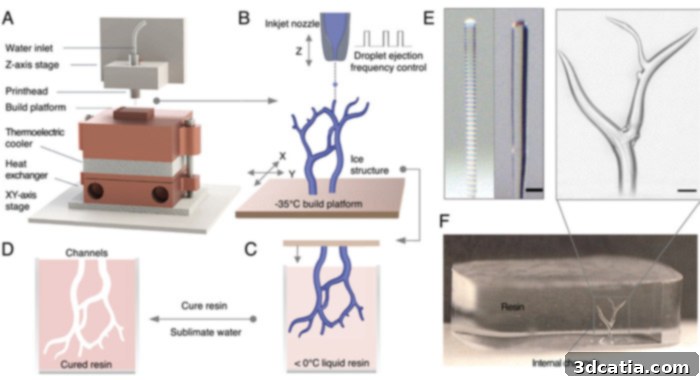
The innovative manufacturing method developed for ice 3D printing (photo credits: Carnegie Mellon University)
The Breakthrough Ice 3D Printing Process Explained
The pioneering ice 3D printing process was meticulously developed by Akash Garg, a dedicated PhD student in mechanical engineering, and Saigopalakrishna Yerneni, a postdoctoral associate specializing in chemical engineering. Their method centers on the precise deposition of microscopic water droplets onto an extremely cold build platform, maintained at a frigid -35°C. This critically low temperature ensures that each water droplet freezes almost instantaneously upon contact, forming solid ice structures layer by layer. The speed of this phase change is crucial for maintaining structural integrity during the printing process.
Achieving the desired level of precision and structural quality was an arduous journey of trial and error. The research team undertook multiple iterations, systematically adjusting various printing parameters. This included fine-tuning the exact printing trajectory of the nozzle, optimizing the speed at which the nozzle moved across the build platform, and precisely controlling the frequency of droplet deposition. Their relentless experimentation aimed to overcome inherent challenges, such as preventing premature freezing in the nozzle, managing ice crystal growth, and ensuring smooth adhesion between layers. Only after extensive optimization were they able to consistently create smooth, well-defined geometries with excellent structural integrity. A key advantage of their developed method is its ability to produce reproducible patterns, ensuring reliability for future applications.
A significant hurdle in many conventional 3D printing methods is the necessity for support structures, especially when dealing with overhangs or complex geometries. However, thanks to the rapid phase change of water into ice and the inherent rigidity and resistance of the resulting ice material, the Carnegie Mellon researchers found they could imagine and fabricate all kinds of intricate shapes without the need for additional supports. This support-free printing capability simplifies the process, reduces material waste, and is particularly beneficial when creating delicate microstructures where post-processing to remove supports would be challenging or damaging.
Microscale Marvels: Demonstrating Precision and Complexity with Ice 3D Printing
Following countless tests and meticulous parameter adjustments, the dedicated team successfully fabricated an array of complex shapes at an impressive microscopic scale. Among their notable creations were a miniature tree, a delicate propeller, and an intricately detailed octopus, all testament to the precision and control achieved by their novel ice 3D printing method. These examples demonstrate the capability to produce geometries that are both intricate and functional, even at such tiny dimensions.
Akash Garg, one of the lead developers, elaborated on the significance of these structures: “Using our 3D ice process, we can fabricate microscale ice templates with incredibly smooth walls and complex branched structures that feature seamless transitions. This capability is critical because these perfectly formed ice templates can subsequently be used to fabricate microscale parts with exquisitely well-defined internal voids and channels. The smoothness of the ice template directly translates to the smoothness of the final internal features, which is paramount for many advanced applications.” This ability to control internal architecture with such high fidelity opens doors to designing and manufacturing components with previously unattainable levels of internal complexity and functionality.
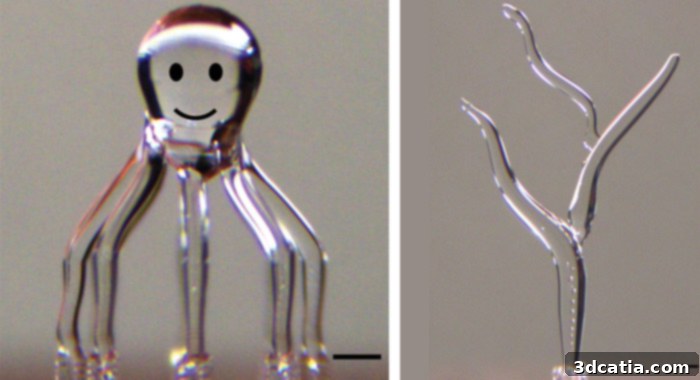
Examples of incredibly detailed 3D printed ice structures (photo credits: Carnegie Mellon University)
Inside-Out Printing: Leveraging Ice as a Sacrificial Template
The core innovation behind this research lies in using these delicate ice structures not as final products, but as “sacrificial templates” for designing and manufacturing more complex and functional final parts. The researchers aptly term this approach “inside out” printing or reverse molding, a methodology that flips the traditional additive manufacturing paradigm. Instead of building the final structure directly, they first create the negative space (the channels) out of ice, then fill around it to form the positive. This technique is particularly powerful for creating intricate internal features that would be impossible to achieve with conventional molding or even most other 3D printing methods.
Once the precise ice template is 3D printed and ready, the next step involves immersing or bathing these structures in a liquid or gel of a chilled structural material. This material could be a biocompatible resin for medical devices, a specialized polymer for microfluidics, or even a precursor for advanced manufacturing applications. The chilled environment helps maintain the integrity of the ice template while the structural material is applied. After the chosen material has successfully hardened or cured around the ice template, the sacrificial ice can then be easily and cleanly removed from the newly formed part. This removal can be achieved through two primary methods: simply melting the ice into water, which can then be drained away, or by turning it directly into water vapor through sublimation. Both methods offer an incredibly clean and residue-free removal process after molding, which is a significant advantage over other sacrificial materials that might leave behind chemical traces or require harsh solvents. The result is the creation of incredibly smooth, accurate, and perfectly defined internal channels, precisely matching the original ice template’s geometry.
Transformative Applications Across Biomedical Engineering, Advanced Manufacturing, and Beyond
The implications of this ice 3D printing technology are vast and far-reaching, promising to revolutionize several high-demand fields. In **biomedical engineering**, the ability to create complex, smooth-walled internal channels with such precision is a game-changer. It could enable the fabrication of highly realistic tissue scaffolds that mimic the body’s natural vascular networks, essential for developing artificial organs, organ-on-a-chip devices for drug testing, and advanced regenerative medicine applications. The biocompatibility of water ensures that no toxic residues are left behind, which is critical for medical implants and devices that will interact with living tissues.
For **advanced manufacturing**, this technique offers an unprecedented approach to integrate internal complexities into components. Imagine lightweight structures with optimized internal cooling channels for aerospace applications, or intricate fluid pathways within heat exchangers for enhanced thermal performance. The method allows for the creation of customized molds with internal features that were previously impossible to achieve, opening up new possibilities for casting and injection molding processes where complex internal voids are desired. Industries requiring high-performance parts with integrated functionalities will benefit immensely from this capability.
The team concludes, “We believe this approach has enormous potential to revolutionize tissue engineering and other fields, where miniature structures with complex channels are demanded, such as for microfluidics and soft-robotics.” This statement highlights two other critical areas. In **microfluidics**, precise internal channels are the fundamental building blocks for controlling and manipulating tiny volumes of fluids, crucial for lab-on-a-chip devices, chemical analysis, and diagnostic tools. For **soft robotics**, the ability to embed intricate pneumatic or hydraulic networks directly into flexible materials could lead to robots with more agile movements, sensitive grippers, and enhanced functionality, mimicking biological systems. Beyond these functional applications, the ability to rapidly produce complex ice structures could also find niche uses in art for temporary installations or educational models, demonstrating complex geometries in an accessible and intriguing medium.
This innovative research from Carnegie Mellon University marks a significant stride in additive manufacturing, demonstrating that even the most common materials can yield revolutionary results when approached with ingenuity. The purity and clean removal of ice as a sacrificial material present a compelling alternative to existing methods, paving the way for a new generation of microscale devices and complex internal architectures. You can find more information about this fascinating ice 3D printing process and the research team’s work HERE.
What are your thoughts on using water as a printing material for such advanced applications? Do you envision other potential uses for this groundbreaking ice 3D printing technique? Let us know your insights and comments below, or engage with us on ourLinkedIn,Facebook, andTwitter pages! Don’t forget to sign up for our free weeklyNewsletter here, ensuring you receive the latest 3D printing news straight to your inbox! You can also find all our compelling videos and demonstrations on ourYouTube channel.
*Cover Photo Credits: Prime Time PBC