

Revolutionizing Rider Safety: Custom Motorcycle Helmets Through Advanced 3D Scanning Technology
The pursuit of unparalleled safety and optimal performance in high-stakes motorcycling competitions has led to innovative applications of cutting-edge technology. A crucial question resonating within the industry asks: can 3D scanning technology fundamentally enhance the construction and design of helmets for motorcyclists? This very inquiry is at the heart of pioneering research conducted at the Prototyping Laboratory of the Miguel Hernández University Science Park (PCUMH), strategically located in Elche, Spain. Thanks to remarkable advancements in metrology and 3D scanning, the once complex task of achieving perfect helmet fit has become significantly more accessible and precise. For the second consecutive year, PCUMH has solidified its commitment to innovation by renewing its pivotal collaboration agreement with MT Helmets, a globally recognized brand dedicated to developing state-of-the-art motorcycle equipment. This enduring partnership harnesses the power of advanced 3D scanning solutions, enabling teams in elite Moto 2 and Moto 3-class competitions to adapt helmet models with unprecedented accuracy. The result is the creation of truly custom helmets, meticulously designed and individually adapted to the unique morphology of each rider’s head, thereby promising a new era of safety, comfort, and performance on the track.
Modern technological advancements are continually pushing the boundaries of vehicle development, and the motorcycle industry is no exception. This rapid progression is largely attributable to the immense advantages offered by technologies that facilitate the creation of customized models, especially those with intricate geometries like the human head. Beyond 3D scanning, 3D printing also plays a transformative role in this sector, having been integrated into numerous automotive applications. Leading companies such as Porsche, BMW, and General Motors have already embraced additive manufacturing methods within their assembly lines and R&D processes, demonstrating the widespread adoption and proven benefits of these digital fabrication techniques. In the context of the Moto 2 and Moto 3 research, however, 3D scanning emerges as the primary catalyst. This sophisticated process enables the acquisition of highly accurate, granular data, which then serves as the indispensable foundation for engineering and manufacturing truly customized helmets. The ability to capture every nuance of a rider’s head shape ensures that the final product is not merely a good fit, but an extension of the rider themselves, maximizing protection and minimizing distractions.
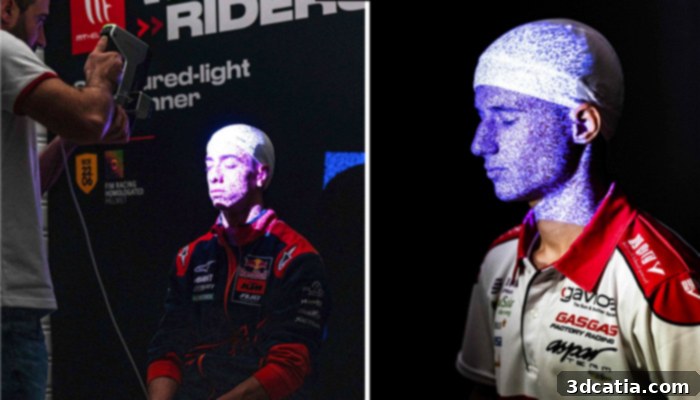
The process of 3D scanning the riders’ heads (Image credits: PCUMH)
The genesis of this groundbreaking project can be traced back to Álvaro Alhama, a distinguished engineer and the head of the PCUMH Prototyping Laboratory. His journey led him to Cheste, the vibrant town set to host a major motorcycling competition, where the crucial work of data acquisition unfolded. Utilizing an advanced 3D scanning solution based on white structured light technology, Alhama spearheaded a comprehensive digitization process. Structured light scanning offers exceptional precision and speed, projecting patterns onto an object and capturing their distortion with cameras to create a highly accurate digital 3D model. This non-contact method is ideal for delicate or complex surfaces, ensuring the rider’s comfort and safety during the data capture phase. Once the initial scanning was complete, the raw data underwent a rigorous digital polishing and cleaning process. This critical post-processing step removes any anomalies, noise, or extraneous data, ensuring that the final 3D model is an exact, high-fidelity reproduction of the riders’ precise head measurements and unique anatomical contours. This digital twin of each rider’s head became the blueprint for MT Helmets, who then leveraged these exact models to manufacture a special series of custom-designed helmets. Each helmet was meticulously crafted to individual specifications, providing an unprecedented level of personalized fit. A notable and immediate benefit observed from the deployment of these customized helmets has been a significant reduction in the vibrations experienced by competitors, particularly when they push their machines to extreme speeds. This reduction not only enhances comfort but also directly contributes to improved rider concentration and reduced fatigue during intense races, offering a competitive edge and elevating safety standards.
Álvaro Alhama emphasizes that the substantial improvement in ergonomics delivered by these custom helmets extends far beyond mere comfort for the riders. This enhanced ergonomic design translates directly into a heightened feeling of safety, empowering riders with increased confidence and allowing for a deeper level of focus on the track. In competitive motorcycling, even the slightest discomfort or distraction can have profound consequences, impacting reaction times and overall performance. A perfectly fitted helmet eliminates pressure points, reduces helmet shift during sudden movements, and optimizes airflow, all contributing to a rider who is more connected to their machine and less concerned with their equipment. While this specific project primarily leveraged 3D scanning for data acquisition, the fundamental benefits of tailor-made customization are also extensively realized through other advanced manufacturing technologies, notably additive manufacturing (3D printing). Imagine using 3D printing to create custom internal padding with varying densities, optimized ventilation channels, or even lightweight, personalized helmet components that perfectly complement the 3D scanned head data. This symbiotic relationship between scanning for precise data capture and printing for bespoke physical creation opens up even greater possibilities for future helmet development. The synergy between PCUMH’s profound technical expertise and MT Helmets’ forward-thinking, innovative vision is clearly laying robust foundations. This collaboration is not only shaping the future of custom design within the competitive motorcycling world but also demonstrating the successful and transformative application of 3D technology across a diverse array of industries. From sports equipment to medical devices and consumer goods, the principles of precise digital measurement and customized manufacturing hold immense potential. It now remains to be seen what other groundbreaking projects will emerge, capitalizing on these exciting new technologies, both on the thrilling racetrack and in broader applications that demand precision, personalization, and peak performance. This partnership serves as a powerful testament to what can be achieved when academic research meets industrial innovation, driving progress and setting new benchmarks for rider safety and ergonomic excellence. For those interested in delving deeper, more information about this remarkable project is available in Spanish on the PCUMH website HERE.
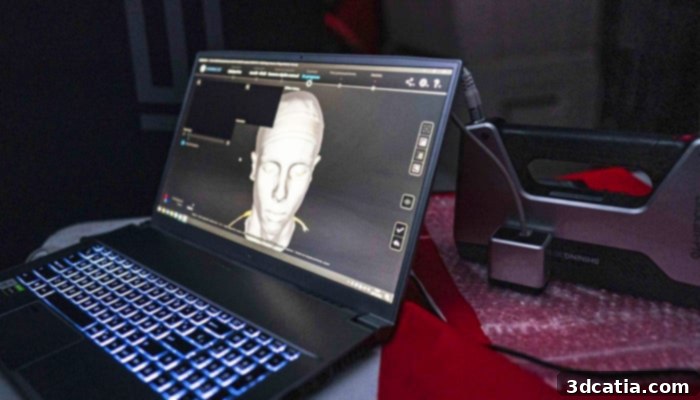
The 3D head model after scanning. (Image credits: PCUMH)
What are your thoughts on the transformative potential of using 3D scanning technology to create custom helmets, especially in high-performance sports? We invite you to share your insights and opinions in a comment below or join the conversation on our LinkedIn, Facebook, and Twitter pages! Don’t miss out on the latest advancements and news in the world of additive manufacturing and 3D technologies; be sure to sign up for our free weekly Newsletter here, delivering the freshest 3D printing news straight to your inbox! Additionally, you can explore all our engaging videos and content on our dedicated YouTube channel.
*Cover photo credits: Motociclismo / Sport Life Ibérica