
Revolutionizing Architecture: How 3D Printing is Shaping Sustainable Design in Saudi Arabia
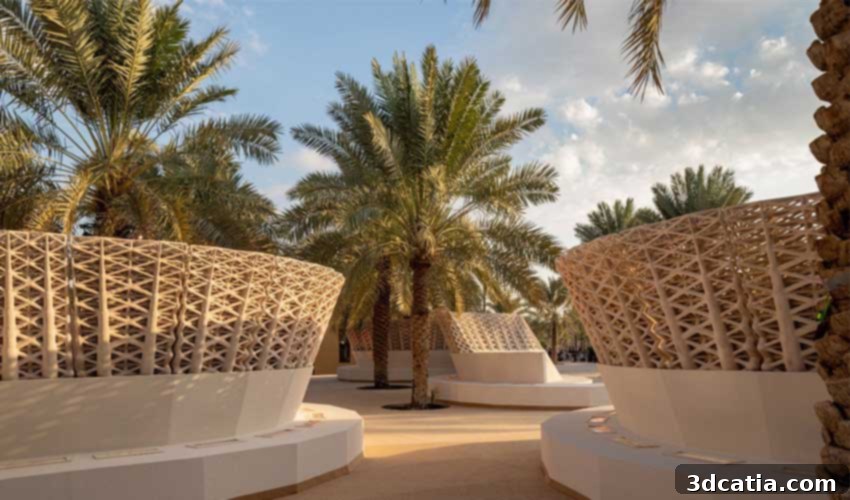
The world of architecture is in a constant state of flux, perpetually evolving to meet new demands for aesthetics, functionality, and, increasingly, sustainability. In this dynamic landscape, 3D printing technologies have emerged as transformative tools, empowering architects and designers to envision and construct projects previously deemed impossible. This additive manufacturing revolution is particularly evident in Saudi Arabia, a nation committed to ambitious future-forward initiatives. Here, two acclaimed architectural design studios, Precht and Mamou-Mani Architects, have leveraged the power of 3D printing to create a pair of groundbreaking, sustainable installations: “Sandwaves” and “Pixel Gate.” These projects not only showcase the immense design freedom offered by digital fabrication but also highlight a responsible approach to resource utilization and environmental impact, setting a new benchmark for innovative construction in the region.
The global architectural community is increasingly recognizing the potential of 3D printing to address some of the most pressing challenges of our time, from housing shortages to the need for eco-conscious building practices. By allowing for the precise deposition of materials layer by layer, additive manufacturing minimizes waste, optimizes material usage, and facilitates the creation of intricate, organic forms that are often impractical or prohibitively expensive with conventional construction methods. Precht and Mamou-Mani, known for their experimental and ecologically minded designs, have masterfully harnessed these advantages to deliver structures that are both visually captivating and environmentally sound, perfectly aligning with Saudi Arabia’s progressive Vision 2030 goals.
Sandwaves: A Ribbon of Local Resources
The first of these remarkable installations, “Sandwaves,” is a striking, ribbon-like structure that redefines the concept of street furniture. Commissioned for the Diriyah Season, an international festival celebrating sports and entertainment in Saudi Arabia, Sandwaves was ingeniously 3D printed directly from sand, bound with furan resin. The choice of sand as the primary building material was not merely aesthetic; it was a deeply considered decision rooted in sustainability and local resourcefulness. Saudi Arabia, being a desert nation, possesses an abundant supply of sand. Utilizing this readily available local material significantly reduces the environmental footprint associated with transportation and extraction of materials from distant sources, a common issue in traditional construction supply chains.
Chris Precht, co-founder of Precht, articulates this philosophy succinctly: “We believe that responsibility starts locally and uses regional resources to create visionary projects. The Sandwaves are an example of responsible innovation that can have a positive impact on the future of our built environment.” This statement underscores the core principle behind the project: leveraging the unique characteristics of a region to inform sustainable design solutions. By transforming a ubiquitous natural resource into functional and artistic street furniture, Sandwaves serves as a tangible example of how innovative design and additive manufacturing can contribute to a circular economy and responsible resource management.
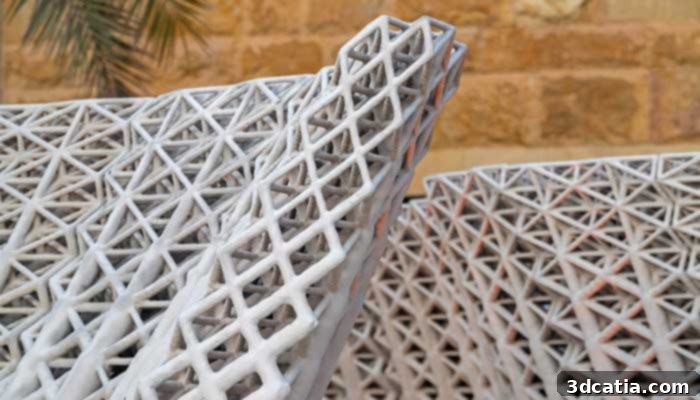
Sandwaves was created from 58 individual 3D printed elements, showcasing modular construction. | Photo via Precht/Mamou-Mani
The Intricate Process Behind Sandwaves
A closer examination of the Sandwaves’ production process reveals the sophistication of modern 3D printing and parametric design. The continuous ribbon structure was not printed as a single monolithic piece, but rather meticulously crafted from 58 individual, intricately designed 3D printed elements. This modular approach offered several advantages, including ease of manufacturing, transportability, and simplified on-site assembly. To achieve the optimal structural integrity and aesthetic flow, Precht and Mamou-Mani Architects collaborated closely with engineers at Format, specialists in structural design and digital fabrication.
The unique properties of sand – particularly its inherent granular nature and relatively low tensile strength – posed significant design challenges. To ensure the durability and resistance of the final structure, parametric design tools were indispensable. These advanced computational design techniques allowed the team to generate and optimize the precise shape, curvature, and thickness of each individual piece. By feeding various parameters into the software, engineers could iteratively test and refine designs to achieve the best balance of material efficiency, structural soundness, and aesthetic appeal. The result was a design where each element, weighing approximately 160 kg, was robust enough to withstand public interaction and environmental conditions. The individual components were produced on an ExOne printer, a leading industrial system known for its binder jetting capabilities for sand and other granular materials. Binder jetting is particularly well-suited for large-format architectural components, offering high throughput and the ability to produce complex geometries without the need for support structures, further minimizing material waste and post-processing efforts.
Pixel Gate: Bioplastics and Modular Innovation
In stark contrast to the earthly composition of Sandwaves, the “Pixel Gate” installation embraces another facet of sustainable design: bioplastics. This striking structure was 3D printed using compostable PLA (Polylactic Acid). The use of PLA demonstrates the studios’ ongoing commitment to exploring diverse eco-friendly materials in their architectural endeavors. This isn’t the first time Precht and Mamou-Mani Architects have ventured into large-scale PLA 3D printing; in 2019, they captivated audiences with “Conifera,” a monumental installation that similarly utilized this biodegradable material, establishing a precedent for their innovative use of bioplastics in public spaces.
Pixel Gate shares a distinct conceptual lineage with Conifera, both projects being characterized by their modular construction and distinctive aesthetic. It is composed of numerous interlocking modular blocks, affectionately termed ‘bio-bricks’ by the designers. This assembly method generates a unique pixelated appearance, which is not merely an aesthetic choice but a result of “optimized material distribution.” By strategically designing each bio-brick, the architects achieved a delicate balance between structural integrity and material efficiency. This thoughtful approach minimizes the amount of material required for each module while maximizing its contribution to the overall form, lending itself to a lightweight yet robust structure. The pixelated effect further enhances the visual interest of the gate, creating a dynamic interplay of light and shadow that changes with the viewer’s perspective and time of day.
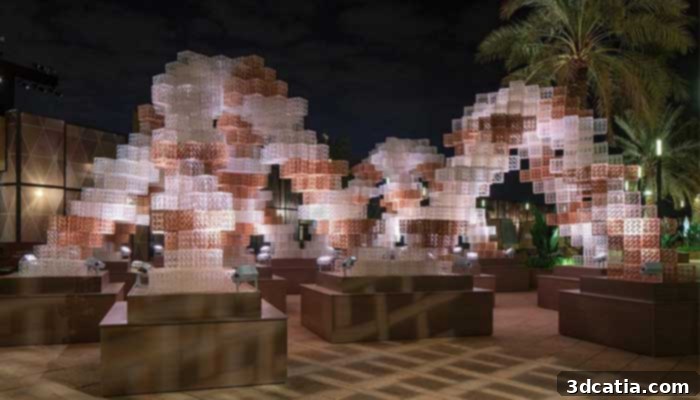
Pixel Gate was 3D printed using compostable PLA bio-bricks. | Photo via Precht/Mamou-Mani.
3D Printing: Unleashing Unprecedented Design Freedom
Both Sandwaves and Pixel Gate serve as powerful testaments to the unparalleled design freedom achievable with 3D printing technologies, especially when compared to conventional manufacturing techniques. Traditional construction often relies on standardized components and rectilinear forms, limited by the constraints of molds, cutting, and assembly methods. Additive manufacturing, however, liberates designers from these restrictions, allowing for the creation of complex, organic, and non-standard geometries with relative ease. This ability to produce bespoke, intricate forms opens up entirely new aesthetic possibilities, enabling architects to translate their most imaginative concepts into tangible structures without compromising on structural performance or material efficiency. From the undulating curves of Sandwaves to the intricate interlocking bio-bricks of Pixel Gate, these installations exemplify how digital fabrication can push the boundaries of architectural expression.
While the technology is still some distance from routinely producing entirely 3D printed multi-story buildings, its progression is remarkably rapid. The advancements in materials science, printer size, and software capabilities are constantly expanding the horizons of what’s possible. Furthermore, the inherent sustainability benefits of construction 3D printing are becoming increasingly evident. These include significant reductions in material waste, as components are built up layer by layer with minimal offcuts; the potential for localized production, which cuts down on transportation emissions; and the ability to utilize unconventional or recycled materials, as demonstrated by the use of sand and compostable PLA in these projects. The future of architecture is undeniably moving towards more efficient, customizable, and environmentally conscious methods, with 3D printing at its forefront.
Saudi Arabia’s Vision 2030 and the Future of 3D Printed Construction
Saudi Arabia, in particular, has become a fertile ground for such innovative projects. The nation’s ambitious Vision 2030 mandate includes a strong commitment to technological advancement, economic diversification, and sustainable urban development. Within this framework, numerous initiatives have been undertaken to push the limits of design and construction, with a keen interest in adopting advanced manufacturing techniques like 3D printing. The scale of this ambition is staggering: the country has pledged to build over 1.5 million private-sector homes over the next ten years. Fulfilling such a monumental housing demand requires not just traditional methods but also groundbreaking solutions that can accelerate construction, reduce costs, and enhance sustainability. 3D printing, with its speed, efficiency, and flexibility, is being seriously explored as a vital component in achieving these audacious goals, promising a future where homes can be rapidly constructed using locally sourced, often recycled materials.
The projects by Precht and Mamou-Mani serve as excellent case studies for the broader application of 3D printing within Saudi Arabia’s burgeoning construction sector. They illustrate how additive manufacturing can contribute not only to public art and temporary installations but also lay the groundwork for more permanent, sustainable, and rapidly deployable building solutions. By fostering an environment that encourages architectural experimentation and the adoption of cutting-edge technologies, Saudi Arabia is positioning itself as a leader in the global shift towards smarter, more sustainable, and digitally driven construction practices.
“We believe that true innovation builds upon the achievements of the past. Innovation looks at history, learns from it and reinvents it for our future demands,” concludes Chris Precht, perfectly encapsulating the philosophy that drives these forward-thinking architectural practices. By combining ancient wisdom with cutting-edge technology, Precht and Mamou-Mani are not just designing structures; they are crafting a vision for a more sustainable and imaginative built environment. These projects offer valuable insights into how 3D printing in architecture is evolving, making sustainable design more accessible and creative. You can find more information on the innovative work of Precht and Mamou-Mani. What do you think of these pioneering 3D printed installations and their impact on sustainable architecture? We invite you to share your thoughts in a comment below or join the conversation on our Facebook and Twitter pages. Don’t forget to sign up for our free weekly Newsletter to stay updated on the latest trends and innovations in 3D printing!