
Transforming Manufacturing: The Power of Robotic Arms in Large-Format 3D Printing
The landscape of additive manufacturing is continuously evolving, with a significant trend emerging towards large-format 3D printing as the technology industrializes. While traditional large-scale machines, particularly those utilizing Fused Deposition Modeling (FDM), certainly play a role, robotic arms are increasingly recognized for their unparalleled advantages. These sophisticated systems offer not only an extended reach for creating impressively large parts but also provide enhanced freedom of movement thanks to their multiple axes. A notable benefit is the ability to often produce parts that require minimal, if any, support structures, streamlining post-processing and reducing material waste. Though the core robotic arms are manufactured by a select group of industry leaders, their versatility has led to widespread adaptation by numerous 3D printing manufacturers, resulting in innovative solutions for both polymer and metal additive manufacturing. This article delves into the current market offerings, exploring both the original robotic arm manufacturers and the specialized third-party companies that harness their power to push the boundaries of large-format 3D printing.
Pioneering Robotic Arm Manufacturers for Additive Manufacturing
At the heart of many advanced robotic 3D printing systems are the industrial robots supplied by global automation giants. These companies provide the foundational hardware, known for its precision, reliability, and robust design, which is then integrated and customized for additive manufacturing applications. Their extensive experience in diverse industrial sectors makes them ideal partners for the demanding environment of 3D printing.
KUKA: A Leader in Industrial Automation
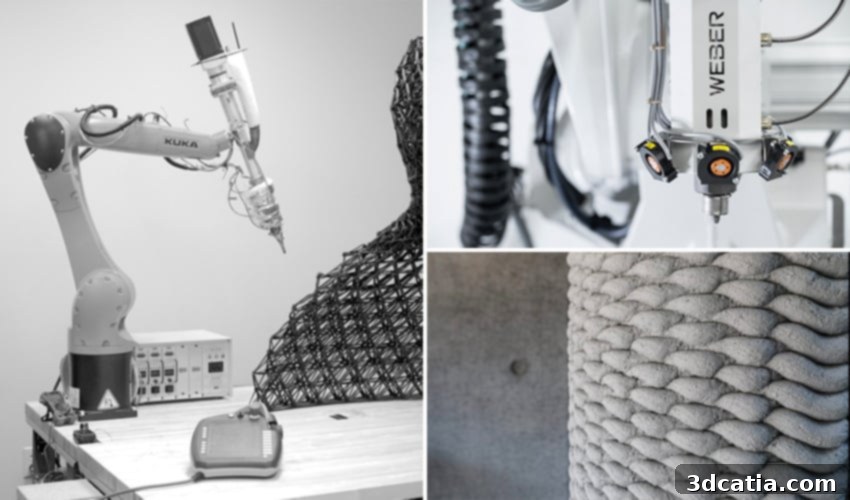
The German engineering powerhouse, KUKA, stands as an undisputed leader in the global automation market. Their advanced robots are instrumental across a multitude of industries, including electronics, automotive, and healthcare, where they consistently simplify and optimize complex manufacturing processes. It is therefore no surprise that KUKA’s versatile solutions have found a significant niche in additive manufacturing. From designing intricate metal components to large-scale plastic structures and even monumental concrete parts, KUKA robots are a prevalent choice for industrial 3D printing systems. A prime example is their KR QUANTEC line of robotic arms, renowned for its impressive specifications. These machines boast a substantial reach, typically ranging from 2,671 mm to an expansive 3,904 mm, coupled with a robust load capacity of 120 to 300 kilograms. This combination of extended reach and high payload makes them exceptionally well-suited for handling heavy extruders and maneuvering across vast build areas, essential for true large-format additive manufacturing. Their precision and reliability ensure consistent results, making KUKA an invaluable partner for 3D printing innovators.
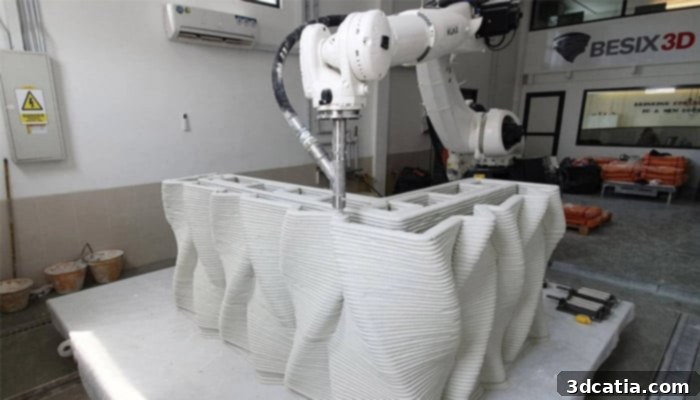
The KR QUANTEC arm was equipped with a nozzle to extrude concrete for the Besix3D company (photo credits: KUKA)
ABB: Innovating for Robotic 3D Printing Solutions
The ABB Group is a renowned multinational corporation with a comprehensive portfolio of industrial robotic arms, many of which are specifically adapted for advanced 3D printing applications. Their diverse range of industrial robots caters to a broad spectrum of consumer and industrial needs, offering flexible solutions for various manufacturing challenges. A key enabler of their success in additive manufacturing is RobotStudio®, widely recognized as the world’s most popular offline programming and simulation tool for robotic applications. This powerful software allows users to design, simulate, and fine-tune robotic movements and processes virtually, optimizing workflows and dramatically increasing productivity before any physical operation begins. According to ABB, this solution unlocks unparalleled flexibility, enabling businesses to elevate their operational efficiency and innovation capabilities. Users even have the unique opportunity to design and customize robots to meet their specific requirements, particularly for highly specialized additive manufacturing processes. As we will explore further in this list, ABB’s advanced six-axis industrial robots are leveraged by pioneering companies such as Massive Dimension, which focuses on sustainable development within the evolving 3D printing industry. This demonstrates ABB’s commitment to fostering innovation and providing robust, adaptable solutions for the future of manufacturing.
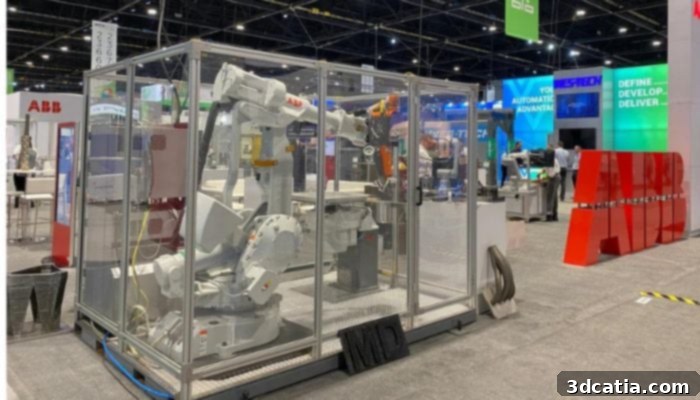
Massive Dimension and ABB Additive Manufacturing Demonstration at IMTS 2022. (Photo credit: Massive Dimension)
Comau: Italian Excellence in Robotics and Automation
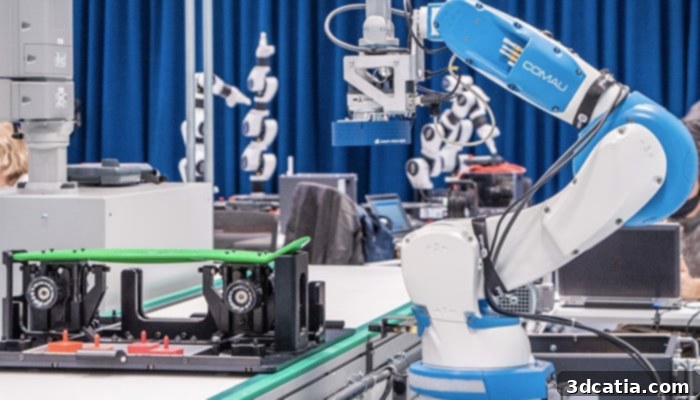
Comau is an esteemed Italian company celebrated for its expertise in industrial automation and robotics. Dedicated to advancing manufacturing through cutting-edge solutions, Comau develops systems, products, and services that are fully compatible with the principles of Industry 4.0. Their extensive product portfolio includes a comprehensive family of robots, featuring a wide array of robotic arm solutions designed for various industrial applications. Since its inception in 1978, Comau has been at the forefront of manufacturing these sophisticated machines, with the strategic objective of integrating and enhancing innovative applications across all industrial sectors. Their robotic arms are diverse, varying significantly in their payload capacities, allowing them to handle a broad range of tools and materials essential for additive manufacturing. Crucially, Comau’s robots leverage state-of-the-art Internet of Things (IoT) and Artificial Intelligence (AI) technologies, enabling them to operate with a high degree of autonomy and intelligence. This intelligent operation contributes to greater efficiency, adaptability, and precision in robotic 3D printing processes, making Comau a pivotal provider for companies looking to implement advanced, automated manufacturing solutions.
Third-Party Innovators: Leveraging Robotic Arms for Advanced 3D Printing
Beyond the manufacturers of the robotic arms themselves, a vibrant ecosystem of third-party companies has emerged, specializing in integrating these powerful systems with advanced extruders and software to create bespoke 3D printing solutions. These innovators are pushing the boundaries of what’s possible in large-format additive manufacturing, addressing specific industry needs and material challenges.
CEAD: Combining Printing and Milling for Large-Scale AM
CEAD, a pioneering Dutch company based in Delft, is at the forefront of developing large-scale 3D printers that offer unparalleled versatility. What truly distinguishes CEAD is its innovative approach to robot-based solutions, which seamlessly integrate both additive manufacturing (printing) and CNC milling processes within a single workflow. This hybrid capability allows for the creation of complex geometries with superior surface finishes, removing the need for separate machines and multiple setups. One of their flagship offerings is the AM Flexbot, a robust robot-based solution explicitly designed for large-scale 3D printing. A key technological aspect of the AM Flexbot is its control system, which utilizes Siemens Sinumerik controllers to precisely manage the Comau robotic arm. This integration means that a dedicated robot controller is not required, simplifying the overall system architecture. The powerful Siemens controller is capable of simultaneously managing up to 31 axes, ensuring incredibly precise and dynamic movement along its entire path. Furthermore, the AM Flexbot’s modular design allows for extensive customization and expansion with additional functions, such as rotary tables, supplementary robots, or other production processes like further CNC milling. This flexibility makes CEAD’s solutions a perfect choice for businesses seeking a highly customized, multi-functional additive manufacturing system tailored to specific, demanding applications.
Weber Additive: The DXR Series for Precision Robotic 3D Printing
The German company Weber Additive is renowned for its dedication to developing diverse and advanced manufacturing technologies, with a strong focus on robotic arm solutions for industrial 3D printing. Their flagship DXR robotic system is a testament to this commitment, featuring a high-quality, purpose-built extruder designed for optimal 3D printing performance. This advanced extruder is meticulously powered by a 6-axis industrial robot, enabling exceptionally precise and fluid movement throughout the build volume. Weber Additive strategically bases its robotic arm solutions on those from the established manufacturer KUKA, ensuring a foundation of reliability and proven performance. These KUKA arms are then intricately adapted with Weber’s AE series extruders, specifically tailored to meet the unique needs and application demands of their customers, consistently delivering optimal results. The DXR systems offer a plethora of advantages, including true 3D printing with 6-axis kinematics, which allows for intricate part creation and greater design freedom. Furthermore, the variable angle of the manufacturing head and the capability for overprinting on existing parts open up new possibilities for repairs, modifications, and the creation of hybrid structures. Weber Additive’s integrated solutions provide a robust platform for companies seeking high-precision, flexible, and efficient robotic 3D printing capabilities across various materials and applications.
Hyperion Robotics: Sustainable Construction through Robotic AM
Founded in 2019 in Helsinki, Hyperion Robotics is an innovative company specializing in the construction industry, leveraging additive manufacturing to create more affordable, sustainable, and automated structures. Their mission is to revolutionize traditional construction methods by embracing the efficiencies and design possibilities of robotic 3D printing. To achieve this, Hyperion Robotics strategically relies on robust KUKA industrial robots, onto which they integrate their proprietary extruder system. This system is capable of precisely depositing Hyperion Robotics’ unique material – a special concrete mix that significantly reduces the amount of cement required by incorporating recycled waste components. This commitment to using sustainable materials aligns perfectly with their goal of making the construction market more environmentally friendly. Moreover, Hyperion Robotics has developed its own sophisticated software platform, which provides universal compatibility, allowing it to interface seamlessly with any industrial robot. This software enables advanced control and optimization of the printing process, ensuring high-quality and consistent results. In terms of practical applications, the Finnish company has already successfully constructed a diverse range of projects, including intricate decorative elements, complex structures designed to imitate natural coral reefs, and critical energy infrastructures. Their work demonstrates the immense potential of robotic additive manufacturing to transform construction into a more efficient, sustainable, and automated industry.
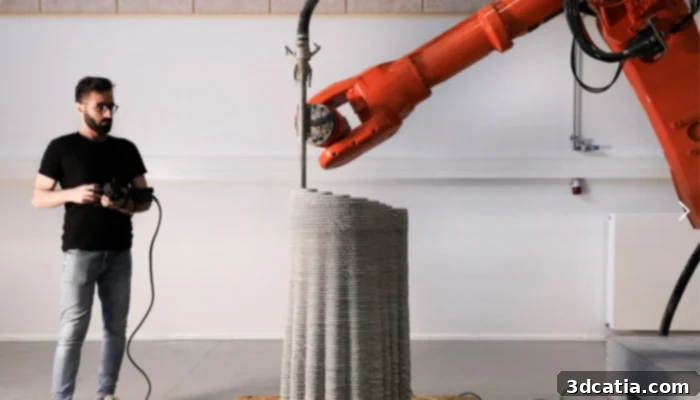
Photo credits: Hyperion Robotics
Massive Dimension: Large-Format Polymer Extrusion with ABB Robots
As their name aptly suggests, Massive Dimension is a specialist manufacturer focused on large-format 3D extruders and comprehensive printing solutions, including integrated, turnkey robotic printing cells. The company was founded with a clear vision: to contribute significantly to sustainable manufacturing solutions by actively reducing waste on our planet. Currently, Massive Dimension’s advanced solutions are primarily centered around large-scale polymer pellet 3D printing, a method known for its cost-effectiveness and material versatility. For their sophisticated robotic cells, they incorporate high-performance six-axis industrial robotic arms supplied by ABB, a testament to the reliability and precision of ABB’s automation technology. When these robust robotic arms are paired with ABB’s specialized 3D Printing Powerpac software, users gain access to an incredibly comprehensive and streamlined workflow specifically optimized for pellet 3D printing. Massive Dimension highlights that their robotic arms have been meticulously custom-tailored for the demands of robotic printing, particularly for large-format applications, offering an impressive typical build volume of 3ft x 5ft x 5ft. This substantial capacity enables the production of truly enormous parts that would be impossible with conventional FDM machines. Moreover, these advanced robotic cells are designed with customization in mind, allowing them to be further adapted to perfectly fit the unique operational requirements and individual needs of each user, offering unparalleled flexibility in large-scale additive manufacturing.
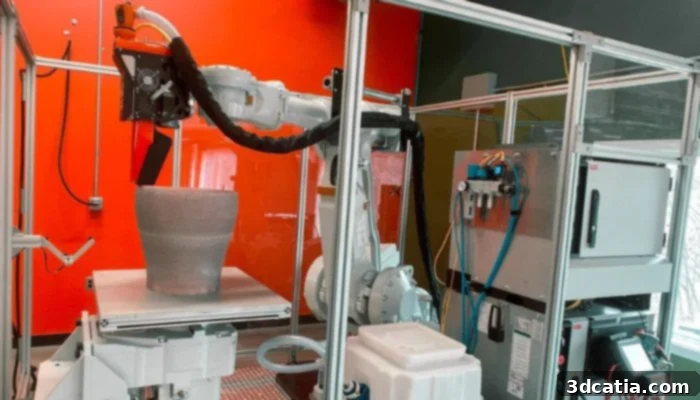
Massive Dimension
Orbital Composites: The Orbital S for Industrial-Scale Robotic 3D Printing
Orbital Composites is driven by an ambitious goal: to fundamentally disrupt the traditional 3D printing industry. The company firmly believes that advanced robotics offers the definitive answer to many persistent limitations faced by the industry, including issues of scale, speed, structural strength, and design complexity. To directly address these critical challenges, Orbital Composites introduced the Orbital S, which they proudly position as the first robotic 3D printer specifically engineered for true industrial scale applications. This impressive robotic system boasts remarkable technical specifications designed for high performance. It achieves a maximum printing speed of 2 meters per second, enabling rapid production cycles, and offers a maximum payload capacity of 10 kg, allowing for the use of robust extruders and heavier materials. With a maximum reach of 1.1 meters, it provides ample workspace for a wide range of parts. The build platform measures a generous 1m x 1m x 1m, granting the capability to create relatively large, high-quality end-use parts. Furthermore, the Orbital S provides users with a flexible choice of materials, expanding its application potential. At its core, the system utilizes the highly reliable KUKA KR10 R1100 robot arm, a choice reinforced by KUKA being an official partner of Orbital Composites. This partnership underscores the commitment to integrating proven, high-performance robotic technology into their innovative 3D printing solutions.
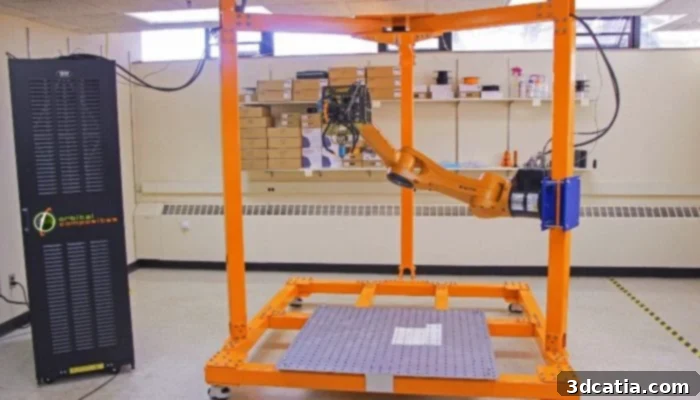
Orbital Composites’ Orbital S robotic 3D printer. Photo Credit: Orbital Composites
Dyze Design and Pulsar: High-Speed Pellet Extrusion for Robotics
Pulsar, developed by Dyze Design, represents a cutting-edge, large-scale, and high-speed plastic pellet extruder engineered with a singular, critical objective: to enable the 3D printing of expansive parts as quickly and cost-effectively as possible. This advanced extruder is meticulously designed for seamless compatibility with industrial robotic arms, making it an ideal component for large-format additive manufacturing systems. The Pulsar is capable of an impressive material output, producing up to 500 mm³/s, which translates to approximately 2.5 kg per hour, facilitating rapid fabrication of substantial objects. Its versatility extends to accommodating a wide range of large nozzle sizes, from 1.00 mm up to 5.00 mm, allowing for varying levels of detail and print speeds. Furthermore, the Pulsar is engineered to operate reliably under diverse and challenging environmental conditions. It incorporates a sophisticated water cooling loop that actively maintains the entire system at a consistent operating temperature, preventing overheating during prolonged use. With the addition of an optional heat shield, the Pulsar can even withstand ambient environments up to 200°C. This robust thermal management makes the machine compatible with high-performance engineering plastic materials that require elevated processing temperatures, such as PEEK, Ultem, and PSU, expanding the possibilities for demanding industrial applications.
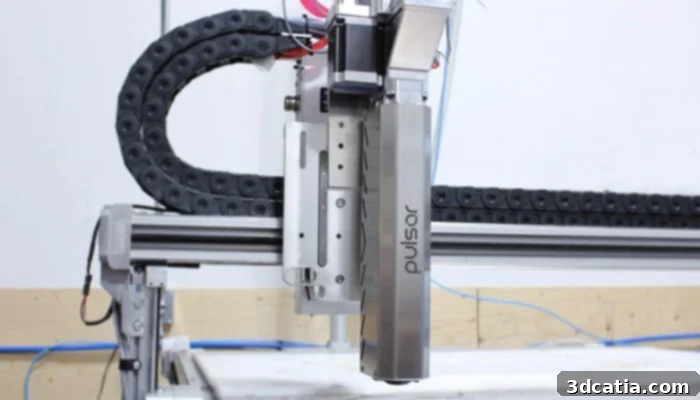
Branch Technology: Architectural Innovation with Freeform 3D Printing
Branch Technology is a visionary company that masterfully combines the power of large-scale additive manufacturing, advanced prefabrication techniques, and cutting-edge digital technology to revolutionize architectural and construction design. Through their patented “Freeform 3D printing” technology, they empower a new generation of designers and architects to conceptualize, compose, and ultimately construct structures that were previously deemed impossible with conventional building methods. An exemplary project showcasing their capabilities is the construction of an iconic 3D printed pavilion, where they extensively utilized KUKA robotic technology. The synergistic combination of KUKA robots with Branch Technology’s unique 3D printing process proved to be a game-changer. It not only enabled the successful fabrication of the final structure but also deeply integrated into the entire design process, from initial conceptualization to final realization, in collaboration with architects and designers from the Gould Turnes Group. This advanced 3D printing application, powered by KUKA robots, offers significant advantages: it facilitates the production of incredibly precise, remarkably lightweight, and highly cost-effective components from a diverse array of materials. This approach dramatically reduces material waste, accelerates construction timelines, and opens up unprecedented architectural freedom, demonstrating the transformative potential of robotic AM in shaping our built environment.
MX3D: Pioneering Large-Scale Metal WAAM with ABB Robots
For anyone interested in the advancements of Wire Arc Additive Manufacturing (WAAM) technology, MX3D is a name that almost certainly resonates. This innovative Dutch company garnered significant international attention for its groundbreaking achievement: the creation of an entirely 3D printed, fully functional metal bridge, which proudly stands in the heart of Amsterdam. This remarkable feat, alongside numerous other large-scale metal 3D printing accomplishments, has solidified MX3D’s reputation as a leader in industrial additive manufacturing across various sectors. Central to their impressive solutions are sophisticated robotic arms. More specifically, MX3D leverages an advanced 8-axis ABB industrial robotics system within its M1 metal Additive Manufacturing system. This highly articulate robotic setup enables the precise and efficient creation of medium to large-scale metal parts, offering unmatched flexibility in geometry and size. To further streamline the entire process, MX3D also provides MetalXL, a proprietary software platform specifically designed to control their WAAM-based systems. MetalXL ensures that every part is manufactured precisely as intended, providing comprehensive control over every stage, from initial design and simulation through meticulous monitoring during the actual printing process. This integrated approach guarantees accuracy, repeatability, and high-quality results for demanding metal additive manufacturing applications.
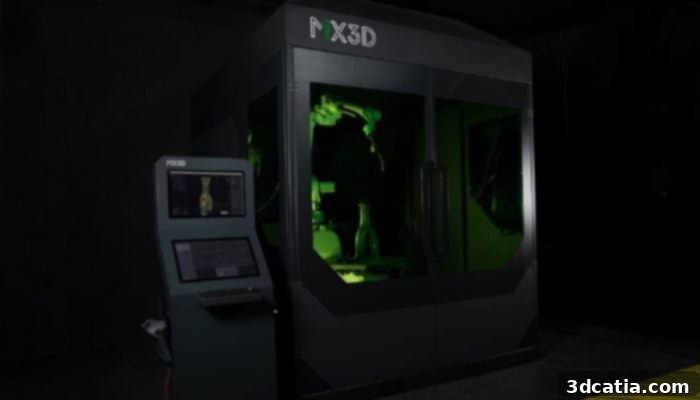
MX3D printer
Continuous Composites: Advanced Fiber 3D Printing for Space Applications
Continuous Composites is an innovative company making significant strides in advanced materials and manufacturing. They recently received a prestigious selection from NASA to develop low coefficient of thermal expansion (CTE) open isogrid composite structures, specifically for demanding space applications. This critical project utilizes their patented Continuous Fiber 3D Printing (CF3D) technology, a revolutionary approach that combines high-performing composite materials with rapid-curing thermoset resins. The CF3D printer is designed to demonstrate exceptional capability in producing high-quality and consistent prints, characterized by outstanding accuracy and precision – vital attributes for aerospace components. A key advantage of their system is its inherent configurability and scalability, meaning it can be readily adapted to projects of widely varying dimensions and complexities. For the crucial robotic arm component of their advanced printing system, Continuous Composites turned to Comau, recognizing the Italian company’s reputation for robust and precise industrial robots. This strategic partnership underscores the importance of reliable robotic platforms in pushing the boundaries of continuous fiber additive manufacturing, enabling the creation of lightweight, strong, and thermally stable structures for the next generation of space exploration and other high-performance applications.
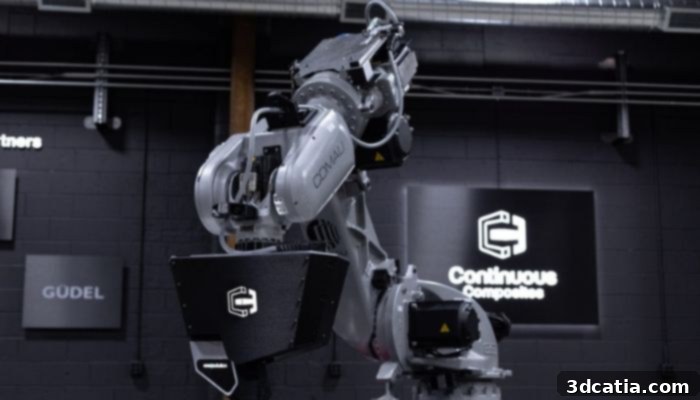
A robotic 3D printer with Comau arm capable of producing thermoset objects with continuous carbon fiber (Photo credit: Continuous Composites)
The rapid adoption of robotic arms in additive manufacturing highlights a transformative shift towards more flexible, scalable, and automated production. From foundational robotic arm manufacturers like KUKA, ABB, and Comau, to specialized integrators such as CEAD, Weber Additive, Hyperion Robotics, Massive Dimension, Orbital Composites, Dyze Design (Pulsar), Branch Technology, MX3D, and Continuous Composites, the industry is continually innovating. These collaborations are enabling the creation of larger, more complex, and more functional parts across diverse materials like polymers, metals, and concrete, pushing the boundaries of what 3D printing can achieve. The future of large-format additive manufacturing is undoubtedly robotic, promising unprecedented design freedom, efficiency, and sustainability.
What are your thoughts on these innovative solutions in robotic 3D printing? Did we miss any groundbreaking technologies or companies you believe deserve a mention? We’d love to hear your insights! Please share your comments below or engage with us on our LinkedIn, Facebook, and Twitter pages. Don’t forget to sign up for our free weekly Newsletter here to get the latest 3D printing news delivered straight to your inbox! You can also find all our compelling videos on our YouTube channel.