
Revolutionary 3D Printed Amphibious Prosthetic: “The Fin” Redefines Mobility for Amputees
In a remarkable testament to the power of innovation and the transformative capabilities of additive manufacturing, Northwell Health has unveiled a pioneering medical device poised to significantly enhance the lives of individuals with limb loss. Named “The Fin,” this groundbreaking 3D-printed prosthetic represents one of the world’s first prosthetics specifically engineered to facilitate seamless transitions between land and water environments. This significant breakthrough offers unprecedented freedom and ease for amputees, empowering them to engage in athletic pursuits and daily activities that were once incredibly challenging or even deemed impossible. The development of “The Fin” not only highlights the immense potential of 3D printing in personalized healthcare solutions but also underscores a profound commitment to improving the quality of life, fostering greater independence, and promoting inclusion in sports and recreational activities for those living with prosthetics.
The Genesis of Innovation: A Personal Journey Inspires “The Fin”
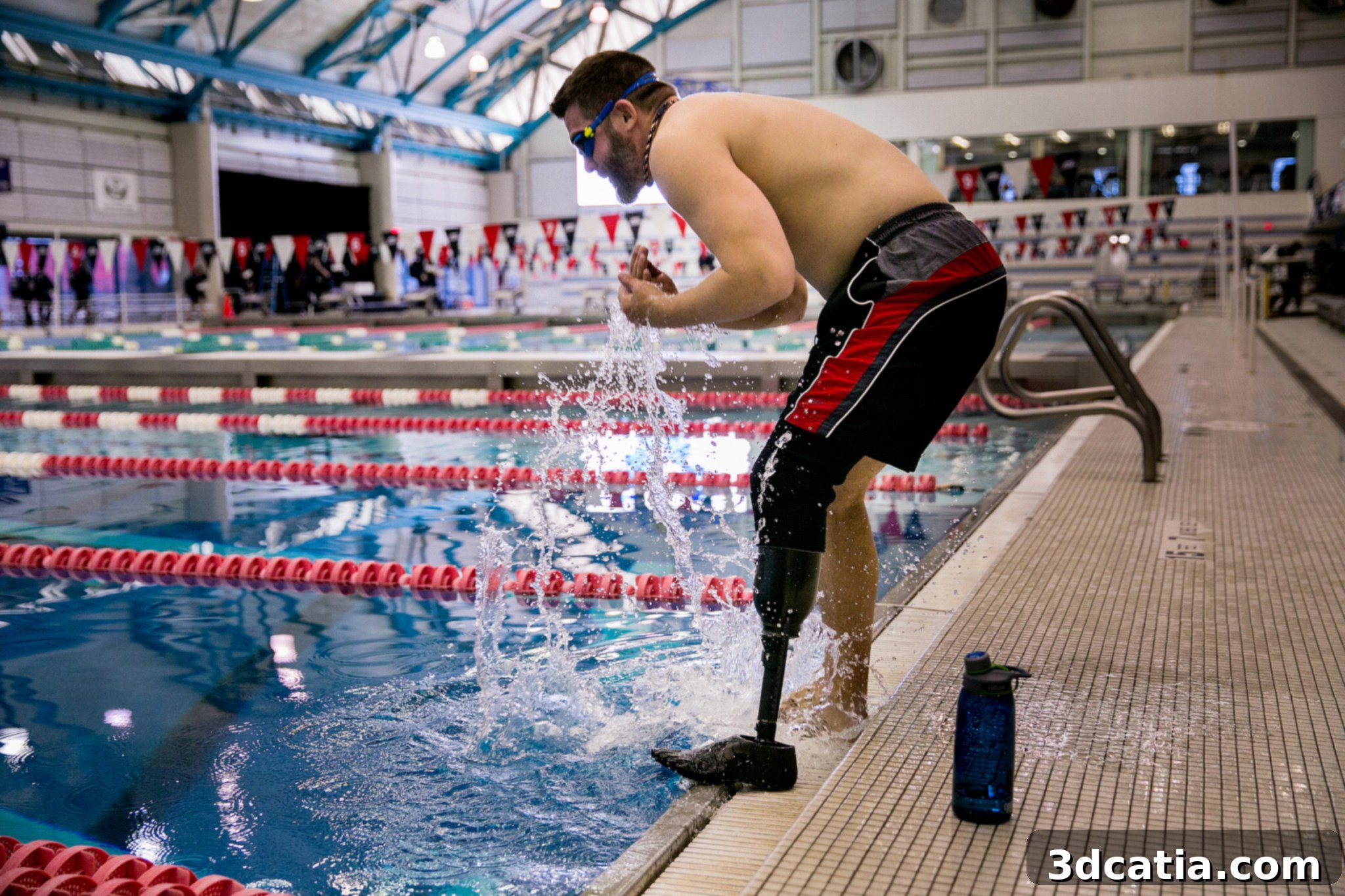
The inception of “The Fin” was not merely a theoretical concept; its design was profoundly influenced by a very real and deeply personal need, specifically tailored for Mr. Dan Lasko of Pennsylvania. Mr. Lasko, a distinguished retired U.S. military veteran, bravely served his country but tragically lost his leg during a tour of duty in Afghanistan. As an inherently active and athletic man, he subsequently faced considerable limitations when attempting to participate in many of the physical activities he cherished. Among these, swimming presented a particularly significant hurdle. Before the advent of “The Fin,” Mr. Lasko relied almost exclusively on his upper body strength to propel himself through the water, an arduous and often frustrating experience that greatly diminished his enjoyment and full participation in aquatic environments. His personal experiences and desire to regain full recreational capabilities served as a powerful catalyst for the dedicated team at Northwell Health, driving them to engineer an innovative solution that would directly address these daily challenges and restore a sense of normalcy, joy, and athletic prowess to his life.
Dan Lasko and his new amphibious prosthetic leg, “The Fin.”
Engineering Excellence: The Innovative Design and Materials Behind “The Fin”
“The Fin” distinguishes itself through its remarkably intelligent and user-centric design, meticulously crafted to facilitate effortless movement between diverse environments. This cutting-edge device is a 3D-printed, triangular attachment that seamlessly integrates with an amputee’s existing running or walking prosthetic, affixing securely to the calf portion. Its distinctive shape is far more than an aesthetic choice; it is precisely engineered for optimal hydrodynamic performance, mimicking natural aquatic forms. A critical design feature involves strategically placed holes incorporated throughout its structure. These perforations allow water to pass through the device with minimal resistance, effectively reducing drag and transforming what was once a cumbersome struggle into a smooth, efficient propulsion mechanism in aquatic settings. This innovative approach means users can now move through water with greater speed, less exertion, and significantly enhanced comfort, greatly enriching their swimming and other water-based activities.
The judicious selection of materials for “The Fin” is equally pivotal to its groundbreaking functionality and durability. The prosthetic is constructed from a robust combination of high-performance Nylon and Carbon Fiber, materials renowned for their exceptional properties. Nylon provides excellent flexibility, impact resistance, and a degree of inherent buoyancy, while Carbon Fiber is highly regarded for its superior strength-to-weight ratio, rendering the device incredibly strong yet remarkably lightweight. These advanced materials combine to make “The Fin” not only completely waterproof and corrosion-resistant but also robust enough to comfortably support the full weight and dynamic movements of the user, even during strenuous athletic activities. The utilization of advanced 3D printing technology was absolutely indispensable in bringing this complex and customized design to life. Additive manufacturing allowed Northwell Health to create intricate geometries and internal structures that would be incredibly difficult, if not impossible, to achieve with traditional manufacturing methods. Furthermore, it enabled rapid prototyping and iterative design improvements, ensuring that the final product was perfectly tailored to meet the specific biomechanical needs and preferences of the wearer, truly embodying the principles of personalized medicine and prosthetic innovation.
A New Lease on Life: The Profound Impact of “The Fin”
The impact of “The Fin” on Mr. Dan Lasko’s life has been nothing short of transformative, providing him with a profound sense of liberation and restored ability. Reflecting on this monumental change, Mr. Lasko shared his immense gratitude and excitement: “The Fin has greatly improved my quality of life and allows me to return to my love of swimming. I recently got back in the pool with my two young sons and for the first time I was able to dive into the pool with them.” This powerful statement encapsulates the true essence of this innovation – it transcends mere functionality; it’s about restoring fundamental human experiences, connections, and the simple, priceless joy of fatherhood. For Dan, the ability to dive into a pool and actively participate with his children represents an invaluable moment, a seemingly everyday pleasure that was previously unattainable and deeply missed.
Beyond individual anecdotes, the broader implications of “The Fin” are immense for the amputee community worldwide. This revolutionary amphibious prosthetic promises to significantly enhance the overall quality of life by dismantling barriers to participation in water-based activities, which are often highly beneficial for physical therapy, recreation, mental well-being, and social interaction. It empowers amputees to fully embrace activities such as swimming, surfing, paddleboarding, kayaking, or simply enjoying a day at the beach with family and friends without the cumbersome and time-consuming necessity of changing prosthetics. The psychological benefits are equally profound, fostering greater confidence, independence, and a renewed sense of possibility and self-worth. This innovation serves as a powerful beacon of hope, vividly demonstrating how advanced technology, particularly 3D printing, can directly contribute to greater social inclusion and athletic freedom for individuals with limb loss, opening doors to adaptive sports and active lifestyles that were once considered beyond reach.
An up close look at “The Fin” prosthetic, showcasing its design.
Availability, Cost, and Future Prospects of Amphibious Prosthetics
While Mr. Lasko was fortunate to receive “The Fin” at no cost – a gesture that truly underscores Northwell Health’s unwavering commitment to veterans and pioneering research – the device is not yet widely available to the general public. Current projections suggest a waiting period of at least another six months before its commercial release. This crucial period allows for further refinement, comprehensive testing, and the establishment of robust, scalable manufacturing processes necessary to meet anticipated demand. When “The Fin” does become commercially available, the estimated cost is expected to range between $2,000 and $5,000. This price variation will largely depend on the specific levels of customization required for each individual user, as 3D printing allows for precise tailoring to ensure an optimal fit, maximum comfort, and peak performance. Compared to some highly advanced bionic prosthetics, this price point positions “The Fin” as a relatively accessible yet highly specialized solution for amphibious mobility, making it a viable and attractive option for a broader demographic of amputees seeking to significantly enhance their active lifestyles.
The future of amphibious prosthetics, powerfully exemplified by “The Fin,” looks incredibly promising and is ripe for further innovation. This pioneering device sets a new benchmark in prosthetic design, moving far beyond basic functionality to specifically address and cater to diverse lifestyle needs. The inherent flexibility and precision of integrating 3D printing technology allows for continuous evolution, with the tangible potential for even lighter, stronger, and more intricately customizable designs in the foreseeable future. As 3D printing technology continues to advance and production scales, it is fervently hoped that the manufacturing cost will become even more accessible, ultimately bringing these life-changing devices to a wider global audience. Northwell Health’s groundbreaking work with “The Fin” serves as a profound inspiration, actively challenging the medical and engineering communities to continue pushing the boundaries of what is possible in modern prosthetic care and adaptive technology. For more detailed information on “The Fin” and the inspiring story behind its development, interested readers are encouraged to explore Northwell Health’s dedicated initiative, The Return.
What are your thoughts on this revolutionary 3D-printed amphibious prosthetic? Do you believe innovations like “The Fin” will significantly improve the quality of life, independence, and accessibility for amputees around the world, particularly in vital areas like adaptive sports, recreational activities, and everyday living? We invite you to share your valuable insights and opinions in the comments section below. Don’t forget to join the ongoing conversation and follow us on Facebook and Twitter to stay updated on the very latest advancements in 3D printing, medical technology, and adaptive solutions!