
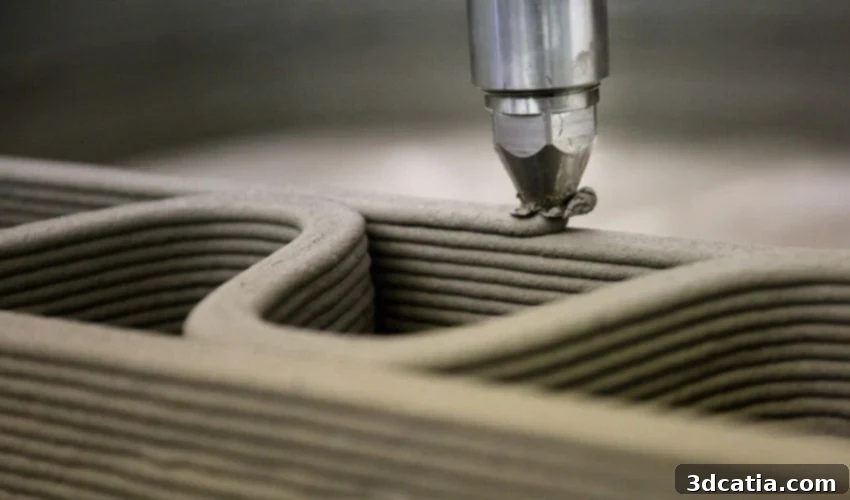
The Future of Construction: Revolutionizing Building with 3D Printing Technologies
The landscape of the construction industry is undergoing a profound transformation, driven by the advent of 3D printing technology. What began as a pioneering academic endeavor in 2004 has rapidly evolved into a viable and increasingly adopted method for constructing everything from entire houses to intricate architectural components. Professor Behrokh Khoshnevis of the University of South Carolina is widely credited with initiating this revolution, attempting the first 3D printed wall. His groundbreaking work involved developing an FDM 3D printer, uniquely adapted and mounted on a robotic arm, designed to extrude layers of concrete instead of conventional plastic filaments, thereby creating a large-scale 3D model. This innovative approach laid the foundation for what is now known as Contour Crafting, a method that promises to reshape how we build, offering the astonishing possibility of constructing a complete house in as little as 20 hours.
Contour Crafting technology swiftly demonstrated its immense potential for integrating additive manufacturing into traditional construction sites. Its inherent advantages are numerous and compelling: a significant reduction in construction costs and material waste, dramatically increased building speeds, enhanced worker safety due to reduced manual labor and on-site risks, the unprecedented ability to create complex and organic architectural forms, and greater design flexibility. Professor Khoshnevis’s discovery unequivocally marked the dawn of 3D printing in the construction sector. While its adoption is still nascent compared to more established industries like aeronautics or medical device manufacturing, the pace of innovation and market growth indicates a swift convergence with mainstream building practices.
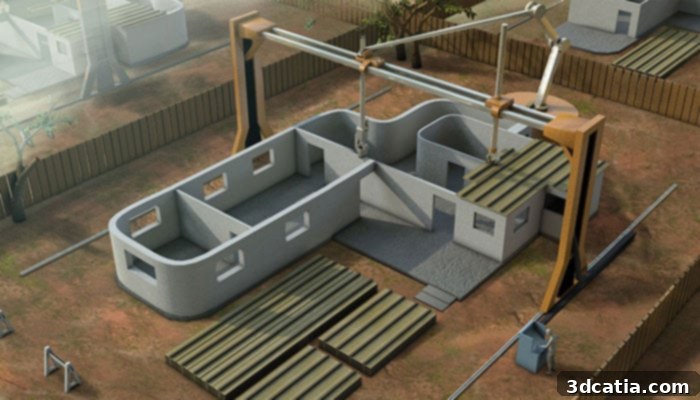
Large-scale, industrial concrete printers can create whole house structures autonomously, signaling a new era in rapid construction.
Leading construction giants and visionary startups alike are rapidly recognizing the transformative potential of 3D technologies and their undeniable impact on the future of building. The market for concrete 3D printing, a key segment of this innovation, is experiencing exponential growth, with projections estimating it to reach $56.4 million in 2021 and continue its upward trajectory. This enthusiasm is well-founded, as an increasing number of companies are entering the sector, pioneering new and often audacious projects. Some initiatives verge on the futuristic, while others are tangibly impacting the present, such as Apis Cor’s remarkable 3D printed house, completed in just 24 hours. 3D concrete printing is a rapidly evolving field, leveraging diverse technologies and materials to offer a myriad of benefits to its users. However, it’s crucial to acknowledge that this technology is still in its nascent stages, bound by current limitations in material science, regulatory frameworks, and scaling capabilities, presenting both exciting opportunities and challenges for future development.
What 3D Printing Processes Are Used in the Construction Sector?
1 – Robotic Arm Extruders: The Foundation of Additive Construction
The Contour Crafting method, pioneered by Professor Khoshnevis, is a prime example of robotic arm extrusion. This process involves the precise deposition of building material, typically a specialized concrete mix, layer by layer to create a large-scale 3D model with an impressively smooth surface finish. To guide the robotic arm with extreme accuracy, rails are often installed around the construction site, serving as a structural framework. The robotic arm then traverses these rails, moving back and forth to extrude the concrete in continuous layers, progressively building the structure from the ground up. To ensure the structural integrity and aesthetic quality of the model, trowels are strategically placed on the side and above the nozzle. These tools flatten the freshly extruded layers, removing imperfections and ensuring a consistent, strong bond between layers.
A critical aspect of this process is the material science involved. Conventional concrete, designed for traditional pouring methods, cannot be used due to its slow hardening properties. If standard concrete were 3D printed, subsequent layers would be deposited on still-wet material, causing the structure to collapse under its own weight. Therefore, specialized concrete mixes with rapid setting properties are essential. These fast-curing formulations allow each layer to gain sufficient strength quickly, providing a stable foundation for the next layer and enabling the continuous, autonomous construction that defines this technology.
While Contour Crafting (the company sharing the method’s name) maintains a discreet profile regarding its advancements, its impact is undeniable. Chinese construction powerhouse WinSun Decoration Engineering Co., for instance, has effectively demonstrated the capabilities of this technology on an industrial scale. They describe it as being able to “steal the show,” highlighting its groundbreaking nature. WinSun’s machines are colossal, often measuring 32 meters long, 10 meters wide, and 6.6 meters tall. This enormous scale allows them to 3D print complete structural components or even entire buildings, which can then be assembled on-site. Their process involves mixing concrete with glass fibers directly at the construction location before printing. These impressive feats have significantly raised awareness of additive manufacturing among builders and construction workers worldwide, showcasing its tangible benefits and future potential.
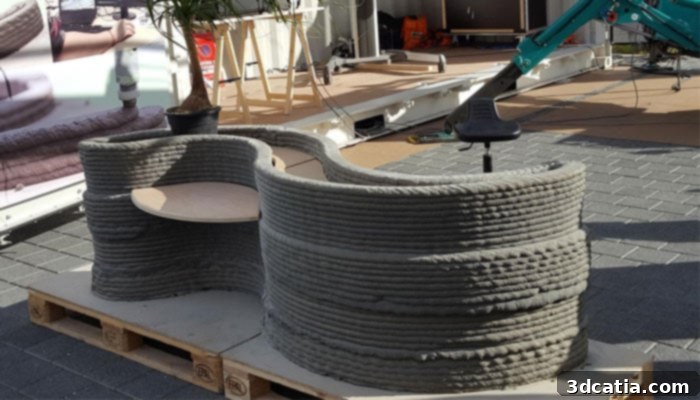
Constructions-3D, a prominent competitor, is also advancing the use of robotic arm technology for 3D printing large concrete structures on-site.
Competing Companies and Advanced Extrusion Methods
The rapid growth of 3D printing in construction has spurred a wave of innovation, with various market players developing unique machines and processes for extruding concrete and other building materials. French company Constructions-3D has engineered an innovative polar 3D printer designed to operate efficiently within the confines of a construction site. This ingenious machine is capable of printing a building from the inside out and is then able to “walk out” through the front door upon completion. It comprises a robust mechanical base supporting a robotic arm, which is fitted with a specialized nozzle for material extrusion. This versatile arm offers an impressive printable area of more than 250 square meters and can reach heights exceeding 8 meters, making it suitable for a wide range of building projects.
Similarly, Cazza Construction has introduced a robot that utilizes a mobile crane system, significantly expanding the printable area and enabling the creation of larger and taller structures. This scalability has been vividly demonstrated by companies like Apis Cor and XtreeE, who have quickly constructed entire houses and complex architectural elements using similar advanced robotic extrusion methods.
Beyond concrete, other companies are specializing in extruding alternative materials with this technology. BatiPrint 3D’s patented process stands out as a striking example of material diversification. A collaborative effort between the University of Nantes, Bouygues Construction, and Lafarge Holcim, this industrial robot is designed to print three distinct layers of material simultaneously. Two of these layers consist of a polymeric foam, which provides essential insulation, while the third layer is concrete, forming the load-bearing and anti-seismic structure. Benoit Furet, a professor at the University of Nantes, eloquently explains the synergy: “the foam brings inner and outer insulation; concrete and reinforcement the antiseismic bearing structure.” This multi-material approach not only streamlines the construction process but also enhances the thermal performance and structural resilience of the printed buildings.
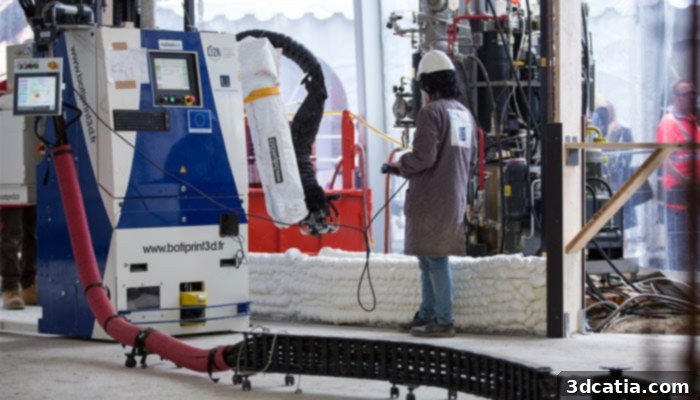
Batiprint 3D, a French company, is at the forefront of 3D printing large structures with innovative multi-material extrusion.
2 – Sand Layers Linked Together: The D-Shape Method
Italian architect Enrico Dini initially garnered widespread attention as ‘the man who 3D prints houses,’ showcasing a visionary approach to construction. More recently, he has continued to make waves by demonstrating an intriguing 3D printing process utilizing his bespoke ‘D-Shape’ 3D printer. This sophisticated machine operates on the principle of binder jetting, where layers of granular material are selectively solidified by a binding agent. The process involves depositing thin layers of sand, typically according to a desired thickness. Following the deposition of each sand layer, a print head precisely pours droplets of a liquid binder. This binder chemically reacts with the sand, hardening it into a solid, stone-like material. The D-Shape printer, with its substantial 4 x 4 meter build platform, is capable of creating impressively large structures, reaching volumes of up to 6 cubic meters. This method opens up possibilities for using readily available aggregates like sand, potentially reducing reliance on traditional concrete and enabling construction in remote areas with abundant natural resources.
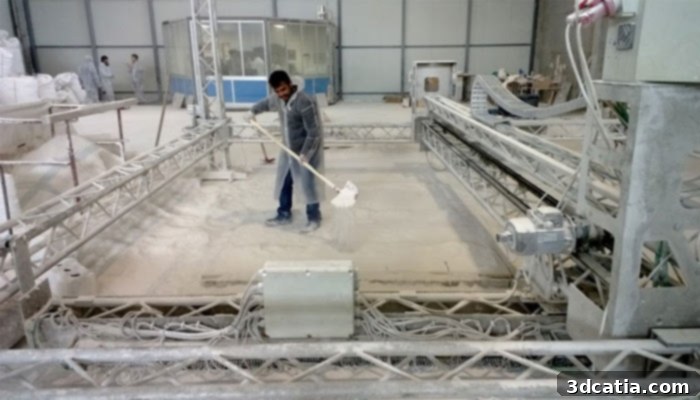
The construction site where the D-Shape printer is set to 3D print a complex concrete structure, demonstrating the capabilities of binder jetting.
3 – Metal for Solid Structures: Wire Arc Additive Manufacturing (WAAM)
Pushing the boundaries of additive construction even further, the Dutch company MX3D has pioneered a unique construction method known as WAAM (Wire Arc Additive Manufacturing). This innovative technique enables the 3D printing of robust metal structures using a sophisticated 6-axis robotic arm. The robot is equipped with a welding machine and a specialized nozzle that precisely deposits and welds metal rods, layer by layer, at an impressive rate of 2 kilograms of material per hour. This process effectively functions as a giant, highly automated soldering iron, capable of creating intricate and structurally sound metal components.
The development of this advanced robotic system was the result of a significant collaboration with industry leaders Air Liquide and ArcelorMittal, combining expertise in welding technology and material science. A key advantage of WAAM is its compatibility with a wide array of metal alloys, including stainless steel, bronze, aluminum, and Inconel, offering unparalleled flexibility in material choice for specific structural requirements. The MX3D team elaborated on their breakthrough, stating: “we combined an industrial robot with a welding machine to turn it into a 3D printer that works with our own software.” This technology is particularly adept at creating complex, freeform metal structures that would be incredibly challenging or impossible to achieve with conventional manufacturing methods, opening new horizons for architectural design and structural engineering.
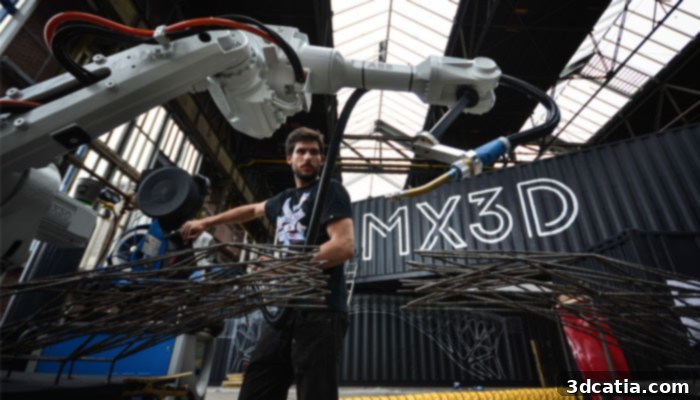
MX3D stands among the innovative startups driving advancements in the 3D printed construction sector, particularly with metal structures.
While many of these groundbreaking concepts originate from agile startups, their large-scale implementation often necessitates strategic support from established names in the construction industry. Collaborative efforts are crucial for overcoming technical hurdles, securing funding, and navigating regulatory complexities. For instance, the Royal BAM Group partnered with Eindhoven University of Technology to design and construct a pioneering 3D printed concrete bridge specifically for cyclists, showcasing practical applications. Similarly, Bouygues Construction has embraced 3D printing to develop affordable housing solutions in Lille, France. Vinci Construction has joined forces with French startup XtreeE to experiment with the construction of highly complex architectural structures. Moreover, the Swedish group Skanska recently collaborated with the University of Loughborough to refine and commercialize a 3D concrete printing process, highlighting the growing trend of industry-academia partnerships in this rapidly evolving field.
“we combined an industrial robot with a welding machine to turn it into a 3D printer that works with our own software,” – MX3D team.
Why Use 3D Printing in Construction? Unpacking the Benefits
The rationale behind adopting 3D printing in construction is multifaceted, offering compelling advantages across several key areas. Firstly, and perhaps most significantly, 3D printing concrete drastically reduces construction timelines. What might traditionally take weeks can potentially be completed in a matter of days. For example, a project that would typically span two weeks could be condensed to just 3-4 days using these advanced technologies. This expedited process translates into substantial time savings, faster project delivery, and quicker returns on investment.
Secondly, it significantly enhances workplace safety by minimizing human involvement in hazardous tasks. Benoit Furet from the University of Nantes emphasizes this point: “the reduction of the hardship and the risks is a reality, we realized rays of 3.8m of height without any scaffolding. In addition, the construction site is very quiet.” By automating the most demanding and dangerous aspects of building, 3D printing reduces the risk of injuries and accidents, creating a safer working environment. His team successfully 3D printed a 95m² house and the first 3D printed social housing in the city, underscoring the practical application of these benefits.
Furthermore, Benoit notes that their BatiPrint technology has made it considerably easier and more cost-effective to create intricate and curved architectural shapes, which are often expensive and labor-intensive with conventional methods. An undeniable advantage is also the tireless nature of 3D printers; unlike human workers, they do not require rest, food, or sleep. This means they can operate continuously, around the clock, until a project is finished, dramatically reducing waiting times and accelerating project completion.
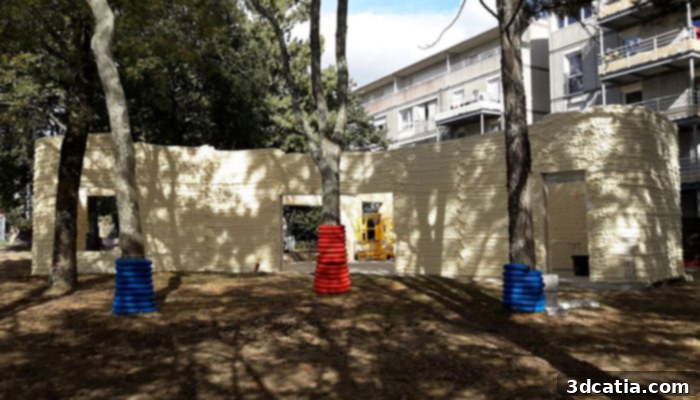
Advantages of 3D Printing in Construction: Beyond Speed and Safety
In terms of materials usage, 3D printing is inherently economical and environmentally friendly. Utilizing additive manufacturing processes, where material is added layer by layer only where needed, significantly reduces waste compared to traditional subtractive methods. This efficiency translates into a reduced environmental impact, as less raw material is consumed and less waste is generated during construction. Romain Duballet, a co-founder of XtreeE, reinforces this: “with an increased geometric mastery, we can build optimized shapes to limit the amount of materials used.” This ability to create geometrically optimized structures not only saves material but also allows for lighter, yet equally strong, designs.
However, despite these compelling advantages, there are still notable caveats to the widespread realization of 3D printed houses, bridges, and skyscrapers. A significant hurdle lies in the regulatory landscape. Axel Thèry of Constructions-3D highlights a critical challenge: “the main difficulties come from the fact that the process of 3D printing buildings is not today recognized as a construction method by many codes and standards bodies.” Because 3D printed structures deviate significantly from traditional building forms, assessing their long-term resistance and structural integrity through conventional calculation methods is difficult. Consequently, habitable structures often require rigorous, case-by-case testing at the initial stages of adoption. These standards bodies understandably prioritize public safety and are concerned about ensuring that these innovative structures are genuinely solid, resilient, and capable of withstanding various environmental stresses over time.
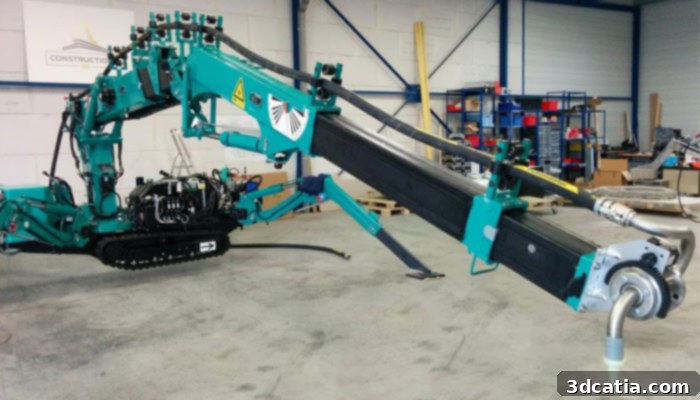
Constructions-3D’s impressive machine resembles a huge tractor, designed to 3D print concrete and create substantial structures on demand.
3D Printed House: A Solution to the Global Housing Crisis?
Given its inherent speed and potential for cost reduction, 3D printing is increasingly viewed as an ideal solution to address the pressing global housing crisis. Many companies are now orienting their additive manufacturing efforts towards this critical social need. One such pioneer is the Italian company WASP, driven by a mission to foster a more sustainable world through 3D printing. They have engineered one of the world’s largest 3D printers, capable of constructing homes using locally sourced, eco-friendly materials such as clay and soil. What makes WASP’s approach particularly innovative is its ability to operate independently, powered by renewable energy sources like solar, wind, or hydropower. This self-sufficient model enables the construction of environmentally friendly structures, leveraging local resources even in regions that currently lack access to a reliable electricity grid, offering a truly sustainable and accessible building solution.
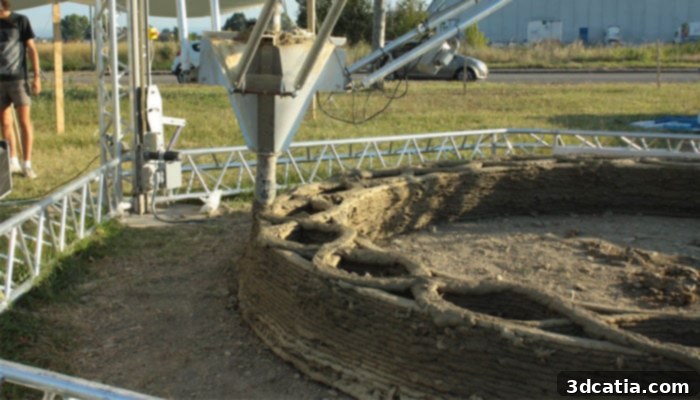
WASP 3D printers diligently working to realize a future where environmentally friendly materials create sustainable 3D printed houses, addressing global housing needs.
Similarly, in Brazil, Anielle Guedes founded Urban3D with the explicit aim of responding to her country’s severe housing crisis. Her company employs a strategy of 3D printing building components in a dedicated factory environment, which are then transported and assembled on-site. This hybrid approach circumvents the height limitations often associated with on-site 3D printing, allowing Urban3D to construct taller and more complex buildings. The company is actively testing various prototypes and holds significant promise in providing innovative solutions to the rapid development of Brazilian shantytowns, offering dignified and affordable housing alternatives.
The Russian company Apis Cor also firmly believes in the profoundly positive impact that 3D printing can have on global housing challenges. Founder and CEO Nikita Chen-iun-tai articulates this vision: “we believe that additive manufacturing is an effective solution against the housing crisis and that is why we have developed our project. We hope that in a few years this approach will be thoroughly tested in different parts of the world to demonstrate its feasibility. We believe that more and more construction companies will adopt this technology, as it is already the case for some today.” Their pioneering work, including the construction of a complete house in just 24 hours, serves as a powerful testament to the technology’s potential for rapid, efficient, and scalable housing solutions.
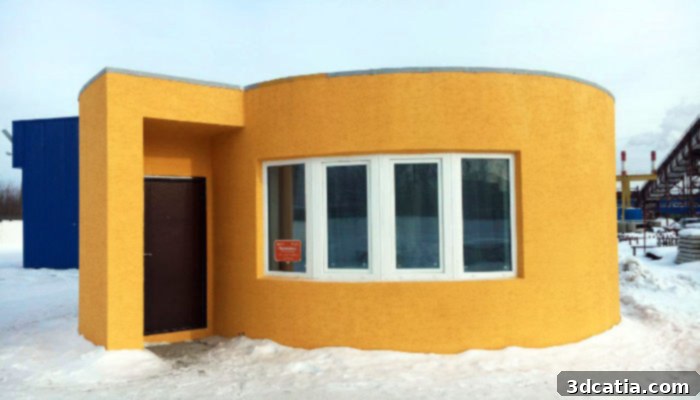
Russian company Apis Cor impressively constructed this house in a mere 24 hours, leveraging the efficiency of their advanced concrete 3D printer.
3D Printing in Space? Expanding Humanity’s Reach
Beyond terrestrial applications, additive manufacturing holds an even more ambitious promise: facilitating humanity’s exploration and settlement of space. NASA, recognizing this potential, launched the innovative ‘3D Printed Habitat Challenge.’ This initiative encourages the development of technologies capable of building sustainable homes in extraterrestrial environments, such as on the Moon or Mars, utilizing local regolith (moon dust or Martian soil) as building material. While this vision is undoubtedly ambitious and fraught with scientific and engineering challenges, it underscores the boundless potential of 3D printing. It is too early to definitively declare 3D printing as the ultimate viable solution for off-world construction, but the research and development in this area are rapidly advancing, pushing the boundaries of what’s possible.
What is clear, however, is that 3D printing in construction is poised to become a very real and significant global force on Earth. SmarTech Publishing, a leading market intelligence firm, recently published a report forecasting global revenues in the additive construction sector to reach an astounding $40 billion by 2027. This projection, indicating a monumental leap from a few million dollars to $40 billion in just over a decade, is nothing short of astonishing and reflects the profound confidence in this technology’s future. The coming years will undoubtedly reveal how the world adapts to and harnesses this transformative technology, fundamentally reshaping the way we conceive, design, and build our environments, both on and beyond Earth.
Did you enjoy our feature story on the revolutionary impact of 3D printing in construction? We’d love to hear your thoughts! Let us know in a comment below or connect with us on our Facebook and Twitter pages. For all the latest news and updates in the world of 3D printing, sign up for our free weekly Newsletter, delivered straight to your inbox!