
Boston Dynamics’ Atlas: How 3D Printing Powers the Next Generation of Agile Humanoid Robots
The concept of robots seamlessly integrating into our daily lives has long been a staple of science fiction, captivating imaginations with visions of a futuristic society. Yet, recent advancements are rapidly transforming these fantastical notions into tangible realities. Not long ago, the internet was abuzz with a video showcasing Boston Dynamics’ SpotMini robot dog effortlessly opening a door, a seemingly simple act that underscored the growing sophistication of autonomous machines. However, this was merely a prelude to a far more profound unveiling. The acclaimed American robotics company, Boston Dynamics, renowned for its innovative quadruped robots, has once again pushed the boundaries of what’s possible, reintroducing the world to Atlas. This remarkable bipedal robot, significantly enhanced through cutting-edge 3D printing technologies, represents a monumental leap towards creating a machine that truly emulates human capabilities and agility, setting a new benchmark for advanced robotics.
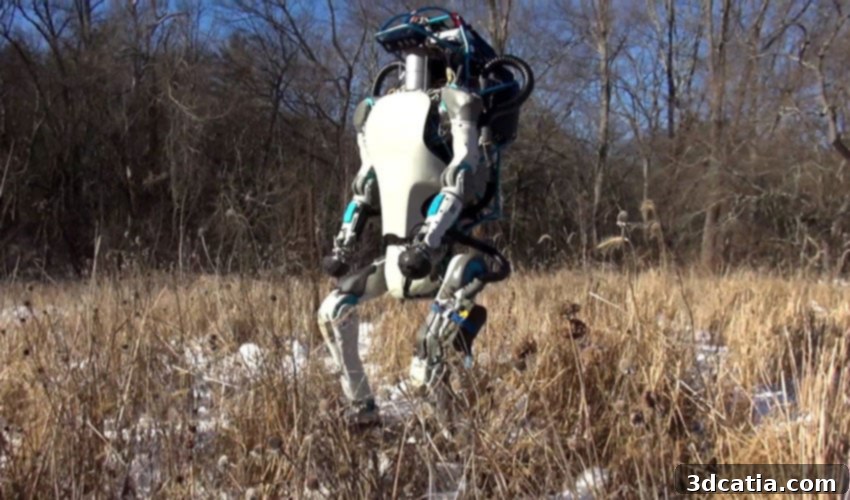
Atlas is not just another robot; it is a testament to years of dedicated research and engineering prowess aimed at perfecting bipedal locomotion. Standing at an impressive 1.5 meters (approximately 4 feet 11 inches) and weighing around 75 kg (about 165 pounds), Atlas possesses an unparalleled ability to navigate complex environments with human-like grace. Its capacity to run, jump over obstacles, and perform dynamic movements rivals the dexterity and balance of a highly trained athlete. When compared to its initial conceptualization in 2009, Atlas has undergone a radical transformation. The strategic application of advanced 3D printing technologies has been a game-changer, enabling a drastic reduction in its overall weight while simultaneously boosting its agility, strength, and operational endurance. Today, Atlas is capable of a sophisticated repertoire of actions, including running at considerable speeds, executing complex jumps, performing intricate acrobatic tricks like backflips, and efficiently transporting objects from one location to another, showcasing an impressive blend of strength, balance, and fine motor control essential for interaction in dynamic environments.
The Unsettling Reality of Advanced Robotics: Hopes and Ethical Concerns
The latest video demonstrations released by Boston Dynamics, featuring Atlas performing parkour-like movements with astounding grace and precision, have undoubtedly generated significant global discussion. While many are inspired by these technological marvels, an undercurrent of apprehension has also emerged. The uncanny realism and increasing autonomy displayed by Atlas have inevitably drawn comparisons to dystopian narratives, particularly reminiscent of the unsettling scenarios depicted in popular culture, such as the science fiction anthology series Black Mirror. These concerns are rooted in the growing reality of autonomous systems already at play in various sectors. For instance, the US Army’s combat drones are capable of executing complex group tasks and making strategic decisions in the field, blurring the lines between human command and machine autonomy. Similarly, industrial innovations like the Siemens Spiders, which collaborate on intricate 3D printing tasks, highlight the increasing capability of robots to work cooperatively and intelligently. These examples underscore that the era of truly autonomous, decision-making robots is not a distant future, but a rapidly unfolding present, prompting crucial societal conversations about ethics, control, potential job displacement, and the responsible integration of such powerful technologies into human society.
Engineering Marvel: The Intricate Development of the 3D Printed Robot
Atlas is widely regarded as one of the most sophisticated and advanced humanoid robots to emerge from the Massachusetts-based company’s labs. Its intricate design incorporates 28 hydraulic joints, granting it an extraordinary range of motion and flexibility, essential for its dynamic maneuvers. Beyond its physical dexterity, Atlas is equipped with state-of-the-art sensory systems, including LiDAR (Light Detection and Ranging) and stereo vision. LiDAR allows Atlas to precisely map its environment in 3D, detecting distances and shapes with high accuracy, while stereo vision provides it with depth perception, enabling it to interpret its surroundings much like human eyes do. These combined sensory inputs are crucial for real-time navigation, complex obstacle avoidance, and interacting with objects in varied conditions. Furthermore, Atlas boasts impressive strength, capable of lifting objects weighing up to 11 kg (about 24 pounds) with precision and control. A pivotal factor in achieving its current level of agility and performance has been the targeted use of 3D printing, particularly for its leg components. This advanced manufacturing technique enabled engineers to significantly reduce the weight of Atlas’s limbs, a critical achievement that enhances its stability and allows it to maintain an upright, bipedal stance even during strenuous and high-impact activities, making it an unprecedented feat in robotics.
The Transformative Power of Additive Manufacturing in Robotics
The integration of additive manufacturing, commonly known as 3D printing, into the development of Atlas highlights its revolutionary impact on robotics. This technology has become indispensable for creating parts that are simultaneously lightweight, strong, and geometrically complex. As Aaron Saunders, Vice President of Engineering at Boston Dynamics, eloquently stated at a recent event in Germany, “We were able to reduce limb inertia significantly, which is a big deal for a walking robot — most of the power in the system goes to swinging the legs through the air and accelerating and stopping them.” This statement underscores a fundamental biomechanical challenge in bipedal robotics: minimizing the energy required for locomotion. By using 3D printing to create lighter, yet incredibly strong, components for Atlas’s legs, engineers dramatically reduced the inertia of its limbs. This means less energy is wasted fighting the mass of the limbs themselves, leading to more efficient movement, longer operating times, and the ability to perform more dynamic and rapid maneuvers. Saunders further elaborated on the versatility of additive manufacturing, stating, “It’s so we can make very organic structures and minimize pressure drops—get rid of a lot of excess components. It’s kind of exciting, the things that can be done in printing manifolds.” This speaks directly to the unparalleled design freedom offered by 3D printing, allowing for complex internal geometries, such as optimized fluidic manifolds for Atlas’s advanced hydraulic system, that are impossible to achieve with traditional manufacturing methods. Such intricate designs reduce weight, improve performance, and consolidate multiple parts into single, more robust components, propelling Atlas’s capabilities far beyond conventional robotic designs.
Beyond Atlas: The Broader Impact of 3D Printing on Robotic Design and Future Innovation
The success seen with Atlas serves as a powerful case study for the broader application of 3D printing in the rapidly evolving field of robotics. This technology facilitates rapid prototyping, allowing engineers to iterate on designs quickly and cost-effectively, significantly accelerating the development cycle from initial concept to functional prototype. Furthermore, 3D printing enables the creation of highly customized parts perfectly tailored to a robot’s specific functions and form factor, an essential capability for developing specialized robotic systems for diverse applications. The ability to produce lightweight yet durable components from advanced polymers and metal alloys, like titanium or aluminum, is crucial for robots designed for agility, endurance, and operation in demanding environments. By consolidating parts and optimizing geometries, 3D printing not only reduces overall weight but also enhances structural integrity and reduces assembly complexity, leading to more reliable and efficient machines. This synergy between advanced robotics and additive manufacturing is paving the way for robots that are more robust, adaptable, and capable than ever before, pushing the boundaries of what autonomous machines can achieve in diverse environments, from hazardous exploration zones to precision manufacturing floors.
The Future Vision: Robots as Companions, Colleagues, and Agents of Change
Boston Dynamics remains at the forefront of robotic innovation, committed to the continuous progress and refinement of its 3D printed robots. The company envisions a future where its creations, particularly advanced humanoids like Atlas, transition from being sophisticated research platforms to practical, indispensable tools in various sectors. Within the next few years, it is widely anticipated that these robots could be deployed as advanced home assistants, performing a myriad of tasks to support daily living, from routine chores and mobility assistance for the elderly to providing companionship. In corporate and industrial environments, they could revolutionize logistics, provide support in dangerous or repetitive tasks, or even act as sophisticated assistants for human workers, thereby enhancing productivity, safety, and efficiency across numerous industries. However, the path to widespread commercialization involves overcoming significant challenges, including further reducing manufacturing costs, ensuring fail-safe operations and robust safety protocols, developing intuitive user interfaces, and addressing public perception and profound ethical concerns surrounding autonomous intelligence. Boston Dynamics is not only focused on technological breakthroughs but also on fostering public trust and clearly demonstrating the beneficial, responsible applications of advanced robotics for the betterment of society.
A recent video demonstrating Atlas’s advanced capabilities, showcasing its remarkable agility and dynamic balancing:
The journey of Atlas epitomizes the rapid evolution of robotics, propelled by groundbreaking innovations like 3D printing and advanced AI. As these machines become increasingly sophisticated, capable of mimicking human movement, perception, and even complex decision-making, they ignite critical conversations about the future of automation, artificial intelligence, and our evolving relationship with technology. The potential for these advanced robots to improve quality of life, tackle dangerous and undesirable jobs, and revolutionize entire industries is immense, offering solutions to some of humanity’s most pressing challenges. Yet, it is equally important to approach their integration into society with careful consideration, robust ethical frameworks, and ongoing public dialogue. Boston Dynamics’ pioneering work with Atlas not only showcases incredible engineering feats but also serves as a poignant reminder of the profound and multifaceted impact advanced robotics will have on humanity in the decades to come.
For more comprehensive information and a deeper dive into the incredible engineering behind Atlas and other cutting-edge robotic developments, we strongly encourage you to visit the official Boston Dynamics website here.
What are your thoughts on a future intertwined with highly advanced, 3D printed robots? Do you envision them as indispensable assistants and partners, or do you harbor concerns about their increasing autonomous capabilities and societal implications? We invite you to share your valuable perspectives in the comments section below or join the vibrant conversation on our Facebook and Twitter pages! And to stay abreast of all the latest groundbreaking news, technological breakthroughs, and significant developments in the fascinating world of 3D printing and additive manufacturing, don’t forget to sign up for our free weekly Newsletter, delivered straight to your inbox!