
NFTs and 3D Printing: Pioneering the Future of Digital Art, Fashion, and Ownership
The digital landscape has been buzzing with terms like NFT, blockchain, Ethereum, Ether, cryptocurrency, eWallet, and the Metaverse. These concepts dominate headlines and fuel a robust debate: are we witnessing another fleeting investment bubble, or does this digital revolution truly herald a new era of ownership and creation? This question holds particular significance for artists and investors navigating the complexities of digital assets. But what exactly do these buzzwords mean? How does one define an NFT, and why has it become so important? More intriguingly, how might the burgeoning digital market, powered by non-fungible tokens, intersect with and benefit additive manufacturing? To delve into these questions, we engaged with leading innovators in the field. We spoke with Danit Peleg, a renowned fashion designer celebrated for her groundbreaking 3D-printed garments, and Ioan Florea, the visionary creator behind the first 3D-printed art collection. They offered invaluable insights into the aspirations of art creators, especially those within the 3D printing community, regarding cryptocurrency. Additionally, Jerome de Tichey, Global Head of Client Success at Ledger and President at Ethereum France, a distinguished blockchain expert, shed light on the intricate legal challenges that currently surround NFTs.
Understanding Non-Fungible Tokens (NFTs)
While Non-Fungible Tokens (NFTs) might seem like a recent sensation, their origins trace back to 2014 and 2015. To grasp their significance, let’s first establish a clear definition. NFT stands for non-fungible token, a crucial distinction that implies they are unique and not interchangeable. Unlike conventional currencies such as the Euro or Bitcoin, where one unit can be perfectly swapped for another identical unit, an NFT possesses an individual identification code. This makes each NFT distinct; you cannot exchange one for another in a one-to-one manner. This inherent uniqueness is what gives non-fungible tokens their value and purpose. Thanks to this characteristic, virtually any digital good—from intricate illustrations and captivating video clips to influential social media posts and even musical compositions—can be “minted” or tokenized on a blockchain, thereby assigning it verifiable ownership and a specific value. This process essentially creates digital scarcity for assets that were once infinitely reproducible, transforming them into collectible items.
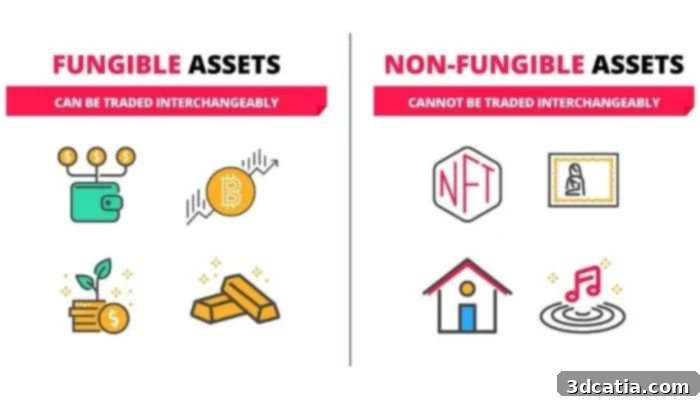
The difference between fungible and non-fungible assets, highlighting the unique nature of NFTs.
The impact of NFTs on the art market has been nothing short of revolutionary, with some digital creations fetching astronomical prices. Let’s examine a couple of the most prominent examples that underscore the transformative potential of this technology. Perhaps the most celebrated case is the JPEG file titled “Everyday: The First 5000 Days.” This digital artwork, a monumental collage comprising 5,000 individual pieces created daily by the artist Beeple (Michael Joseph Winkelmann), was famously auctioned off by Christie’s in early 2021 for an astonishing $69 million USD. This sale not only propelled Beeple into the ranks of the three most valuable living artists but also solidified NFTs as a legitimate and highly lucrative segment of the art world. Another widely recognized example demonstrating the diverse applications of NFTs is the sale of the first-ever tweet by Twitter co-founder Jack Dorsey, which commanded a price of $3 million USD. These high-profile sales demonstrate that NFTs are not merely a technological curiosity but a powerful new medium for establishing verifiable ownership and value for digital assets, challenging traditional notions of art collection and investment.
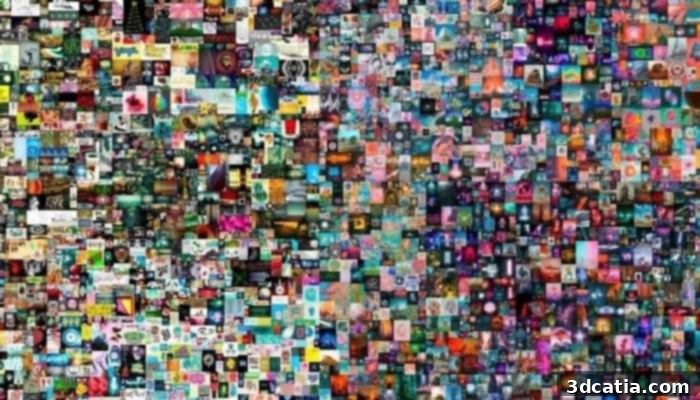
Beeple’s JPEG collage “Everyday: The First 5000 Days” was a landmark NFT sale, fetching $69 million.
The Intersection of NFTs and 3D Printing: A New Frontier for Creation
The innovative spirit of the digital art world is increasingly merging with the capabilities of additive manufacturing. More and more artists are leveraging digital marketplaces like Rarible and OpenSea to offer their unique 3D-printed works as NFTs. Danit Peleg stands out as a visionary in this emerging space. Not only is she a recognized pioneer in 3D printed fashion, but she has also mastered the art of creating verifiable value for her designs through non-fungible tokens. In our conversation, Peleg revealed that for several years, she has been exploring methods to securely document the digital creation process of her designs and make them accessible to others. Her innovative approach bridges the gap between digital ownership and physical creation. When an interested party purchases one of her NFTs, they gain exclusive access to a digital folder linked to that specific token. This folder contains a wealth of resources, including detailed instructions on print settings and a comprehensive guide on how to assemble the individual 3D-printed pieces into the finished garment. This system empowers buyers with both the digital proof of ownership and the practical means to bring the digital design into the physical world.
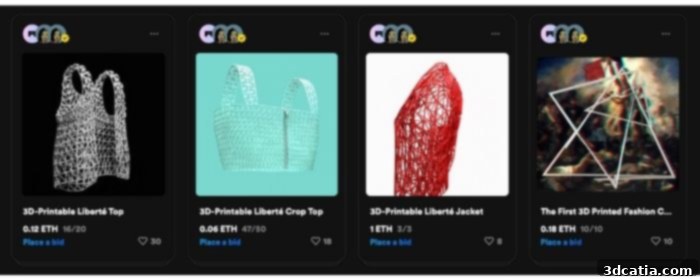
Danit Peleg’s exquisite 3D-printed fashions are available as limited-edition NFTs, which can be purchased on Rarible.
By providing buyers with the necessary digital files at the point of purchase, Danit Peleg masterfully constructs a tangible link between the digital asset and a physical object. This unique model allows buyers the flexibility to either 3D print the garments themselves or commission her to create the physical piece. Peleg emphasizes her philosophy: “I allow my buyers to additively make the garments themselves. I don’t restrict the buyers in any way, quite the opposite; I find it extremely exciting to follow what they do with my creations further down the line.” This approach empowers buyers to personalize their garments by choosing their preferred materials and colors, resulting in truly unique physical objects. Looking ahead, Danit envisions a future where entire fashion collections could be sold as NFTs. Imagine a scenario where a purchased digital garment could dynamically transform with the seasons—a T-shirt design evolving into a sweater for winter. She enthusiastically embraces the myriad of new business opportunities and creative avenues that NFTs are unlocking for artists and designers worldwide.
Ioan Florea, an artist whose work deeply resonates with the philosophy and expansive possibilities of open-source technologies, also offers his distinctive 3D-printed art objects as NFTs. His journey into this domain began years ago, as he recounts: “I became interested after exhibiting my 3D Printed liquid metal Ford Torino to Inside Bitcoin-Inside 3D printing show in New York in 2014. The theme of the 2014 was the 3rd Industrial revolution with the 3D printed liquid metal Ford Torino making the transition from assembly line to the blockchain open-source 3D printing technologies…NFTs give you access to the ownership and use of the 3D printed file artwork, I think is the first step of 3D printed art to become a new form of art. At this point 3D printed art is not recognized as artwork for tax or custom. It is considered industrial prototype machine made not art. This reminds me of Constantin Brancusi at the beginning of the 20th century when his “Bird” sculpture was classified by US custom and registered it in the same category with kitchen utensils.” Florea’s comparison to Brancusi powerfully illustrates the current struggle of 3D-printed art to gain official recognition as a legitimate art form, highlighting the bureaucratic and conceptual hurdles it faces.
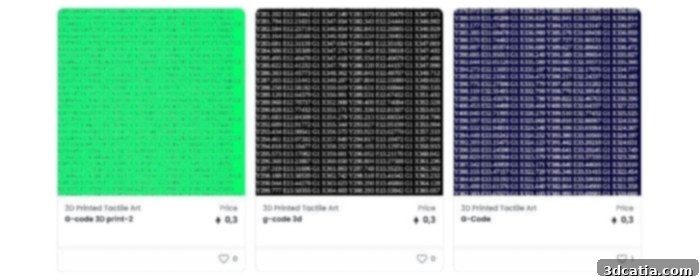
Ioan Florea’s G-Code, an example of digital and physical art, can be purchased for 0.3 Ether (approximately 899.40 Euro as of October 13, 2021).
Florea further explains that the typical buyers of his NFTs belong to a new generation of investors deeply embedded in the virtual world and thoroughly convinced of the intrinsic value and enduring potential of cryptocurrencies. Similar to Danit Peleg’s model, Florea’s buyers also receive the 3D file with unlocked content, and in some instances, a direct link to the original STL file. This approach highlights a significant advantage of 3D printing NFTs: their inherent association with a physical object. Even if the digital asset is primarily represented on the blockchain, buyers always retain the opportunity to generate a tangible, physical representation for themselves. This crucial distinction sets 3D printing NFTs apart from many other purely digital goods. Consequently, 3D printing emerges as an ideal candidate for NFT adoption because, despite potential fluctuations in cryptocurrency prices, buyers are always left with a physical art object that they can see, touch, and experience in the real world, providing a unique blend of digital ownership and physical presence.
The Underlying Technology and Legal Framework of NFT Ownership
At its core, the technology behind NFTs is rooted in the same principles as other cryptocurrencies: the blockchain. This decentralized, distributed ledger system is instrumental in storing the unique “digital fingerprint,” or “hash,” of each work. This immutable record is what ensures the uniqueness and verifiable ownership of an NFT. Among the myriad of blockchains available, Ethereum stands out as one of the most popular and robust platforms for NFTs. Jerome de Tichey elaborates on Ethereum’s advantages, stating: “Ethereum provides the flexibility to list, auction, and automate NFTs. Smart contracts (basically software used within the blockchain) come to play an important role in Ethereum, whereas they are used in a limited way in Bitcoin.” These smart contracts are self-executing agreements with the terms of the agreement directly written into lines of code. They automatically execute, control, or document legally relevant events and actions according to the terms of a contract or an agreement, eliminating the need for intermediaries. For artists, this is a game-changer, as smart contracts can be programmed to stipulate, for instance, that the original creator of the work receives a specific percentage of the sale value every single time their NFT is resold. This innovative mechanism allows artists to continuously profit from any increase in the value of their works over time, creating a perpetual royalty stream that was previously unimaginable in traditional art markets.
While NFTs provide a revolutionary way to attribute ownership of virtual goods on a blockchain, their rapid emergence has also unearthed a multitude of complex legal questions. These challenges primarily revolve around intellectual property rights, data protection laws, and various financial regulatory aspects. Jerome de Tichey highlighted in our discussion that we are currently operating within a significant legal “gray area” concerning intellectual property rights tied to NFTs. A broad consensus among intellectual property experts suggests that there are currently no universally recognized rights implicitly associated with an NFT that extend to the underlying digital file it links to. Furthermore, existing regulations are often ill-equipped to address the unique circumstances presented by NFTs. De Tichey stressed that any rights associated with NFTs can primarily be enforced only within the specific blockchain environment where they were issued and where they exist, underscoring the limitations of current legal frameworks in the broader digital and physical realms.
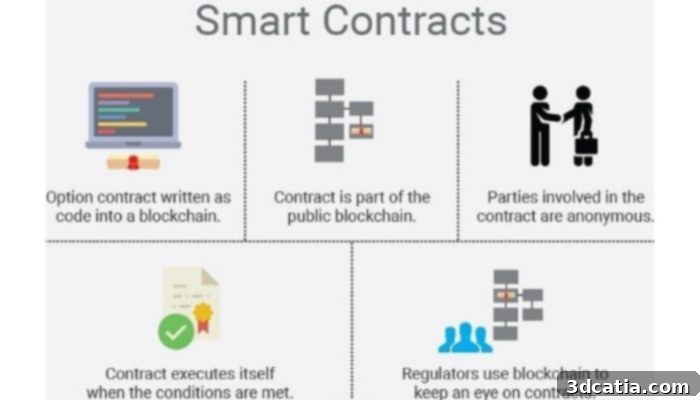
Image Credits: CodeBrahma, illustrating the intricate relationship between artists, NFTs, and the blockchain.
To further elucidate the nuances of NFT ownership and copyright, Jerome de Tichey provided a compelling example: “Let’s take the example of an artwork: as an artist, I use a pair of cryptographic keys to sign a blockchain transaction that generates the NFT. This step is similar to the technology used in most document digital signatures, which you may have received yourself via email. At the same time, I have assigned a file that represents my art. Now I can transfer and sell this NFT to anyone, and anyone can prove that this NFT originally came from me because it has my digital signature on it. After releasing the NFT, someone can copy the file and create another NFT with the same file using their own signature, no barrier exists here. However, if a third party runs a blockchain-based museum, that third party can only whitelist and publish the NFTs of verified artists, while the art curator can track every NFT an artist has ever created in real time.” This scenario highlights a critical distinction: while an NFT verifies unique ownership on the blockchain, it doesn’t inherently prevent the copying or unauthorized re-tokenization of the underlying digital asset by others. The true power lies in verified provenance and the establishment of authoritative platforms, such as blockchain-based museums, which can curate and endorse authentic digital art, offering a layer of trust and verification beyond mere file ownership.
Future Outlook and Overcoming Challenges in the NFT Space
The future of NFTs, particularly in conjunction with 3D printing, presents both immense promise and significant hurdles. Ioan Florea explains that, for now, a major technical limitation exists: it is not yet possible to store large 3D print files (such as STL or OBJ formats) directly on the blockchain. Instead, these files are typically accessed via a link, which, crucially, is not inherently secured by blockchain technology. This presents a notable disadvantage for buyers, as the long-term accessibility and integrity of the linked file are not guaranteed by the token itself. Florea expresses optimism that future advancements will enable direct on-chain storage for these files, simultaneously hoping that platforms will evolve to make crypto-mining more energy-efficient and sustainable. He also observes that many current NFT platforms tend to prioritize traditional digital media like JPEG animations and videos. While 3D printing is a relatively nascent art form in the digital realm, Florea firmly believes it possesses the potential to become significantly more mainstream and recognized as its unique advantages become more apparent.
Danit Peleg shares this optimistic vision, particularly for the fashion industry. She hopes that NFTs can play a pivotal role in democratizing fashion entirely, making high-quality, custom designs accessible to a broader audience. Peleg envisions a future where her stunning 3D-printed garments are not only worn in the physical world but also seamlessly integrated into a thriving metaverse – a collective virtual shared space where digital fashion will be as significant as its physical counterpart. Beyond the creative potential, Peleg is also convinced that the current high energy consumption associated with NFTs, and its corresponding environmental impact, will see substantial improvements over time. This is a critical concern for the entire crypto space, and ongoing developments in blockchain technology, such as the transition from Proof-of-Work to more energy-efficient Proof-of-Stake consensus mechanisms, offer promising solutions. The following video provides a deeper dive into why blockchain technology can be so power-hungry and the efforts being made to address this challenge.
In light of these discussions, you might still ponder the fundamental questions: Why are non-fungible tokens created and purchased? Can purely digital goods truly hold lasting value? And how can the environmental concerns, particularly the significant energy consumption, be ethically justified? Admittedly, opinions on these profound questions remain deeply divided. While a growing cohort clearly perceives the immense added value and transformative potential that NFTs bring to digital ownership, verifiable scarcity, and new economic models for creators, others approach the phenomenon with considerable skepticism and numerous lingering questions. Thus, the journey of NFTs, and their integration with technologies like 3D printing, is still unfolding. It remains to be seen precisely how and to what extent non-fungible tokens will redefine the way we perceive and value digital goods in the future. Nevertheless, this trend is undeniably captivating, and we will continue to closely monitor its evolution, eagerly anticipating the novel opportunities and challenges that will undoubtedly arise for 3D printing within this dynamic new paradigm.
What are your thoughts on NFTs and their burgeoning use in the world of 3D printing? We invite you to share your insights and opinions in a comment below or join the conversation on our LinkedIn, Facebook, and Twitter pages! Don’t forget to sign up for our free weekly Newsletter here to receive the latest 3D printing news directly in your inbox! You can also find all our engaging videos and interviews on our YouTube channel.