
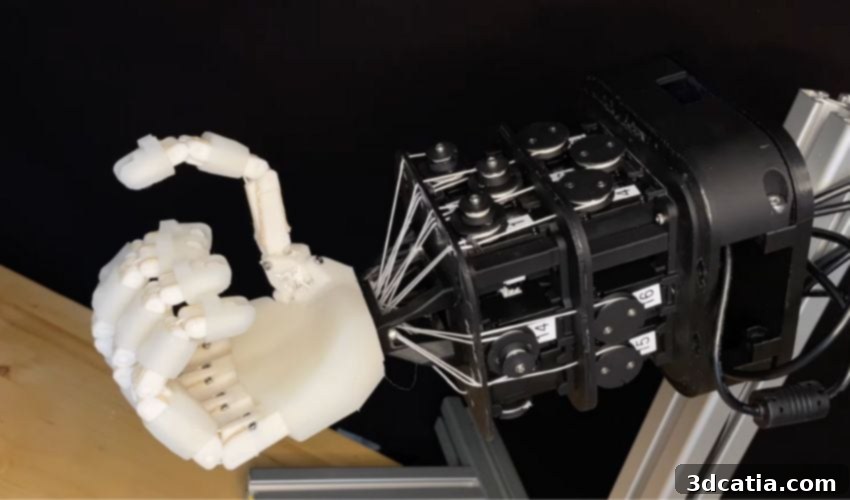
Revolutionizing Robotics: ETH Zurich’s 3D Printed Faive Hand and the Future of Human-Machine Interaction
The convergence of additive manufacturing and the medical field is experiencing a period of unprecedented growth and innovation. This powerful synergy is fundamentally transforming healthcare, leading to breakthroughs from crafting intricate 3D printed blood vessels and personalized implants to revolutionizing drug delivery systems by fabricating medication in precise pill forms. These diverse applications are not merely expanding; they are catalyzing a profound and transformative shift across the entire medical sector, promising more tailored, efficient, and accessible patient care. At the forefront of much of this pioneering research and development is ETH Zurich, a renowned institution known for its groundbreaking contributions. Their researchers have a history of pushing boundaries, having previously introduced innovative solutions such as skin created through bio-3D printing using fungi, and ingeniously crafted insoles with real-time monitoring capabilities, demonstrating their commitment to integrating advanced manufacturing with biological and medical applications.
Building on their impressive track record, these dedicated researchers at ETH Zurich have now unveiled a significant advancement in the realm of robotics: the “Faive Hand.” This revolutionary tendon-controlled robotic hand, brought to life through sophisticated 3D printing techniques, represents a major leap forward in biomimetic design. Developed in a strategic partnership with the esteemed Max Planck ETH Center for Learning Systems, the core objective was ambitious: to engineer a robotic hand that not only physically resembles a human hand but also functionally mimics its remarkable dexterity and adaptability. The result is the Faive Hand, an astonishingly human-like device capable of performing a wide array of daily tasks, from delicate manipulation to more robust household chores, opening up new possibilities for assistive technology and human-robot interaction.
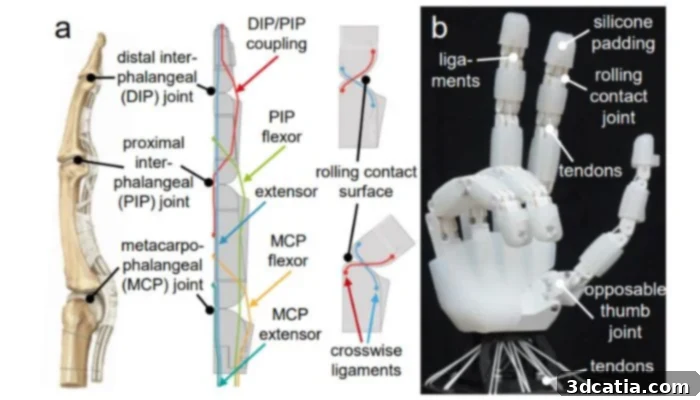
3D printed Faive hand with tendons and a thumb joint (photo credit: ETH Zürich)
What truly sets the Faive Hand apart is its unparalleled ability to execute fluid, unrestricted motions, enabling it to undertake intricate and highly skillful activities with remarkable precision and grace. This level of nuanced control is a testament to its advanced design and control methodology. Unlike many traditional robotic systems that rely on rigid, model-based control approaches, the scientists behind the Faive Hand opted for a more sophisticated paradigm: reinforcement learning (RL). This cutting-edge artificial intelligence technique is exceptionally well-suited for complex, lifelike robotic configurations such as this, especially those demanding meticulous and delicate actions and attributes that are difficult to program explicitly. Reinforcement learning allows the robotic hand to learn optimal strategies through trial and error, much like humans learn, by interacting with its environment and receiving feedback. Conceived within ETH Zurich’s innovative Soft Robotics Lab, a hub for developing compliant and adaptable robotic systems, the Faive Hand was meticulously fabricated through state-of-the-art 3D printing processes and is expertly propelled by an array of high-precision servo motors, which provide the nuanced power required for its intricate tendon system.
The integration of 3D printing played a pivotal role in the Faive Hand’s realization. The intricate structure, particularly the complex tendon system and the unique joint designs, would be incredibly challenging, if not impossible, to produce using conventional manufacturing methods. Additive manufacturing allowed for the rapid prototyping and iteration of complex geometries, enabling the researchers to finely tune the hand’s anatomy to closely mimic human biological structures. This flexibility in design and fabrication is essential for creating biomimetic robots that require a high degree of customization and detailed internal components. The ability to print with various advanced materials also contributes to the “soft” nature of the robot, allowing for a more compliant interaction with objects and environments, enhancing safety and adaptability, and reducing the risk of damage to delicate items or interactions with humans.
Bridging the Gap Between Man and Machine: Advanced Control and Future Outlook
A key innovation contributing to the Faive Hand’s human-like articulation is the incorporation of rolling contact joints. These advanced joints introduce the potential for rotations without a fixed axis, replicating the natural, complex movements found in human anatomy more accurately than traditional pin or hinge joints. This allows for a much broader and more fluid range of motion, essential for true dexterity and mimicking the nuanced grip and manipulation capabilities of a human hand. Nevertheless, this sophisticated design can present significant challenges in terms of management and maneuverability, primarily due to the intricate nature of its high Degree of Freedom (DoF) design. Managing multiple independent axes of movement simultaneously requires exceptionally advanced control systems. To precisely address these control complexities and enhance accuracy during steering operations, sophisticated joint angle encoders are being developed and integrated. These encoders provide real-time, highly accurate feedback on the exact position of each joint, crucial for the precise execution of desired movements and for the reinforcement learning algorithms to effectively learn and refine motor skills.
Furthermore, the robust simulation framework and its low-level controller are instrumental in facilitating the execution of commands, especially through extensive reinforcement learning (RL) training. The researchers leverage platforms like the IsaacGym simulator, a high-fidelity physics simulation environment developed by NVIDIA, to train the Faive Hand in virtual scenarios. This virtual training is paramount, as it allows the robot to undergo millions of iterations and learn from a vast array of interactions without the wear and tear or safety concerns associated with physical prototypes. This environment also enables rapid experimentation with different control policies and task parameters, significantly accelerating the development cycle. The demonstrated successful skill transfer and impressive capabilities within the IsaacGym simulator highlight the efficacy of their RL approach, proving that complex behaviors learned in a virtual environment can be effectively transferred to the physical robotic hand, paving the way for seamless real-world deployment.
The long-term implications of the Faive Hand extend far beyond simple task automation. This technology holds immense promise for revolutionizing various aspects of human life and industry. In the field of prosthetics, the biomimetic design and advanced control offered by the Faive Hand could lead to a new generation of prosthetic limbs that offer unprecedented levels of dexterity, proprioception, and intuitive control for amputees, significantly improving their quality of life. For assistive robotics, this level of precision and adaptability means robots could seamlessly assist individuals with disabilities or the elderly in complex daily activities, from preparing meals to handling fragile objects with care. Moreover, the Faive Hand’s capabilities open doors for safer and more efficient human-robot collaboration in industrial settings, where robots could perform delicate assembly tasks or work alongside humans in shared workspaces without posing a risk. In hazardous environments, such as nuclear decommissioning, space exploration, or deep-sea operations, robots equipped with such dexterous hands could perform complex manipulations that are currently impossible or too dangerous for humans, ensuring greater safety for human workers.
Presently, researchers are continuously dedicated to enhancing the Faive Hand’s capabilities and performance, focusing on areas such as improved sensory feedback (e.g., touch and force), further miniaturization of components for sleeker designs, increased power efficiency for extended operation, and developing even more robust learning algorithms for true real-world adaptability. These ongoing advancements are thereby paving the way for truly novel and transformative prospects in human-machine interaction (MMI) down the line, moving closer to a future where robots can seamlessly and intelligently integrate into our lives as capable assistants and collaborators. For more detailed information on this groundbreaking project and to explore the technical specifics, click HERE to go directly to Faive’s official website, or gain further insights by checking out the informative video below:
What are your thoughts on the biomimetic Faive Hand and its potential to redefine the boundaries of robotics and human-machine interaction? We invite you to share your insights and engage with our community by leaving a comment below or connecting with us on our social media channels: LinkedIn, Facebook, and Twitter pages! For the very latest updates and breaking news in the exciting world of 3D printing and advanced manufacturing, don’t forget to sign up for our free weekly Newsletter here, ensuring the freshest industry insights are delivered straight to your inbox. You can also explore all our comprehensive video content and interviews on our dedicated YouTube channel, where innovation comes to life visually and informatively.
*Cover photo credits: ETH Zürich