

Relativity Space’s Terran 1: Ushering in a New Era of 3D Printed Rocketry for Space Exploration
The aerospace industry is on the cusp of a revolutionary leap, and the countdown to a historic event is officially underway. For those who have been following the groundbreaking applications of 3D printing in space exploration, particularly in the manufacturing of rockets, a significant milestone is about to be reached. Relativity Space, a pioneer in additive manufacturing for aerospace, is preparing to launch its much-anticipated Terran 1 rocket on a pivotal test flight. This monumental event is scheduled for March 8th, 2023, from the iconic Launch Complex 16 in Cape Canaveral, Florida – a site synonymous with humanity’s ventures into the cosmos.
Dubbed GLHF (Good Luck, Have Fun), this maiden flight of the Terran 1 is not just another rocket launch; it represents a paradigm shift in how space vehicles are designed, fabricated, and brought to life. Standing at an impressive 110 feet tall and 7.5 feet wide, this expendable rocket is a testament to the power of additive manufacturing. A staggering 85% of its mass was created using cutting-edge 3D printing technologies, with specialized processes like Direct Metal Laser Sintering (DMLS) employed to craft its intricate, high-performance components. Even more remarkably, the nine powerful Aeon rocket engines that provide its thrust were entirely fabricated through 3D printing – a feat that was first announced back in 2019 and has now come to spectacular fruition.
The Terran 1: A Deep Dive into its 3D-Printed Engineering
The Terran 1 is engineered to achieve an impressive altitude of 500 kilometers (approximately 310 miles), demonstrating its capability to deliver payloads into orbit. It boasts a payload capacity of 1,250 kg (2,756 lbs), a significant achievement for a rocket so heavily reliant on additive manufacturing. This capability is largely attributed to Relativity Space’s innovative Aeon 1 engines, which are fueled by a combination of liquid oxygen (LOX) and liquid natural gas (LNG). This choice of propellants is not only efficient but also environmentally conscious, aligning with modern aerospace trends.
Beyond the Aeon 1, Relativity Space has also developed the Aeon R and Aeon VAC engines, each designed for specific roles within the rocket’s propulsion system. The entire Aeon engine family has undergone rigorous testing, with over 200 test firings successfully conducted at NASA’s Stennis Space Center. This extensive validation process underscores the reliability and performance of these 3D-printed powerhouses.
The Terran 1’s architecture is divided into two primary stages. The first stage comprises the cluster of nine Aeon 1 engines, along with the liquid natural gas and liquid oxygen tanks, and an interstage component. The second stage features its own set of liquid oxygen and liquid natural gas tanks, propelled by a single AeonVac engine, optimized for operations in the vacuum of space. Crucially, the structural components of both stages are produced using Relativity Space’s proprietary metal alloy and their colossal Stargate 4th Generation 3D printers, showcasing the company’s commitment to vertically integrated manufacturing.
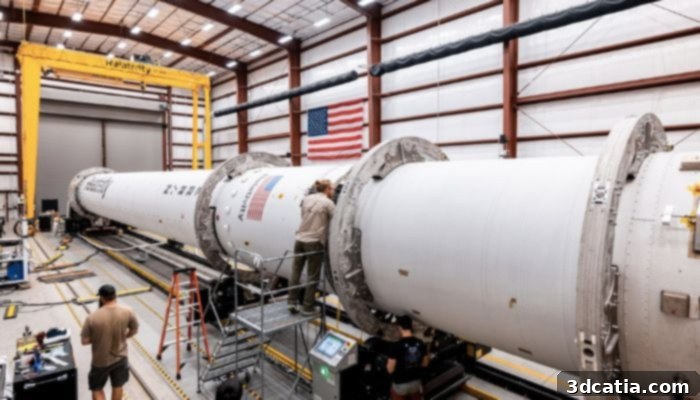
Relativity Space’s team working on the Terran 1
Relativity Space: Leading the Charge in Additive Manufacturing for Space
Relativity Space has consistently made headlines in the aerospace sector for its ambitious vision and technological prowess. Their innovative approach to rocket manufacturing garnered significant recognition in 2021 when they secured a $3 million contract from NASA. This contract aimed to utilize the Terran 1 rocket for launching small, lightweight satellites, underscoring the trust placed in their additive manufacturing capabilities by governmental agencies. While these specific satellites may not be aboard the inaugural flight, Relativity Space’s official website explicitly highlights the Terran 1’s application for ‘next-gen satellite launches,’ signaling a clear strategic direction for the company toward commercial and scientific satellite deployment.
Central to Relativity Space’s success is their unparalleled investment in large-scale metal 3D printing. In 2022, we explored their groundbreaking Stargate 4th Generation 3D printers. These aren’t just any industrial printers; they are monumental machines capable of fabricating entire rocket sections in a single print, reducing part count, lead times, and overall production complexity. The Stargate system, coupled with Relativity Space’s proprietary metal alloys, has been instrumental in the realization of the Terran 1. This advanced manufacturing capability allows for unprecedented design freedom, enabling engineers to create optimized structures that are lighter, stronger, and more efficient than those produced through conventional methods. The ability to iterate designs rapidly and print large, complex structures on demand is a game-changer for the notoriously slow and expensive aerospace industry.
The Transformative Impact of 3D Printing in Rocketry and Space
The Terran 1 stands as a powerful emblem of additive manufacturing’s transformative potential in rocketry. Traditional rocket manufacturing is a labor-intensive, time-consuming process involving thousands of individual components, intricate welding, and complex assembly lines. 3D printing streamlines this by allowing for part consolidation, where multiple components are designed as a single, geometrically optimized structure. This not only reduces the overall weight of the rocket, leading to better performance and payload capacity, but also significantly cuts down on manufacturing time and costs.
For instance, the ability to 3D print entire rocket engines, as demonstrated by the Aeon series, means integrating complex features like injector plates and cooling channels directly into the engine’s structure, enhancing efficiency and reliability. The precision afforded by DMLS for smaller, highly complex parts ensures that critical components meet the stringent demands of spaceflight. Furthermore, the rapid prototyping capabilities of 3D printing allow engineers to quickly test and refine designs, accelerating the development cycle from concept to launch. This agility is crucial in the fast-paced, competitive landscape of modern space exploration.
Beyond Earth-based manufacturing, the principles demonstrated by Terran 1 pave the way for future in-space manufacturing. Imagine printing spare parts or even entire habitats on the Moon or Mars using local resources and autonomous 3D printers. Relativity Space’s work with the Terran 1 is not just about launching rockets; it’s about proving the viability and scalability of a manufacturing paradigm that could redefine humanity’s presence beyond our home planet. This test flight is a critical step in validating these advanced technologies for deeper space missions, enabling more cost-effective and ambitious ventures into the cosmos.
Witness History: How to Watch the Terran 1 Launch Live
The “space race” of the 21st century is increasingly accessible to the public, and this historic launch will be no exception. Relativity Space is committed to sharing this momentous occasion with a global audience. For those eager to watch the Terran 1 embark on its maiden journey live from Cape Canaveral, Florida, Relativity Space has arranged a dedicated livestream. This will allow enthusiasts and curious minds from around the world to witness the future of rocketry unfold in real time. Further details regarding the livestream and event coverage can be found directly on their website: HERE. Mark your calendars for March 8th, 2023, and prepare to observe a truly groundbreaking event in aerospace history.
Will you be tuning in to witness Relativity Space’s Terran 1 launch in March 2023? We invite you to share your thoughts and excitement in the comments section below, or engage with us on our social media platforms: LinkedIn, Facebook, and Twitter. Don’t miss out on the latest advancements and breaking news in the world of additive manufacturing and space exploration! Be sure to sign up for our free weekly Newsletter here to get all the cutting-edge 3D printing news delivered straight to your inbox. You can also discover more insightful content and all our exclusive videos on our YouTube channel.
*All photos credit: Relativity Space