
Revolutionizing Drug Discovery: How Newcastle University’s ReJI 3D Bioprinting Tech is Paving the Way for Advanced Medical Treatments
The field of bioprinting has seen remarkable advancements since its inception, with its application in medical purposes dating back to around the year 2000. For over two decades, researchers and innovators have harnessed the power of additive manufacturing to create biological structures, from simple cell cultures to complex tissue constructs. However, despite its immense potential, bioprinting has long faced significant limitations, particularly in the realm of drug development. The traditional drug discovery pipeline is notoriously lengthy, expensive, and plagued by high failure rates, often due to the reliance on outdated testing models that fail to accurately mimic human physiology.
Addressing these critical challenges, a groundbreaking innovation has emerged from Newcastle University. Thanks to vital financial support from Versus Arthritis, a dedicated team of researchers has developed a novel method of 3D bioprinting gels containing living cells. This pioneering technology, aptly named Reactive Jet Impingement (ReJI), holds the promise of ushering in a new era for medical treatments, offering significant advancements in the development of therapies for devastating diseases such as cancer, heart disease, and arthritis. ReJI is set to transform how we approach drug testing and tissue engineering, providing a more accurate, faster, and cost-effective pathway to therapeutic breakthroughs.
The significance of this development is underscored by its global recognition and commercialization efforts. This innovative process, which has demonstrated an extraordinary capability to faithfully reproduce intricate human tissue structures, has already been granted patents in both the USA and Europe. This intellectual property protection highlights the unique nature and immense potential of ReJI technology. To ensure its widespread deployment and impact, the research team, under the visionary leadership of Professor Kenny Dalgarno, took a crucial step by founding the startup Jetbio. Jetbio’s primary mission is to attract the necessary investment and establish strategic partnerships for the global distribution of the ReJI printer to laboratories and research institutions worldwide, accelerating its integration into the drug development ecosystem.
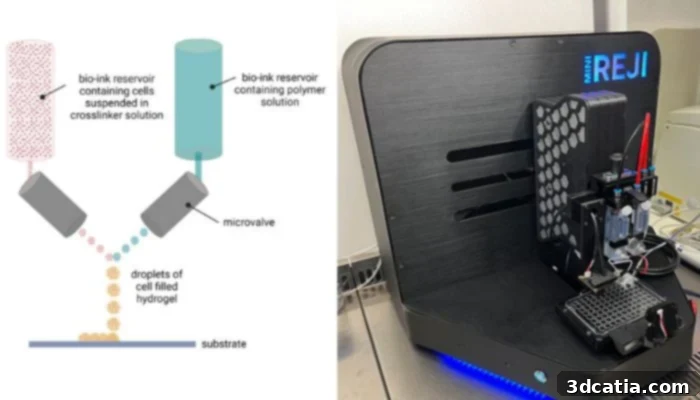
Left: Traditional 3D printing technology, and right: the advanced ReJI bioprinter developed by Jetbio.
So, how exactly does this revolutionary printing process work? At its core, Reactive Jet Impingement, or ReJI, is a sophisticated bioprinting technology that diverges significantly from conventional methods. It operates on a principle where two distinct liquid solutions are precisely sprayed against each other in mid-air. One of these liquids is a carefully formulated cross-linking solution, which serves as a scaffold component and contains a suspension of living cells—the very building blocks of the desired tissue. The second liquid is a specialized polymer solution, designed to react with the cross-linking agent upon contact. The magic happens during their instantaneous mixing: as these two liquids impinge and combine in the air, they rapidly form a cell-enriched hydrogel. This hydrogel is a soft, water-rich material that provides an ideal environment for cell survival, proliferation, and differentiation, closely mimicking the extracellular matrix found in natural tissues.
The immediate formation of this bio-ink allows for its subsequent 3D printing onto virtually any surface, offering unparalleled versatility for various applications. This innovative approach presents several key advantages over conventional bioprinting technologies. Most notably, the ReJI process is significantly faster, enabling the rapid creation of complex biological structures. Furthermore, it achieves an impressive cell density that is ten times higher than what is typically possible with older methods. This higher cell density is crucial for creating more robust and functional tissue constructs that closely resemble their natural human counterparts. The resulting tissues from ReJI bioprinting don’t just mimic the architecture of human tissue samples; they also exhibit similar mechanical and biochemical properties, making them invaluable for research and therapeutic development.
The unique capabilities of Reactive Jet Impingement (ReJI) technology position it as a pivotal tool in revolutionizing drug development, particularly for crucial in vitro cell culture tests. For decades, researchers have relied on traditional 2D models, where cells are typically grown on flat surfaces outside the body under artificial conditions. While these methods have provided foundational insights, they inherently fall short in accurately representing the complexity of the human body. In natural physiological environments, cells do not exist in isolation on a flat plane; instead, they interact dynamically within a three-dimensional matrix, influenced by neighboring cells, growth factors, and mechanical stimuli. This fundamental difference means that traditional 2D models often fail to predict how drugs will behave in a living organism, leading to misleading results and significant attrition rates in clinical trials.
This is precisely where ReJI technology makes a transformative impact. By enabling the precise printing of cells within a sophisticated 3D matrix, ReJI allows for the creation of tissue models that are far more biomimetic and physiologically relevant. These 3D constructs better reproduce the complex cellular interactions, structural integrity, and microenvironments found in human tissues and organs. The result is significantly more accurate and reliable drug testing, as the models can more realistically simulate how a drug will be absorbed, metabolized, distributed, and exert its therapeutic or toxic effects within a living system. This enhanced accuracy not only reduces the risk of costly failures in later stages of drug development but also helps to speed up the entire process by providing earlier and more dependable insights into a compound’s efficacy and safety profiles.
Beyond its scientific precision, the Jetbio method powered by ReJI technology offers substantial practical advantages. It is designed to be more economical than many existing advanced bioprinting solutions, which can often be prohibitively expensive for broader adoption. This cost-effectiveness makes advanced drug development technologies more accessible to a wider range of research institutions and pharmaceutical companies, fostering greater innovation across the industry. By streamlining the drug discovery process and reducing overall development costs, ReJI ultimately contributes to making life-saving and life-improving treatments more affordable and accessible to a larger patient population. The profound implications of these advancements have already garnered significant attention, with the Jetbio team having been invited to the Chamber of Deputies to present their groundbreaking technology and demonstrate its potential to optimize drug production on a national and global scale, showcasing its relevance beyond the lab bench.
Professor Kenny Dalgarno, a distinguished figure from the Faculty of Engineering at Newcastle University and the driving force behind Jetbio, eloquently articulated the pressing need for technologies like ReJI. He highlighted the formidable challenges inherent in the current drug discovery landscape: “Drug discovery is a complicated and extremely costly process involving multiple rounds of testing before they reach clinical trials. In clinical investigations, only one in ten of compounds tested proceeds to reach market. These rates of failure make it clear that we must improve our models so that they are more representative of drug response in humans. There is currently a lot of interest in developing better human in vitro models of diseases and tissues so we have better ways of testing drugs.” His statement underscores the critical bottleneck in pharmaceutical research, where a vast majority of promising compounds fail in late-stage clinical trials, not due to a lack of efficacy, but often because the initial testing models couldn’t accurately predict their behavior in complex human biology. ReJI directly addresses this by providing superior, high-fidelity human tissue models for early-stage screening.
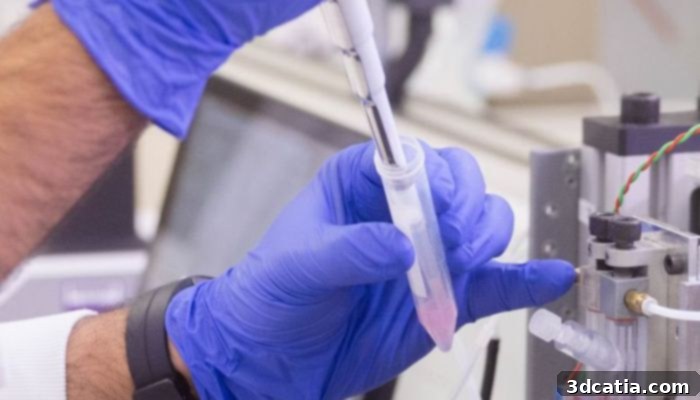
The Reactive Jet Impingement (ReJI) bioprinting technology is a rapid system for printing highly biomimetic gels, crucial for the development of advanced in vitro disease models for comprehensive drug testing.
Looking towards the future, the scientists at Newcastle University and Jetbio are not limiting ReJI’s application to drug screening alone. A significant area of focus is the development of personalized treatments, particularly for arthritis patients. The team aims to leverage ReJI technology to enable more personalized cell culture as an integral part of existing clinical procedures such as autologous chondrocyte implantation (ACI). ACI is a surgical procedure used to repair damaged cartilage in joints, where healthy cartilage cells are harvested from the patient, grown in a lab, and then reimplanted. ReJI’s ability to create high-density, biomimetic 3D cell constructs offers the potential to significantly improve the efficacy and success rate of ACI by providing a more robust and native-like environment for chondrocyte expansion and differentiation, leading to better long-term outcomes for patients. Lucy Donaldson, Director of Research at Versus Arthritis, enthusiastically affirmed the transformative potential of this research: “The JetBio team are in the vanguard of research driving forward new technologies that promise to improve both the quality and speed of drug development. These advances can potentially bring new drugs to the population sooner – and that applies to treatments for arthritis, cancer and cardiovascular disease. This is a very exciting leap forward.” Her statement underscores the broad impact ReJI is expected to have across multiple critical disease areas.
The future vision for ReJI bioprinters extends far beyond their current applications. It is anticipated that these advanced systems will be instrumental in treating a wide range of debilitating diseases. A prime example of this forward-thinking application is the EU-funded REBORN project, in which a dedicated team from Newcastle University is actively developing complex in vitro models of a human heart ventricle. Such models are indispensable for studying cardiac diseases, testing new cardiovascular drugs, and potentially for regenerative medicine applications, pushing the boundaries of what’s possible in treating heart conditions. The versatility and precision of ReJI make it an ideal platform for creating such intricate, functional tissues. To delve deeper into the innovative ReJI printer and explore the extensive research conducted at Newcastle University, interested readers can click HERE. Furthermore, to discover more about the pioneering startup Jetbio and its mission, detailed information is available by clicking HERE.
Adding another layer of insight into this groundbreaking technology, Professor Kenny Dalgarno, who serves as Jetbio’s Scientific Director, offers a comprehensive explanation of the process in the video below. He illustrates how ReJI technology is being meticulously utilized for the evolutionary manufacture of in vitro leukemia models, demonstrating its potential in understanding and combating complex blood cancers. This visual insight provides a unique opportunity to grasp the practical application and scientific rigor behind ReJI.
The introduction of ReJI technology by Newcastle University and Jetbio represents a significant leap forward in the fields of bioprinting, drug discovery, and regenerative medicine. By offering a faster, more economical, and significantly more accurate method for creating 3D human tissue models, ReJI is poised to accelerate the development of life-changing treatments for some of humanity’s most challenging diseases. This innovation not only addresses the critical shortcomings of traditional research models but also opens up new avenues for personalized medicine and accessible healthcare solutions globally.
What are your thoughts on the revolutionary ReJI technology and its potential impact on future medical treatments? We invite you to share your perspectives in a comment below or join the conversation on our LinkedIn, Facebook, and Twitter pages! Don’t forget to sign up for our free weekly Newsletter here to receive the latest 3D printing news straight to your inbox! You can also find all our insightful videos on our dedicated YouTube channel. For more comprehensive news and updates in the ever-evolving medical and dental sectors of 3D printing, explore additional content HERE.
*All Photo Credits: Jetbio and Newcastle University