
Driving the Future: How 3D Printing is Reshaping the Automotive Industry
The automotive industry stands on the precipice of its most significant transformation yet. Self-driving vehicles, electric powertrains, and connected cars are no longer distant dreams but rapidly approaching realities that will fundamentally alter our daily lives. This paradigm shift isn’t solely driven by traditional automotive giants like Volkswagen, Audi, and Daimler; a new wave of innovation is emerging from tech behemoths such as Google and Apple, alongside agile startups and visionary manufacturers who are boldly reimagining the very concept of mobility. Experts widely agree that this dynamic and intense competition is a powerful catalyst, propelling the automotive sector into a new era of growth and technological advancement.
At the heart of this revolution are groundbreaking technologies, with 3D printing (also known as additive manufacturing), artificial intelligence, and electric mobility leading the charge. These innovations are not only making vehicle production and operation vastly more efficient but are also paving the way for significantly more ecological solutions. From streamlined prototyping to the creation of lightweight, high-performance end-use parts, 3D printing is proving to be an indispensable tool. It offers unparalleled design freedom, enables rapid iteration, and opens doors to new material possibilities that were once unthinkable. In this article, we delve into some compelling examples of how 3D printing is making a tangible impact on the automotive industry, showcasing its pivotal role in shaping the vehicles of tomorrow.
BMW Pioneers with Additive Manufacturing for the iX Series Production
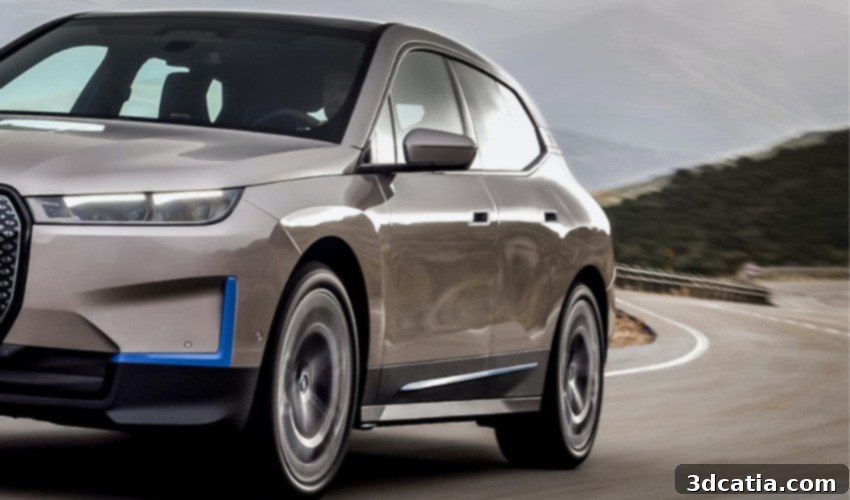
As the automotive industry navigates its “third revolution,” characterized by the convergence of diverse cutting-edge technologies, many companies are strategically specializing in the development of sophisticated parts and systems. BMW, a long-time proponent of advanced manufacturing, exemplifies this approach through its collaborative efforts with technology leaders like Intel and Mobileye to bring the revolutionary BMW iX to market. This all-electric Sports Activity Vehicle (SAV) is not just about zero emissions; it represents a leap forward in automotive connectivity and intelligence, leveraging 5G data transmission to usher in an unprecedented era of car-to-X communication. This connectivity allows vehicles to communicate with each other, infrastructure, and the cloud, enhancing safety and efficiency.
BMW has been at the forefront of embracing additive manufacturing for a variety of applications, from rapid prototyping and tooling to producing complex vehicle components. The company’s dedicated Additive Manufacturing Campus in Munich is a testament to this commitment, annually producing over 100,000 parts from both metal and plastic using diverse 3D printing technologies. This facility serves as a critical hub for innovation, enabling engineers to quickly test and validate new designs and functionalities. For the unveiling of the iX model, BMW showcased a striking 3D-printed radiator grille. This intricately designed component not only serves an aesthetic purpose but also subtly embodies the intelligent, technologically advanced platform beneath, acting as a “fusion surface” where cameras, radar functions, and other sensors are integrated seamlessly behind a transparent surface. While the exact extent of 3D printing’s application in the full-scale production launch of the BMW iX remains under close observation, its strategic use in critical prototypes and functional components underscores BMW’s vision for leveraging additive manufacturing to achieve unparalleled design flexibility, lightweighting, and functional integration. The market launch for the iX is slated for the end of the year, signaling a significant step towards the integration of these advanced manufacturing methods into mainstream automotive production.
Hyundai’s TIGER-X1: Unleashing Unmanned Exploration with Advanced 3D Printing
Beyond conventional vehicles, the spirit of innovation in the automotive sector is also driving companies to explore new frontiers of mobility, often integrating additive manufacturing into their core development and production processes. A prime example comes from the South Korean automotive giant, Hyundai. In a remarkable collaboration with Autodesk, Hyundai has unveiled an ambitious project: the TIGER (Transforming Intelligent Ground Excursion Robot) – an extraordinary four-legged robotic vehicle concept. Developed by Hyundai’s New Horizon Studio in California, this pioneering vehicle is the result of extensive transportation studies, designed to push the boundaries of off-road and extraterrestrial exploration. The TIGER-X1 is envisioned as a potential future model for unmanned lunar and moorland expeditions, capable of traversing terrains that are impassable for traditional wheeled vehicles.
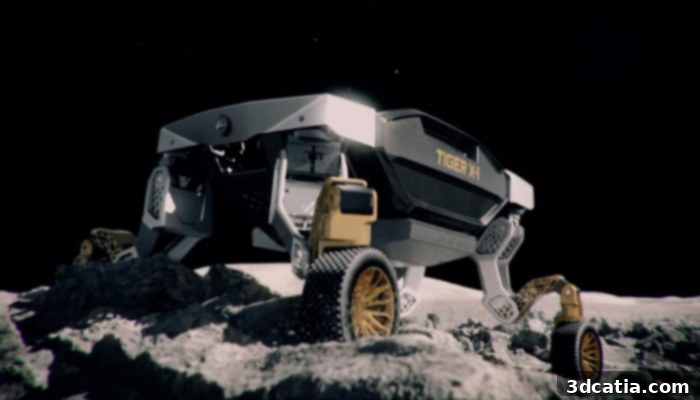
The TIGER-X1 could revolutionize lunar expeditions with its advanced design and 3D printed components (photo credits: Hyundai)
The New Horizon Studio, an integral part of the Hyundai Motor Group, is driven by the mission to enable mobility that transcends conventional roads. The TIGER-X1 is engineered to conquer otherwise inaccessible terrains, such as the rugged surface of the moon or challenging moorlands. To achieve this extraordinary capability, the robot employs a sophisticated combination of 360-degree sensors for comprehensive environmental awareness and highly flexible robotic legs, allowing it to walk, crawl, or even roll over obstacles. Crucially, the chassis and the specialized tires of the TIGER-X1 are manufactured using advanced 3D printing processes. For its filament, Hyundai has strategically chosen carbon fiber as a composite material. This choice is vital due to carbon fiber’s exceptional properties: it offers incredible strength and resistance to extreme conditions while maintaining an impressively light weight, a critical factor for space exploration and energy efficiency. Furthermore, Hyundai Mobis, the dedicated automotive supplier for the Hyundai-Kia Group, has made a significant investment of $2.8 million into a specialized workshop focused on 3D printing-assisted prototyping of vehicle parts, underscoring their commitment to additive manufacturing. The company also reported substantial optimizations in its additive manufacturing workflows thanks to Materialise’s Streamics software. According to Hyundai, the implementation of this software has resulted in an astonishing 77% reduction in labor hours previously required during the prototyping process, demonstrating the immense efficiency gains enabled by integrating sophisticated software with additive manufacturing.
PIX Moving Employs WAAM for Lightweight, Autonomous Chassis Production
The evolving landscape of mobility has created fertile ground for innovative young companies to challenge established norms and outshine traditional manufacturers with fresh, sophisticated business models. PIX Moving, a startup founded in 2014, perfectly embodies this trend. By synergistically combining robotics, advanced digital manufacturing processes, and cutting-edge metal 3D printing, PIX Moving is poised to revolutionize multiple facets of the automotive industry simultaneously. Their product portfolio includes a range of modular, autonomous vehicle chassis platforms, such as the PIXBOT and the PIXLOOP. These innovative chassis are produced using Wire-Arc Additive Manufacturing (WAAM), a robust metal 3D printing technology that is also known as additive welding.
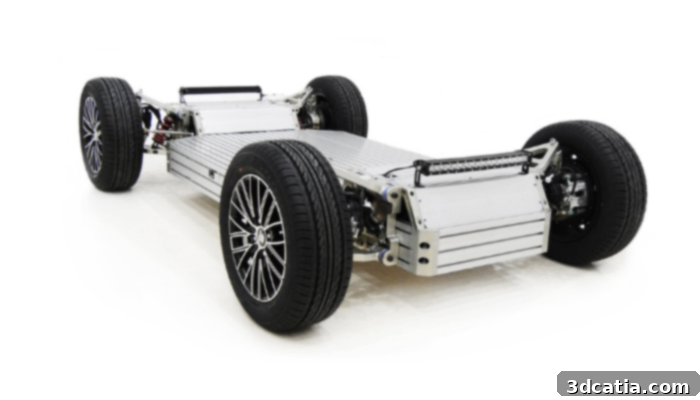
The PIX LOOP, an autonomous chassis, exemplifies the power of WAAM 3D printing for large-scale metal components (photo credits: PIX MOVING)
WAAM technology is particularly well-suited for the efficient production of large, high-quality metal components and end products. Unlike some other additive processes, WAAM leverages readily available welding wire and equipment, making it a cost-effective solution for manufacturing substantial structures. PIX Moving further enhances this process by integrating generative design principles into the production of its autonomous chassis. This design methodology is supported by an innovative, company-designed algorithm called the “Slime Mold Algorithm.” This advanced algorithm plays a crucial role in optimizing designs by performing static finite element analysis (FEA) and conducting stress and deformation simulations. Through these sophisticated computational methods, the algorithm iteratively refines the design to achieve optimal structural integrity, material efficiency, and performance. Once the algorithm generates an optimized model, it undergoes rigorous review by human collaborators, who can then perform any necessary rework or fine-tuning.
PIX Moving’s ambitious goal is to leverage WAAM technology to accelerate the mass production of chassis structures specifically designed for autonomous vehicles. By employing this method, the company aims to achieve significant weight savings in their chassis, which directly translates to improved energy efficiency and extended range for electric autonomous vehicles. Furthermore, WAAM drastically reduces lead times compared to traditional manufacturing methods, enabling faster product development cycles and quicker market deployment. According to PIX Moving, the strategic application of 3D printing is projected to slash manufacturing costs by an impressive 60% and reduce overall lead times by approximately 75%. These dramatic improvements highlight the transformative potential of additive manufacturing not just for prototyping, but for the full-scale, cost-effective production of critical structural components in the future of mobility.
The Road Ahead: 3D Printing’s Enduring Impact on Automotive Innovation
The examples from BMW, Hyundai, and PIX Moving vividly illustrate that 3D printing is far more than a niche technology; it is a foundational pillar supporting the ongoing revolution in the automotive industry. From accelerating design iterations and prototyping to enabling the production of high-performance, lightweight end-use parts, additive manufacturing is redefining what’s possible. It empowers engineers with unprecedented design freedom, facilitates the use of advanced materials like carbon fiber composites, and significantly streamlines complex manufacturing workflows. This leads to vehicles that are not only more efficient and sustainable but also safer and more adaptable to future demands, whether on urban streets or distant celestial bodies.
As we look to the future, the influence of 3D printing in automotive is only set to grow. Expect to see continued advancements in materials, faster print speeds, and larger build volumes, paving the way for even more widespread integration. The ability to produce highly customized components on demand, optimize supply chains, and enable localized manufacturing will become increasingly critical in a world demanding greater flexibility and sustainability. Ultimately, additive manufacturing is empowering the automotive industry to push beyond conventional limits, driving innovation, and accelerating the journey towards a smarter, more connected, and truly revolutionary future of mobility.
What are your thoughts on the pivotal role 3D printing is playing in revolutionizing mobility? We’d love to hear your insights! Share your comments below or engage with us on our Linkedin, Facebook, and Twitter pages! Don’t miss out on the latest advancements in additive manufacturing—sign up for our free weekly Newsletter here to get the freshest 3D printing news delivered straight to your inbox. You can also explore our extensive video library on our YouTube channel for more in-depth content.
*Thumbnail Photo Credits: BMW