
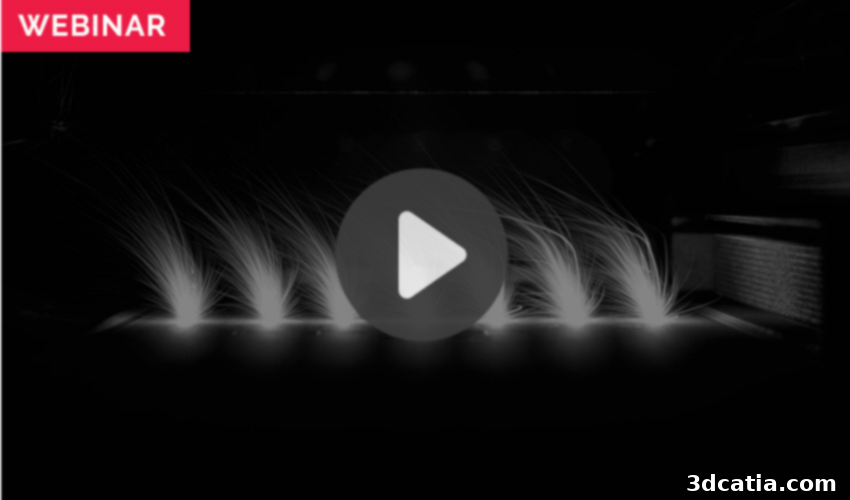
Mastering L-PBF: Revolutionizing Metal 3D Printing with Advanced Process Control
In the rapidly evolving landscape of industrial metal 3D printing, Laser Powder Bed Fusion (L-PBF) stands out as a transformative technology for manufacturing complex, high-performance components. However, achieving consistent quality, reliability, and repeatability in L-PBF has long been a significant challenge. This is precisely why process control in L-PBF is often heralded as the “holy grail” for industrial additive manufacturing. While historically a specialized offering from a select few companies and machines, sophisticated process control systems are now fundamentally reshaping the industry, dramatically reducing production errors and paving the way for the creation of exceptionally high-quality parts.
The imperative for robust process control in L-PBF stems from the inherent complexities and costs associated with this advanced industrial process. Working with fine metal powders, powerful lasers, and precisely controlled thermal environments leaves virtually no margin for error. Even minor deviations can lead to critical defects, material waste, increased scrap rates, and significant financial losses. Consequently, integrating advanced process control mechanisms is not merely an advantage; it’s an absolute necessity for producing top-tier metal parts. These parts are destined for demanding end-use applications across vital sectors such as the automotive, aerospace, and medical industries, where failure is simply not an option. From lightweight structural components in aircraft to intricate medical implants and high-performance automotive parts, the integrity and performance of these additively manufactured components are directly tied to the precision and control exerted during their creation.
Understanding the Core of L-PBF Process Control
Process control in L-PBF involves the real-time monitoring, analysis, and adjustment of key parameters during the entire build process. This multi-faceted approach ensures that each layer is fused optimally, leading to consistent material properties and geometric accuracy throughout the component. Without this stringent oversight, variations in laser power, scan speed, powder layer thickness, chamber temperature, and other environmental factors can introduce porosity, residual stresses, or microstructural inconsistencies that compromise the part’s mechanical performance and structural integrity. Effective process control addresses these variables proactively, minimizing the risk of defects and maximizing the probability of first-time-right builds.
The journey towards achieving reliable and repeatable L-PBF parts can be significantly streamlined by leveraging expert insights and cutting-edge solutions. To shed light on the advancements and ongoing challenges in this crucial field, 3Dnatives hosted a compelling webinar titled “Progress & Current Challenges in Online Process Control for L-PBF.” This insightful session, which originally took place on March 30th at 4 PM CEST (10 AM EDT), provided attendees with an invaluable opportunity to delve deeper into the mechanics of process control in L-PBF, exploring how it functions and how industrial users can effectively harness its capabilities to enhance their additive manufacturing operations. The webinar brought together leading voices and innovators in the field, offering a comprehensive look at the state of the art.
Expert Perspectives from Industry Leaders
The webinar featured an esteemed panel of speakers, including Dr. Yves Hagedorn, the accomplished CEO of Aconity3D, and Ryan Sommerhuber, an expert Application Engineer from XARION Laser Acoustics. Aconity3D stands at the forefront of the industry, widely recognized for developing and implementing sophisticated process control solutions that empower manufacturers to achieve unparalleled precision and quality in their L-PBF operations. Their commitment to innovation drives the advancement of industrial metal 3D printing. Complementing this expertise, XARION Laser Acoustics contributes a unique technological perspective. Their groundbreaking work focuses on developing the world’s first membrane-free optical microphone, a revolutionary sensor technology with no moving parts. This innovative sensor is critically dependent on advanced process control solutions to function optimally, showcasing the symbiotic relationship between cutting-edge sensing and precise control in high-tech manufacturing environments.
Key Solutions and Discussions from the Webinar
The 3Dnatives webinar was instrumental in presenting a diverse array of efficient solutions designed to enable reliable process control in L-PBF. The discussions ranged from fundamental aspects, such as achieving full control over applied parameter sets, to more advanced topics, including automated inline process adaptations and the strategic application of modifiable beam shapes for comprehensive temperature regulation. Attendees gained a nuanced understanding of how these technological advancements contribute to more robust and predictable manufacturing outcomes.
One of the highlighted topics included how applied parameter sets can be accessed and manipulated remotely via an open Python API. This innovative approach offers unprecedented flexibility, enabling customers to develop highly specific build routines tailored to unique material properties or part geometries. Furthermore, it facilitates sophisticated off-line, layer-to-layer parameter adaptation, allowing for intricate adjustments that can significantly optimize the printing process for complex parts or challenging materials. This level of programmability and remote access empowers engineers to fine-tune processes with precision, leading to superior material characteristics and reduced development cycles.
The webinar also featured an in-depth discussion on automated inline process control, a critical area for achieving real-time quality assurance in L-PBF. This segment involved a comparative analysis of characteristics from various sensor types specifically designed for extracting vital process information during the print. From thermal cameras monitoring melt pool dynamics to acoustic sensors detecting irregularities and optical sensors capturing surface morphology, the session explored the strengths and applications of each. Building on this, a comprehensive approach for true inline process adaptation was presented. This advanced methodology integrates data from multiple sensors with intelligent algorithms, allowing the system to make real-time adjustments to print parameters. Such dynamic control ensures consistent melt pool stability, optimal material densification, and minimized internal defects, thereby pushing the boundaries of what is achievable in industrial metal 3D printing.
For those who missed the live session or wish to revisit the valuable insights shared by these industry leaders, a replay of the webinar is available. This allows ongoing access to the crucial discussions and technical breakdowns that illuminate the path forward for L-PBF process control.
Meet the Visionary Speakers:
Dr. Yves Hagedorn, CEO of Aconity3D: Dr. Hagedorn brings a rich academic and professional background to the field of additive manufacturing. He completed his comprehensive studies in mechanical engineering, business administration, and automation at both RWTH-Aachen and INSA Lyon (France). From 2009 to 2014, his work at the renowned Fraunhofer Institute for Laser Technology was dedicated to pioneering research in high-temperature L-PBF, culminating in the achievement of his Ph.D. degree. Since 2017, Dr. Hagedorn has served as the managing director of Aconity3D GmbH, where his leadership is strongly focused on developing cutting-edge solutions for state-of-the-art laser-based metal additive manufacturing. His expertise lies in transforming research insights into practical, industrial-grade process control systems.

Ryan Sommerhuber, Application Engineer at XARION Laser Acoustics: Ryan Sommerhuber’s academic journey began with a degree in material science from the University of Applied Sciences Koblenz (Germany). He then pursued a Master’s degree in Music Technology at the Cork Institute of Technology (Ireland), where he specialized in acoustics and recording engineering—a unique blend of skills that underpins his current work. In 2017, Ryan joined XARION Laser Acoustics as an application engineer. His primary focus involves leveraging the company’s revolutionary Optical Microphone technology to develop advanced acoustic process monitoring solutions. His work is crucial in applying highly sensitive, membrane-free acoustic sensing to real-world industrial challenges, particularly in environments requiring precise, non-contact measurement for process control.
The Future is Controlled: Enhancing Industrial Metal 3D Printing
The continuous advancement of process control in L-PBF is not just about incremental improvements; it represents a paradigm shift in how metal parts are conceived, designed, and manufactured. By enabling greater reliability, repeatability, and predictability, these control systems reduce material waste, shorten lead times, and ultimately lower the cost per part, making additive manufacturing more competitive for large-scale industrial applications. The ability to monitor and adapt processes in real-time ensures that every part meets stringent quality requirements, opening up new possibilities for innovation in critical sectors.
Whether you’re looking to enhance your understanding of L-PBF process control or simply stay abreast of the latest innovations, resources like the “Progress & Current Challenges in Online Process Control for L-PBF” webinar are invaluable. We encourage you to engage with the additive manufacturing community. Let us know your thoughts on process control in L-PBF by leaving a comment below or connecting with us on our Facebook, Twitter, and LinkedIn pages! Furthermore, ensure you don’t miss out on any critical industry updates by signing up for our free weekly Newsletter, which delivers all the latest news in the 3D industry directly to your inbox!