
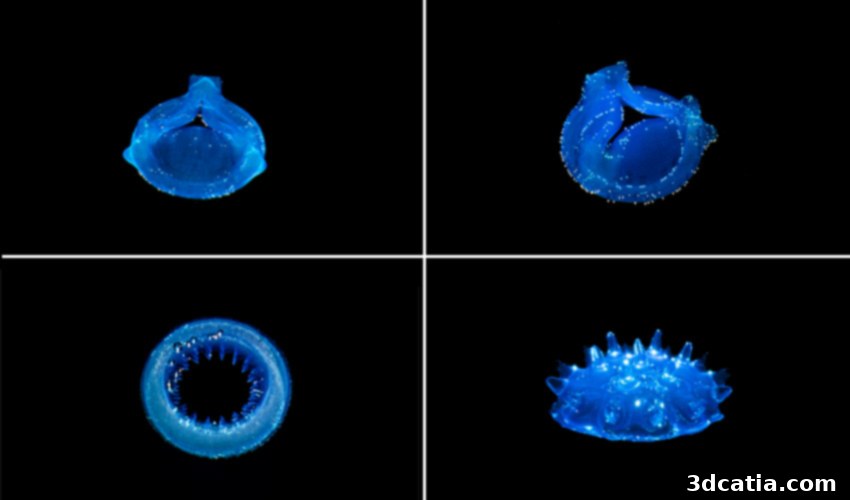
Revolutionizing Healthcare: Readily3D’s Volumetric Bioprinting Paves the Way for Rapid Organ Models and Diabetes Breakthroughs
In the rapidly evolving landscape of additive manufacturing, Readily3D, an innovative Swiss startup, stands at the forefront, pioneering a groundbreaking volumetric 3D printing method. This revolutionary technology enables the creation of intricate, organic shapes within mere seconds – a stark contrast to the conventional layer-by-layer approach that has long defined the industry. Leveraging the principles of tomography, similar to medical imaging, Readily3D has engineered its initial 3D printer to solidify an entire object simultaneously. This transformative capability holds immense promise for the medical sector, offering the potential to swiftly and reliably manufacture complex biological structures, including human tissues, organs, and highly accurate medical models invaluable for surgical planning and training.
A testament to its profound impact, Readily3D recently unveiled its significant preliminary work on the pancreas. As a key participant in the European ENLIGHT project, the startup successfully bioprinted organic tissues of this vital organ. This achievement represents a monumental leap forward in the global fight against diabetes, offering unprecedented tools for research and therapeutic development. To delve deeper into the intricacies of volumetric bioprinting and understand the ambitious future endeavors of the company, we had the privilege of speaking with Damien Loterie, co-founder of Readily3D, whose insights illuminate the path forward for this disruptive technology.
Introducing Readily3D: A Vision Born from Swiss Innovation
“My colleagues, Paul Delrot and Christophe Moser, and I proudly co-founded Readily3D SA,” begins Damien Loterie. “Our company emerged as a spin-off from the prestigious Swiss Federal Institute of Technology in Lausanne (EPFL), a hub of scientific and technological innovation. Our core mission is to commercialize a novel 3D printing technology, which we term ‘volumetric,’ fundamentally based on the principles of tomography.” The genesis of this advanced technology traces back to 2017, stemming directly from the extensive and pioneering research that Paul and Damien had been meticulously conducting during their doctoral studies within Professor Christophe Moser’s cutting-edge laboratory. This deep academic foundation provided the intellectual rigor and experimental validation necessary to transform a revolutionary concept into a commercially viable and impactful solution for advanced manufacturing.
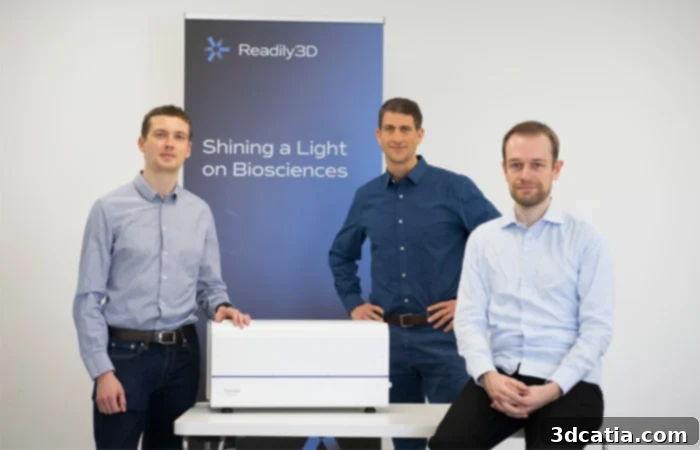
From left to right: Paul Delrot, Christophe Moser, Damien Loterie, the founders of Readily3D, who are spearheading the volumetric bioprinting revolution.
The Genesis of the ENLIGHT Project: A Collaborative Medical Breakthrough
The ENLIGHT project, a beacon of collaborative medical innovation, did not emerge overnight. “This significant project is the culmination of a long-standing and fruitful collaboration between our dedicated team at Readily3D and the esteemed group led by Professor Riccardo Levato at UMC Utrecht in the Netherlands,” Damien explains. Following a series of highly successful preliminary trials involving various other cell types, Professor Levato conceived the visionary idea of applying Readily3D’s unique tomographic printing technology specifically to pancreatic cells. The primary objective was ambitious yet critical: to generate more anatomically and functionally representative models of the pancreas than what could be achieved through conventional two-dimensional cell cultures. This endeavor capitalized on two pivotal advantages of Readily3D’s printers: their unparalleled speed and their exceptional ability to intricate complex vascular networks directly within the bioprinted objects. Given the pancreas’s central and crucial role in the pathogenesis of diabetes, the capacity to obtain highly realistic, three-dimensional simulations of this organ through advanced bioprinting techniques promises to dramatically accelerate and facilitate the discovery and development of novel therapeutic strategies and cures for this widespread condition.
Unpacking Readily3D’s Revolutionary Volumetric Printing Technology
At the heart of Readily3D’s innovation lies a paradigm shift in 3D printing methodology. “Unlike conventional systems such as extrusion or stereolithography, which painstakingly build objects layer by layer, our 3D printer solidifies the entire object in one swift action,” Damien elucidates. This fundamental distinction is key to understanding its efficiency and capabilities. The core principle underpinning this method is tomography, a concept familiar from medical imaging, where it’s used to generate detailed cross-sectional images. However, Readily3D ingeniously re-purposes this technology not for imaging, but for the precise manufacturing of three-dimensional objects. The process begins with sophisticated software that calculates tomographic projections of the desired object from a multitude of angles, spanning a full 0 to 360 degrees. Subsequently, the printer orchestrates the delivery of these intricate projections as finely tuned light beams into a rotating volume of photosensitive resin. In a remarkable display of technological prowess, within mere tens of seconds, the fully formed object materializes, suspended precisely within the resin, ready for retrieval and post-processing.
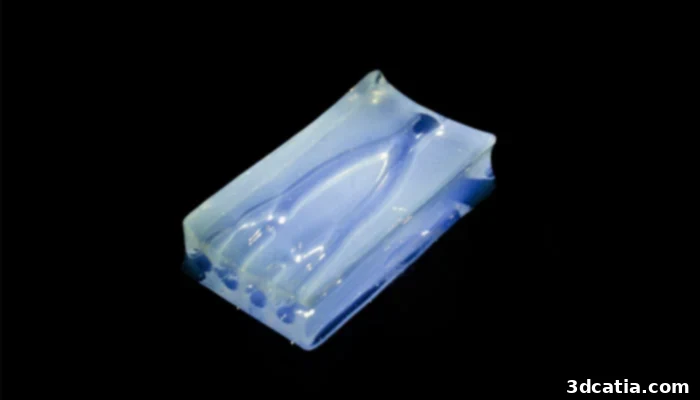
In a few seconds, Readily3D’s technology enables the design and creation of complex organic shapes, showcasing the speed and precision of volumetric bioprinting (photo credits: Readily3D).
The versatility of this method is another significant advantage. “Our technology is compatible with a broad spectrum of photosensitive materials,” Damien confirms, “including commonly used acrylates, silicones, and various hydrogels. Generally, any material that functions effectively with DLP or stereolithography machines will also yield excellent results with our volumetric printer.” Precision is paramount in bioprinting, and Readily3D’s machine delivers an impressive optical resolution of 40 micrometers, enabling the replication of fine biological structures. The current printing volume, perfectly optimized for bioprinting applications, is a cylinder measuring 10mm in diameter and 27.5mm in height. Furthermore, the printer itself is designed for convenience and accessibility, boasting a compact footprint of just 30cm x 40cm x 60cm, making it easily deployable on a standard desk or laboratory bench, thus integrating seamlessly into existing research environments.
The Distinct Advantages of Volumetric Bioprinting for Medical Applications
Volumetric printing distinguishes itself from conventional methods through a multitude of compelling advantages, particularly crucial for delicate bioprinting applications. “Its most striking feature is its exceptional speed, boasting a printing time of approximately 30 seconds,” Damien highlights. This unprecedented rapidity is not merely a convenience; it is a critical factor when dealing with living cells, minimizing exposure to external stressors and dramatically accelerating research cycles. Beyond speed, this method excels in realizing exceptionally complex organic shapes, complete with intricate internal vessels, cavities, and smooth surfaces, oriented in any direction. This capability represents a significant breakthrough, as traditional layer-by-layer printers are inherently limited to building structures through vertical stacking, often struggling with overhangs and internal complexity without extensive support structures. Volumetric printing, by solidifying the entire object simultaneously, overcomes these geometrical constraints, allowing for truly biomimetic designs.
“In addition to sheer speed and design freedom, we offer the significant benefit of non-contact printing,” Damien continues. This crucial feature allows the printing process to occur within sterilized and resealable glass vials. This hermetic environment provides unparalleled protection for the biomaterials and living cells from external contamination, a paramount concern in biological research and medical applications. Furthermore, this controlled environment facilitates the use of a wider range of materials, including more viscous resins or even materials in gel form, which might be challenging to process with other printing techniques. These combined advantages culminate in an excellent preservation rate for living cells. We consistently achieve a remarkable cell viability of approximately 80% to 90% after 7 days post-printing. This high viability is especially critical for the study of fragile cells, which often do not withstand the mechanical stresses, prolonged processing times, or environmental exposures inherent in classical extrusion printing methods. Readily3D’s technology thus opens new avenues for researchers to work with sensitive biological materials, pushing the boundaries of what is possible in regenerative medicine and drug discovery.
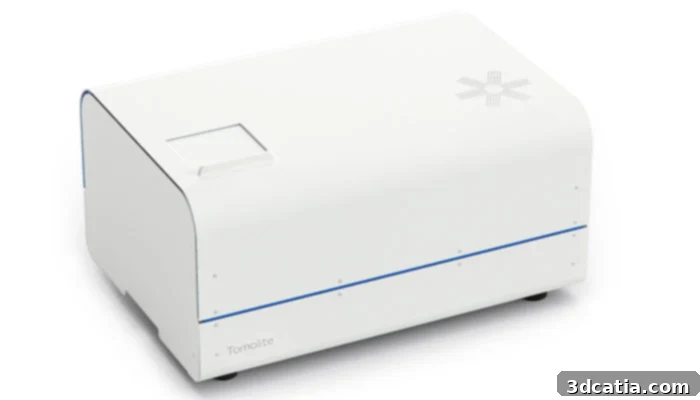
The compact and highly efficient 3D printer developed by the Swiss startup Readily3D, poised to transform bioprinting capabilities (photo credits: Readily3D).
Addressing the Limits and Future Challenges of Volumetric Bioprinting
While volumetric printing presents numerous advantages, it also comes with specific inherent limitations and exciting challenges that Readily3D is actively addressing. “As our method relies on light projections passing through the resin, it is inherently not suitable for materials that are completely opaque,” Damien acknowledges. This optical requirement defines a boundary for material selection, though the range of compatible translucent and photosensitive materials remains extensive. Looking to the immediate future, Readily3D has set its sights on several key areas for improvement and expansion. These include the development of ‘overprinting’ capabilities, which would allow for multi-material printing within a single, continuous process, opening doors to even greater biological complexity and functionality. Additionally, ongoing efforts are focused on further enhancing the resolution of the printed objects, enabling even finer and more intricate cellular architectures.
Longer-term goals include a significant increase in the size of the printing volume. “Considering current material capabilities, the printing volume can theoretically reach up to 100mm in diameter, and is not limited in height,” Damien explains. However, he also provides a pragmatic perspective: “That said, the applications we are currently focusing on primarily necessitate a smaller scale. Particularly in bioprinting, the centimeter scale is often preferred due to the inherent difficulty and resource intensiveness of growing and maintaining living cells in larger numbers. Expanding the volume must be balanced with the biological realities of cell culture and viability.” This strategic approach ensures that Readily3D’s development aligns precisely with the most pressing and achievable needs within the bioprinting and medical research communities, pushing boundaries while maintaining practical relevance and biological integrity.
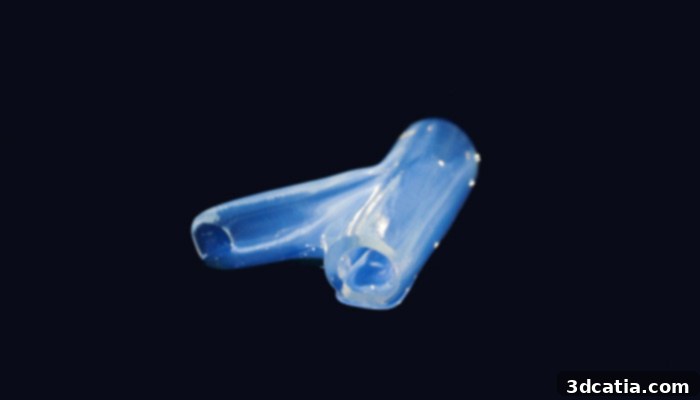
An intricate structure created using Readily3D’s volumetric printing technology, demonstrating its capability for complex biological forms (Photo Credits: Readily3D).
Accelerating Medical Innovation: 3D Printing’s Role in Diabetes Research and Beyond
Readily3D’s pioneering work, particularly in designing pancreas models for diabetes research, underscores the profound impact 3D printing can have on the medical industry. “The development of new therapies is an arduous and time-consuming process, frequently relying on extensive trials involving dozens, or even hundreds, of molecular combinations,” Damien emphasizes. “3D bioprinting offers a transformative solution by enabling the rapid, controlled, and repeatable production of highly realistic organ pieces. These bioprinted models serve as superior platforms for conducting these critical tests, being far more representative of the complex human body than traditional cell cultures or tissues extracted from animals.” This enhanced representativeness translates directly into faster and more reliable responses regarding drug efficacy and safety, significantly streamlining the preclinical research phase. Moreover, a truly groundbreaking aspect is the ability, in certain instances, to directly utilize a patient’s own cells for bioprinting. This capability ushers in an era of highly personalized medicine, allowing for studies to be conducted in an extremely targeted manner, predicting individual patient responses with greater accuracy. “This ability to dramatically accelerate and personalize the development of therapies is the paramount advantage of 3D printing,” Damien affirms. Looking to the future, the sophisticated tools and refined procedures that Readily3D is developing today for research purposes hold the potential to evolve into technologies for even more ambitious goals, such as direct regeneration of damaged tissues or even the complete replacement of organs within a patient, fundamentally changing the landscape of clinical treatment.
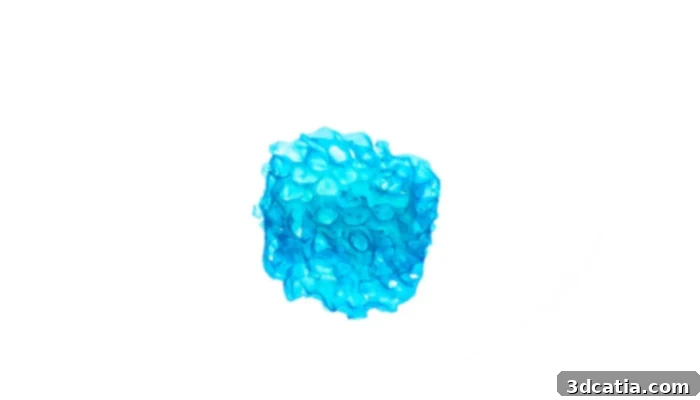
Volumetric bioprinting dramatically accelerates the process of designing and fabricating complex organ models, a critical advancement for medical research and personalized therapies (photo credits: Readily3D).
Readily3D is committed to expanding its collaborative network with leading research centers worldwide, tackling hitherto unsolved bioprinting challenges, especially concerning the cultivation and printing of the most fragile cells and the scaling up of bioprinting to larger volumes. “In the future, we are excited to extend this cutting-edge printing technology to other diverse fields where precision and speed are equally critical, such as audiology and dentistry, where we are already witnessing promising initial results,” Damien concludes. The field of 3D printing is in a constant state of dynamic evolution, and Readily3D is at its leading edge. We invite you to stay abreast of our latest innovations, breakthroughs, and exciting developments by following our LinkedIn page and regularly visiting our official website!
What are your thoughts on Readily3D’s groundbreaking work in volumetric bioprinting? We’d love to hear from you! Let us know your opinions and insights in a comment below or engage with us on ourFacebook,Twitter, andLinkedIn pages! Don’t miss out on the latest advancements in additive manufacturing – sign up for our free weeklyNewsletter here and get the freshest 3D printing news delivered straight to your inbox!