
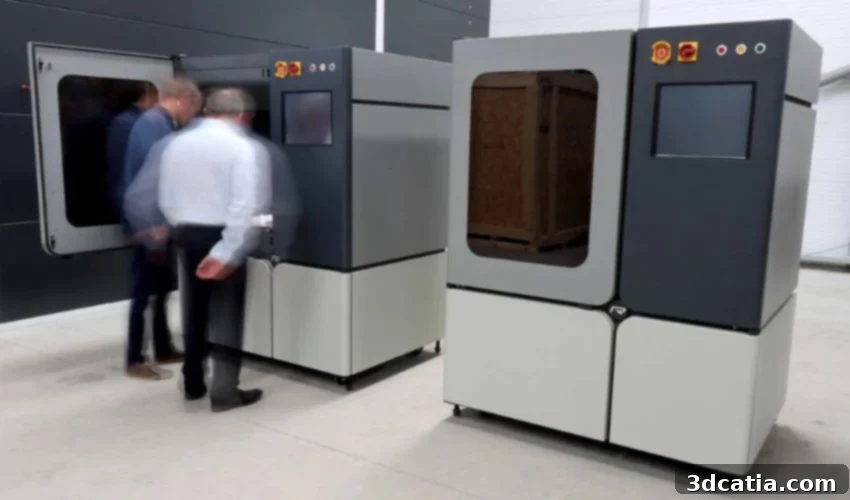
Raplas Technologies: Redefining Industrial 3D Printing with Unmatched Accuracy, Flexibility, and Production-Ready SLA Solutions
Raplas Technologies is swiftly establishing itself as a pioneer in the industrial 3D printing landscape, operating from its strategic base in the UK. Co-founded by Richard Wooldridge and Paul Freeman, two visionaries who each bring over three decades of invaluable experience to the table, this British manufacturer is dedicated to advancing resin additive manufacturing. Their core mission is to provide robust solutions that consistently deliver exceptional accuracy and unwavering repeatability, critical factors for demanding industrial applications. The company’s impressive portfolio already features three cutting-edge, laser-based SLA systems, meticulously engineered to meet the stringent requirements of demanding sectors such as automotive and defense – industries that have long encountered the limitations of conventional additive manufacturing equipment. We recently had the privilege of sitting down with the founders, Richard and Paul, to delve into what makes Raplas Technologies so profoundly innovative and why their solutions are truly invaluable assets for industrial users striving for higher levels of production and performance.
3DN: Can you introduce yourself and your link with additive manufacturing?

Richard Wooldridge
Richard: Hello, I’m Richard Wooldridge, and I am proud to be one of the co-founders of Raplas Technologies. My journey in the professional world began long before Raplas. In my previous role, I served as a dedicated 3D printing technical specialist for the Ford Motor Company, a position that allowed me to witness and contribute to the evolution of this technology firsthand. Over my extensive 35-year professional career, I have been intimately involved with 3D printing from its very nascent stages. This involvement included rigorous testing and evaluation of nearly every significant additive manufacturing technology that emerged, providing me with a comprehensive understanding of its capabilities and limitations.
Upon my retirement from Ford, a lifelong dream finally became a tangible opportunity: to design and build a 3D printer from the ground up, one that would truly perform as it should, without the compromises I had often encountered. It was around this time that Paul and I found ourselves in a remarkably similar position, both driven by a shared vision for what industrial additive manufacturing could and should be. Recognizing the synergy in our experiences and aspirations, we decided to join forces, combining our expertise to create Raplas Technologies. Our goal was clear: to push the boundaries of what was achievable in industrial 3D printing.

Paul Freeman
Paul: Hello, my name is Paul Freeman, and much like Richard, my introduction to 3D printing dates back approximately 30 years. My professional journey in this field commenced in 1994, working in a dynamic service bureau that extensively utilized 3D Systems SLA machines. This early exposure provided me with deep insights into the practical applications and operational challenges of stereolithography technology.
My foundational background is rooted in engineering, manufacturing systems, and design. From the very beginning of my career, I was captivated by the potential of these 3D printers, but also keenly aware of their inherent limitations. This led me to constantly contemplate how these machines could be optimized and modified to achieve greater efficiency and versatility. I often envisioned enhancements, such as integrating an additional laser to boost throughput or exploring new ways to expand material compatibility. This persistent drive for improvement and innovation ultimately paved the way for the creation of Raplas Technologies, where we strive to turn these early concepts into reality.
3DN: Why did you create Raplas Technologies?
Richard: The impetus behind creating Raplas Technologies stemmed from a profound frustration with the state of industrial 3D printing at the time. You have to understand that back then, the machines were completely proprietary and ‘locked down’ across all critical aspects: materials, servicing, and maintenance. This meant that every single component, every consumable, and all support services had to be sourced exclusively from the original equipment manufacturer (OEM), which was not only incredibly costly but also stifled innovation and user autonomy. This lack of flexibility was immensely frustrating for industrial users who needed to iterate quickly, experiment with new materials, and optimize processes for their specific production needs. We created Raplas Technologies directly out of that frustration with existing 3D printers that were inflexible, restrictive, and ultimately prevented users from building parts exactly the way they envisioned. Our fundamental and unwavering principle from day one has been that customers should possess the absolute freedom to utilize their machines in any manner they deem fit, without artificial constraints.
Paul: Driven by this shared vision of an open and flexible additive manufacturing ecosystem, we embarked on developing our own SLA machines. We strategically chose stereolithography technology because it represented the most widely adopted and versatile plastic-based 3D printing process, offering the greatest inherent scope for material development and innovation. This choice allowed us to leverage extensive existing knowledge while also pushing new boundaries. Furthermore, by starting from scratch, we were uniquely positioned to integrate the very latest advancements in production processes. This included cutting-edge motion control systems for unparalleled precision, sophisticated laser control for superior detail, and real-time dynamic control algorithms to ensure consistent quality and adaptability. These technological foundations enabled us to create genuinely better, more responsive, and more efficient solutions for industrial users.
When a customer invests in one of our machines, they are not just buying a piece of hardware; they are acquiring the inherent right and the freedom to use it however they choose. If a user wishes to experiment with something unconventional, perhaps a new material or a unique build style, our machines are designed to seamlessly handle it. Our processes, proprietary software, and integrated systems are all meticulously engineered to fully support this unparalleled flexibility. We are firm believers that this truly open approach is the only viable path for the 3D printing industry to decisively transition from its origins in rapid prototyping to becoming a mainstream technology for full-scale industrial production, unlocking its true potential.
3DN: Can you tell us what Raplas offers in terms of machines, materials and software?
Richard: Our current portfolio proudly showcases three advanced laser-based SLA machines: the PR 450, the PR 700, and the PR 800. The primary distinction among these systems lies in their respective building volumes, allowing customers to select the machine that best fits their specific part size and production capacity requirements. The PR 450 is ideal for intricate, high-detail parts or smaller batch runs, while the PR 700 and PR 800 cater to larger components or higher throughput applications, offering generous build envelopes. And there’s exciting news: we are thrilled to be launching a fourth, even more innovative machine at Formnext this year, a global benchmark event for additive manufacturing. So, for those attending, please make sure to stop by our booth in Frankfurt – we promise it will be worth your while!
Regarding materials, our approach is equally comprehensive and user-centric. We have proactively developed our own proprietary resin systems, which include incredibly versatile general-purpose resins that consistently demonstrate exceptional performance across a wide range of applications. Beyond our in-house developments, we have forged strategic partnerships with leading resin manufacturers to produce materials specifically tailored to our stringent specifications, and the collaborative results have been nothing short of excellent, meeting the highest industrial standards. Our extensive material range now encompasses various colors, crystal-clear resins for optical applications, as well as specialized engineering and high-performance resins designed for demanding mechanical properties. Crucially, because our machines are fundamentally open systems, they offer unparalleled versatility, capable of reliably printing an incredibly wide variety of materials, including those from third-party suppliers, giving our users maximum choice and control.
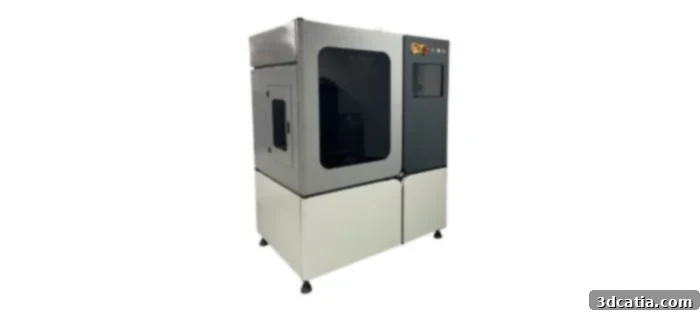
One of the 3D printing solutions from Raplas
Paul: As for the software, we have meticulously integrated Magics from Materialise, a recognized industry leader, directly into our system architecture. This advanced integration is pivotal because it empowers us to utilize vector-based commands rather than relying on conventional sliced files. The significance of this distinction cannot be overstated: vector-based commands grant us an unprecedented level of dynamic control over every single printer parameter. This includes laser power, scan speed, exposure patterns, and even layer thickness, all adjustable in real-time. This granular control also enables the implementation of vastly different build styles for multiple part types within the same build tray, optimizing for speed, accuracy, or surface finish as required for each individual component.
Our software is designed with user flexibility at its core, catering to a spectrum of experience levels and specific needs. Depending on their proficiency and the complexity of their project, users can either delve deep into adjusting parameters, exploring nuanced aspects of part design and material interaction for highly customized results. Alternatively, for simpler tasks or less experienced operators, they can simply set up their print with pre-defined profiles and initiate the build process with minimal fuss. At the same time, the system consistently provides the inherent flexibility to control every minute detail when precise customization is paramount, which is an especially critical advantage for achieving consistent quality and efficiency in high-volume production environments.
3DN: What are the main strengths of your 3D printers?
Richard: In this industry, it’s common to hear claims about “serial production” or “production runs,” but rarely do you encounter manufacturers confidently asserting “mass production.” This distinction is crucial because traditional 3D printers often fall short of the rigorous demands of true mass production primarily due to insufficient accuracy and inconsistent repeatability. That’s precisely where Raplas machines stand apart. Our machines are built to meet and exceed these demanding criteria! We deliver the consistent accuracy and unparalleled repeatability that are essential for high-volume manufacturing. This unwavering reliability is, without a doubt, their foremost strength and a key differentiator in the market.
Paul: Building on Richard’s point about mass production capabilities, I would emphatically add that our machines offer extraordinary flexibility. Users have the freedom to build virtually any part, in precisely any way they desire. This extends to having diverse parts, each with its own optimized build style, co-existing and being printed within the very same build. Our systems give users the ability to command them to execute exactly what is needed, down to the minutest detail, which makes them incredibly powerful and versatile tools for innovation and production alike.
Lastly, and crucially for long-term investment, I would highlight that our machines are inherently future-proof. This isn’t just a marketing claim; it’s a design philosophy. We achieve this by utilizing globally recognized standard components instead of relying on proprietary branded parts that can become obsolete or difficult to source. This strategic choice ensures that replacement parts are always readily available locally, significantly reducing downtime and operational costs. Furthermore, it means that new technological upgrades, whether in lasers, optics, or other system components, can be easily integrated into existing machines, extending their lifespan and ensuring they remain at the forefront of additive manufacturing capabilities for years to come. This commitment to an open, adaptable architecture is a cornerstone of our value proposition for industrial clients.
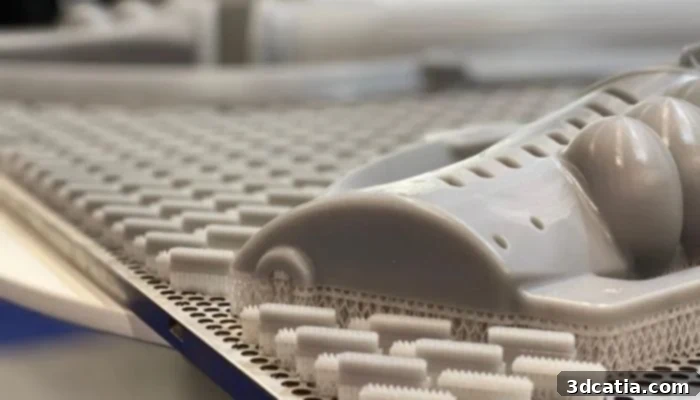
Example of 3D printed pieces made with a Raplas machine
3DN: Who are your clients? What type of applications do they create?
Richard: Our typical clientele consists of experienced users who possess a deep understanding of additive manufacturing. These are often individuals or organizations who have previously utilized competitor machines but have reached the limits of what those systems could offer. They come to Raplas because they now require significantly greater flexibility, enhanced control, and truly advanced capabilities to support their production-level applications. They are seeking to move beyond mere prototyping and into serious, consistent manufacturing processes where reliability and precision are non-negotiable.
Paul: Our clients engage in a broad spectrum of different applications across various industries. However, we’ve observed that our machines are particularly well-suited to meet the stringent demands of the automotive and defense industries. These sectors require parts with incredibly tight tolerances, consistent material properties, and absolute reliability for mission-critical applications. Our systems excel here because we are able to provide a highly repeatable process and deliver consistent accuracy across the entire building plate, irrespective of how many parts one needs to create in a single batch. For instance, our robust mass production capability has been definitively demonstrated through a significant, ongoing UK Ministry of Defense project focused on 3D printing energetic materials. Raplas was rigorously selected as the only company whose machines were deemed capable of true mass production for this highly sensitive and demanding application, a testament to our technology’s unparalleled performance and reliability in critical scenarios.
3DN: What are your future plans?
Richard: I believe our primary focus right now is to unequivocally demonstrate just how powerful and robust our products truly are. Historically, we may not have been vocal enough about our unique capabilities, but the time is absolutely right to amplify our message. While it’s common for every company to claim they have the ‘best 3D printer on the market’—cheaper, faster, more innovative than the rest—I genuinely believe that Raplas Technologies offers something far more substantial. We are not just promising incremental improvements; we are delivering foundational advancements in accuracy and repeatability. These are precisely the qualities and guarantees that the industrial additive manufacturing sector has been desperately seeking to transition from niche applications to widespread production, and Raplas is uniquely positioned to fulfill that critical need.
Paul: In conjunction with showcasing our product strength, we also have ambitious plans for significant expansion and market penetration. We are actively looking to extend our reach into new geographical markets around the world. Our immediate and key strategic focus for this global expansion is firmly set on the United States. We are currently seeking to establish strong partnerships with new resellers across the US who share our vision and possess the expertise to introduce Raplas Technologies’ groundbreaking solutions to a broader industrial audience. This expansion is crucial for supporting global customers and solidifying our position as a leader in industrial additive manufacturing.
3DN: How do you see the evolution of the additive manufacturing market?
Richard: In my extensive experience, the additive manufacturing industry has been plagued by far too many exaggerated claims. We’ve heard promises about ‘moving into production’ almost effortlessly, ‘achieving the impossible,’ or being the ‘best ever’ with revolutionary new technologies. This kind of hyperbolic rhetoric is markedly absent from more mature manufacturing sectors, such as CNC machining, where discussions are grounded in verifiable performance and proven reliability. I firmly believe that the additive manufacturing industry has, to some extent, overhyped itself, inadvertently raising customer expectations to an unsustainable level. Consequently, the industry is now in critical need of a period of genuine maturity. This maturation should entail a stronger, unwavering focus on fundamental engineering principles: demonstrable quality, consistent repeatability, and inherent reliability. These are the truly crucial attributes that define the success and utility of any industrial machine, regardless of its underlying technology.
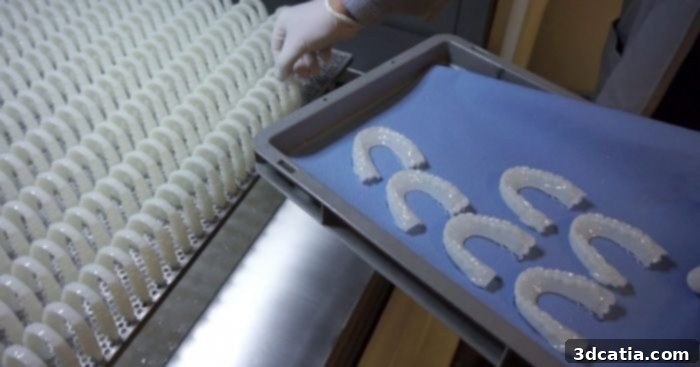
Raplas machines will help users move toward production
Paul: For me, the most significant and encouraging trend in the additive manufacturing market is the undeniable move toward full-scale production. We are now witnessing several strong, tangible projects and initiatives that unequivocally demonstrate this pivotal shift. The industry has demonstrably progressed beyond its origins in rapid prototyping; we are now seeing the emergence of true “factories of printers” that are consistently producing goods every single day. This transformation, where additive manufacturing is becoming a reliable and integral part of the supply chain for end-use parts, is truly starting to take shape, and it is an incredibly encouraging development for the entire sector. We at Raplas are thrilled to be at the forefront of enabling this transition.
To conclude, I would like to emphasize the incredible talent within Raplas Technologies. We are fortunate to have a team of young, exceptionally skilled engineers and dedicated software specialists who are incredibly proficient and passionate about what they do. They represent the vibrant future of this dynamic field, and it is both our responsibility and our privilege as founders to guide, mentor, and fully support them in their professional growth and innovative endeavors. Their fresh perspectives and technical acumen are vital to our continued success and evolution.
3DN: To sum up, could you describe Raplas Technologies in one word?
Paul: Oh, trying to distill everything into just one word is quite a challenge. But if I had to choose, I would say we’re ‘British-founded.’ It speaks to our roots, our engineering heritage, and our commitment to quality manufacturing from the UK.
Richard: For me, the defining characteristic would be ‘cutting-edge.’ It perfectly encapsulates our commitment to innovation, pushing boundaries, and delivering the most advanced solutions in industrial 3D printing.
What are your thoughts on Raplas Technologies’ innovative approach to industrial 3D printing? If you’re interested in exploring their advanced 3D printing solutions further, you can find more detailed information by clicking here. We’d love to hear your feedback – share your comments below or connect with us on our LinkedIn or Facebook pages! And to stay abreast of the latest developments in additive manufacturing, don’t forget to sign up for our free weekly Newsletter, delivering the most current 3D printing news directly to your inbox. You can also explore all our insightful videos and content on our dedicated YouTube channel.
*All Photo Credits: Raplas