

Unlocking Affordable Healthcare: Strathclyde’s Breakthrough £50 3D-Printed Microscope
In a remarkable demonstration of ingenuity and the transformative power of additive manufacturing, a dedicated team of scientists at the University of Strathclyde in Glasgow, Scotland, has embarked on an ambitious project. Their challenge? To develop fully functional laboratory equipment at an unprecedentedly low cost – less than £50, or approximately $63. The result is an innovative microscope, featuring a main body and even its crucial lenses entirely produced through 3D printing. Leveraging an SLA (Stereolithography) machine and specialized transparent resin, this project holds immense potential to revolutionize access to vital diagnostic tools that, in their traditional forms, remain prohibitively expensive for many. The central question, however, remains: can such budget-friendly, 3D-printed equipment truly deliver the necessary quality and reliability expected from a medical diagnostic instrument? This article delves into the specifics of this groundbreaking initiative, exploring its capabilities, the manufacturing process, and its far-reaching implications for global healthcare and scientific education.
The medical sector has long been a frontier for additive manufacturing, primarily recognized for its capabilities in designing custom-made prostheses, crafting intricate anatomical models for surgical planning, producing personalized implants, and creating specialized cutting guides and tools. These applications leverage 3D printing’s precision and customization potential to enhance patient care and surgical outcomes. However, the adoption of 3D printing for diagnostic equipment itself has been considerably slower. While this particular device is not the world’s first 3D-printed microscope, it distinguishes itself as arguably the first large-scale, low-cost tool of its kind specifically engineered for medical analysis and designed for broad accessibility. The researchers at the Scottish university didn’t start from scratch; they ingeniously utilized a publicly available open-source model sourced from the OpenFlexure project. Building upon this foundation, they integrated essential components such as a camera, a dedicated light source, and a powerful yet miniature Raspberry Pi computer, creating a complete and functional diagnostic system.

The OpenFlexure website includes several microscope models, fostering open-source scientific instrument development (photo credits: Flickr / OpenFlexure)
The design of this innovative 3D-printed microscope incorporates a single, specially designed lens, offering a magnification of 2.9x and a numerical aperture (NA) of 0.07. While these specifications might appear modest when compared to high-end, traditional laboratory microscopes that can boast magnifications hundreds of times greater, the true genius of this design lies in its practicality and purpose. For many essential diagnostic tasks, particularly in resource-limited settings, extreme magnification is not always the primary requirement. Instead, reliable resolution at a low cost is paramount. The researchers have demonstrated that despite its humble specifications, the resolution achieved by this device is more than adequate to perform accurate and reliable diagnostics. This balance of cost-effectiveness and functional performance makes it an ideal solution for widespread adoption, promising to bridge significant gaps in diagnostic accessibility.
The Ingenious Process: How to Make a £50 3D Printed Microscope
The journey to constructing this affordable diagnostic tool began with the structural foundation: 3D printing the microscope frame. The Strathclyde team opted for the v6 model, readily available on the OpenFlexure platform, a testament to the power of open-source collaboration in scientific instrument design. After downloading the necessary STL files, these were imported into the Bambu Studio slicer software, a popular choice for preparing models for FDM (Fused Deposition Modeling) 3D printers. The material of choice for the frame was black PLA (Polylactic Acid), a biodegradable and widely accessible thermoplastic, known for its ease of printing and cost-effectiveness. The team configured the print settings with a layer thickness of 0.2 mm, which offers a good balance between print speed and resolution, and a pragmatic infill density of 15% to ensure structural integrity without excessive material usage. Utilizing a high-performance consumer printer, a Bambu Lab X1C, the various components of the microscope frame were produced in a mere 10 hours, consuming just over 260 grams of filament. Following the printing phase, the researchers meticulously assembled the individual parts, bringing the microscope’s mechanical structure to life.
The next crucial step involved the creation of the optical components, starting with the condenser lens. This component was not merely replicated but thoughtfully redesigned using Fusion 360, a powerful CAD (Computer-Aided Design) software, based on the specifications of a commercially available lens. This bespoke design process allowed for optimization specific to 3D printing. Once the precise STL file for the condenser lens was finalized, it was imported into LycheeSlicer, another specialized software used for preparing models for resin 3D printers. The printing itself was executed on an Elegoo Mars 3 Pro, a popular and accessible desktop SLA resin machine, utilizing Formlabs resin known for its excellent optical clarity and print fidelity. Achieving the necessary precision for an optical component, the layer height was set at an incredibly fine 10 microns, with an exposure setting of 9 seconds per layer to ensure proper curing and detail. Post-processing is particularly critical for resin prints, especially those intended for optical use. This phase involved a thorough cleaning process that took 9 minutes to remove uncured resin, followed by a 15-minute post-curing cycle in a dedicated UV curing machine, which enhances the material’s final strength and optical properties.
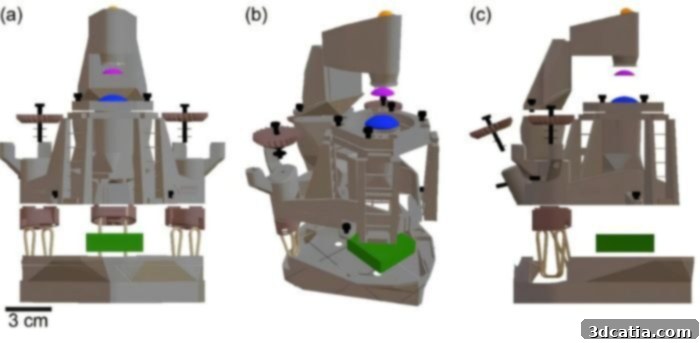
Detailed views of the 3D-printed microscope: front (a), oblique (b) and side (c)
Finally, the microscope’s critical objective lens also underwent a custom redesign specifically optimized for 3D printing. This equally vital optical component was fabricated using an ELEGOO Mars 2 machine, another robust resin 3D printer, and again employed the high-quality Formlabs resin. The meticulous post-processing steps—cleaning and UV curing—identical to those used for the condenser lens, were rigorously applied to ensure the objective lens achieved the necessary optical clarity and structural integrity required for effective magnification. The ability to precisely 3D print both the body and the intricate lenses of a microscope represents a significant leap forward in accessible scientific instrumentation, demonstrating that high performance doesn’t necessarily demand high cost when innovative manufacturing techniques are applied.
Tangible Results and Future Implications
Following the careful assembly of all 3D-printed components, the Strathclyde team conducted a series of comprehensive tests to accurately measure the effectiveness and imaging performance of their novel 3D-printed microscope. The findings were not only satisfactory but deeply promising. As the researchers themselves explained, “To benchmark the imaging performance of the system, we used standard test targets and histological specimens, namely, a Giemsa-stained blood smear sample and a thin section of mouse kidney stained with Haemotoxylin and Eosin. We demonstrated that sub-cellular resolution was obtained, and we corroborated this by imaging individual red blood cells and intricate anatomical details of the stained mouse kidney section.” This scientific validation underscores that despite its low cost and unconventional manufacturing method, the microscope is capable of providing detailed, cellular-level insights crucial for diagnostic work. The ability to clearly visualize individual red blood cells and the fine structures within a mouse kidney section confirms its utility for basic medical diagnostics and educational purposes.
The implications of these satisfactory results are profound. They unequivocally demonstrate that the creation of 3D-printed lenses, coupled with a 3D-printed body, can drastically reduce the overall cost of a functional microscope. This affordability opens up a world of possibilities, enabling laboratories with more modest budgets, as well as educational institutions from schools to universities, to equip themselves with essential diagnostic tools that were once out of reach. The potential impact on global health equity is particularly significant. Dr. Liam Rooney, the postdoctoral research associate who spearheaded the creation of this groundbreaking device, eloquently summarized the project’s vision: “This opens the doors to democratized access, rapid prototyping, and bespoke design of microscopes and optics at a fraction of the price of traditional microscopes. It could help scientists and medics in low-income countries around the world, as well as enabling students to learn more about science through accessible, cheap kit.” This sentiment highlights the project’s core mission: to break down financial barriers to scientific exploration and medical diagnosis, fostering innovation and education on a global scale. Imagine rural clinics in developing nations, now able to perform on-the-spot diagnostics with equipment costing less than a high-end meal, or students worldwide gaining hands-on experience with microscopy without prohibitive costs.
While the initial analyses are exceptionally promising, the researchers acknowledge that there are still areas for improvement and further refinement of the device. However, the current success firmly establishes the viability and immense potential of 3D printing in revolutionizing scientific instrumentation. This project is not just about a single microscope; it’s a blueprint for a future where advanced scientific tools are no longer exclusive to well-funded institutions but are accessible to anyone with a need to observe, analyze, and discover. Would you like to delve deeper into the technical specifics and full methodology behind this incredible 3D-printed microscope? You can read the complete study and all its intricate details HERE.
What are your thoughts on this innovative 3D-printed microscope? Do you believe it has the power to significantly advance medical research and education, particularly in underserved regions? Share your insights and opinions in a comment below or join the conversation on our social media platforms, including LinkedIn, Facebook, and Twitter pages! For those interested in more content regarding 3D printing in the medical and dental fields, we invite you to explore our dedicated page HERE. Don’t forget to sign up for our free weekly Newsletter here to receive the latest 3D printing news directly to your inbox! You can also find all our engaging videos and in-depth discussions on our YouTube channel, offering a visual journey into the world of additive manufacturing.
*Cover Photo Credits: Dr Liam M. Rooney / University of Strathclyde