
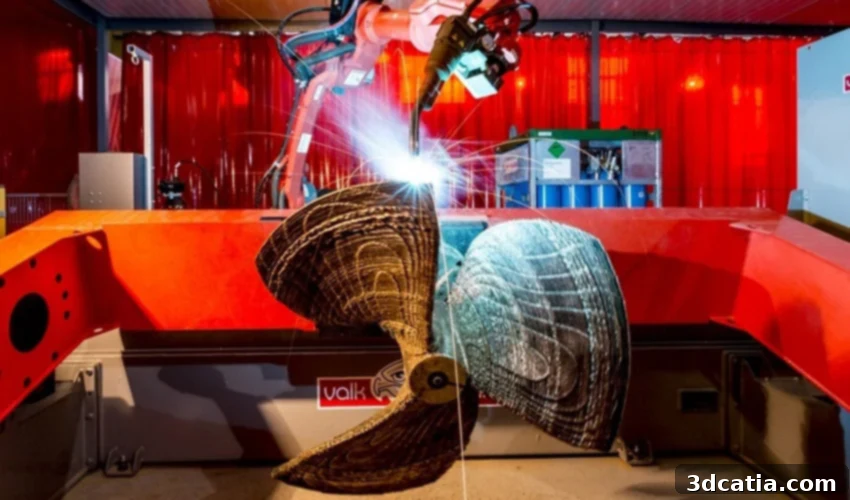
Revolutionizing Marine Propulsion: RAMLAB’s 3D Printed Propeller Pioneers the Future of Shipbuilding
The port of Rotterdam, a bustling gateway to Europe and its largest maritime hub, is not only a center for global trade but also a hotbed for technological innovation. Within this dynamic environment, a groundbreaking initiative has been unfolding: RAMLAB (Rotterdam Additive Manufacturing Lab). This pioneering 3D printing facility was established with a clear mission – to rigorously test and integrate additive manufacturing technologies within the demanding shipbuilding and maritime sectors. The ultimate goal is to redefine how critical components, such as marine propellers, are designed, manufactured, and utilized, leading to advancements that could transform the entire industry. RAMLAB’s efforts have notably focused on creating propellers for boats, showcasing the immense potential of 3D printing for large-scale, high-performance applications. This endeavor represents a significant leap towards a more efficient, customized, and sustainable future for marine engineering, particularly in the production of crucial components like RAMLAB propellers for boats.
Back in May, the maritime and additive manufacturing communities were abuzz with news of a pivotal partnership. We previously highlighted the significant collaboration between software giant Autodesk and Rotterdam’s Additive Manufacturing Fieldlab (RAMLAB). This strategic alliance aimed to push the boundaries of metal 3D printing, specifically targeting marine applications. The initial phase of their joint venture successfully demonstrated the feasibility of additive manufacturing for complex nautical components, culminating in the 3D printing of a small-scale boat propeller. This early success served as a compelling proof of concept, illustrating the technical viability and immense promise of manufacturing intricate metal parts layer by layer. Following this initial triumph, the dedicated teams at RAMLAB and its esteemed partners have not only built upon their foundational research but have also scaled their ambitions, triumphantly succeeding in creating a full-scale prototype! This remarkable achievement marks a new era in marine propulsion, solidifying the potential of additive manufacturing in shipbuilding.
This full-scale, 3D-inspired propeller is a testament to the power of collaborative innovation, measuring an impressive 1350 mm in diameter. Its creation represents a monumental step forward, bringing together a consortium of leading industry experts. The project saw the formidable synergy of Autodesk, providing essential design and simulation software; Damen Shipyards Group, a global leader in shipbuilding and marine services; Promarin, a specialized German propeller designer; and Bureau Veritas, a world-renowned classification society. This diverse expertise ensured that the prototype not only met ambitious engineering specifications but also adhered to stringent industry standards for safety and performance. Since the announcement of the initial small-scale success in May, this collective has diligently worked towards realizing the full potential of their vision. They have now successfully produced their first functional prototype, meticulously crafted from a detailed model developed using Autodesk’s advanced design software. This innovative propeller is composed of a sophisticated Nickel Aluminum Bronze (NAB) alloy, a material chosen for its exceptional strength, corrosion resistance, and excellent mechanical properties crucial for demanding marine environments. The propeller’s distinctive design features a robust three-blade configuration, expertly developed by Promarin, a German firm celebrated for its propeller manufacturing prowess. Furthermore, the structural integrity and design principles are directly aligned with those used for Damen’s renowned Stan Tug 1606, ensuring practical applicability and performance validation against an established vessel design. This groundbreaking achievement showcases how advanced additive manufacturing can produce complex, high-performance components previously only achievable through traditional, often more time-consuming, casting methods, signaling a revolution in marine component fabrication.
The journey to produce this pioneering propeller was far from straightforward, as RAMLAB candidly admits. The additive manufacturing process presented a myriad of technical challenges, primarily due to the specific material chosen for its marine suitability and the intricate, complex design of the component itself. Working with a specialized Nickel Aluminum Bronze (NAB) alloy, while offering superior performance characteristics, necessitated extensive research and rigorous testing. The propeller developers at RAMLAB invested a significant amount of time and effort into thoroughly characterizing the material. This involved numerous rounds of mechanical and metallurgical testing to ensure that its inherent properties, once the complex part had been fully 3D printed layer by layer, not only met but exceeded the rigorous performance and safety standards established by Bureau Veritas, a leading global certification agency. This meticulous validation process is crucial for introducing novel manufacturing techniques into a highly regulated industry like shipbuilding, where component reliability is paramount for safety and operational efficiency.

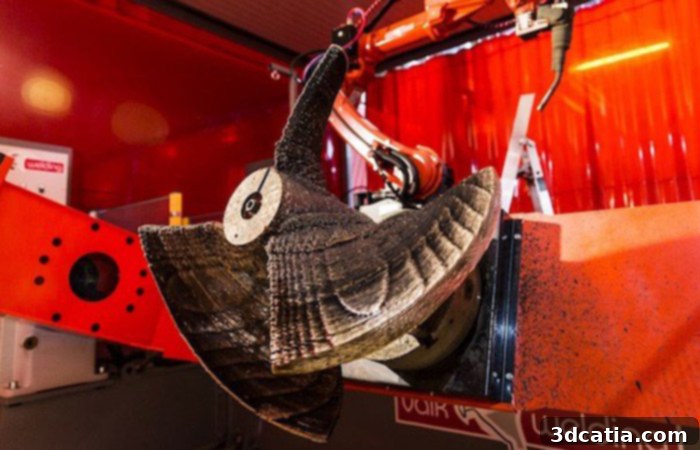
The propeller was 3D printed, layer by layer
Beyond material science, the geometric complexity of the propeller itself posed significant manufacturing hurdles. Translating a sophisticated 3D digital model into a physical, 3D printable product was a delicate and intricate endeavor. The propeller features a highly advanced double-curve structure, alongside numerous challenging overhanging components. These design elements, while critical for optimal hydrodynamic performance, make additive manufacturing particularly difficult, requiring precise control over the deposition process, cooling rates, and support structures to prevent warping or structural deformation. This demands an extremely delicate balance of parameters throughout the entire printing operation, transforming the theoretical design into a tangible, robust component that can withstand the extreme forces encountered in marine environments. The precision and expertise required for such a delicate process underscore the advanced capabilities of RAMLAB and its partners in pushing the boundaries of 3D printing technology for demanding industrial applications.
“Material characterization and mechanical testing have been an important part of this project,” emphasized Wei Ya, a Postdoctoral Researcher from the University of Twente, contributing her expertise at RAMLAB. She further elaborated on the criticality of this phase, stating, “We have to make sure that the material properties meet the needs of the application. Material toughness, for example – ensuring that the propeller is able to absorb significant impact without damage.” This underscores the paramount importance of ensuring not just the successful printing of a part, but also its ability to withstand the harsh realities of maritime operations. Durability, resilience against unforgiving impacts, and resistance to corrosion are non-negotiable requirements for marine components, and RAMLAB’s meticulous approach ensures that these crucial performance benchmarks are not just met, but exceeded, providing a robust solution for future shipbuilding needs.
The prototype of this trailblazing 3D printed propeller, weighing in at a substantial 400 kg, is initially designated for rigorous demonstrations and further developmental testing. Its primary role will be to serve as a tangible proof-of-concept, showcasing the capabilities of large-scale metal additive manufacturing for the marine industry to potential collaborators, investors, and stakeholders. This demonstration phase is crucial for building confidence in the technology and accelerating its adoption throughout the maritime sector. Building on the success of this first prototype, RAMLAB is already planning to commence manufacturing a second, equally ambitious propeller in the coming month. The ultimate aspiration for this next iteration is to achieve full operational deployment: RAMLAB harbors strong hopes of successfully installing this second propeller onto one of its working tugs by the end of the year. This transition from laboratory prototype to real-world application will mark another significant milestone, proving the commercial viability and performance reliability of 3D printed marine components in active service, paving the way for widespread industrial integration.
The implications of RAMLAB’s pioneering work extend far beyond the creation of a single propeller. Additive manufacturing offers a paradigm shift for shipbuilding, presenting numerous advantages over traditional casting and fabrication methods. For instance, it allows for unprecedented design freedom, enabling engineers to create complex, optimized geometries that were previously impossible or prohibitively expensive to produce. This means propellers can be custom-designed for specific vessel types and operational profiles, leading to enhanced hydrodynamic efficiency, reduced fuel consumption, and lower operational costs. Furthermore, 3D printing can significantly reduce lead times for component manufacturing, accelerating repair schedules and new vessel construction. The ability to produce parts on demand, and potentially even on-site or closer to ports, could revolutionize global supply chains, minimizing logistical complexities and environmental footprints. The successful certification by bodies like Bureau Veritas for such 3D printed parts will pave the way for wider acceptance and integration of this technology across the entire maritime sector, moving towards a future where customized, high-performance, and sustainably manufactured components become the standard rather than the exception in shipbuilding and marine engineering.
For those interested in delving deeper into the specifics of this revolutionary propeller prototype and RAMLAB’s ongoing efforts, comprehensive information is available directly on the Damen Shipyards website, which has been a key partner in this groundbreaking venture. You can access further details and updates by visiting their dedicated news section here, to explore more about how this innovation is shaping the future of marine propulsion.
Considering these monumental advancements, it begs the question: Do you foresee a future where 3D printed boat propellers become commonplace on marine vessels? We invite you to share your insights and predictions in a comment below, or join the discussion on our vibrant social media platforms, including our Facebook and Twitter pages! And to stay at the forefront of additive manufacturing news, don’t miss out on signing up for our free weekly Newsletter, delivering all the latest developments in 3D printing directly to your inbox!