
Revolutionizing 3D Printing: Beer Holthuis’s Sustainable Paper Pulp Printer Tackles Plastic Waste
The landscape of additive manufacturing is undergoing a profound transformation, with its applications expanding rapidly from the automotive industry to advanced ceramics. This burgeoning market, driven by innovations in design flexibility, rapid prototyping, and on-demand production, continues to attract significant investment and research. However, a persistent challenge looms over the industry’s impressive growth: its heavy reliance on traditional plastic materials. While 3D printing offers undeniable advantages such as speed, reduced waste compared to subtractive manufacturing, and unparalleled customization, the pervasive use of plastic filaments raises significant environmental concerns. Plastics are known for their slow degradation rates, contribution to landfill accumulation, and potential to harm ecosystems, making them one of the most environmentally detrimental materials currently in widespread use.
This critical environmental paradox became a focal point for Dutch product designer Beer Holthuis. Confronted with the industry’s plastic dependency, Holthuis questioned the lack of genuinely sustainable alternatives for 3D printing. His inquiry led him on an innovative quest to develop a groundbreaking solution: a method to 3D print using readily available and often discarded material – wet paper pulp. The result of his pioneering efforts is the Paper Pulp Printer, heralded as the world’s first 3D printer capable of using paper pulp as a primary material, effectively replacing plastic. While the market for alternative materials is indeed expanding, offering various options, many of these are still hybrid composites that largely rely on polylactic acid (PLA) as a base. While PLA is often touted as biodegradable, its industrial composting requirements and continued plastic-like properties mean it doesn’t fully address the core issue of plastic accumulation. Holthuis’s invention represents a significant leap towards truly circular and eco-friendly additive manufacturing.

Beer Holthuis Pioneers 3D Printing with Repurposed Paper Waste
Beer Holthuis, a visionary product designer hailing from the Netherlands, found himself deeply immersed in the world of 3D modeling and additive manufacturing through his professional practice. During this immersive experience, he became acutely aware of the alarming volume of plastic consumed in the 3D printing process. This observation ignited a passion within him to seek out and develop a more sustainable, environmentally benign material that could effectively substitute conventional plastics. His journey led him to focus on one of the most abundant and often overlooked waste streams: paper.
Considering that the average individual generates approximately 80 kg of paper waste annually, Holthuis recognized the immense potential of this seemingly mundane material. His ambition was to transform this plentiful waste into a valuable resource for additive manufacturing. Unlike earlier paper printing technologies, such as those pioneered by Mcor, which typically utilize sheets of paper glued together, Beer Holthuis envisioned a direct-to-pulp approach. He sought to develop a system that could print directly with the raw, wet paper pulp material itself, rather than pre-processed paper sheets. This innovative distinction positions his invention as the world’s first 3D printer capable of directly extruding and shaping paper pulp, marking a significant departure from previous methodologies and opening up entirely new avenues for sustainable product creation and design. His commitment to utilizing actual waste material at its most fundamental form truly distinguishes his approach within the additive manufacturing sphere, offering a truly circular design solution.
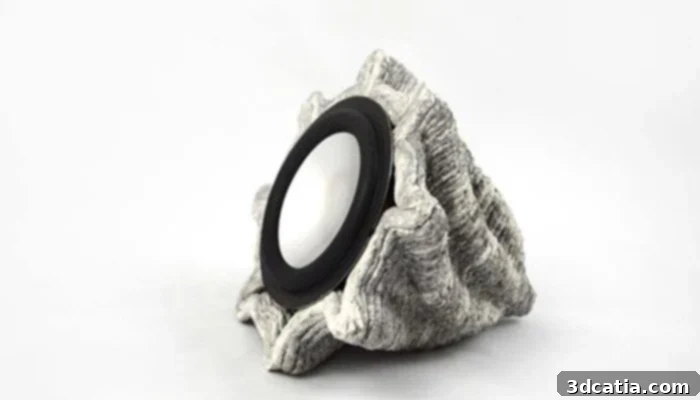
A paper pulp printed speaker demonstrating the material’s structural integrity and distinctive finish.
Unveiling the Mechanics: How Beer Holthuis’s Paper Pulp Printer Operates
The operational principles of the Paper Pulp Printer, while innovative in its material choice, are designed to be relatively straightforward, drawing parallels with the general mechanics of other extrusion-based 3D printing systems. At its core, the printer utilizes ordinary paper pulp, which serves as the primary building material. To ensure the pulp maintains its structural integrity during and after the printing process, Holthuis incorporates a natural binder. The strategic choice of a natural binder is paramount; it means that the resulting 3D printed objects are not only durable but also inherently recyclable, aligning perfectly with circular economy principles. This thoughtful material combination facilitates a true closed-loop system, allowing products to be continuously recycled and repurposed, thus minimizing waste and maximizing resource efficiency over the long term.
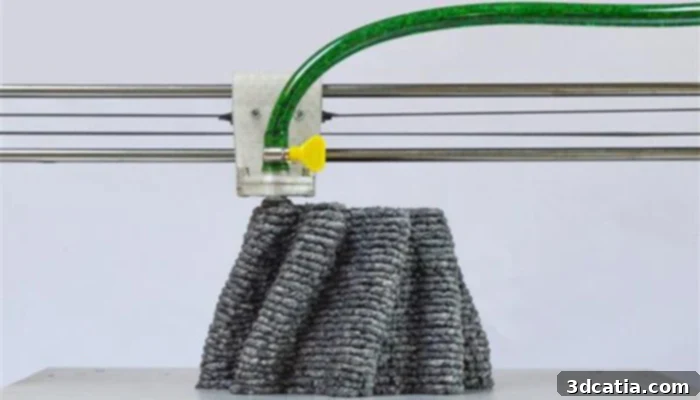
The extrusion process itself involves feeding the prepared paper material, a mixture of pulp and natural binder, into a pressure vessel. From this vessel, the material is then forced through a syringe-type extruder. This method ensures a controlled and consistent flow of the viscous pulp, allowing for precise deposition layer by layer. While the concept is elegantly simple, the practical implementation presents engineering challenges. One of the primary issues Holthuis encountered, and a common hurdle in extruding highly viscous, fibrous materials, is the potential for the extruder nozzle to “gunk up” or become clogged, particularly during pauses in printing or if the material’s consistency is not perfectly maintained. Addressing this challenge involves meticulous calibration of material viscosity, optimizing nozzle geometry, and potentially developing intelligent retraction or cleaning mechanisms to ensure smooth, uninterrupted printing. Overcoming such technical obstacles is crucial for the reliability and widespread adoption of this pioneering sustainable additive manufacturing technology.
The Distinctive Aesthetics and Tactile Experience of Paper Pulp Printing
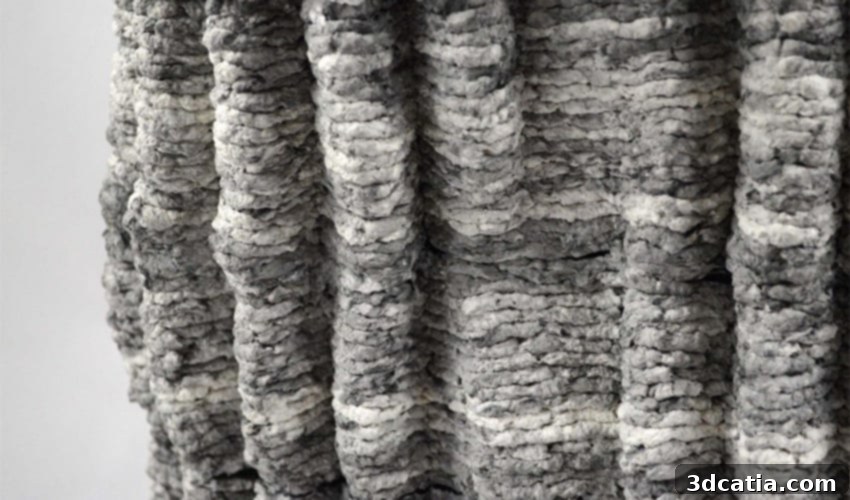
Beyond its impressive environmental credentials, the objects produced by the Paper Pulp Printer possess a distinctive aesthetic and tactile quality that sets them apart from typical plastic 3D prints. The material’s inherent properties and the extrusion process combine to create a unique visual and sensory experience. As Beer Holthuis himself eloquently describes, “The design of the printed objects harnesses the unique possibilities and inherent beauty of this technique.” He further elaborates, “The tactile experience, characterized by bold lines and forms, combined with the inherent print speed, results in truly distinctive shapes and textures.” This means that the rough, fibrous nature of the paper pulp, along with the visible layering from the extrusion process, isn’t just a byproduct; it’s an integral part of the design language. These characteristics contribute to an organic, handcrafted feel, offering a refreshing alternative to the slick, often homogenous surfaces of plastic components.
Furthermore, Holthuis emphasizes the durability of these creations, noting that “Printed paper is surprisingly strong.” This strength is attributed to the interlocking cellulose fibers within the pulp, which, when bound together and dried, create a rigid and resilient structure. This robust nature, combined with the unique aesthetic, makes paper pulp prints suitable for a diverse range of applications, from functional prototypes and bespoke household items to artistic sculptures and interior design elements. The special look of the print injects a certain personality into the designs, offering an authentic, earthy charm that stands out in a world increasingly dominated by mass-produced plastic goods. This blend of sustainable material, innovative technique, and compelling aesthetics positions paper pulp 3D printing as not just an eco-friendly alternative, but a distinct design movement in its own right.

Unlocking Future Potential: Sustainability, Accessibility, and Scale
The innovative Paper Pulp Printer presents a compelling vision for the future of manufacturing, driven by its dual advantages of low cost and profound sustainability. The ability to utilize readily available paper waste, combined with a natural binder, drastically reduces material costs compared to traditional plastic filaments, making additive manufacturing more accessible and economically viable for a wider range of users and businesses. This low-cost aspect, coupled with the inherent environmental benefits, positions Holthuis’s invention as a truly disruptive technology with immense potential. The integrated recycling system, central to its design, champions the principles of the circular economy, wherein waste is transformed into resources, and products are designed for durability, reuse, and ultimately, infinite recyclability. This closed-loop approach is critical for mitigating environmental impact and fostering long-term ecological balance.
Looking ahead, this sustainable recycling system is poised for significant scalability. Imagine local communities or businesses establishing micro-factories where local paper waste is collected, processed into pulp, and then 3D printed into useful, custom objects on demand. Such a model could dramatically reduce reliance on global supply chains, lower transportation emissions, and empower localized manufacturing. Potential applications are vast and varied, ranging from eco-friendly packaging solutions and bespoke furniture to educational tools and artistic installations. The technology could also inspire further research into other waste-based biomaterials for additive manufacturing, catalyzing a broader shift towards sustainable production methods. While challenges such as optimizing print speed, enhancing material properties for diverse applications, and refining the reliability of continuous extrusion still exist, the foundational concept is robust. With continued development and investment, the Paper Pulp Printer could become a cornerstone of sustainable design and production, operating efficiently at high production levels and fundamentally reshaping how we approach resource consumption and waste management in the additive manufacturing era.
To witness this remarkable innovation in action and better understand its operational mechanics and the quality of its output, be sure to check out the insightful video below:
What are your thoughts on Beer Holthuis’s groundbreaking 3D Paper Pulp Printer and its potential to revolutionize sustainable manufacturing? We’d love to hear your perspective and insights! Please share your comments and reactions below, or connect with us on our Facebook and Twitter pages. Don’t forget to sign up for our free weekly Newsletter to receive all the latest news, innovations, and developments in the world of 3D printing delivered directly to your inbox!