
Revolutionizing Prosthetic Limbs: How PSYONIC’s Advanced 3D Printing Technology is Redefining Autonomy and Accessibility
Traumatic limb amputation profoundly impacts over 50 million individuals worldwide, leading to significant physical and emotional challenges. While many choose to embrace prostheses, the journey of integrating these devices into daily life is often arduous. From driving independently to participating in sports or simply managing household tasks, prosthetic limbs fundamentally alter how individuals interact with their environment, making the restoration of autonomy a paramount goal. Unfortunately, traditional prosthetics frequently fall short of expectations. They are often basic in functionality, prohibitively expensive, and prone to breakage, severely limiting accessibility. Astonishingly, only about 10 percent of patients requiring an advanced prosthetic arm can realistically afford one. However, recent breakthroughs in technological innovation are now illuminating a promising new path, offering renewed hope and enhanced solutions for those in need of prosthetic care.
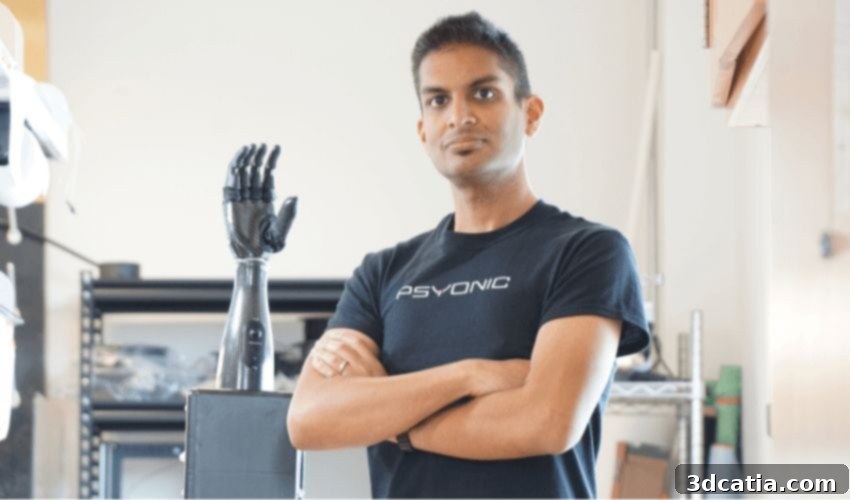
At the forefront of this transformative wave is PSYONIC, a company founded by Dr. Aadeel Akhtar. Their mission is both ambitious and vital: to democratize access to high-quality, high-performance robotic limbs for everyone. By harnessing the power of cutting-edge 3D printing technology, PSYONIC has engineered a bionic hand that is poised to fundamentally reshape the landscape of prosthetics. This innovative approach promises not only to make advanced devices more affordable but also more durable and functional. We recently had the opportunity to speak with PSYONIC’s founder and CEO, Aadeel Akhtar, to gain deeper insights into this groundbreaking innovation and understand how 3D printing is significantly improving the autonomy and overall quality of life for amputees across the globe.
PSYONIC’s Vision and the Role of Additive Manufacturing
PSYONIC is singularly focused on developing state-of-the-art robotic limbs, designed to be accessible for both human and robotic applications. From our inception, integrating additive manufacturing technology into our production process has been a core priority. Over the past nine years, we have meticulously refined our flagship product, the Ability Hand bionic hand, through nine successive iterations. Our journey began by utilizing readily available FDM (Fused Deposition Modeling) 3D printing technology to create initial hand models and prototypes, which allowed for rapid and cost-effective experimentation. As our designs matured and our understanding deepened, we transitioned towards developing our own sophisticated models, tailored specifically for our advanced devices.
This iterative process, deeply rooted in low-cost additive manufacturing, has provided us with invaluable experience in producing highly advanced bionic limbs efficiently. However, extensive dialogues with patients and healthcare professionals revealed a critical vulnerability in existing high-end prostheses: despite being custom-made using traditional methods like injection molding and machining, their rigid composition often led to frequent breakages. To address this pervasive issue, we embraced a more flexible robotics design philosophy. This involved strategically integrating compliant materials such as silicone and rubber alongside our 3D-manufactured internal components. This hybrid approach significantly enhances impact resistance and overall durability, making our prostheses more robust for daily use. Concurrently, we have advanced our manufacturing capabilities by incorporating more sophisticated 3D printing technologies, specifically Stereolithography (SLA) and Selective Laser Sintering (SLS) printing, for the production of our final products, ensuring superior precision and material properties.
The Genesis of PSYONIC: A Personal Journey
My personal quest to design bionic limbs began at the tender age of seven, and it culminated in the founding of PSYONIC in 2015. The initial spark for this lifelong ambition was ignited during a visit to Pakistan, where I encountered a young girl who, having lost her right leg, relied on a simple tree branch as a crutch for mobility. This deeply moving experience left an indelible mark on me, solidifying my resolve to dedicate my life to developing affordable and highly accessible bionic limbs that could truly make a difference. My academic journey led me to pursue a PhD at the University of Illinois, where my research focused intensely on this very goal. In 2014, an extraordinary opportunity arose during a trip to Ecuador: I was able to test a preliminary prototype of what would become the “Ability Hand” on a patient named Juan Suquillo. Juan had tragically lost his right hand in an explosion 35 years prior, during a conflict.
The moment Juan, in front of international media, managed to grasp an object with his right hand for the first time in over three decades, was profoundly transformative. He eloquently described it as the return of a part of his lost identity. Witnessing this raw emotion and tangible impact, I had a profound realization: if my work remained confined to the academic realm, this powerful experience would merely become a fleeting subject for a newspaper article. The immense potential for real-world change was too great to ignore. It was at that juncture that I made the pivotal decision to commercialize the technology, thereby giving birth to PSYONIC. This decision was driven by a deep conviction that this innovation needed to reach those who could benefit most, transforming academic research into practical, life-changing solutions.
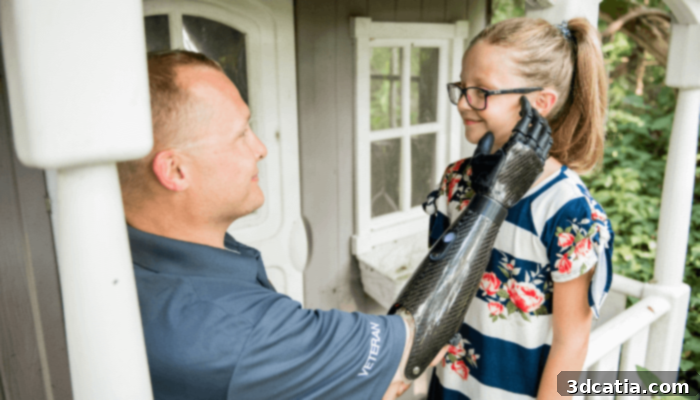
Sensors at the tips of the fingers detect pressure when gripping an object, transmitting this sensation by vibration to your arm, enhancing proprioception and control.
Advanced 3D Printing Technologies Driving Innovation
At PSYONIC, we leverage a diverse array of advanced additive manufacturing techniques to fabricate the intricate components that form the foundation of our flagship product, the Ability Hand bionic hand. This multi-faceted approach allows us to select the optimal printing technology for each specific part, balancing strength, flexibility, precision, and cost-effectiveness. Our toolkit includes robust FDM (Fused Deposition Modeling) printers, such as models from Prusa and Mosaic, which are excellent for creating durable structural components and initial prototypes. For finer details and smoother surface finishes, we employ SLA (Stereolithography) printing, utilizing advanced equipment like those from FormLabs. This technology is crucial for parts requiring high precision and aesthetic quality. Furthermore, for components demanding exceptional mechanical properties, isotropic strength, and the ability to produce complex geometries without support structures, we rely on SLS (Selective Laser Sintering) printing, with devices from manufacturers like SinterIt.
Among the critical components we produce using these diverse 3D printing methods are the individual fingers, the central palm structure, and various internal structural elements. To ensure maximum durability and functionality, these parts are often reinforced with the incorporation of high-performance materials such as carbon fiber, spring steel, and flexible silicone. Carbon fiber provides exceptional strength-to-weight ratio for rigid structures, while spring steel offers elasticity and resilience for dynamic movements. Silicone is strategically integrated to provide crucial flexibility, grip, and impact absorption, addressing the common issue of fragility in traditional prosthetics. Beyond core components, SLA printing is also extensively used to create highly precise production molds, custom connectors, functional switches, and various adapters, streamlining our manufacturing processes and enabling rapid customization for patients.
The Meticulous Process of Creating a Bionic Prosthesis
The manufacturing of the Ability Hand is a meticulously orchestrated process, comprising several essential stages, each critical to the device’s overall performance, durability, and intuitive control. The journey begins with the precision assembly of the transmissions. This involves integrating miniature yet powerful motors, precise encoders for positional feedback, and robust gearboxes that translate electrical signals into controlled, powerful movements, allowing the bionic hand to perform a wide range of grip patterns and manipulations.
Following transmission assembly, the creation of the fingers represents a highly specialized step. Each finger is constructed with an internal bone-like structure, often 3D-printed for custom geometry and strength. This internal framework is then encapsulated in a meticulously molded silicone outer layer, which provides both a natural tactile feel and crucial impact absorption. Integrated within this silicone are advanced pressure sensors strategically placed at the fingertips. These sensors are vital for providing haptic feedback, detecting the force applied when gripping an object, and transmitting this sensation back to the user’s arm through vibrations, thereby enhancing the user’s proprioception and control. The fingers are then securely attached to the transmission system using robust metal connectors, ensuring reliable mechanical linkage.
The palms of the Ability Hand are manufactured with significant carbon fiber reinforcement. This material choice is paramount for ensuring the structural integrity and long-term durability of the device, providing a lightweight yet incredibly strong base for all components. At the heart of the bionic hand’s intelligence lies its sophisticated electronics. A custom-designed printed circuit board (PCB) is centrally located within the palm. This PCB serves as the central processing unit, responsible for precise motor control, interpreting sensor data, and facilitating seamless Bluetooth communication with other devices, allowing for advanced control and potential future updates. Finally, to ensure the device can withstand daily wear and tear and various environmental conditions, complete watertightness is achieved through the careful integration of specialized waterproof fabric and seals throughout the entire assembly, protecting the delicate internal components from moisture and dust.
Once the bionic hand is fully assembled and undergoes rigorous quality control, it is carefully shipped to a specialized clinician. This clinician plays a pivotal role in the final stage: custom fitting the device to the patient. Working closely with the patient, the clinician customizes a special socket designed to perfectly integrate the bionic hand with the individual’s residual limb. This bespoke socket ensures maximum comfort, stability, and effective force transfer. Utilizing sophisticated muscle sensors, typically placed on the residual limb, the patient can then learn to control the bionic hand intuitively, mimicking natural muscle contractions to operate the fingers and perform a wide array of tasks. This personalized fitting and intuitive control system are key to empowering users with enhanced autonomy and functionality.
Each finger of the Ability Hand is engineered to withstand significant blunt impact without breaking, ensuring remarkable durability for daily activities.
Pioneering Future Innovations and Expanding Horizons
PSYONIC is not resting on its laurels; we are actively engaged in pioneering research and development across two transformative major areas that promise to revolutionize prosthetic integration and control. Firstly, we are exploring the direct integration of our device with the bones of the human body, known as osseointegration. This advanced technique aims to create a more stable and permanent connection between the prosthesis and the wearer, eliminating issues associated with traditional socket-based fittings and enhancing natural movement and sensory feedback. Secondly, we are pursuing the ambitious goal of direct neural control, which would allow for individual finger movements and nuanced sensations to be controlled directly by the user’s thoughts. This represents the ultimate frontier in bionic limb control, offering unparalleled dexterity and a more intuitive, almost natural interaction with the device.
Looking ahead, our commitment to improving human mobility extends beyond upper limbs. Within the next five years, our ambitious goal is to develop an assistive leg capable of supporting a triathlon. This project underscores our dedication to pushing the boundaries of prosthetic technology, aiming to empower individuals to achieve extraordinary feats of physical endurance and reclaim active lifestyles.
Beyond human applications, our innovative bionic hand is also finding critical utility in the burgeoning field of robotics. It is currently being adopted by various robotics research teams around the world and is even under consideration for demanding space applications by prestigious organizations like NASA and Meta. The rationale is clear: if you are designing a robot to perform complex tasks that mimic human dexterity and interaction with the environment, our hand is specifically optimized to enable humans to perform these very tasks. Its robust design, precise control, and integrated sensory feedback make it an ideal choice for robotic platforms requiring advanced manipulation capabilities in challenging environments, including the zero-gravity conditions of space. The synergistic potential between advanced prosthetics and robotics is truly exciting, paving the way for unprecedented technological advancements that will benefit both human users and robotic systems alike. The future of bionic technology, for both humans and machines, looks incredibly bright and full of possibility.
What are your thoughts on the groundbreaking work being done by PSYONIC and the future of 3D printed bionic limbs? We invite you to share your insights in a comment below or join the conversation on our LinkedIn, Facebook, and Twitter pages! Don’t miss out on the latest 3D printing news – sign up for our free weekly Newsletter here, delivered straight to your inbox. You can also explore all our informative videos on our dedicated YouTube channel.
*All Photo Credits: Dr. Aadeel Akhtar