
Revolutionizing Space Exploration: China’s Breakthrough in Lunar Regolith 3D Printing
The dream of establishing a permanent human presence on the Moon and beyond has long captivated scientists and engineers worldwide. A critical challenge in achieving this vision is the enormous cost and logistical complexity of transporting construction materials from Earth into space. However, recent advancements in additive manufacturing within the aerospace sector are rapidly transforming this landscape. This burgeoning field holds the key to unlocking sustainable space exploration, enabling the creation of vital infrastructure directly on extraterrestrial bodies.
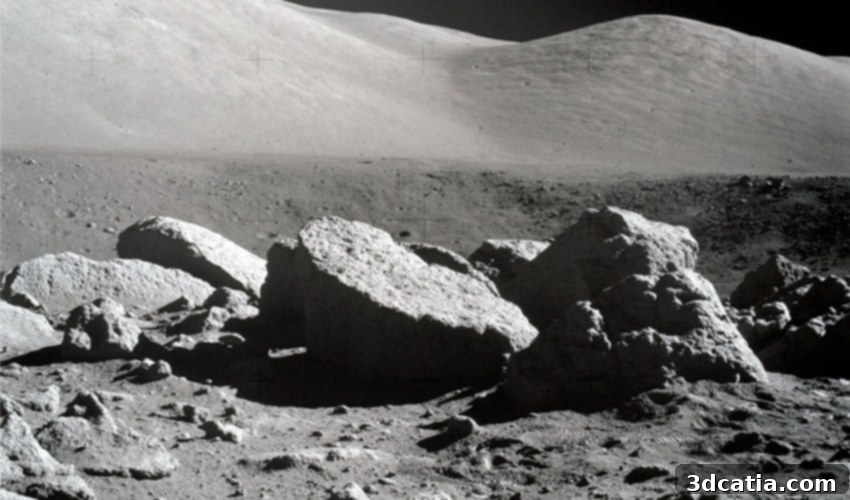
In a monumental leap forward, Chinese scientists at the esteemed Tiandu Laboratory have announced a significant technological breakthrough: the development of a prototype 3D printer capable of utilizing lunar regolith as a primary construction material. Regolith, the ubiquitous layer of loose dust, soil, and rock fragments covering the Moon’s surface, has historically been seen as a formidable obstacle for lunar missions. Now, it stands poised to become a cornerstone of future lunar development. This innovative approach promises to revolutionize space architecture, making it feasible to construct habitats, scientific outposts, and essential facilities directly on the Moon, vastly reducing the need for costly and resource-intensive material shipments from Earth. Such self-sufficient manufacturing capabilities are crucial for making long-term space missions not only viable but also economically sustainable.
Pioneering In-Situ Resource Utilization with Solar Power
The ingenuity of the Tiandu Laboratory’s 3D printer lies in its sophisticated fusion of advanced solar energy collection and precise energy transmission. The system integrates a high-precision solar concentrator with an optical fiber bundle for efficient energy delivery. This ingenious combination allows the printer to harness the abundant solar energy available on the Moon and focus it with incredible intensity. By achieving sufficiently high temperatures, the device can effectively melt lunar regolith, transforming it into a material compatible with additive manufacturing processes.
This achievement represents a paradigm shift in space engineering, embodying the core principles of In-Situ Resource Utilization (ISRU). ISRU is a strategy central to long-duration missions, focusing on the collection, processing, and utilization of local materials available at extraterrestrial destinations. Yang Honglun, the chief engineer of the Tiandu Laboratory, underscored the profound implications of this development, stating, “This printing breakthrough has validated the feasibility of using lunar soil as the sole raw building material, enabling true in-situ resource utilization and eliminating the need to transport any additional materials from Earth.” His remarks highlight the significant reduction in logistical burdens and costs, effectively paving the way for more ambitious and frequent lunar expeditions.
The ability to convert indigenous lunar materials into functional structures marks a pivotal moment for humanity’s expansion into the cosmos. It moves us closer to a future where lunar bases are not merely temporary outposts but permanent settlements, built and sustained by the resources found on the Moon itself. This self-reliance drastically lowers the barrier to entry for space exploration and colonization, fostering a more sustainable and economically sound approach to off-world living.
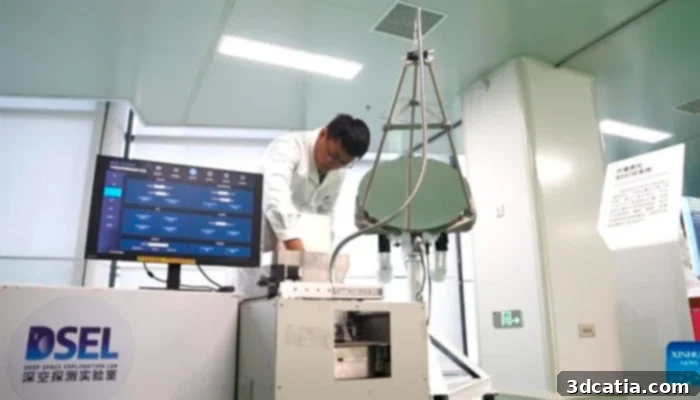
Photo Credits: Xinhua
The Lunar Regolith 3D Printer Prototype: Engineering and Earth-Based Validation
Before embarking on its celestial journey, the prototype lunar 3D printer underwent rigorous testing in Earth-based laboratories. These initial trials were critical for validating the theoretical concepts and practical capabilities of the system. Scientists meticulously demonstrated the printer’s ability to fuse lunar regolith simulants into a variety of forms, ranging from simple lines and complex surfaces to intricate three-dimensional bodies. These successful demonstrations confirmed the printer’s precision and versatility in shaping raw regolith into functional components.
Beyond mere shaping, the Earth-based tests were instrumental in validating the overall efficiency and robustness of the entire system. Key components, such as the solar concentration mechanism and the regolith casting process, were thoroughly evaluated under simulated extreme conditions. One of the paramount challenges encountered during development revolved around effectively managing and utilizing solar energy in environments as harsh and unforgiving as the Moon. Lunar conditions present a unique set of difficulties, including extreme temperature fluctuations between searing daylight and freezing darkness, a near-perfect vacuum, the abrasive and pervasive nature of lunar dust, and constant exposure to cosmic radiation.
Overcoming these formidable technical hurdles required an extraordinary collaborative effort from a diverse, multidisciplinary team. Experts spanning planetary science, materials engineering, optical engineering, and robotics pooled their knowledge to address each specific challenge. Their combined ingenuity led to innovative solutions for energy collection, heat management, material handling, and structural integrity, ensuring the printer could perform reliably in an extraterrestrial environment. The success of these ground tests provides a strong foundation and confidence for the printer’s eventual deployment and operation on the lunar surface.
Transforming Lunar Ambitions: Broad Applications and Future Impact
The potential applications of this lunar regolith 3D printer extend far beyond simple habitat construction. This technology represents a cornerstone for building a comprehensive lunar infrastructure. Imagine the capabilities:
- Habitats and Shelters: Robust, radiation-shielded living quarters for astronauts, protecting them from the harsh lunar environment.
- Roads and Landing Pads: Durable surfaces to facilitate movement of rovers and ensure safe landings and take-offs for spacecraft, mitigating the problem of abrasive lunar dust kicked up during thrust.
- Scientific Outposts: Specialized structures for research facilities, observatories, and resource extraction operations.
- Energy Infrastructure: Platforms and foundations for solar power arrays and other energy generation systems.
- Protection against Micrometeoroids: Additional layers of regolith-based shielding to enhance the safety of existing modules.
This technological advancement opens unprecedented avenues for space exploration and underscores a profound shift towards genuine in-situ resource utilization. By significantly reducing reliance on costly and limited terrestrial supplies, this innovation champions a more sustainable, self-sufficient, and ultimately more ambitious approach to space conquest. The economic advantages are immense, drastically lowering the launch mass and associated fuel costs, thereby making future missions more affordable and frequent. Furthermore, it contributes to environmental sustainability by reducing the carbon footprint associated with repeated rocket launches from Earth.
The long-term vision is a future where the Moon serves as a self-sustaining outpost, a cosmic stepping stone for even more distant explorations, such as missions to Mars. Developing robust construction capabilities on the Moon is not just about building structures; it’s about fostering an extraterrestrial economy and establishing a permanent human presence beyond Earth. While the prototype has shown immense promise on Earth, the next critical phase involves the logistical challenge of transporting this printer to the Moon and initiating real-world construction projects. This will involve overcoming further engineering hurdles related to deployment, calibration, and sustained operation in the true lunar environment.
The Path Forward and Engaging with the Future of Space Construction
The development by the Tiandu Laboratory marks a thrilling milestone in the journey towards building a future in space. This solar-powered 3D printer, capable of transforming lunar regolith into viable building materials, brings us closer to a future of expansive lunar colonies and deeper space exploration. While the Earth-based tests have demonstrated impressive capabilities, the ultimate validation will come from its performance on the Moon itself. The global space community eagerly anticipates the next steps for this groundbreaking prototype, hoping to see it deployed to begin its transformative work on the lunar surface.
What are your thoughts on this revolutionary 3D printer and its potential to shape humanity’s future in space? We invite you to share your insights and engage with us! Let us know your opinions in a comment below or connect with us on our LinkedIn or Facebook pages. Don’t miss out on the latest advancements in additive manufacturing; subscribe to our free weekly Newsletter to receive top 3D printing news directly in your inbox. For a visual dive into the world of 3D printing, explore all our videos on our YouTube channel. Discover more dedicated news and updates on 3D printing in the aerospace and defense sectors HERE.
*Cover Photo Credits: NASA