

Revolutionizing Food: 3D Printing Lab-Grown Fruits and Vegetables to Combat Global Food Insecurity
Imagine a future where fresh, nutritious fruits and vegetables are cultivated not in vast fields, but within sterile laboratory environments, meticulously nurtured from individual plant cells. Now, picture these cells being transformed into three-dimensional produce, layer by intricate layer, by advanced robotic technology. This groundbreaking vision is rapidly becoming a tangible reality, thanks to the ingenuity of two Qatari students, Mohammad Fadhel Annan and Lujain Al-Mansoori. These visionary innovators have developed a pioneering 3D printer specifically engineered to produce edible fruits and vegetables directly from laboratory-grown plant cells. Their ambitious long-term objective is to provide a scalable and sustainable solution to the escalating challenge of food insecurity, a crisis that currently impacts an alarming 258 million people across 58 countries and territories globally, and whose prevalence continues its relentless ascent.
For years, the burgeoning field of 3D food printing has primarily relied on conventional methods, utilizing purees and pastes derived from traditionally cultivated agricultural produce. While offering fascinating possibilities for custom shapes and textures, this approach has faced significant inherent limitations. Chief among these is the fundamental inability to achieve mass production of these essential dietary components efficiently and economically. Relying on pre-processed ingredients from traditional farming means that the core issues of land use, water consumption, and susceptibility to environmental factors remain largely unaddressed. This conventional method often serves niche culinary applications rather than offering a viable pathway to large-scale food production capable of truly disrupting global food supply chains or alleviating widespread hunger.
Recognizing these critical bottlenecks, Mohammad Fadhel Annan and Lujain Al-Mansoori, both bright students from Carnegie Mellon University in Qatar, embarked on a mission to fundamentally revolutionize this process. Their innovative approach bypasses the need for traditionally grown produce as a starting material. Instead, they opted for the direct utilization of laboratory-grown plant cells, combined with the precise application of ultraviolet (UV) light, to fabricate three-dimensional fruits and vegetables. Their initial findings have been nothing short of remarkable, demonstrating the immense potential of this novel technology. Most notably, they successfully printed a prototype carrot, which astonishingly demonstrated a nutritional value equivalent to that of a conventionally grown carrot. This achievement is a pivotal moment, validating the concept of nutrient-rich, cellular agriculture-based 3D printed food and paving the way for further advancements.
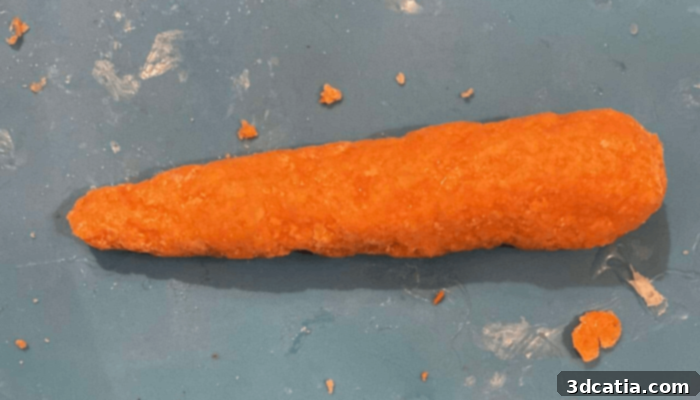
The prototype 3D-printed carrot. (Credits: Mohammad Annan)
The creation process underpinning this cutting-edge technology involves a series of meticulously controlled, yet relatively straightforward, steps. It begins with the artificial cultivation of specific plant cells, which are harvested and then multiplied exponentially within a dedicated, sterile laboratory environment. This cellular proliferation creates a sustainable and abundant source of biological material. These cultivated cells are then ingeniously formulated into a biocompatible “ink” designed specifically for the 3D printer. A crucial aspect of this innovation is that this specialized ink is engineered to react precisely to ultraviolet light. What truly distinguishes and elevates this breakthrough is the application of a 3D printing technique known as masked stereolithography (MSLA). Traditionally, MSLA has been predominantly utilized with resin-based materials for industrial and prototyping applications. However, Annan and Al-Mansoori have boldly pushed the boundaries of this technology, applying it for the very first time to edible biological materials. This unprecedented leap allows for the precise shaping and printing of the living cells into any desired form, utilizing a custom-built machine developed from scratch by the two students themselves. This adaptation of an industrial-grade printing method for food represents a significant cross-disciplinary achievement.
The scientific principles behind cultivating plant cells in a lab are akin to tissue culture techniques used in biology. Tiny samples, known as explants, are taken from a parent plant and placed in a nutrient-rich agar or liquid medium containing essential minerals, vitamins, and plant hormones. Under carefully controlled conditions of light, temperature, and humidity, these cells proliferate, forming undifferentiated masses called calli, or growing directly as cell suspensions. This method offers numerous advantages over traditional agriculture. It dramatically reduces the land and water footprint required for cultivation, eliminates the need for pesticides and herbicides, and allows for year-round production irrespective of climatic conditions. Furthermore, the sterile environment of the lab minimizes the risk of contamination and disease, leading to a consistent and predictable output. This controlled cultivation also opens doors to precise nutrient modulation, allowing for the enhancement or customization of nutritional profiles, such as increasing vitamin or mineral content, or even introducing specific beneficial compounds.
But the question arises: why did they choose to begin their ambitious project with a simple carrot? The answer lies not in its simplicity, but in its scientific utility. The carrot is one of the most extensively studied vegetables in the context of plant stem cells and tissue culture, providing a wealth of research data and established protocols to build upon. Mohammad Fadhel Annan elaborates on the broader philosophical and practical drivers behind their choice: “Transforming non-agricultural land into cultivable land, particularly in regions facing harsh climates or limited resources, undoubtedly represents a considerable financial investment, alongside significant environmental challenges. That’s why we meticulously searched for a sustainable and economically viable alternative. And it was through this exploration that we discovered the immense potential of combining 3D printing technology with the cultivation of fruits and vegetables in a controlled laboratory environment. This synergistic approach, we believe, could provide a powerful and scalable answer to the global fight against food insecurity, offering a way to produce food anywhere, anytime.” Indeed, in the pressing context of accelerating climate change, the global availability of fertile arable land presents an increasingly formidable challenge, threatening agricultural output and exacerbating food shortages. In Qatar, for instance, a mere 2.5% of its entire territory is naturally suitable for traditional agriculture, underscoring the urgent need for innovative food production solutions that transcend geographical and environmental limitations.
This profound breakthrough, a testament to the collaborative spirit and pioneering vision of these two students, therefore presents unprecedented opportunities for the profound evolution of agriculture and food security, not only within Qatar but also on a transformative global scale. It heralds promising new prospects in diverse fields, ranging from sustainable food production and advanced additive manufacturing to personalized nutrition and even space exploration. The ability to grow food independently of vast land, abundant water, and favorable climates could unlock food sovereignty for nations struggling with resource scarcity. It could also drastically reduce the carbon footprint associated with long-distance food transportation and refrigeration. Furthermore, the precision of 3D printing allows for tailored food solutions, catering to specific dietary needs, allergies, or even creating foods with enhanced functional properties. Imagine food customized for elderly individuals who require softer textures, or athletes needing specific nutrient ratios. This technology also opens avenues for creating novel food experiences, pushing the boundaries of culinary art and innovation.
The pathway forward for this technology involves several key considerations. Scalability will be paramount; moving from prototype carrots to mass-produced, diverse fruits and vegetables will require significant advancements in cell cultivation techniques and 3D printer throughput. Cost reduction is another critical factor to ensure accessibility and widespread adoption. Public acceptance will also play a vital role, as consumers adapt to the concept of “lab-grown” and “3D-printed” foods. Robust regulatory frameworks will need to be developed to ensure the safety and quality of these novel food products. Despite these challenges, the foundational success achieved by Annan and Al-Mansoori provides a compelling blueprint for the future. Their innovation points towards a world where fresh, healthy food can be grown and produced in urban farms, vertical farms, or even in arid regions, radically altering our relationship with food production and consumption. This is not just about making carrots; it’s about rethinking the entire global food system from the ground up, or rather, from the cell up. To delve deeper into their inspiring project and future plans, you can find more detailed information HERE.

Mohammad Annan and Lujain Al Mansoori, the creators of this breakthrough 3D printed food concept (Credits: Stephen MacNeil/Carnegie Mellon University)
What are your thoughts on this incredible leap forward in 3D-printed food technology and its potential to reshape global food security? We invite you to share your insights and comments below, or engage with us on our social media platforms: LinkedIn, Facebook, and Twitter! Don’t miss out on the latest advancements and sign up for our free weekly Newsletter here, delivering the most current 3D printing news directly to your inbox! You can also explore all our fascinating videos on our dedicated YouTube channel.
*Cover photo credits : Carnegie Mellon University