
3D Printing: Revolutionizing Cultural Heritage Preservation Through Digital Replication
The delicate balance between public access and the preservation of our shared cultural heritage presents an enduring challenge. Historical artifacts and ancient monuments, invaluable windows into humanity’s past, are inherently susceptible to degradation. Beyond deliberate acts of vandalism or unforeseen accidents, even the most careful human interaction contributes to their slow but inevitable decay. Consider the fragile pages of rare books, which researchers must handle with specialized gloves to prevent damage from natural skin oils, or the iconic statue of St. Peter in the Vatican, whose foot has been worn smooth over centuries by millions of reverent touches. These examples underscore the critical need for innovative solutions that can safeguard these irreplaceable treasures while still allowing the public to engage with, learn from, and be inspired by history.
In this context, 3D printing technology has emerged as a powerful tool, offering a revolutionary approach to cultural heritage preservation. This advanced manufacturing method provides an unprecedented capability to create highly accurate reconstructions, reproductions, and copies of existing historical pieces. By leveraging 3D printing, we can protect original artifacts from further wear and tear, environmental damage, and even catastrophic events, without denying current and future generations the opportunity to explore and appreciate their historical significance. Imagine, for instance, a full-scale 3D printed reproduction of a UNESCO World Heritage Site, accessible to all, yet posing no threat to the original’s integrity.
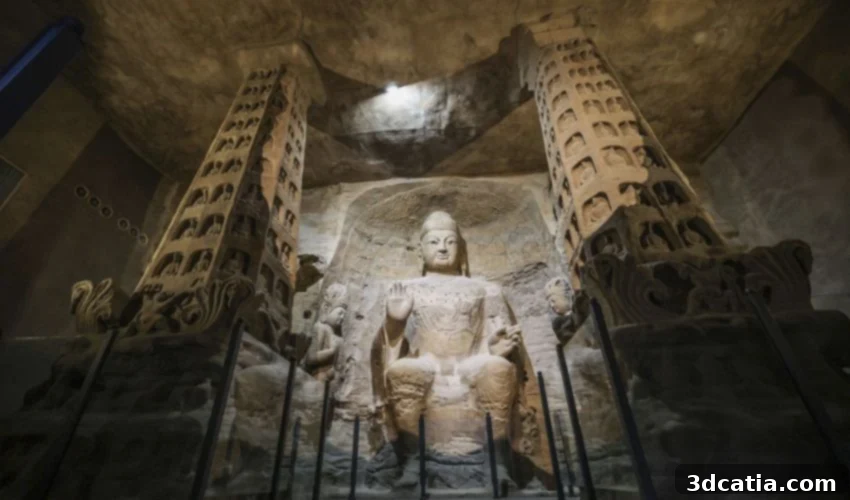
Such an ambitious project is not merely a hypothetical concept; it is already a tangible reality. Currently on display in China is a magnificent 3D printed reproduction of one of the caves within the renowned Yungang Grottoes. These Grottoes constitute an extraordinary Buddhist temple complex and collection of caves, rightfully inscribed on the UNESCO World Heritage list. Carved between the 5th and 6th centuries AD, they comprise an astonishing total of 252 caves, housing over 51,000 statues, and spanning a carved area of 18,000 square meters. UNESCO itself unequivocally highlights their immense importance, stating that the caves “constitute a classical masterpiece of the first peak of Chinese Buddhist art,” reflecting a profound synthesis of Buddhist religious culture with traditional Chinese artistic expression.
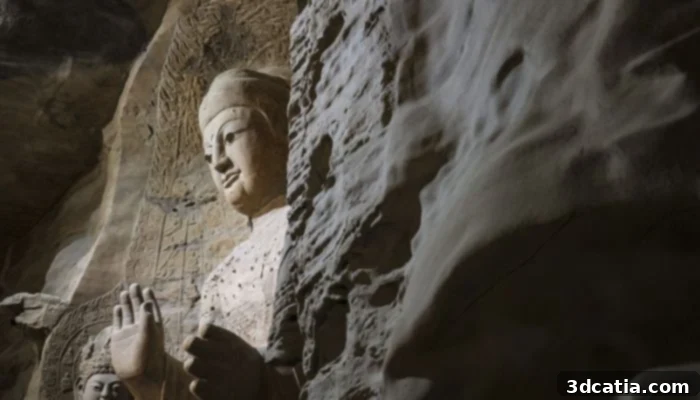
A close-up of the 3D-printed 9.93-meter Amitabha Buddha in cave 3. (Photo credit: CFP via Getty Image)
The Reproduction of the Caves: A Feat of Modern Engineering and Artistry
The 3D printed reproduction of Cave 3 from the Yungang Grottoes is a testament to the remarkable capabilities of modern technology. This replica stands as a colossal achievement, meticulously mirroring the original cave in both appearance and precise scale. The intricate copy measures an impressive 17.9 meters tall by 13.6 meters wide, with the awe-inspiring main Buddha statue within reaching a height of 9.93 meters. The scale and detail achieved ensure that visitors to the replica can experience the grandeur and intricate artistry of the original without ever setting foot inside the ancient site.
The construction of this monumental replica followed a rigorous multi-stage process, emblematic of advanced 3D printing projects. The initial phase involved extensive data acquisition. A team of skilled 3D technicians meticulously collected approximately 10,000 high-resolution images of the original cave and its central Buddha statue. This massive photographic dataset was then processed using photogrammetry software, transforming two-dimensional images into a detailed and accurate three-dimensional digital model. This digital blueprint served as the foundation for the entire reproduction, capturing every nuance of the ancient carvings and architectural features.
Given the immense scale of the cave, printing the entire structure in a single piece was an impossibility. Instead, the complex digital model was intelligently divided into 842 individual parts. These segments were then fabricated using multiple 3D printers operating concurrently. While the specific models or types of 3D printers used were not explicitly stated by the researchers, the final appearance of the replica strongly suggests that the cave sections were printed using a concrete-based material. This implies the utilization of FDM (Fused Deposition Modeling) 3D printing technology, specifically tailored for large-scale construction applications often employing robotic arms to extrude concrete or similar composite materials. FDM’s ability to handle robust materials and build large structures layer by layer makes it an ideal choice for such ambitious architectural replicas. Following the printing phase, the intricate installation and meticulous coloring stages took approximately three months to complete, requiring immense precision and artistic skill to replicate the aged patinas and vibrant pigments of the original Buddhist art.
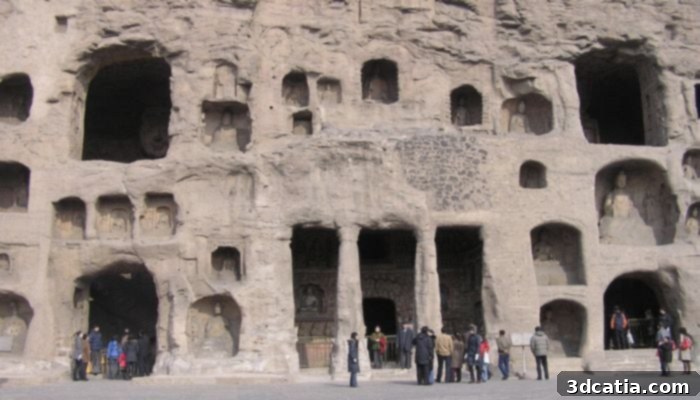
The Yunyang Grottoes are an extensive cave system which attract many tourists every year. (Photo credit: Ian Whitfield)
Beyond Replication: The Multifaceted Benefits of 3D Printing in Heritage Preservation
This groundbreaking reproduction of a Yungang Grottoes cave offers a multitude of benefits, extending far beyond simple display. For academics, it provides an invaluable tool for non-invasive study. Researchers can meticulously analyze every detail of the replica, experimenting with lighting, angles, and conservation techniques, without risking damage to the fragile original. For the general public, it unlocks access to world heritage in an unprecedented way. Ordinary people can experience the awe-inspiring scale and intricate artistry of the caves in a tangible manner, regardless of their ability to travel to the remote original site. This direct engagement fosters a deeper appreciation for history and culture, making heritage more accessible and inclusive.
Crucially, 3D scanning and printing technologies contribute significantly to the broader field of historical preservation by allowing for the creation of precise digital twins of these ancient sites. These digital models serve as permanent, high-fidelity archives of our heritage, safeguarding invaluable information against the ravages of time, natural disasters, and human conflict. Should the originals ever suffer damage, these digital records provide an essential blueprint for restoration or even full reconstruction. This proactive approach to digital preservation ensures that the intricate details of cultural artifacts are documented forever, forming a cornerstone of modern archaeological conservation.
Indeed, the application of 3D printing for heritage preservation is not limited to large-scale reproductions. It has proven its worth in various critical scenarios. One of the best-known and most impactful projects that harmonizes 3D technologies with conservation efforts is “Scan The World.” This ambitious initiative aims to produce open-source 3D scans of precious monuments and artifacts from around the globe, creating a vast digital library for both educational purposes and preservation. A poignant example of the immediate utility of this work came to light in October of last year, when a devastating fire severely damaged many of the iconic Easter Island statues (the Moai). In the aftermath, Scan The World promptly issued a call for the scanning of the Easter Island Statues that survived, and to utilize existing scans for those that were damaged, highlighting the critical role of digital documentation in disaster recovery and cultural restoration efforts. This demonstrates how 3D technologies provide a crucial safety net for our most vulnerable heritage assets.
The Future of Cultural Heritage: Accessibility, Preservation, and Education
The innovative use of 3D printing in projects like the Yungang Grottoes replica signifies a pivotal shift in how we approach cultural heritage. It offers a powerful means to democratize access to historical wonders, allowing people from all walks of life to engage with monumental works of art and architecture that might otherwise be out of reach. These replicas can be displayed in museums, educational institutions, or even public spaces, serving as dynamic teaching tools that bring history to life. Furthermore, by creating these tangible copies, we effectively reduce the pressure on the original sites, minimizing the impact of tourism and environmental exposure, thereby ensuring their longevity for countless generations to come.
While the initial investment in scanning and printing technologies can be substantial, the long-term benefits in terms of preservation, education, and public engagement far outweigh the costs. As 3D printing technologies continue to evolve, becoming faster, more affordable, and capable of handling an even wider range of materials, their application in cultural heritage is set to expand dramatically. We can anticipate more detailed replicas, sophisticated digital archives, and even interactive historical experiences powered by these cutting-edge innovations. The debate between the authenticity of an original and the educational value of a perfect replica will undoubtedly continue, but the undeniable advantages of 3D printing in protecting and sharing our collective human story are becoming increasingly clear.
What are your thoughts on 3D reproductions of historical monuments and their role in preserving our global heritage? We invite you to share your perspective in a comment below or join the conversation on our LinkedIn, Facebook, and Twitter pages! Don’t forget to sign up for our free weekly Newsletter here to receive the latest 3D printing news straight to your inbox! You can also find all our compelling videos and interviews on our YouTube channel, offering deeper insights into the world of additive manufacturing.
*Cover photo credit: CFP via Getty Image