
Revolutionizing Ocean Conservation: How 3D Printed Reefs Offer a Sustainable Future
Our planet’s marine ecosystems are facing unprecedented threats, with the degradation of natural reefs standing out as one of the most critical environmental challenges of our time. These magnificent underwater structures are not merely beautiful; they are incredibly vital for the health and well-being of the entire planet, hosting an astonishing variety of life and constituting some of the most biodiverse ecosystems on Earth. Natural reefs provide essential habitats for countless marine species, protect coastlines from erosion, support fisheries, and even play a role in climate regulation by absorbing carbon dioxide. However, they are rapidly disappearing due to a confluence of factors collectively termed “environmental damage,” including climate change, ocean acidification, pollution, overfishing, and destructive human activities. The scale of this destruction necessitates urgent and innovative solutions, and the answer appears to lie in advanced additive manufacturing technologies. Experts across the globe are increasingly recognizing that 3D printed reefs could offer the most effective short-to-medium-term solution to mitigate this ongoing ecological crisis and help restore our precious marine environments.
The Urgent Crisis Facing Our Marine Ecosystems
The decline of natural coral reefs and other vital marine habitats is a stark indicator of the broader environmental pressures affecting our oceans. These intricate structures, built over millennia by tiny organisms, support an estimated 25% of all marine life, providing nurseries, feeding grounds, and shelter. Beyond their ecological significance, reefs offer tangible benefits to human societies, from acting as natural breakwaters that protect coastal communities from storm surges and erosion, to underpinning the livelihoods of millions through tourism and fishing industries. The rapid loss of these ecosystems not only threatens biodiversity but also has profound socio-economic consequences. The urgency of finding viable, scalable, and environmentally friendly methods for reef restoration has never been greater, prompting scientists and engineers to look towards cutting-edge technologies for hope.
Additive Manufacturing: A New Horizon for Restoration
In this context, additive manufacturing, commonly known as 3D printing, has emerged as a groundbreaking approach for creating complex and customized structures. Unlike traditional subtractive manufacturing methods, 3D printing builds objects layer by layer from a digital design, offering unparalleled flexibility in terms of shape, size, and internal geometry. This capability is particularly advantageous for marine restoration, where intricate designs that mimic natural reef formations are crucial for attracting and supporting diverse marine life. The ability to precisely control the internal and external textures, porosity, and structural complexity of artificial habitats allows for the creation of structures that are far more bio-receptive and functionally effective than those produced by conventional means. Moreover, the inherent efficiency of 3D printing, reducing waste and allowing for the use of novel, sustainable materials, positions it as a key technology in the quest for ecological restoration.
The 3DPARE Project: Pioneering Ecological Reef Solutions
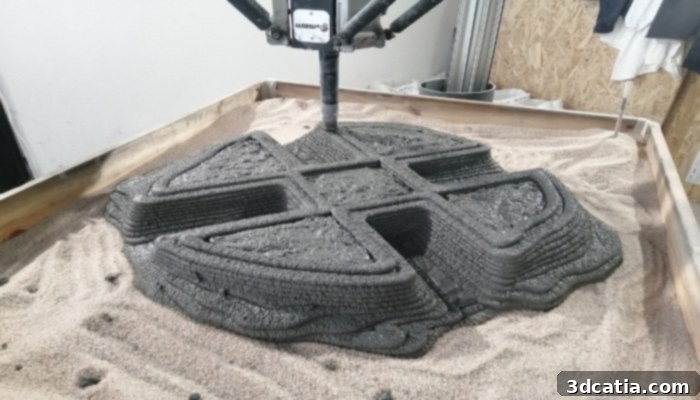
Responding to this critical need, the INTERREG Atlantic Area program, a European funding initiative dedicated to fostering transnational cooperation among 36 Atlantic regions across five European countries, spearheaded the funding of the ambitious 3DPARE project. This collaborative endeavor was born from the combined expertise of several leading European research institutions: the University of Cantabria (Spain), ESITC Caen Institute for Civil Engineering and Construction (France), the University of Porto (Portugal), and Bournemouth University (the UK). The project is expertly led by the University of Cantabria’s Department of Civil Engineering, renowned for its specialization in advanced 3D printing techniques. The overarching goal of 3DPARE is to meticulously design, manufacture, deploy, and subsequently monitor innovative artificial reef blocks that are being strategically planted in various locations within the Atlantic Ocean. These pioneering reef blocks represent a significant leap forward, as they are not only designed with sophisticated 3D printing technology but are also fabricated using sustainable, bio-receptive materials specifically engineered to promote marine colonization and enhance biodiversity.
Credits: 3DPARE
Beyond Conventional: The Advantages of 3D Printed Ecological Reefs
It is important to acknowledge that the concept of artificial reefs is not entirely new; various forms have been deployed in oceans for decades. However, the solutions proposed and implemented by the 3DPARE project represent a significant evolution compared to existing artificial reefs. Traditional artificial reefs are typically constructed from conventional, often inert, materials such as concrete, steel, or even discarded structures like old tires or sunken ships. While these can provide some form of substrate for marine life, their design is often generic, lacking the tailored complexity required to truly replicate natural habitats. Furthermore, the production of these conventional materials can have a considerable environmental footprint. In stark contrast, 3DPARE’s approach is deeply rooted in ecological sustainability and innovative design. Their optimized artificial reefs are precisely shaped through large-scale 3D printing, allowing for intricate geometries and specific features that are proven to be highly attractive to marine organisms. Crucially, the materials used are developed from natural and renewable raw resources, specifically formulated to stimulate and accelerate the colonization process within the marine habitat, fostering a rich and diverse ecosystem rather than just providing a passive structure. This focus on bio-receptivity and environmental impact from conception to deployment sets 3DPARE’s reefs apart as a truly sustainable and effective restoration tool.
Innovating with Sustainable Materials and Advanced Manufacturing
One of the most compelling aspects of the 3DPARE project lies in its meticulous development of the materials used for the reefs. The consistency of the selected printing material was a paramount challenge, requiring extensive research and iterative testing. After initial characterization in laboratories, printing tests began, revealing the necessity for continuous modifications to the mixtures to achieve the ideal rheological properties for large-scale additive manufacturing. The material had to possess a delicate balance: soft enough to be extruded precisely through the 3D printer nozzle, yet robust enough to maintain its intricate shape immediately after deposition and bear the significant weight of subsequent layers without deforming or collapsing. This demanding requirement led to the development of more than 50 variants of cement mortar mixtures. These optimized mixtures utilize a cement with low clinker content, significantly reducing the carbon footprint associated with traditional cement production, combined with specialized additives and carefully selected recycled aggregates. The integration of these sustainable components not only addresses the structural integrity and bio-receptivity of the reefs but also substantially reduces their overall environmental impact, making the entire solution more ecologically responsible from its very foundation.
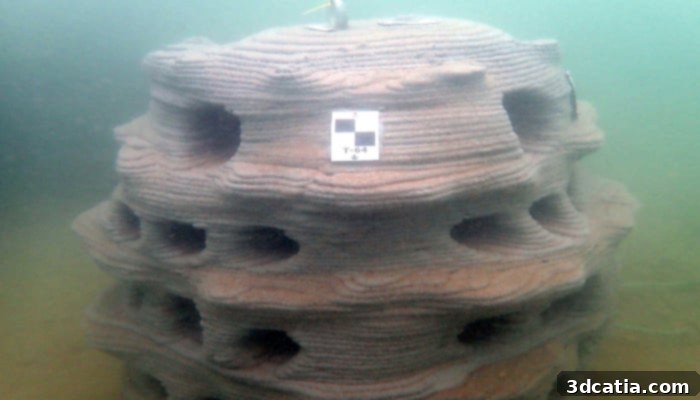
The 3D printed reef on the sea floor
Designing for Life: Creating Thriving Marine Habitats
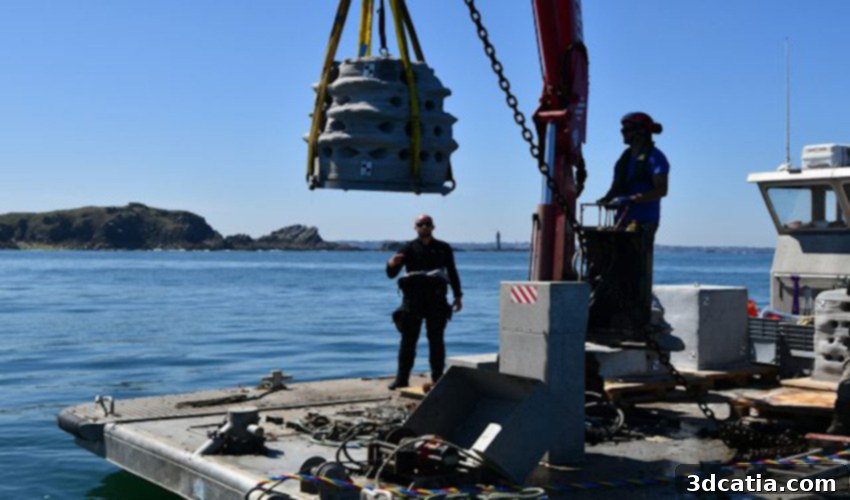
The production phase of these colossal reefs presented significant engineering and logistical challenges. Each individual reef piece measures nearly one meter in dimension and weighs close to one ton, necessitating specialized large-scale 3D printing equipment and careful handling. In total, 36 such monumental pieces were successfully printed. Following their creation, nine of these substantial structures remained in Santander, Spain, where they were manufactured, serving as reference units for further study and observation. The remaining 27 reef units were strategically dispatched to three other key partner locations: Caen (France), Porto (Portugal), and Bournemouth (the UK), ensuring a wide geographical spread for diverse environmental testing. Once all 36 meticulously crafted structures are carefully immersed and secured on the sea floor, marine biologists will embark on a crucial long-term monitoring program. This involves regular dives to meticulously assess the bio-receptivity of the 3D printed reefs – observing the extent to which marine life colonizes and thrives on them. A key design element integrated into every single reef unit is the deliberate inclusion of numerous holes, tunnels, and overhangs. These complex, interconnected features are not merely aesthetic; they are precisely engineered to provide diverse and suitable micro-habitats, offering shelter, breeding grounds, and feeding opportunities for a wide array of marine species, from small invertebrates and fish to larger crustaceans, thereby fostering a vibrant and self-sustaining ecosystem.
Monitoring Success and Scaling Future Impact
The ongoing monitoring efforts by marine biologists are absolutely critical to the success and future development of 3D printed reef technology. Regular assessments of the bio-receptivity will provide invaluable data on how effectively these structures attract and support marine life, allowing researchers to refine designs, optimize material compositions, and understand the ecological impact over time. This data-driven approach ensures that future iterations of 3D printed reefs can be even more effective in their mission. The success of projects like 3DPARE holds immense potential for scaling this innovative technology globally. As the degradation of natural reefs continues worldwide, the ability to rapidly deploy custom-designed, ecologically sound, and bio-receptive artificial reefs could revolutionize ocean conservation efforts. This technology offers a tangible, proactive strategy for marine restoration, providing a glimmer of hope for the recovery of vulnerable ecosystems and the protection of marine biodiversity for generations to come. It underscores a powerful synergy between advanced manufacturing and ecological science, showcasing how human ingenuity can be harnessed to mend the environmental damage we have inflicted.
You can find out more about the detailed progress and scientific findings of the 3DPARE project HERE. What are your thoughts on the groundbreaking potential of 3D printed reefs? Do you believe this innovative approach offers a truly sustainable and scalable solution to the pressing issue of marine ecosystem degradation? We encourage you to share your insights and opinions in a comment below or join the conversation on our Facebook and Twitter pages! Don’t miss out on the latest advancements in additive manufacturing and marine conservation; sign up for our free weekly Newsletter to receive all the cutting-edge news in 3D printing straight to your inbox!