
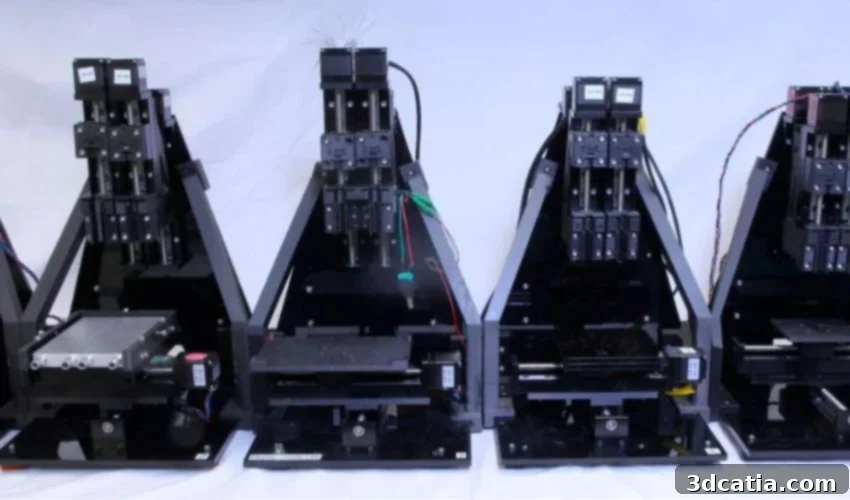
Printess: Stanford’s Open-Source, Low-Cost 3D Bioprinter Democratizes Biofabrication
The realm of 3D bioprinting represents a frontier in advanced additive manufacturing, a pioneering process that meticulously combines biomaterials, living cells, and active biomolecules to engineer intricate structures that precisely mimic the complex properties of natural tissues and organs. This sophisticated technology is not merely a scientific curiosity; it plays an absolutely crucial role in the progressive fields of regenerative medicine and tissue engineering, offering unprecedented possibilities for medical breakthroughs, from creating functional human tissues for transplantation to developing advanced disease models for drug discovery.
Despite its immense potential, the impressive capabilities of 3D bioprinting have historically been hindered by a formidable barrier: the prohibitive cost of the specialized bioprinters required for such intricate work. With price tags soaring up to 200,000 US dollars, these advanced machines remain largely inaccessible to many research institutions, particularly those with limited budgets, smaller academic labs, or emerging scientific communities worldwide. This financial hurdle severely restricts the pace of innovation and limits the number of researchers who can actively contribute to this vital field.
However, a groundbreaking development from the Skylar Scott Lab at Stanford University is poised to fundamentally transform this landscape. They have unveiled Printess, a modular and open-source 3D bioprinter designed specifically to address the cost and accessibility challenges. Printess emerges not just as an alternative, but as a genuinely promising solution, poised to democratize access to advanced bioprinting technology and accelerate research across the globe.
The High Stakes of 3D Bioprinting and Its Costly Barriers
The promise of 3D bioprinting is nothing short of revolutionary. Imagine the ability to print functional human organs on demand, eliminating the critical shortage of donor organs and saving countless lives. Envision pharmaceutical companies developing more effective drugs by testing them on realistic, bioprinted human tissues rather than traditional animal models or less accurate cell cultures. These are not distant dreams but active areas of research, fueled by the capabilities of bioprinting.
Yet, the journey towards realizing these ambitions has been arduous, primarily due to the technological complexity and the associated financial investment. High-end bioprinters often integrate sophisticated robotics, precise control systems, and specialized environmental chambers, all contributing to their exorbitant cost. This effectively creates an elite club, where only well-funded institutions can afford the tools necessary to push the boundaries of biofabrication, leaving many talented researchers and innovative ideas on the sidelines. The impact of this limitation extends beyond individual labs; it slows down the collective progress of an entire scientific discipline, preventing a diverse range of perspectives and approaches from contributing to critical medical advancements.
Printess: Engineering Accessibility Through Innovation
The new Printess bioprinter represents a paradigm shift, meticulously engineered to offer high performance at a fraction of the traditional cost. At its core, Printess utilizes Direct Ink Writing (DIW) technology, an innovative 3D printing process that stands out for its versatility and precision. Unlike some other 3D printing methods, DIW involves the direct extrusion of paste-like materials—often complex biomaterial formulations laden with living cells—through a fine nozzle. This highly controlled process allows for the precise deposition of these materials layer by layer, enabling the creation of intricate, multi-layered structures with remarkable resolution and a wide variety of material compositions.
Direct Ink Writing (DIW): The Precision Core of Printess
DIW is particularly well-suited for bioprinting because it can handle a diverse range of bioinks, from hydrogels that provide structural support to viscous solutions containing various cell types and active biomolecules. The ability to directly control the extrusion path and material deposition is crucial for mimicking the complex architectures found in biological tissues. Printess harnesses this capability, allowing researchers to design and fabricate sophisticated microenvironments that support cell viability, proliferation, and differentiation, essential for creating functional tissue constructs.
The physical architecture of Printess is a testament to clever engineering and cost-conscious design. In total, the printer is robustly constructed from just six linear actuators, a powerful microcontroller, and a collection of readily available components, many of which are themselves 3D-printed or laser-cut. The design process leveraged industry-standard software like SolidWorks and Onshape, ensuring both precision and the ability for others to easily modify or adapt the existing design files. This thoughtful choice of components and design methodology significantly reduces manufacturing complexity and expense, contributing directly to its remarkably low price point without compromising on fundamental performance.
Modular Design for Unprecedented Flexibility
One of Printess’s most compelling features is its inherent modularity. This intelligent design allows researchers an unparalleled degree of flexibility, enabling them to customize the bioprinter to meet their specific experimental needs. For instance, the build space can be scaled up or down, making it suitable for printing everything from small, intricate cellular arrays for drug screening to larger tissue constructs. Similarly, the print heads themselves are interchangeable and adaptable. This means that researchers can experiment with different nozzle sizes, extrusion mechanisms, or even integrate multiple print heads for multi-material deposition, all within the same fundamental Printess framework. This adaptability is critical in a field as diverse as bioprinting, where experimental requirements can vary dramatically from one project to another.
Beyond Cost: Unrivaled Accuracy and Open-Source Empowerment
While its affordability is a headline feature, Printess does not sacrifice performance. Another significant advantage of the system is its impressive movement accuracy of ten micrometers (0.01 mm). This level of precision is paramount in bioprinting, where cellular structures and biomaterial scaffolds often require intricate geometries and fine details to function correctly. Such high accuracy actively supports advanced DIW methods, including sophisticated multi-material printing, where different bioinks are deposited adjacent to or on top of each other, and even active mixing during the printing process, allowing for on-the-fly customization of material properties.
Precision at an Unbeatable Price Point
Adding to its technical prowess, Printess boasts an impressive repeatability of ± five micrometers. This exceptional consistency is vital for scientific research, ensuring that experiments can be reliably reproduced and results can be trusted. This repeatability, combined with its high accuracy, allows Printess to process numerous materials with different viscosities, from thin hydrogels to thicker cell suspensions, making it incredibly versatile. The multi-material capabilities further enhance its utility, enabling the fabrication of complex biological constructs that more closely resemble natural tissues, which are often composed of multiple cell types and extracellular matrix components.
The Power of Open-Source: Fostering a Global Research Community
Perhaps one of the most transformative aspects of Printess, beyond its technical specifications and low cost, is its commitment to openness. The complete assembly instructions and firmware are made freely available, embracing the ethos of open-source development. This transparency is a game-changer for the scientific community, allowing for:
- Easy Replication and Customization: Researchers worldwide can build their own Printess bioprinter, modifying it to suit their unique experimental needs without proprietary restrictions.
- Accelerated Innovation: The open-source nature fosters a collaborative environment where improvements, new features, and creative applications can be developed and shared rapidly by a global community of users.
- Democratization of Technology: By removing the barriers of high cost and proprietary control, Printess makes advanced bioprinting accessible to a much broader audience, including educational institutions, startups, and research labs in developing countries.
- Enhanced Education and Training: Students and emerging scientists can learn and experiment with cutting-edge bioprinting technology hands-on, preparing the next generation of innovators in regenerative medicine.
This openness promotes unprecedented collaboration in the scientific sector and significantly facilitates the integration of new functions and methodologies, ensuring that Printess remains at the forefront of accessible bioprinting innovation.
Revolutionizing Research: The Broad Applications of Printess
The implications of a high-performance, open-source, and extremely affordable bioprinter like Printess are vast and far-reaching. By drastically lowering the entry barrier, Printess is set to ignite a surge of innovation across various scientific disciplines, transforming how research is conducted and breakthroughs are achieved. This accessible tool empowers a new generation of scientists to engage with biofabrication, leading to diversified approaches and faster discovery cycles.
Advancing Regenerative Medicine and Tissue Engineering
In regenerative medicine, Printess offers a vital platform for creating functional tissues and organs for transplantation. Researchers can now more easily experiment with different cell types, biomaterials, and scaffold designs to optimize tissue regeneration. This includes printing skin grafts for burn victims, cartilage for joint repair, or even preliminary organ constructs. For tissue engineering, it provides an unprecedented opportunity to develop more accurate disease models. By printing complex 3D cellular environments that mimic human physiology, scientists can study disease progression, test therapeutic interventions, and evaluate drug toxicity in a more relevant and ethical manner than traditional 2D cell cultures or animal models.
Pioneering New Biomaterials and Drug Discovery
Printess is also a powerful tool for the rapid development and testing of novel biomaterials. Its multi-material capabilities and precision allow for the creation of intricate scaffolds with varying mechanical and biochemical properties, enabling researchers to explore how different material compositions influence cell behavior and tissue formation. This accelerates the discovery of next-generation bioinks and implantable materials. Furthermore, in drug discovery, Printess can facilitate the creation of high-throughput screening platforms. By bioprinting standardized micro-tissues or organoids, pharmaceutical companies can screen potential drug candidates more efficiently and accurately, identifying promising compounds faster and reducing the overall cost and time associated with drug development.
Printess: A Catalyst for the Future of Biofabrication
In conclusion, Printess is more than just a low-cost bioprinter; it is a catalyst for democratizing access to cutting-edge biofabrication technology. By combining impressive movement accuracy and repeatability with a modular, open-source design and an astonishingly low price point of just 250 US dollars, Printess opens up a world of promising prospects for the future. From accelerating progress in regenerative medicine and tissue engineering to fostering the development of new biomaterials and transforming drug discovery, Printess offers researchers a major, tangible advantage. This pioneering instrument empowers a broader community to engage with the intricacies of 3D bioprinting, paving the way for innovations that were previously confined to well-resourced laboratories. Find out more about Printess and its capabilities HERE.
What are your thoughts on this revolutionary low-cost 3D bioprinter? We invite you to share your insights and comments below, or join the conversation on our LinkedIn, Facebook, and Twitter pages! If you’re seeking more compelling content on 3D printing in the medical and dental fields, be sure to explore our dedicated page HERE. And to stay abreast of all the latest advancements in 3D printing, don’t forget to sign up for our free weekly Newsletter here, delivering the freshest news straight to your inbox! You can also discover all our insightful videos on our YouTube channel.
*Cover Photo: Printess