
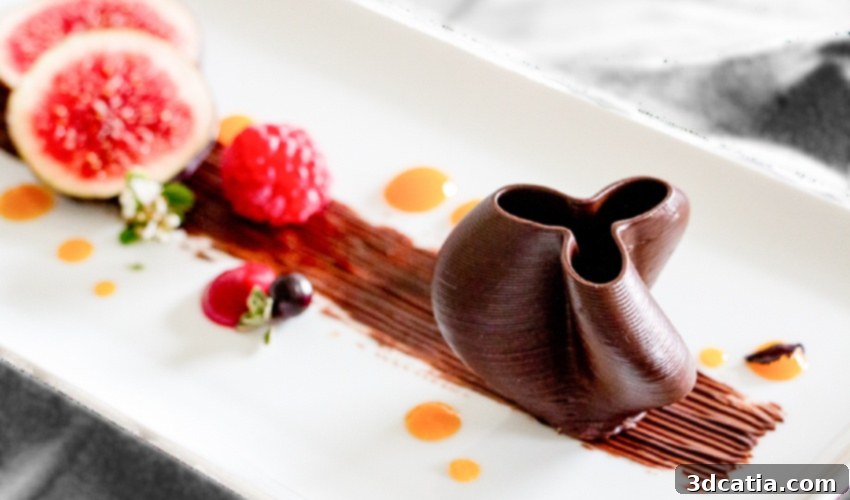
Revolutionizing Culinary Arts: An In-Depth Look at Print2Taste and Food 3D Printing
Conventionally, we’re taught not to play with our food. But what if playing with food could lead to remarkable culinary innovation? Print2Taste, a pioneering company founded in Freising, Germany, in 2014, challenges this notion, offering a groundbreaking answer to gastronomic creativity. With its advanced 3D printers, Print2Taste empowers users to playfully design, personalize, and 3D print a wide array of edible creations. The company’s mycusini and Procusini printers stand out for their exceptional ease of use and ability to deliver fast, high-quality results, making intricate food design accessible to everyone from home bakers to professional chefs.
Beyond just the sophisticated machines, Print2Taste offers a comprehensive ecosystem designed to enhance the food 3D printing experience. This includes a variety of specialized refills, such as the popular Procusini® 3D Choco and Procusini® 3D Pasta, ensuring perfect consistency and delicious outcomes. Furthermore, users gain exclusive access to the Procusini®Club, a vibrant online community that serves as a treasure trove of resources. The club provides a vast template library, an extensive collection of 3D objects, options for logo integration, and invaluable tips & tricks to master the art of edible printing.
For those looking to push the boundaries even further, the Procusini®Club sparks endless inspiration. It features a curated selection of recipe suggestions and also encourages users to submit their own innovative ideas. Imagine printing delicate herb butter shapes, intricate wasabi garnishes, personalized fresh goat cheese designs, perfectly formed spritz cookies, or ethereal meringue decorations – all achievable with the right consistency and precise printer settings. Print2Taste’s commitment to user education is also evident in its offering of free online seminars, which provide comprehensive insights into operating the Procusini 3D printer and developing custom 3D objects. To delve deeper into this fascinating company and the future of food 3D printing, we sat down with CEO Gerd Funk, who graciously shared his vision and insights into the world of Print2Taste.
3DN: Could you introduce yourself and your company in more detail?
We are an innovative startup based in Freising, Germany, a region renowned for its strong technological and culinary heritage. Our dynamic and interdisciplinary team, currently comprising ten dedicated professionals, brings together a diverse range of expertise critical to our unique field. Our team members hail from backgrounds spanning food technology, biology, software development, and mechanical engineering, ensuring a holistic approach to our product development. Crucially, we also have experienced chefs on board, whose practical culinary knowledge is invaluable in refining our food printing capabilities. As one of the few “non-food technologists” within the team, I primarily oversee the vital areas of marketing and sales, connecting our innovations with the wider world.
Print2Taste was officially established in mid-2014, evolving as a spin-off from the prestigious Weihenstephan-Triesdorf University of Applied Sciences. This academic foundation provided us with a robust research and development environment, allowing us to meticulously refine our core technologies. Our business model is built upon robust, multi-layered pillars that intricately weave together hardware, software, specialized food materials, and comprehensive services. This integrated approach culminates in what we proudly call a “plug & play” solution. This philosophy ensures that our customers, regardless of their prior experience or technical proficiency, can achieve impressive results within minutes of setup. Whether it’s our mycusini 3D Choco printer, perfect for enthusiastic hobby bakers and home chefs, or our professional-grade Procusini line, designed for demanding environments like hotels, caterers, and confectioners, the promise of immediate, high-quality output remains consistent. We are deeply committed to local innovation, developing and producing both our cutting-edge hardware and our specialized food refills right here at our Freising facility, maintaining stringent quality control and fostering a true sense of craftsmanship.
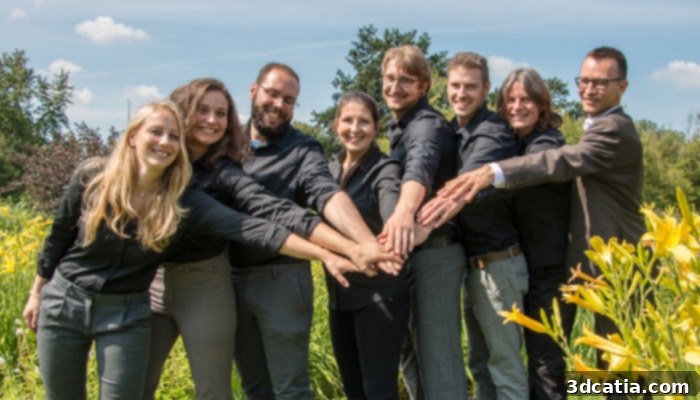
Gerd Funk (first from right) with his talented team.
3DN: How did your business idea come about?
The inception of our business idea was quite organic, stemming from a fundamental understanding of food science and an eagerness to explore new technological frontiers. At its core, if one possesses a deep comprehension of how food “ticks” – its rheological properties, its behavior under different temperatures and pressures, and how various ingredients interact – it becomes a natural progression to apply this extensive knowledge to emerging technologies like 3D printing. The goal was simply to observe and understand what extraordinary possibilities could unfold. It truly isn’t “rocket science” in the intimidating sense. In fact, the foundational concept has historical parallels; even our grandmothers masterfully worked with piping bags in their kitchens, creating intricate decorations with cream or icing to embellish cakes and pastries. Food 3D printing, in many ways, is a modern, digitized evolution of these time-honored techniques, bringing precision, complexity, and automation to culinary artistry that was previously only achievable through immense manual skill and repetitive effort. We saw an opportunity to bridge traditional culinary craftsmanship with cutting-edge digital fabrication, making advanced food design more accessible and reproducible than ever before.
3DN: Why did you decide to use food 3D printing? What are the advantages of additive manufacturing here?
Our decision to focus on food 3D printing was driven by its immense potential to revolutionize culinary practices, primarily through its unique ability to enable creative and highly personalized food design, even for a batch size of just one item. This level of customization is a game-changer across various segments of the food industry. Consider a confectioner crafting an exquisitely unique wedding cake: with 3D food printing, they can create intricate, bespoke decorations that are impossible to achieve through traditional methods, offering truly one-of-a-kind masterpieces. For a caterer or hotel, imagine serving a dessert elegantly adorned with a corporate logo or a special event motif, particularly impactful for a corporate event with 150 discerning guests. The technology allows for consistent, branded elements that elevate the dining experience and leave a lasting impression.
The advantages of additive manufacturing in the culinary world are manifold. Firstly, it offers unparalleled **precision and intricacy**, allowing for designs that are either too complex or too time-consuming to produce by hand. This opens up entirely new avenues for aesthetic presentation. Secondly, **personalization** is paramount; customers can tailor designs to specific themes, names, or dietary requirements (e.g., sugar-free, gluten-free decorations), enhancing the bespoke nature of any food item. Thirdly, there’s significant **efficiency and consistency**. Once a design is perfected, it can be replicated flawlessly an unlimited number of times, eliminating human error and ensuring uniform quality, which is crucial for professional settings. This also contributes to **reduced waste**, as only the exact amount of material needed is printed. Lastly, it fosters **culinary innovation**, encouraging chefs and food technologists to experiment with new textures, shapes, and ingredient combinations, pushing the boundaries of what edible art can be. This versatility extends seamlessly to the mycusini for amateur bakers, where the joy of crafting personalized cake decorations, intricate chocolate figures, or unique cookie shapes transforms home baking into an exciting, creative endeavor.
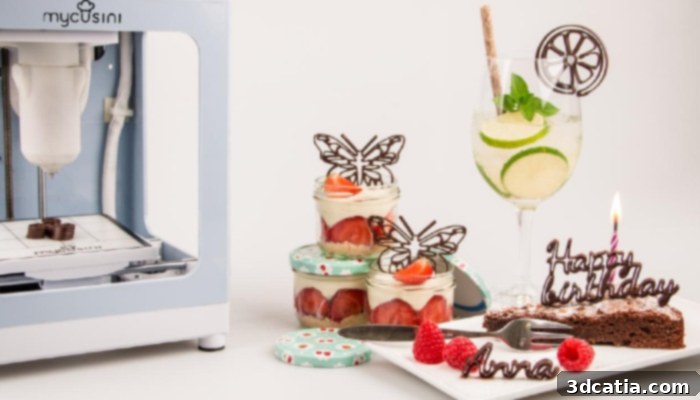
Print2Taste printers can be used to create delicate edible decorations.
3DN: How do the mycusini and Procusini 3D printers work? What do you have to consider with the materials?
Both our mycusini and Procusini 3D printers operate on a user-friendly, cartridge-based system, primarily utilizing our specially formulated 3D Choco Refills. These practical, pre-filled cartridges are designed for maximum convenience and consistent results. The process is remarkably straightforward: users simply insert a refill cartridge into their mycusini or Procusini device. After a brief preheating phase, the printer is ready to operate, allowing creativity to flow almost instantly. We take great pride in developing and producing these high-quality refills ourselves, right here in Freising. This in-house production ensures optimal consistency, flow properties, and delicious taste profiles, which are crucial for successful food 3D printing.
When it comes to materials, consistency is key in food 3D printing. Our proprietary 3D Choco Refills are meticulously engineered to have the perfect rheological properties – that is, how they flow and deform – to ensure smooth extrusion, precise layering, and rapid solidification, resulting in sharp, detailed prints. However, we also recognize the desire for culinary experimentation among professionals. For Procusini users, we offer an advanced “expert mode” that grants them the flexibility to utilize their own food materials. This mode comes with a comprehensive suite of necessary setting options, allowing experienced users to fine-tune parameters such as extrusion temperature, print speed, and nozzle pressure. When using custom materials, careful consideration must be given to their specific properties: the material needs to have the correct viscosity to flow smoothly through the nozzle, yet be robust enough to hold its shape once extruded. Factors like moisture content, particle size, and fat content significantly influence printability. Our expert mode provides the tools and guidance for professionals to experiment with a vast array of ingredients, from fruit purees and cheeses to savory pastes, truly unlocking unlimited creative potential while maintaining optimal print quality.
3DN: What was particularly important to you in the making of your products?
At Print2Taste, the customer and user experience are always at the forefront of our product development philosophy. We operate with a deep understanding that while 3D printing technology is fascinating, the average user, especially in a culinary context, rarely possesses extensive programming knowledge or technical expertise in additive manufacturing. Our market research and user feedback consistently show that the vast majority of individuals simply want to achieve beautiful, impressive results in the easiest and most intuitive way possible. This fundamental insight is precisely where our “Plug & Play” philosophy comes into its own.
Our goal is to make the operation of our food 3D printers exceptionally user-friendly, almost child’s play. This means integrating intuitive interfaces, pre-set programs, and clear instructions that guide users seamlessly through the entire process, from design selection to the final edible creation. We deliver a meticulously coordinated overall system to our customers, ensuring a harmonious interaction between all components. For example, a mycusini customer receives not just the innovative mycusini 3D printer, but also the precisely formulated mycusini 3D Choco refills, and full access to the mycusini Club – our bespoke application software and design platform. This complete, integrated system is designed to remove any technical barriers and simplify the creative journey. Our confidence in this holistic approach is so strong that we even offer a “guarantee of success,” underscoring our commitment to ensuring every customer can achieve delightful and impressive edible prints. This focus on seamless integration, ease of use, and guaranteed satisfaction is what truly differentiates our products and empowers culinary enthusiasts of all skill levels to explore the exciting world of food 3D printing.
3DN: Any last words for our readers?
Many of your readers are likely already well-versed in the fascinating world of 3D printing, perhaps with extensive experience in plastics and other industrial materials. However, we genuinely believe that the realm of designing and creating food with 3D technology offers an entirely new and incredibly exciting dimension to explore. It’s a field that combines the precision of engineering with the artistry of gastronomy, opening up endless possibilities for sensory experiences.
Our mycusini 3D Choco printer, in particular, represents a wonderful gateway to delve into this captivating topic. It provides an accessible and fun way to experiment with food 3D printing right in the comfort of your own kitchen, allowing you to craft unique and delicious treats that are sure to impress. Whether you’re looking to personalize gifts, create bespoke dessert decorations for special occasions, or simply unleash your inner culinary artist, the mycusini makes it possible with surprising ease. We encourage everyone, from seasoned 3D printing enthusiasts to curious home cooks, to discover the creative potential of edible 3D printing. It’s an innovative way to interact with food, transforming ordinary ingredients into extraordinary edible art. You can find more comprehensive information about Print2Taste, our products, and our vision for the future of food at our official website HERE.
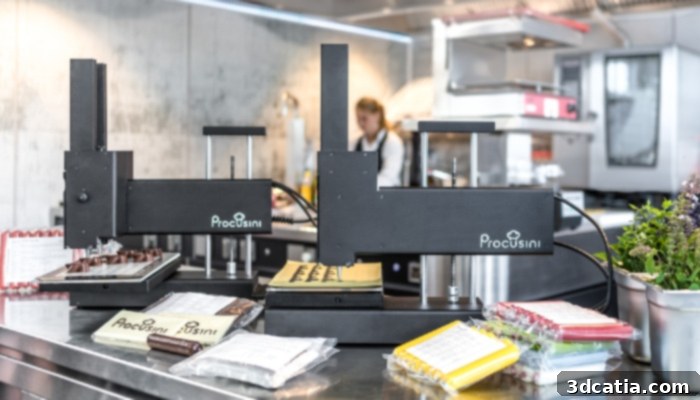
What are your thoughts on Print2Taste’s innovative approach to food 3D printing? Have you tried edible 3D printing yourself, or are you intrigued by its potential? We’d love to hear your insights! Let us know in a comment below or join the conversation on ourFacebook,Twitter andLinkedIn pages. For the very latest news, trends, and advancements in the world of 3D printing, remember to sign up for our free weeklyNewsletter here, delivered straight to your inbox!
*All image credits: Print2Taste