
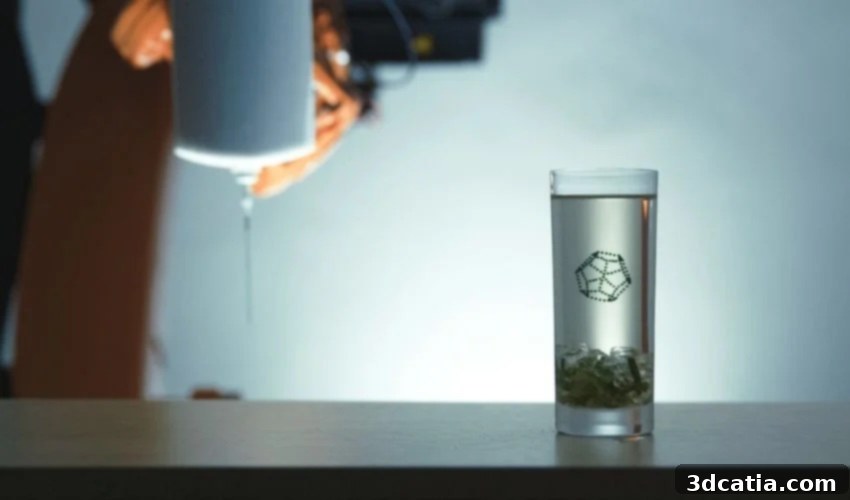
Pioneering Liquid Art: The Revolutionary World of Print a Drink’s 3D Printed Cocktails
In an era dominated by technological innovation, one entrepreneur is redefining the boundaries of mixology and event experiences. Meet Benjamin Greimel, the visionary behind Print a Drink, a groundbreaking company that has captured widespread attention at events across the globe. Operating as a unique, one-person enterprise, Print a Drink specializes in a concept once thought to be science fiction: 3D printable liquids. This innovative approach, while seemingly simple, is the culmination of countless prototypes, relentless experimentation, and the overcoming of significant technical hurdles by Greimel himself. Wearing many hats—CEO, business developer, programmer, and chief operator—Benjamin Greimel shares the captivating journey of his startup’s creation, the strategic decision to maintain a lean operational model, and the intricate technical details that underpin Print a Drink’s exceptional business model.
The Genesis of Print a Drink: From Academic Project to Event Sensation
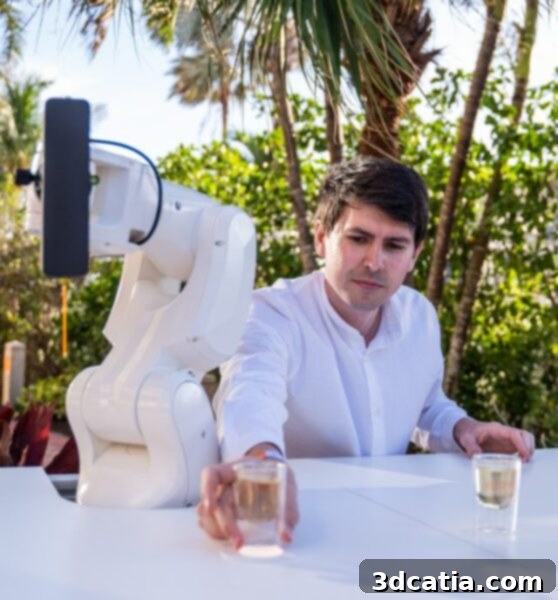
Founder of Print a Drink, Benjamin Greimel
The innovative concept for Print a Drink first took shape during Benjamin Greimel’s Master’s studies in Industrial Design at the University of Art in Linz, Austria. The spark for this unique venture was ignited during a semester project, following the introduction of the KUKA robot and related lectures by a new professor. The assignment was refreshingly open-ended: students were challenged to leverage robotics in a creative way involving food. Greimel initially explored the intriguing dynamics of immiscible liquids, such as vinegar and oil, observing how they interacted without blending. This early experimentation laid the groundwork for a far more ambitious idea: the 3D printing of beverages. Through dedicated effort and numerous trials over the course of a single semester, Benjamin successfully developed a compelling proof of concept, demonstrating the viability of his vision.
Recognizing a significant untapped potential, Greimel quickly identified Print a Drink as a niche technology poised to revolutionize the event and entertainment sector. At the time, no comparable technology existed globally, underscoring the pioneering nature of his work. The initiative also had a lasting impact on his alma mater, contributing to the establishment of the university’s dedicated “Creative Robotics” department, a testament to the inspiring blend of art and technology his project embodied. In his free time, Benjamin relentlessly refined the 3D printing process, transforming his academic project into a polished service ready for commercial deployment at events. Even during its developmental stages, Print a Drink garnered considerable interest, leading to initial inquiries from prominent companies and victories in several startup competitions. The revenue generated from these early successes allowed him to swiftly invest in new equipment, including his very first robotic arm. Today, Print a Drink boasts complete robotic setups operating in both Europe and the USA, with the latter accounting for the majority of its revenue. Despite remaining a highly specialized niche technology, Print a Drink has been Benjamin’s full-time profession for over six years. Every facet of the operation—from sophisticated processes and customized hardware to intricate logistics—has been meticulously optimized, enabling him to independently prepare and execute even large-scale international events with seamless precision.
The Lean Philosophy: A One-Man Operation Driving Innovation
Benjamin Greimel’s approach to business is notably unconventional in today’s startup landscape. He made a deliberate decision to keep Print a Drink exceptionally lean, with the primary objective of minimizing ongoing expenses and maximizing operational efficiency. This means that Benjamin himself is the architect, engineer, and operator of every aspect of the company. His responsibilities span the entire workflow: from initial customer communication and creative recipe development to complex prototyping, sophisticated robot programming, and even the seemingly mundane task of washing glasses after an event. While many startups prioritize rapid scaling and extensive teams, Greimel’s strategy has proven immensely successful for his highly specialized business model. He firmly believes that this hands-on, comprehensive involvement fosters a deep connection to his work, making it an incredibly fulfilling profession. This lean model allows for unparalleled agility, direct control over quality, and a profound understanding of every technical and client-facing detail, ensuring that Print a Drink consistently delivers a high-quality, bespoke service that few larger companies could replicate.
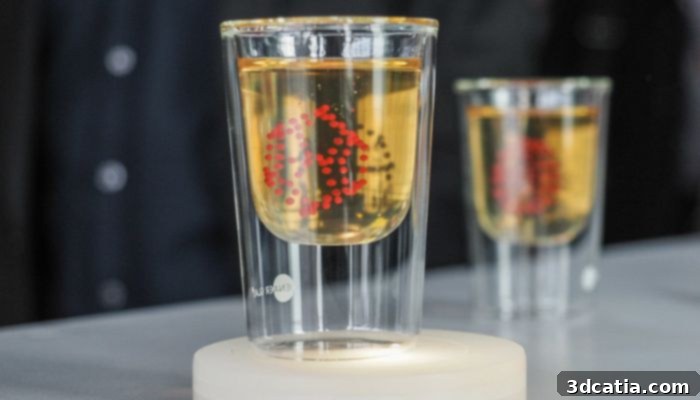
First concepts at the Creative Robotics Exhibition in Linz, 2017 (Credit: Ars Electronica | Martin Hieslmair)
Technological Mastery: Custom Tools and FDM for Rapid Prototyping
The core of Print a Drink’s operation relies on a sophisticated integration of advanced technologies and custom-engineered solutions. To translate intricate 3D patterns for cocktails into actionable commands for the robotic arm, Benjamin Greimel developed his own proprietary slicer software. This custom-built tool is essential because standard 3D printing slicers are designed for solid materials, not delicate liquids. The 3D patterns themselves are meticulously crafted using CAD software, and the slicer then parametrically generates the precise robot code, much like a conventional slicer prepares G-code for a Fused Deposition Modeling (FDM) printer. Throughout the intensive development of Print a Drink, Greimel also designed and modified countless specialized tools and aids. These custom components are crucial for everything from ensuring the perfect creation of the 3D printed cocktails to facilitating smooth event operations and simplifying equipment maintenance. This dedication to bespoke tooling reflects a level of precision and customization often seen in specialized communities, where enthusiasts develop new gadgets to extract maximum performance from their equipment. In Greimel’s case, however, he stands almost alone in the world, pioneering the field of 3D printing beverages.
For prototyping, 3D printing has been an indispensable technology. In the initial phases, Benjamin occasionally outsourced the production of SLS (Selective Laser Sintering) or SLA (Stereolithography) parts to external service providers. However, to achieve maximum agility and control over his design iterations, he quickly transitioned to producing all necessary components in-house using his own FDM (Fused Deposition Modeling) 3D printers. This strategic shift has been transformative, as FDM technology, when combined with intelligent design techniques, allows for the effective creation of complex, aesthetically pleasing, and even delicate parts. The ability to iterate rapidly, without the need for time-consuming post-processing or messy cleaning procedures often associated with other 3D printing methods, was the primary factor in his decision to rely exclusively on FDM for his developmental work. This continuous, agile prototyping process is critical for fine-tuning the intricate mechanisms required for 3D liquid printing.
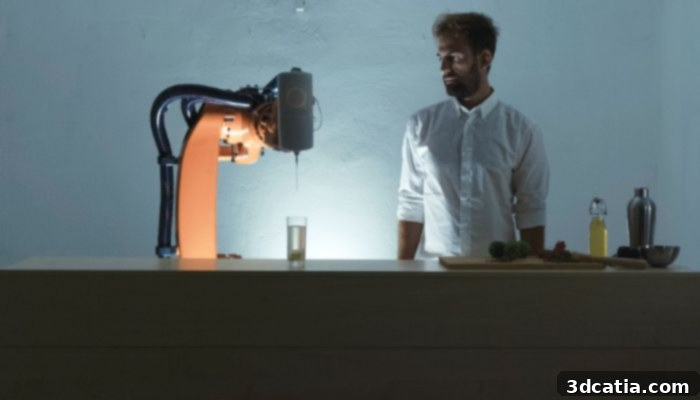
Print a Drink in Action: Exclusive Event Experiences and Client Acclaim
Print a Drink’s unique offering is currently provided exclusively as a high-end service for a diverse range of events, trade shows, and performances worldwide. This business model, centered on delivering bespoke experiences, is one Benjamin intends to maintain and grow in the coming years. The scope of engagements varies significantly, from intimate, exclusive corporate gatherings to sprawling, large-scale international conventions. The client base primarily comprises international technology and IT companies, as well as major event agencies looking to create unforgettable brand activations and guest experiences. The feedback from clients has been consistently overwhelmingly positive, a testament to the technology’s novelty and the flawless execution of the service. This satisfaction is further evidenced by a high rate of repeat orders, with many clients booking Print a Drink for multiple subsequent events. The ability to provide visually stunning, personalized, and interactive beverage experiences transforms ordinary events into memorable spectacles, cementing Print a Drink’s reputation as a leader in innovative event technology.
Navigating Technical Frontiers: The Challenges of 3D Liquid Printing
The journey of developing Print a Drink was paved with countless technical challenges, ranging from minor adjustments to significant engineering feats. One of the earliest and most fundamental questions Benjamin faced was identifying a suitable printing medium. Initial experiments quickly revealed that water-soluble liquids, such as traditional syrups or spirits, were unsuitable due to their inherent polarity, which caused them to mix rather than form distinct, stable structures. The eventual solution, elegant in its simplicity today, involved using droplets of edible oil. These oil droplets, when carefully stabilized within the beverage, form perfect spheres thanks to the principles of surface tension. These spheres act as ephemeral, floating 3D pixels, allowing intricate patterns to be “printed” within the drink. Furthermore, oils like lemon or nut oil offer the added benefit of infusing extra layers of flavor into the beverage, enhancing the overall sensory experience. Achieving this stability requires a meticulous balance of viscosity, density, and temperature, ensuring the oil droplets retain their form and position within the cocktail without dispersing or sinking prematurely.
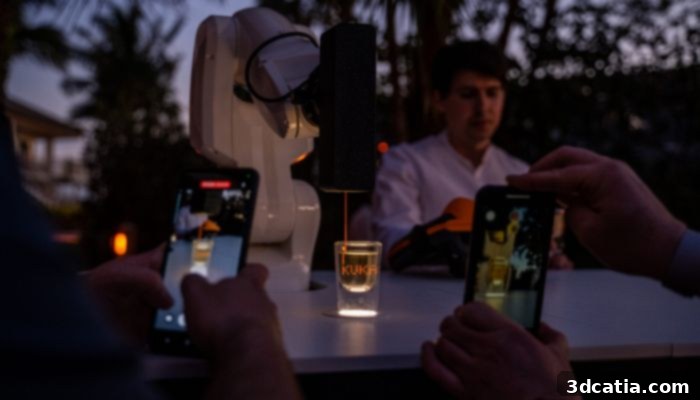
At the heart of Print a Drink’s hardware lies the custom-designed print head—a marvel of micro-engineering. Its primary function is to precisely, repeatedly, and rapidly dispense oil droplets in the microliter range directly into the cocktail. From the outset, the print head was designed to operate purely electrically, bypassing the need for compressed air systems often found in conventional dosing equipment. This electrical operation ensures greater portability, quietness, and reliability. A crucial performance metric was the dispensing time per print point, which had to be no more than 200 milliseconds to achieve acceptable printing speeds and pattern fluidity. Moreover, to guarantee impeccable pattern integrity, any post-flow of the liquid—even down to the nanoliter range—had to be completely prevented, eliminating faulty print points that could mar the delicate designs. Naturally, all components of the print head that come into contact with the printing medium had to meet stringent food-safety standards. Benjamin’s initial prototypes involved creatively modified laboratory pipettes, which, while functional, presented numerous limitations in terms of precision and speed. Today, the print head is an entirely in-house development, featuring specialized components such as high-precision microvalves sourced from advanced medical technology, ensuring unparalleled control and reliability.
The print head offers exceptional versatility in dosing volume, capable of dispensing anywhere from approximately 500 nanoliters up to several microliters per print point. This granular control allows for a wide range of aesthetic effects and pattern densities. Over the years, the print head has undergone continuous optimization, with Benjamin personally designing and 3D printing hundreds of components for its ongoing development. A critical element is the custom-made glass capillary responsible for dispensing the printing medium. Its geometry has been painstakingly optimized to ensure that the oil droplets separate from the capillary as cleanly as possible, preventing any turbulence in the liquid that could disrupt the nascent 3D pattern. This intricate design and iterative refinement process underscore the engineering prowess behind Print a Drink, transforming complex technical challenges into a seamless, mesmerizing art form.
Future Horizons: Expanding the Reach of Liquid 3D Printing
Currently, Print a Drink benefits from an organic, word-of-mouth marketing strategy. Benjamin Greimel has intentionally avoided active marketing campaigns, yet the company consistently generates sufficient inquiries and orders each year. This success is largely due to the inherent spectacle of the printing process itself; every event serves as a dynamic showcase, with the robot in action almost invariably filmed and widely shared across social media platforms. Looking ahead, however, Benjamin plans a strategic shift towards more active and targeted marketing efforts. His goal is to focus on securing partnerships with the largest entertainment companies and the most exclusive event agencies globally. This proactive approach aims to unlock new markets and elevate Print a Drink’s visibility to an even broader, high-profile audience.
Beyond event services, Greimel envisions the potential for permanent installations in iconic locations. He imagines a Print a Drink setup seamlessly integrated into a world-class theme park, a luxurious hotel, or a high-end restaurant, offering a unique, ongoing attraction or a premium, personalized beverage experience. Such installations would provide continuous exposure and solidify Print a Drink’s position as a cutting-edge technological marvel. The allure of the Asian market is particularly strong, given its technological embrace and appetite for novel experiences. While inquiries from Asia have emerged, projects there have historically faced significant hurdles due to complicated and often prohibitively expensive logistics. Overcoming these logistical challenges will be a key focus for future international expansion, unlocking a vast potential market for Print a Drink’s unique liquid artistry.
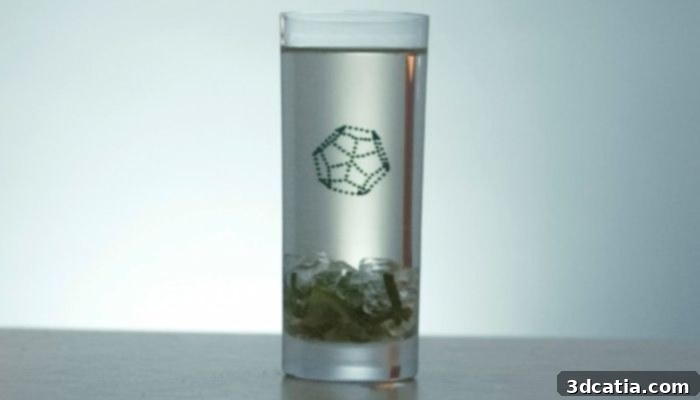
Artful Designs and More: Print a Drink Impresses at Numerous Events
Benjamin Greimel’s Print a Drink stands as a remarkable example of how ingenuity, perseverance, and a deep understanding of technology can converge to create a truly innovative and captivating experience. From a simple university project to a globally recognized service, the journey of 3D printed cocktails continues to inspire and push the boundaries of what’s possible in the world of beverages and event technology. You can learn more about Print a Drink and its pioneering work by visiting their official website HERE. We invite you to share your thoughts on this unique approach to manufacturing printable liquids. Let us know what you think in a comment below or connect with us on our Facebook and Twitter pages. Don’t forget to sign up for our free weekly newsletter to stay informed on all the latest news in 3D printing, delivered directly to your inbox!
*All Photo Credit: Print a Drink