

Unlocking Vibrant Creations: The Ultimate Guide to Full-Color 3D Printers and Technologies
The world of additive manufacturing is constantly evolving, and a crucial aspect gaining significant traction is the integration of color. When selecting a 3D printer, various factors come into play, such as intended applications, desired print speed, final part quality, and production volume. For an increasing number of users, however, the ability to produce parts in vivid, true-to-life color has become an indispensable criterion. While color integration may not always be the primary consideration, it is absolutely essential for specific applications. Imagine creating a realistic visual prototype for a perfume bottle that accurately reflects its design, or an intricate anatomical model where distinguishing blood vessels from nerves and arteries is critical for educational or medical purposes. This is where full-color 3D printers step in, transforming concepts into visually stunning, multi-hued realities.
The integration of color into additive manufacturing is now a sophisticated reality, thanks to machines and complementary accessories that offer an extensive spectrum of colors. To assist you in navigating this dynamic market, we have compiled a comprehensive list of some of the leading multicolor 3D printers available today. These innovative machines are categorized by their underlying technology: Fused Deposition Modeling (FDM), Material Jetting, and Binder Jetting. Dive in below to discover the capabilities and specifications of these groundbreaking full-color solutions.
Fused Deposition Modeling (FDM) Color 3D Printers
FDM technology, known for its versatility and accessibility, offers several distinct approaches to producing colored parts. One common method involves 3D printers equipped with multiple extruders, allowing users to load different colored filaments simultaneously and combine them within a single print. This enables seamless transitions between colors and the creation of multi-colored objects. Another innovative solution developed by some manufacturers involves a system that can color filaments directly within the printer; these machines dispense precise color inks at the print head, effectively transforming a single base filament into a range of colors as it is extruded. Furthermore, a variety of additional accessories are available on the market that facilitate the mixing and blending of different filaments to achieve unique color combinations or gradients. These diverse methods ensure that FDM remains a viable and evolving option for color 3D printing.
Palette 3 Pro – Mosaic Manufacturing
Manufactured by the Canadian company Mosaic Manufacturing, the Palette 3 Pro stands out not as a 3D printer itself, but as an advanced and compact filament management system. Measuring a mere 30.9 x 23.5 x 7.4 cm and weighing 3.2 kg, this ingenious tool allows users to seamlessly utilize up to eight different filaments within a single print. The Palette 3 Pro is designed to integrate with an existing FDM 3D printer, enabling the mixing of multiple materials and colors and their subsequent use through a single extruder. It boasts broad compatibility with popular solutions like Ultimaker and Lulzbot, connecting effortlessly to your printer and offering remote control for starting and monitoring prints from anywhere. A key feature is its autonomous filament management: the Palette 3 Pro automatically detects when a filament spool is depleted and intelligently switches to a new one, guaranteeing uninterrupted print management. This latest iteration joins filaments 10% faster than the Palette 3 and a remarkable 30% faster than the Palette 2. The user experience is further enhanced by an improved four-inch touch screen interface. The Palette 3 Pro supports 1.75 mm filaments and is compatible with a wide array of materials, including PLA, PETG, TPU, ABS, PVA, and HIPS, making it an incredibly versatile accessory for multicolor FDM printing.
P1S – Bambu Lab
Bambu Lab’s P1S represents a powerful entry into the FDM 3D printing market, distinguished by its exceptional printing speed, precision, and versatility, all while offering impressive color capabilities. This printer boasts a maximum tool head speed of 500 mm/s and incorporates a direct drive extruder, which provides superior control over the extrusion and retraction of even challenging flexible filaments. The result is consistently smooth and flawless prints across various geometries. The P1S offers extensive material compatibility, allowing users to print with ABS, ASA, PLA, PETG, TPU, PVA, and PC. A standout feature for multicolor printing is the optional Automatic Material System (AMS), which can be integrated to enable the use of up to 16 different colors in a single print. With a generous print volume of 256 × 256 × 256 mm³, the P1S provides ample space for a wide range of projects, from functional prototypes to visually rich models, making it a highly attractive option for both enthusiasts and professionals seeking speed and multi-color functionality.
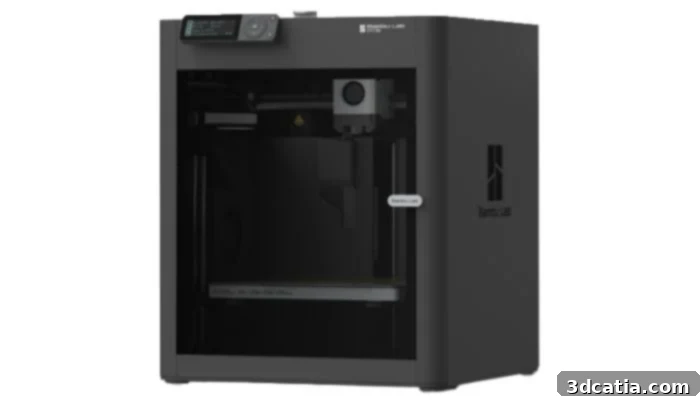
Photo Credits: Bambu Lab
K2 Plus Combo – Creality
The K2 Plus Combo from Creality is engineered specifically for sophisticated multicolor 3D printing. At its core is the innovative Color Filament System (CFS), which intelligently manages filaments and allows for the simultaneous feeding of four different spools. These spools can hold either multiple materials or multiple colors, providing significant flexibility for diverse printing needs. By integrating up to three additional CFS units, the K2 Plus Combo can achieve prints with an astonishing sixteen colors within a single part, pushing the boundaries of FDM color capabilities. Filament loading and removal are fully automated, streamlining the entire printing process. Beyond filament management, the CFS also functions as a smart drying system, equipped with temperature and humidity sensors to ensure optimal filament conditions. The printer features a Direct Drive “Apus” metal extruder, which includes a trimetallic thermal protection nozzle capable of reaching temperatures up to 350°C. This high-temperature capability allows users to process a vast range of materials, including advanced high-performance filaments. Furthermore, with its expansive print volume of 350 x 350 x 350 mm, the K2 Plus Combo facilitates the creation of large-scale multicolor objects. All these features are delivered with incredible speed, boasting an extrusion rate of 600 mm/s and a maximum acceleration of 30,000 mm/s², making the K2 Plus Combo a formidable tool for rapid, complex, and colorful 3D printing.
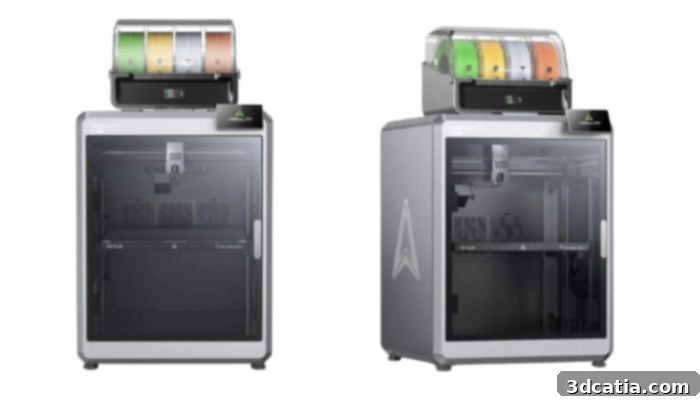
Photo Credits: Creality
AD5X – Flashforge
The Flashforge AD5X is an innovative 3D printer that simplifies multicolor printing with its single, yet highly enhanced, extruder system. This is achieved through its proprietary IFS (Intelligent Filament Switching) module, which allows the machine to work with up to four different colors and materials. The AD5X supports a range of popular filaments, including TPU, various PLA types (PRO, HS, Matte, Silk), and PETG varieties (PRO, HS, and ASA). A significant advantage for users is its open-source nature, meaning it is fully compatible with third-party brand materials, providing greater flexibility and cost efficiency. Performance-wise, the printer delivers impressive speeds of up to 600 mm/s and an acceleration of 20,000 mm/s². According to Flashforge, this optimizes printing time without compromising the quality of the final parts. The AD5X also integrates smart features designed to enhance user experience and reliability, such as automatic filament reloading, automatic feeding, and the ability to exclude failed objects from a multi-part print, saving both time and material. With a print volume of 220 × 220 × 220 mm and a manageable weight of 11 kg, the AD5X distinguishes itself through its ease of assembly, precision, and speed. It offers a streamlined and highly efficient solution for those seeking to print in multiple colors without unnecessary complexities.
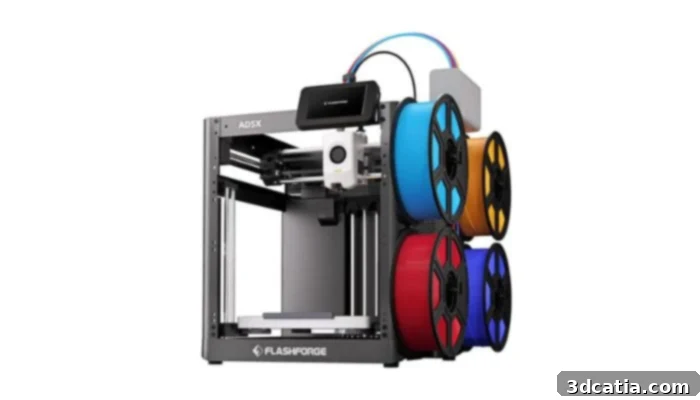
The compact design of the AD5X is still able to integrate four spools of filament (photo credits: Flashforge)
Kobra S1 Combo – Anycubic
The Kobra S1 Combo is Anycubic’s entry into the multi-material and multicolor 3D printing space, offering users the flexibility to print with anywhere from 4 to 8 distinct colors. This printer features a substantial print volume of 250 x 250 x 250 mm, providing ample room for diverse projects. It boasts an excellent extrusion speed of 600 mm/s and can reach a maximum acceleration of 20,000 mm/s², ensuring rapid production times without sacrificing quality. For a more pleasant working environment, the Kobra S1 Combo also includes a 44dB silent printing mode. Anycubic’s printer supports a range of commonly used materials, including PLA, PETG, ABS, and ASA. While TPU can be utilized with the Kobra S1 Combo, it is currently compatible only with single-color printing configurations. The manufacturer recommends using plastic filament spools to ensure the smoothest possible experience, especially for multicolor prints. The printer’s nozzle can reach a high temperature of 320°C, facilitating the extrusion of various filaments, while the print bed temperature can go up to 120°C, ensuring excellent adhesion of prints to the build surface. Finally, the Kobra S1 Combo is equipped with an intuitive touch screen, making printer operation straightforward and user-friendly, catering to both novice and experienced users keen on exploring multicolor FDM capabilities.
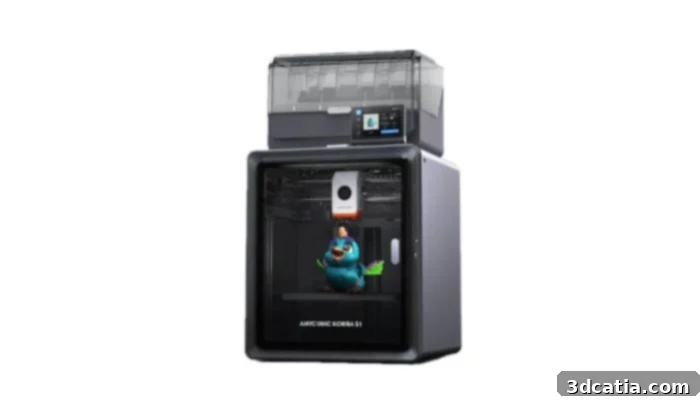
Photo Credits: Anycubic
Prusa XL – Prusa
The Prusa XL represents the latest advancement in large-format, multi-material printing from the renowned manufacturer Prusa. This innovative machine incorporates a fast and highly efficient toolchanger system, capable of housing up to five independent toolheads. This setup allows users to keep five 2kg spools loaded simultaneously, significantly reducing the downtime traditionally associated with lengthy filament changing procedures. Naturally, the capability to print with multiple materials seamlessly translates into the ability to produce objects with multiple colors, making it an ideal choice for complex, visually rich projects. The Prusa XL is compatible with a wide array of materials, including PLA, PETG, TPU, and PC, offering versatility for various applications. With a generous print volume of 360×360×360 mm, this XL printer provides ample space for substantial designs. It is available for purchase in both fully-assembled and semi-assembled configurations, catering to different user preferences. The 2024 iteration of the Prusa XL features several key upgrades designed to enhance print quality and speed, including Input Shaper technology, which effectively cancels resonance vibrations, and Pressure Advance, which precisely compensates for pressure changes in the nozzle during printing. These advancements contribute to exceptionally fast and precise output. Furthermore, investing in the Prusa XL ensures ongoing value, as Prusa commits to providing major firmware and hardware upgrades for years to come, future-proofing your investment in advanced FDM printing.
Material Jetting Solutions for Full-Color 3D Printing
Material Jetting is a distinct additive manufacturing technology that excels in producing highly detailed and vividly colored 3D prints. Unlike FDM, which extrudes plastic, Material Jetting works by jetting droplets of photopolymer resin or other materials from a print head, similar to how an inkjet printer applies ink to paper. These droplets are then immediately cured and solidified by a UV light source. For full-color capabilities, material jetting systems typically use multiple print heads to jet different colored resins (CMYK, plus clear and support materials). This allows for pixel-level color mixing and the creation of millions of color combinations, resulting in models with smooth surfaces, fine details, and photorealistic finishes. This technology is particularly favored for visual prototypes, medical models, and artistic applications where aesthetic fidelity and color accuracy are paramount.
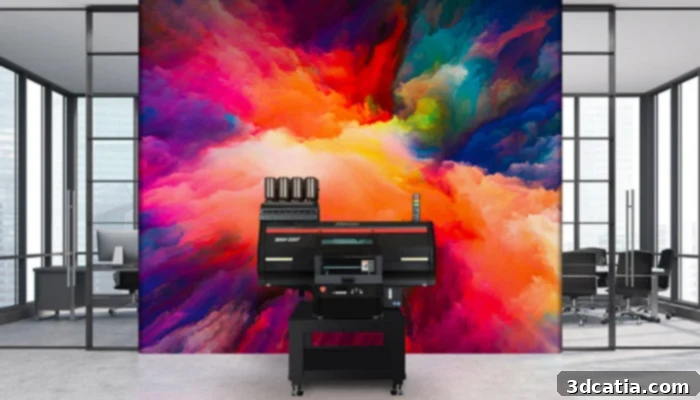
3DUJ-553 and 3DUJ-2207 – Mimaki
Mimaki, a renowned Japanese manufacturer with a strong legacy in traditional 2D printing, made a significant entry into the 3D printing arena by pioneering UV-curable, colored material jet 3D printers. Their flagship solution, the 3DUJ-553, launched in 2017, established a new benchmark for color fidelity in additive manufacturing. This professional-grade machine is capable of creating parts with an astonishing palette of over 10 million colors, making it ideal for applications requiring extreme color accuracy. The 3DUJ-553 operates using a sophisticated UV light curing process: a layer of liquid material is precisely applied, followed by the deposition of UV-sensitive inks that are then instantly solidified by light. This iterative process is repeated layer by layer until the final, full-color part is meticulously built.
Building on the success of the 3DUJ-553, Mimaki subsequently developed the 3DUJ-2207, a more compact and accessible 3D printer that maintains the same high-quality color printing capabilities. Designed to be user-friendly and more accommodating for smaller spaces, the 3DUJ-2207 aims to unlock a broader segment of the market. Its enhanced accessibility makes it particularly well-suited for medical professionals requiring detailed anatomical models, researchers and educators developing visual aids, as well as designers and artists who demand exceptional color accuracy and intricate detailing for their creative projects. Both Mimaki machines underscore the power of material jetting for producing vibrant, full-color 3D models.
J850 TechStyle and J850 Prime – Stratasys
Stratasys, a global leader in additive manufacturing, offers advanced material jetting solutions that push the boundaries of color and texture, particularly with its J850 series. The **Stratasys J850 TechStyle** revolutionizes textile printing by enabling direct design and embellishment on garments and fabrics. Leveraging advanced 3DFashion™ technology, this printer opens up unprecedented possibilities in high-end fashion and haute couture. It can simultaneously print with up to seven different materials, offering full-color capabilities alongside transparency effects and highly refined textures. Its substantial print volume of 460 x 360 x 50 mm is expertly adapted for textile surfaces up to 2 m². An interchangeable tray system simplifies setup, significantly reducing downtime and accelerating production cycles in fast-paced design environments. With seven cartridges accommodating a diverse range of materials, from vibrant hues to flexible or rigid textures, the J850 TechStyle grants unparalleled creative freedom to fashion designers and textile innovators.
Another prominent model in the series, the **J850™ Prime**, transforms general 3D color printing for a wide array of applications. This versatile printer is celebrated for its ability to reduce production time by up to 80% compared to traditional prototyping methods, making it invaluable for designers and engineers. It stands as one of the most adaptable printers available, capable of creating both prototypes and finished parts with over 600,000 color combinations. Beyond color, it can produce models with realistic textures, as well as incorporating flexible or transparent materials within the same print. Its simplified operation further enhances the design process, making it faster and more efficient for iterative development and high-fidelity concept visualization. Both J850 models exemplify Stratasys’ commitment to pushing the envelope of multi-material and full-color additive manufacturing.
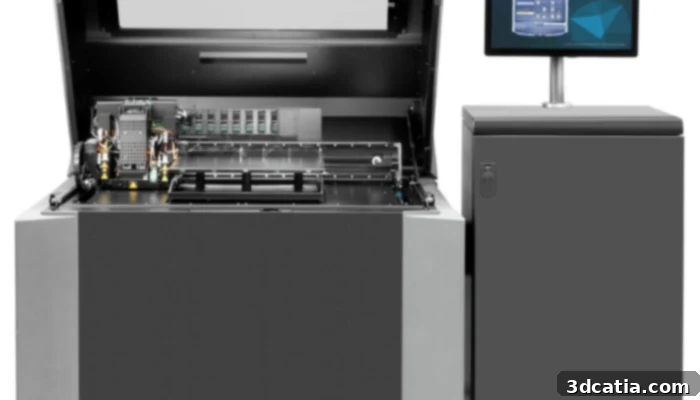
Photo Credits: Stratasys
ProJet ®CJP 660Pro – 3D Systems
The ProJet ®CJP 660Pro is a distinguished ColorJet Printer (CJP) offered by 3D Systems, a pioneer in additive manufacturing. While categorized here under Material Jetting by the original source, it’s important to note that CJP technology is actually a variant of Binder Jetting, where a liquid binder is jetted onto a powder bed. The “color” aspect comes from the binder itself being colored (CMYK), allowing for vibrant, photorealistic models. 3D Systems proudly highlights the 660Pro’s capability to produce photorealistic full-color parts at an impressive printing speed of 28 mm/h, a rate estimated to be five to ten times faster than many other printing technologies. This exceptional throughput is largely attributed to its five print heads, which efficiently jet the colored binder, optimizing material usage and consequently reducing operational costs.
Measuring 193 x 81 x 145 cm and weighing 240 kg, the ProJet ®CJP 660Pro is a substantial, large-format color printer, designed for professional environments. It offers a generous print volume of 253 x 381 x 203 mm, accommodating a wide range of model sizes. The printer is compatible with 3D Systems’ proprietary Visijet PWL materials, which are specially formulated for high-fidelity color reproduction. The ProJet ®CJP 660Pro is an ideal solution for a diverse array of applications requiring precise and vibrant color models, including highly detailed medical models, intricate design pieces, complex art objects, and comprehensive architectural models. Its unique approach to color ensures that concept models and visual prototypes can be created with unparalleled aesthetic quality.
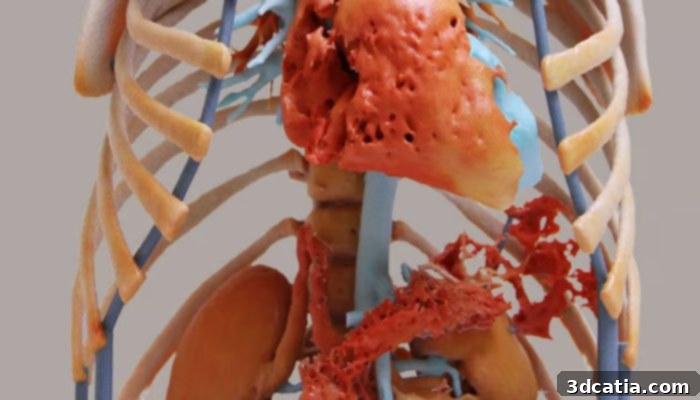
A medical model made with the printer (photo credits: 3D Systems)
D450Plus – Saliner
From the Chinese manufacturer Saliner comes the D450Plus printer, a standout among Material Jetting machines enabling sophisticated multilateral, multicolor 3D printing. Saliner has distinguished itself by developing and integrating its proprietary “direct injection color multi-material 3D printing technology” across its product range. According to the manufacturer, this innovative technology is characterized by several key advantages: high precision, remarkably vivid color reproduction, high efficiency in production, extensive customization options, and robust multimaterial printing capabilities. These attributes position the D450Plus as an ideal solution for a diverse range of demanding applications. Its benefits are particularly impactful in fields such as digital medicine (for highly accurate anatomical models), education and training (for engaging visual aids), culture and art (for intricate and colorful creations), and industrial design (for rapid, high-fidelity prototyping).
In terms of its technical specifications, the D450Plus machine features compact dimensions of 860 x 640 x 790 mm, making it suitable for various professional environments. It offers an impressive resolution of 600 x 600 x 2540 dpi, ensuring exceptional detail and surface finish. Equipped with 2560 nozzles, it can precisely jet a large volume of material. The system is capable of processing up to 7 different materials simultaneously, further enhancing its multi-material capabilities. Furthermore, the D450Plus provides users with three distinct printing modes to tailor output to specific requirements: a Fast mode (offering a layer thickness of 36μm and monochrome printing), a Fine mode (with an 18μm layer thickness for enhanced detail), and a Texture mode (achieving an ultra-fine 10μm layer thickness for exceptional surface textures). These features collectively make the Saliner D450Plus a powerful and versatile tool for advanced color 3D printing.
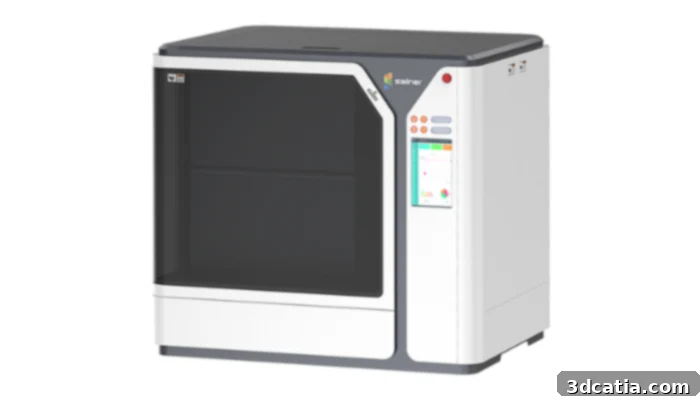
Photo Credits: Saliner
Binder Jetting Color 3D Printers
Binder Jetting is another powerful additive manufacturing technology capable of producing full-color 3D prints, particularly known for its ability to create complex geometries without the need for support structures. In this process, a liquid binding agent is selectively jetted onto a bed of powder material, layer by layer, solidifying it in specific areas to form the object. For full-color capabilities, the binder itself is colored, typically using a CMYK palette, which is precisely jetted to create millions of different hues on the powdered material. After printing, the “green” part often undergoes a post-processing step, such as infiltration or curing, to enhance its strength and finish. This technology is highly valued for producing detailed prototypes, architectural models, figurines, and educational tools that require both intricate details and a full spectrum of colors, offering a unique tactile experience alongside visual fidelity. The unbound powder surrounding the printed part acts as a natural support, which can be easily removed, making it ideal for delicate and complex designs.
G450 – EASYMFG
EASYMFG, a company based in China, specializes in advanced binder jetting solutions for industrial applications. Among their diverse range of products, which includes sand-compatible systems, is the G450 3D printer, specifically engineered for full-color production. The G450 stands out for its capability to produce multiple multicolored parts simultaneously, thanks to its generous build plate measuring 450 x 220 x 300 mm. This large build volume significantly boosts productivity, making it suitable for batch production of intricate color models. The printer offers a configurable layer thickness ranging between 100 and 200 microns, allowing for a balance between print speed and the achievement of fine, precise details. According to EASYMFG, the G450 color 3D printer is exceptionally well-suited for a variety of professional fields, including industrial design for realistic prototypes, architecture for detailed scale models, education for engaging visual aids, and research and development for rapid iteration of colored components. A significant advantage of binder jetting, prominently featured in the G450, is that it does not require separate print media or support structures; the surrounding powder bed inherently acts as support for the printed parts. This feature not only simplifies post-processing but also empowers users to design and produce incredibly complex geometries and internal structures, all realized in vibrant full color, pushing the boundaries of what is achievable in additive manufacturing.
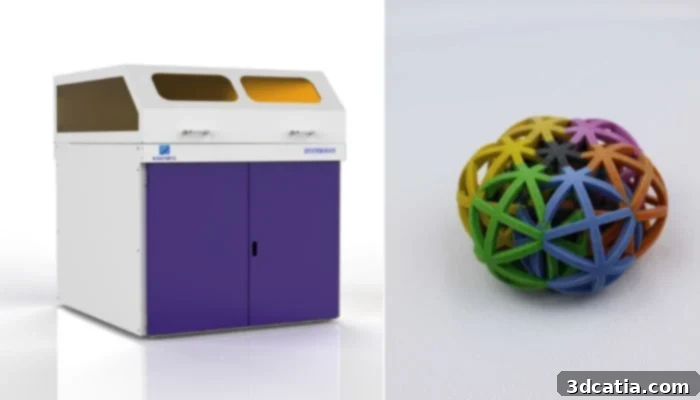
The 3D printer and a multicolored part designed on the machine (photo credits: EASYMFG)
The landscape of full-color 3D printing is expanding rapidly, offering unprecedented possibilities for designers, engineers, educators, and artists across various industries. From the versatile multi-filament systems of FDM to the photorealistic precision of Material Jetting and the structural freedom of Binder Jetting, today’s technologies provide a wide array of options for bringing vibrant, multi-hued digital models to life. These machines are not just about adding aesthetic appeal; they are about enhancing clarity, communication, and functionality in a tangible way, transforming prototypes into products and concepts into compelling realities.
We hope this comprehensive guide to full-color 3D printers has been informative and helpful in understanding the diverse technologies and leading models available on the market. What are your thoughts on these innovative solutions? Share your feedback in a comment below or connect with us on our Facebook and Twitter pages! Don’t forget to sign up for our free weekly Newsletter to receive all the latest news and advancements in 3D printing directly to your inbox!