
Revolutionizing 3D Printing: UC Davis Unveils Droplet-Based Microfluidics for Multi-Material and Soft Structures
A groundbreaking advancement in the field of 3D printing has emerged from the innovative minds of researchers at the University of California, Davis. Their pioneering work, which introduces a novel droplet-based microfluidics additive manufacturing system, was recently detailed in a paper published in the esteemed Proceedings of the National Academy of Sciences of the United States (PNAS). PNAS stands as one of the world’s most selective and prestigious scientific journals, underscoring the significance and scientific rigor of this new development. The approach distinguishes itself by employing a unique nozzle design, fundamentally different from the standard extrusion heads commonly found in traditional 3D printing processes. This innovation promises to unlock new capabilities, particularly in fabricating structures with complex material compositions and finely tuned mechanical properties.
Conventional extrusion-based 3D printers, while widely adopted for their efficiency and cost-effectiveness, operate by pushing a filament through a heated nozzle, depositing material layer by layer to construct the final object. This method has propelled 3D printing into numerous industries, from prototyping to manufacturing. However, it presents two significant limitations that have long challenged researchers and engineers. Firstly, achieving truly multi-material prints – where different materials are precisely integrated within a single structure – remains exceedingly difficult. The challenge lies in managing material compatibility, flow rates, and deposition accuracy from a single or multiple parallel nozzles without cross-contamination or structural compromise. Secondly, controlling the precise softness or stiffness of printed objects is problematic. Once a material is extruded and solidified, its mechanical properties are largely fixed, making it hard to create objects with gradient softness or localized flexible regions. The new droplet-based technique developed by the UC Davis team directly addresses these critical challenges, paving the way for a new generation of functional and adaptable 3D printed objects.

Illustration of the droplet-based 3D printing technology in action, fabricating a hollow tube. (Image Credit: PNAS)
The pioneering research was spearheaded by Jiandi Wan, an assistant professor of chemical engineering at UC Davis. Professor Wan led a dedicated team with a clear objective: to devise an extrusion-based 3D printing method that could precisely modulate the extruded filament at the exact point of printing through the sophisticated inclusion of droplets. The key insight for the team came from an unexpected parallel. They observed a striking resemblance between the nozzles used in traditional extrusion 3D printers and another class of devices they were actively studying: glass capillary microfluidic devices. These advanced microfluidic systems are renowned for their ability to precisely manipulate fluids at microscopic scales, often utilizing multiple concentric nozzles to create emulsions or encapsulate materials. Recognizing this fundamental similarity, Professor Wan and his team realized that adapting a similar multi-nozzle, microfluidic model could offer a revolutionary alternative to the current printheads, effectively transforming the capabilities of conventional 3D printers by introducing an unprecedented level of material control and versatility.
The innovative device developed by the UC Davis team operates on a sophisticated multi-phase drip system, enabling the precise encapsulation of one material within another during the printing process. At its core, the system utilizes an aqueous polyethylene glycol diacrylate (PEGDA) solution as the encapsulated material, which is meticulously inserted into a common silicon-based polymer, polydimethylsiloxane (PDMS). The elegant mechanism involves PDMS flowing around a specially designed dripper. As the PDMS flows, it hydrodynamically shears off minuscule, precisely sized droplets of the PEGDA solution. These newly formed PEGDA droplets are then seamlessly integrated into the continuous flow of PDMS. Subsequently, both materials – the PDMS matrix embedded with PEGDA droplets – are simultaneously extruded onto the growing 3D printed piece. This continuous, controlled encapsulation and co-extrusion process allows for the creation of composite materials with predefined internal structures, a capability that was previously unattainable with conventional single-material extrusion techniques. This meticulous control over droplet formation and integration is key to achieving tunable material properties in the final printed object.

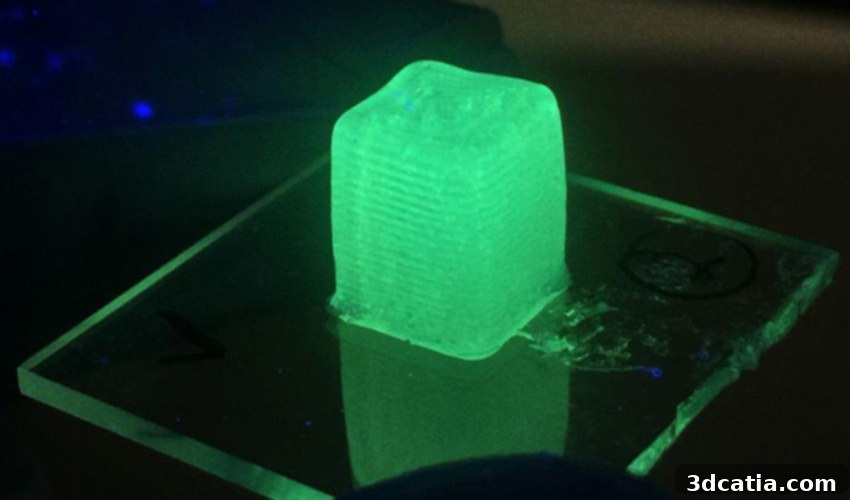
Close-up view of the printed material structure, illustrating the encapsulated droplets. (Image credit: PNAS)
Upon closer inspection, the internal architecture of the printed structure bears a fascinating resemblance to the iconic “Pac-Man maze,” with countless discrete dots of PEGDA droplets uniformly dispersed and surrounded by the continuous PDMS matrix. The genius of this design lies in the interaction between these two materials. During the polymerization process of PDMS – the curing stage where it transforms from a liquid to a solid elastomer – the PEGDA within the droplets gradually diffuses outwards. This diffusion of PEGDA into the surrounding PDMS directly interferes with the polymerization kinetics of the PDMS, specifically disrupting the cross-linking reactions. The result is a localized softening effect within the PDMS matrix, making the overall structure significantly more flexible and elastic than pure PDMS would be. What’s more, this crucial property of structure flexibility is not static; it can be precisely modulated and fine-tuned by altering key parameters during the printing process. Researchers found that by adjusting the size of the PEGDA droplets and controlling the flow rate of both materials, they could achieve a wide spectrum of softness and flexibility. Larger droplets or higher concentrations of PEGDA, for instance, lead to more significant interference and thus softer regions, offering unparalleled control over the mechanical properties of the final printed object. This capability opens doors for creating objects with tailored mechanical responses, from rigid supports to highly deformable sections, all within a single print.
The implications of this innovative droplet-based 3D printing technique are far-reaching and hold immense promise across various advanced technological domains. One of the most anticipated applications is in bioprinting, where the ability to precisely control material softness and integrate multiple biocompatible materials is paramount for creating complex biological structures. Mimicking the varying stiffness of human tissues and organs, or creating scaffolds that encourage specific cell growth and differentiation, becomes significantly more feasible with this technology. In the realm of soft robotics, this technique could revolutionize the design and functionality of robots that are inherently flexible, adaptable, and safe for human interaction. Imagine robots that can change their stiffness on demand, allowing them to grasp delicate objects or navigate challenging environments with unprecedented dexterity. Furthermore, wearable electronics stand to benefit significantly. Devices that conform seamlessly to the human body, offering both comfort and advanced functionality, can be fabricated with integrated flexible components and sensors. This could lead to more durable, less intrusive, and higher-performing wearable technology. As Professor Wan himself enthusiastically states, “I think this will open a new area of research, since applying the established microfluidics technology to 3D printing represents a new direction to go.” This sentiment highlights the potential for a paradigm shift, bridging microfluidics and additive manufacturing to inspire countless future innovations in materials science and engineering.
This novel droplet-based system marks a significant leap forward in the capabilities of 3D printing, moving beyond simple geometric fabrication to enable the creation of truly functional materials with tailored properties. Its potential to impact fields like advanced medicine, robotics, and consumer electronics is enormous, promising a future where 3D printed objects are not only geometrically complex but also functionally sophisticated and responsive. We invite you to share your thoughts on this exciting development. What are your initial impressions of this droplet-based system, and what potential applications do you envision? Let us know in a comment below or join the conversation on our Facebook and Twitter pages! Don’t miss out on the latest advancements in additive manufacturing – sign up for our free weekly Newsletter to receive all the cutting-edge news in 3D printing delivered straight to your inbox!