
Decoding Post-Processing in Additive Manufacturing: Key Trends, Challenges, and the Future of Automation
The landscape of additive manufacturing (AM) is continually evolving, pushing the boundaries of what’s possible in industrial production. However, while much attention is often focused on the printing technologies themselves, the subsequent stages, collectively known as post-processing, are proving to be equally, if not more, critical to the successful realization of end-use parts. PostProcess Technologies has recently released its second annual report on post-processing trends, offering invaluable insights into the methods and challenges faced by AM users across various technologies. This comprehensive report underscores a prevailing sentiment: post-processing methods are inherently complex, and the quest for a skilled workforce proficient in these specialized techniques remains one of the most significant hurdles, often acting as a considerable barrier to entry in the rapidly expanding additive manufacturing market. Encouragingly, the report also highlights a growing trend towards automated solutions. These advanced systems are not only becoming more readily available but are also demonstrating superior efficiency compared to traditional manual approaches, offering a promising outlook for manufacturers aiming for large-scale production.
The elevated status of post-processing, now meriting its own annual industry report, clearly indicates its indispensable role within the broader additive manufacturing workflow. The journey of an additively manufactured part extends far beyond the printing phase; it encompasses initial modeling and design, the actual 3D printing, and ultimately, the comprehensive post-treatment of the part. This crucial final phase involves a series of vital steps, including intricate surface finishing, the meticulous removal of support materials, and often, additional curing or heat treatments to achieve desired material properties. Overlooking this critical link in the production chain can lead to significant inefficiencies and compromised part quality. Despite its undeniable importance, a striking statistic from the report reveals that 20% of participants admit they do not quantify the expenses directly associated with post-processing. This oversight is particularly concerning given the substantial impact post-processing has on the overall workflow and cost-effectiveness, irrespective of the specific AM technology employed. Furthermore, the report highlights the common practice of employing multiple AM technologies: approximately 70% of respondents utilize at least two different processes. Material extrusion, such as Fused Deposition Modeling (FDM), continues to lead the pack in popularity, closely followed by photopolymerization methods like Stereolithography (SLA) and Digital Light Processing (DLP), and various powder bed fusion processes, including Selective Laser Sintering (SLS) and Laser Powder Bed Fusion (LPBF). The direct correlation is clear: the more diverse the manufacturing processes in use, the more varied and numerous the post-treatment methods required, adding layers of complexity to the overall production strategy.
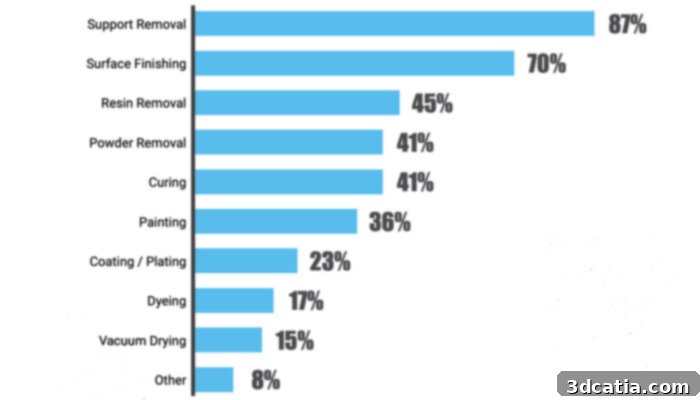
Post-processing methods used
Key Post-Processing Methods and Enduring Challenges
Consistent with previous findings, the annual report identifies the removal of printing supports as the most prevalent post-processing method, engaged by a significant 87% of users. Support structures are indispensable for many AM processes, providing stability during printing and preventing deformation, but their removal is often a labor-intensive and delicate task. This is closely followed by surface finishing, utilized by 70% of respondents, which is crucial for achieving desired aesthetic qualities, functional performance, and dimensional accuracy for end-use parts. Finally, the removal of residual materials—specifically resin (45%) after photopolymerization and powder (41%) from powder bed fusion processes—represents another critical step. The study emphasizes that the increasing array of post-processing methods directly escalates the complexity of the manufacturing process. This proliferation necessitates a wider range of specialized equipment, sophisticated software solutions, and rigorous quality control protocols, all while demanding a consistent level of quality output. Users frequently encounter issues such as missed deadlines and, more critically, a pervasive lack of skilled expertise within the workforce. The current educational and training infrastructure for specific post-processing techniques is notably underdeveloped, creating a significant talent gap.
Handling a newly printed part, particularly complex industrial components, requires a nuanced understanding of material properties, structural integrity, and the specific post-processing requirements for each AM technology. This specialized qualification poses a significant challenge for many participants in the study, especially for those leveraging powder bed and photopolymerization processes, where material handling and finishing can be particularly intricate. Last year’s report pinpointed the amount of time users allocated to post-treatment as the primary hurdle, a concern that persists this year, albeit with some nuances introduced by advancements in newer technologies. For material extrusion processes, for example, the study indicates that excessively long cycle times remain a major issue, now exacerbated by a more frequent occurrence of damaged parts during post-processing—a problem that was less common in previous years. In the realm of powder bed processes, achieving consistent performance continues to be the main challenge, closely followed by the ongoing demand for highly skilled labor to manage the intricacies of depowdering, part recovery, and surface finishing. Overall, a substantial 46% of respondents reported that post-treatment consumes between 11% and 25% of their total production time. The report further illuminates a critical trend: as additive manufacturing increasingly transitions towards large-scale production methods, the challenges associated with post-treatment amplify considerably, leading to heavier operational and financial expenses. This direct correlation between scale and post-processing demands is precisely why automated solutions are experiencing such a surge in demand, promising to alleviate these burdens.
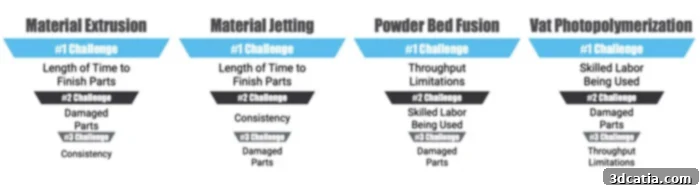
The main challenges faced according to the 3D printing technology
The Future Landscape of Post-Processing: Automation and Quality Drive Innovation
Looking ahead, the trends in post-processing are clearly defined by a push for enhanced quality, efficiency, and automation. A resounding 79% of participants identify improving the quality of end-use parts as a top priority. This commitment to quality is even more pronounced in the medical sector, where the percentage advocating for higher part quality skyrockets to an impressive 93%. In medical applications, part integrity, biocompatibility, precise dimensions, and sterilization capabilities are non-negotiable, directly impacting patient safety and efficacy. Reducing cycle time is another critical objective, with 43% of respondents considering it vital to minimize the time spent on post-processing. This drive for efficiency is crucial for making additive manufacturing competitive with traditional methods, enabling faster iteration, quicker time-to-market, and overall cost reduction. The market’s unequivocal demand is for automated and reliable solutions capable of consistently delivering industrial-quality parts at scale.
This strong industry consensus represents excellent news for numerous players in the additive manufacturing ecosystem. Many companies have already been strategically investing in and developing sophisticated end-to-end solutions for several years, specifically designed to reduce the need for extensive human intervention in post-processing. These innovative automated systems promise a paradigm shift, moving away from labor-intensive manual steps towards more consistent, repeatable, and scalable operations. Automation offers a multitude of benefits, including significant reductions in labor costs, improved process consistency, enhanced safety for workers dealing with hazardous materials or intricate components, and the crucial ability to scale production volumes without a proportional increase in human resources. While it is important to acknowledge that automation will not entirely replace human oversight—human expertise will remain essential for quality control, maintenance, troubleshooting, and strategic process optimization—it will undeniably empower industries to make significant strides towards true mass production with additive manufacturing. This symbiotic relationship between advanced automation and skilled human intervention is key to unlocking the full potential of AM for high-volume, high-quality manufacturing.
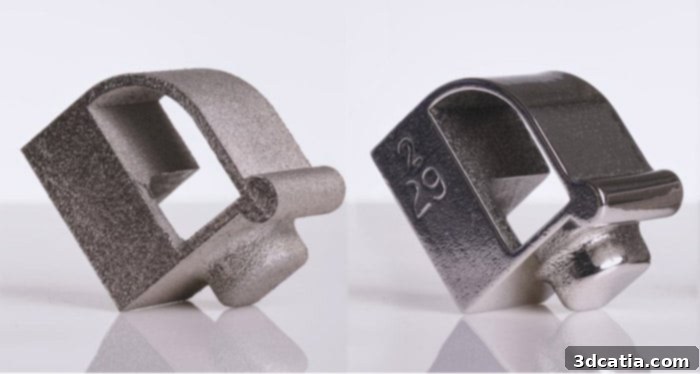
The quality of the end-use parts is crucial for most of the participants in the study.
The rapid advancements and evolving priorities within the post-processing segment of additive manufacturing are a testament to the industry’s maturity and its push towards broader industrial adoption. We eagerly anticipate the third edition of PostProcess Technologies’ report to further track these exciting developments and innovations. To delve deeper into these insights, you can access the comprehensive report HERE. We invite you to share your experiences: what post-processing steps are currently integral to your company’s workflow? Let us know your thoughts in the comments section below or engage with us on our Facebook and Twitter pages! Don’t miss out on the latest updates and trends in the world of 3D printing; sign up for our free weekly Newsletter to receive all the essential news straight to your inbox.