
Société Parisse Drives Innovation with Industrial 3D Printing and High-Performance Polymers
The integration of 3D printing, or additive manufacturing (AM), into diverse industrial sectors is no longer a futuristic concept but a present-day reality. This transformative technology is increasingly adopted by traditional manufacturing industries, not as a replacement, but as a powerful complementary tool. It enables the creation of parts that are not only significantly lighter but also maintain exceptional strength and performance characteristics. A prime example of this strategic evolution is Société Parisse, a distinguished French company based in Bourgogne-Franche-Comté. By embracing industrial 3D printing with advanced high-performance polymers, through a pivotal collaboration with INTAMSYS and CADvision, Société Parisse is setting new benchmarks in precision engineering and manufacturing efficiency.
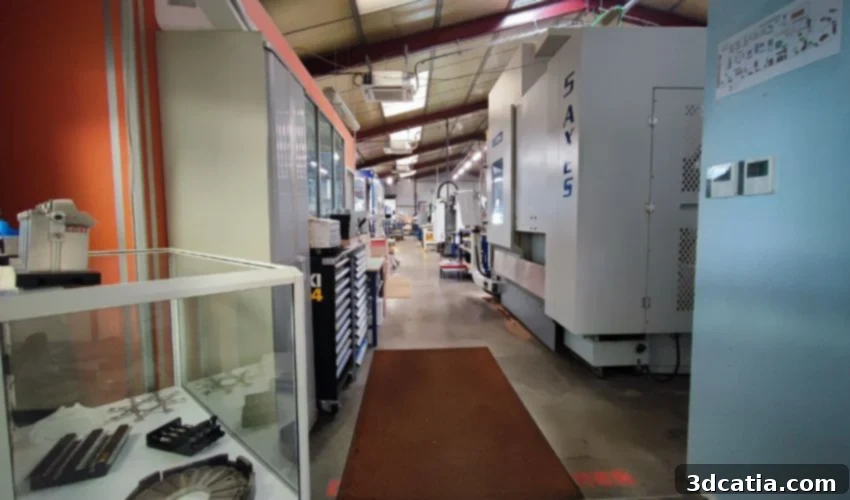
Société Parisse boasts a rich legacy rooted in precision mechanics. Established in 1981 by Gérard Parisse, the company relocated to Donzy in 1985, a testament to its enduring local presence, where its street now proudly bears its founder’s name. Over decades, Société Parisse has carved a niche for itself in mechanical precision engineering, specializing in the design and creation of complex special machinery and sophisticated assembly control systems. Their reputation for unparalleled know-how and consistently high production quality has allowed them to forge strong partnerships across a wide array of demanding sectors. These include the high-stakes world of Formula 1 and motorsport racing, the rigorous requirements of professional cycling, the critical standards of pharmaceuticals, and even the cutting edge of aerospace technology, notably contributing precision parts for the iconic Ariane rocket program.
A part made using high-performance polymers for advanced applications
For much of its history, Société Parisse has excelled through traditional manufacturing processes, leveraging an impressive array of sophisticated equipment. Their facilities house four state-of-the-art machining centers (offering 2, 3, and 5-axis capabilities), four CNC lathes (3 and 4-axis), along with single-spindle and dual-spindle turning machines. Additionally, they operate two EDM (Electro Discharge Machining) wire erosion machines, a high-precision surface grinder, a cylindrical grinder, and conventional turning and milling equipment. A dedicated metrology control laboratory ensures stringent quality, complemented by a laser engraver and a robust design office. However, recognizing the evolving demands of their diverse customer base, both French and international, Société Parisse made a strategic decision to expand its capabilities into industrial 3D printing, marking a significant step into the future of manufacturing.
The Quest for Lightweighting: Embracing 3D Printing with Advanced Polymers
The pivotal question for many traditional manufacturers considering this shift is: why embrace additive manufacturing? For Société Parisse, the answer resonated with a familiar industry challenge: the imperative for increasingly lightweight parts. Laurent Parisse, who acquired the company from his father Gérard in 2003 and now leads its operations, elaborated on this motivation. He noted a specific interest in producing components that, due to their inherent weight, could no longer be efficiently or effectively manufactured through conventional machining methods. Additive manufacturing presented a revolutionary pathway, offering unprecedented freedom in shape and design previously unattainable.
Crucially, while seeking to reduce weight and enhance design flexibility, Parisse understood that the core mechanical and thermal properties of the original metal parts needed to be preserved, or even improved upon, when transitioning to AM. This demanding requirement led him to seek expert collaboration, ultimately partnering with INTAMSYS, a leading manufacturer of high-performance 3D printers, and CADvision, a seasoned reseller of AM solutions with over 15 years of industry experience, also based in France. This partnership was instrumental in navigating the complexities of adopting industrial 3D printing for critical applications.
A complex part manufactured by Société Parisse using the INTAMSYS FUNMAT Pro 610HT 3D printer
Société Parisse’s search criteria were clear: they needed a 3D printer featuring an open material system capable of producing high-quality, production-grade parts. After an independent evaluation, CADvision’s expert recommendation centered on the INTAMSYS FUNMAT PRO 610HT 3D printer. This FFF (Fused Filament Fabrication) machine stood out for its renowned open-system architecture and its exceptional capability to process high-performance engineering materials with precision and reliability. According to Laurent Parisse, the FUNMAT PRO 610HT effectively addressed “at least 99% of the company’s concerns” regarding the integration of industrial 3D printing into their workflows.
Several critical features of the INTAMSYS FUNMAT PRO 610HT were particularly impactful for Société Parisse’s specific needs. The printer’s high-temperature chamber, capable of reaching up to 300°C, proved ideal for processing demanding “super” polymers such as PEEK (Polyether Ether Ketone) and PEKK (Polyetherketoneketone). Furthermore, its extruders, equipped with an all-metal hot end, can achieve temperatures of up to 500°C, ensuring optimal melting and deposition of these advanced materials. The generous build volume of 610x508x508mm (24x20x20 inches) also offered immense flexibility, allowing for the fabrication of very large single components or the efficient batch production of multiple smaller parts, catering to both prototyping and low-volume manufacturing requirements.
Indeed, the ability to work with high-performance polymers was the cornerstone of Société Parisse’s successful adoption of 3D printing. These so-called “super polymers,” which include materials like PEEK, PEKK, and Ultem, are celebrated for their remarkable properties that often enable them to directly replace metal components in demanding applications. Their outstanding characteristics include superior strength and rigidity, exceptional high-temperature resistance, and excellent chemical, corrosion, and wear resistance. These attributes make them suitable for deployment in even the most extreme and challenging operating environments. Crucially, they offer all these benefits while being significantly lighter than their metallic counterparts – a perfect fit for Société Parisse’s quest for lightweighting. Although the company had prior experience with high-performance plastics, the INTAMSYS FUNMAT PRO 610HT allowed them to fully harness these materials within the additive manufacturing paradigm, unlocking AM’s myriad benefits, from design freedom to part consolidation.
A redesigned industrial frame (left) printed on the FUNMAT PRO 610 HT (right)
Transforming Operations: Société Parisse’s Applications of the INTAMSYS FUNMAT PRO 610 HT
Société Parisse has swiftly integrated industrial 3D printing into various facets of its operations. One significant area is prototyping, which, when performed with traditional CNC machining, is often a costly and time-consuming process. Additive manufacturing dramatically streamlines this stage, enabling rapid iteration and design validation. Beyond prototyping, the technology is now actively employed for producing robust end-use parts, including the efficient fabrication of spare parts, which reduces lead times and inventory costs. Furthermore, these 3D printed components are directly implemented in critical applications across the aeronautic, railway, and pharmaceutical industries, showcasing their reliability and performance.
A compelling example of this transformative capability involves a frame designed by Société Parisse. This particular component functions as a remote testing mechanism for a wagon destined for train applications. Conventionally, manufacturing this frame would necessitate the assembly of 17 distinct, U-shaped parts. However, leveraging the power of additive manufacturing, Société Parisse was able to design and print the entire frame as a single, consolidated unit. This not only drastically reduced assembly complexity and potential points of failure but also optimized the part’s weight and structural integrity, illustrating the profound advantages of AM in part consolidation and functional integration.
Reflecting on the strategic choice of the INTAMSYS FUNMAT PRO 610 HT 3D printer, Laurent Parisse concludes with enthusiasm: “For us, everything aligned perfectly: the competitive price point, the substantial chamber size, the advanced features, and more. We are continuously driven by a pursuit of new innovations and a desire to steer clear of mainstream limitations. With INTAMSYS and high-temperature polymer 3D printing, we have unequivocally achieved that objective.” This strategic adoption underscores Société Parisse’s commitment to pushing the boundaries of precision manufacturing and staying at the forefront of technological advancement. Further details on INTAMSYS can be found HERE, or through the insightful video presentation below.
What are your thoughts on Société Parisse’s successful integration of industrial 3D printing into its operations? Have you encountered other inspiring examples of companies utilizing additive manufacturing to complement or enhance traditional machining methods? We invite you to share your insights in the comments section below or engage with us on our Linkedin, Facebook, and Twitter pages! Don’t miss out on the latest advancements in 3D printing; sign up for our free weekly Newsletter here to receive breaking news directly in your inbox. You can also explore all our comprehensive video content on our dedicated YouTube channel.
*All Photo Credits: Société Parisse