
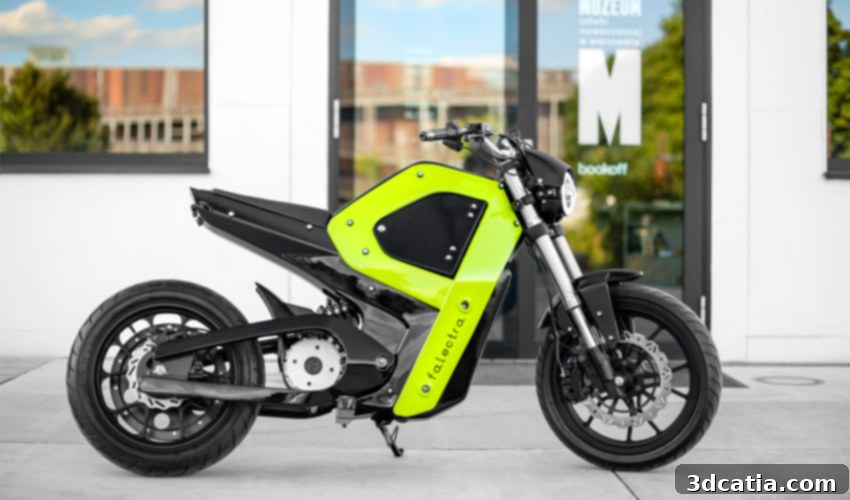
Falectra: Pioneering Sustainable Urban E-Mobility with Advanced 3D Printing Technology
In an inspiring tale of entrepreneurial vision and cutting-edge technology, Piotr Krzyczkowski, a young and ambitious Polish designer, embarked on a mission to revolutionize urban transportation. His dream was to establish his own brand of electric motorcycles, aptly named Falectra. Driven by a desire to address the pressing needs of city dwellers, Piotr envisioned a solution that was not only comfortable and economical but also significantly more environmentally friendly than conventional transport options. To transform this innovative concept into a tangible reality and effectively secure the necessary investment, he strategically designed and fabricated a foundational prototype. This critical initial model was brought to life using state-of-the-art 3D printing technology, specifically leveraging Zortrax’s renowned FDM (Fused Deposition Modeling) machines. This forward-thinking approach clearly resonated with potential backers, as Piotr successfully garnered all the essential funds required to propel his venture forward. Anticipation is high for the debut of the first Falectra electric motorcycles on city streets as early as next year, marking a significant milestone for sustainable urban mobility.
The journey of product development, particularly in the rapidly evolving e-mobility sector, often hinges on the ability to quickly and efficiently test concepts. This is where additive manufacturing, more commonly known as 3D printing, proves to be an indispensable tool. A few months prior, Sculpteo, a prominent player in the additive manufacturing space, released its comprehensive annual study detailing the widespread adoption of additive manufacturing across various professional sectors. The findings from The State of 3D Printing 2019 report were particularly revealing, indicating that a staggering 63% of participating professionals utilize 3D printing primarily for creating “proof-of-concept” parts. This means they validate designs, test innovative ideas, and refine functionalities through the rapid creation of physical models. This methodology offers an unparalleled advantage: it enables numerous iterations to be developed by simply modifying the 3D model digitally, rather than incurring the time and exorbitant costs associated with re-creating an entire mold or tooling system for each design change. Piotr Krzyczkowski’s development process for the Falectra electric motorcycle is a perfect illustration of this principle. He skillfully integrated multiple production methods, with 3D printing playing a pivotal role, to develop a fully functional prototype that was instrumental in captivating and convincing prospective investors of his vision’s viability and potential.
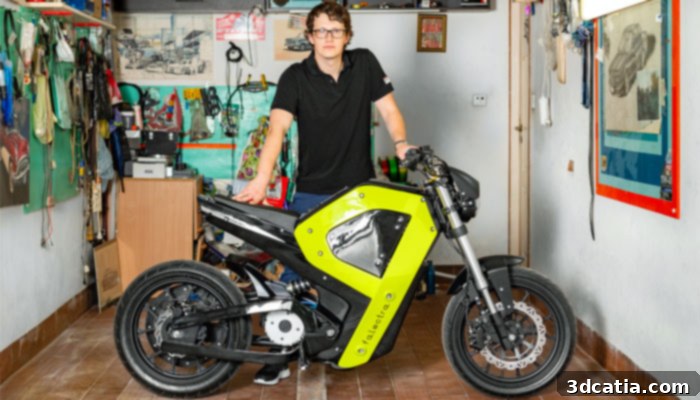
Piotr and the motorbike prototype
The development of the Falectra electric motorcycle was meticulously structured into two distinct and crucial stages. The initial stage, a comprehensive process spanning approximately two years, was dedicated to the conceptualization and refinement of the final product idea, securing essential patents, and obtaining initial seed funding. This foundational phase laid the groundwork for the entire project, ensuring intellectual property protection and early financial stability. Following this, the second stage focused intensively on the physical manifestation of the concept: the creation of a functional, full-scale prototype. In the fast-paced and highly competitive world of e-mobility, presenting a tangible, working model is not merely beneficial; it is often a critical prerequisite for gaining investor confidence and market traction. Piotr Krzyczkowski elaborated on the strategic importance of this step, stating, “Alone, a virtual project is no longer enough to truly engage partners and investors. We recognized the absolute necessity of showcasing a fully functional prototype that demonstrated our capabilities and the product’s potential in a real-world context.”
He continued to highlight the immense financial and logistical advantages offered by additive manufacturing in this critical phase. “Traditionally, simply creating the laminated panels that comprise the vehicle’s bodywork would have incurred costs ranging from PLN 150,000 to 200,000 (approximately USD 39,000 to 52,000), a sum that was well beyond our initial budget constraints. This significant financial hurdle led us to seriously consider alternative manufacturing methods, and that’s when our focus shifted towards 3D printing.” The decision to embrace this innovative technology proved to be a game-changer for Falectra. “Thanks to our invaluable cooperation with Zortrax, a leader in 3D printing solutions, the essential parts required to assemble our functional prototype were efficiently produced on their advanced printers. This collaborative effort dramatically reduced our expenses; the entire prototyping process cost almost seven times less than conventional methods, enabling us to successfully present a fully functional motorcycle to the world. This not only proved the feasibility of our design but also showcased the economic viability of our approach, ultimately securing the investment needed for the next phase of development.” This compelling example underscores how 3D printing democratizes innovation, allowing startups and small enterprises to compete with larger, more established companies by significantly lowering development costs and accelerating time to market.
The efficiency of 3D printing truly shone during the prototype creation phase, which was completed in an impressive timeframe of just six months. While the precise number of components 3D printed on Zortrax’s cutting-edge M200 Plus and M300 Plus machines remains undisclosed, Piotr’s perspective suggests that a substantial majority of the plastic components integral to the prototype were manufactured using additive technology. This reliance on 3D printing for numerous parts allowed for design flexibility, rapid iteration, and the production of complex geometries that would be challenging or cost-prohibitive with traditional methods. Miłosz Bertman, the Lead 3D Designer at Zortrax, shed light on the technical considerations behind their material selection and printing strategy. “Our primary focus throughout this collaboration was to ensure the printed parts possessed exceptional durability. It was paramount that the electric motorcycle designed by Piotr would be fully operational, robust, and unequivocally ready for real-world use and rigorous testing.”
Bertman further elaborated on the specific materials and machines chosen for this demanding application. “To meet the stringent requirements for durability and structural integrity, we opted for the Z-ULTRAT material. This advanced filament is renowned for its superior mechanical properties, particularly its ability to withstand heavy loads and provide excellent impact resistance, making it an ideal choice for functional vehicle components. We utilized both the M200 Plus and M300 Plus printers, which are celebrated for their precision, reliability, and capability to process demanding engineering materials. This strategic combination of high-performance material and advanced printing technology enabled us to create parts that meticulously replicated the aesthetic appearance and, crucially, the full functionality of the components destined for serial production. The success of this prototype is a testament to the power of combining innovative design with sophisticated additive manufacturing processes, bridging the gap between concept and a market-ready product.” The precision and strength offered by these 3D printed components were vital in building a prototype that could convincingly demonstrate the Falectra’s performance and structural integrity to investors and future users alike.
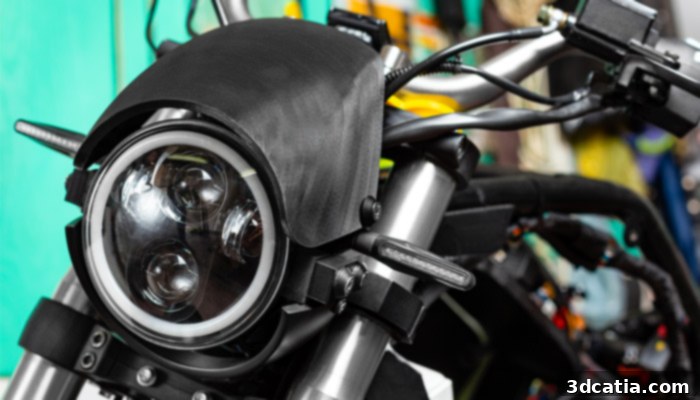
Photo Credits: Zortrax
While the current prototype extensively incorporates 3D printed components, it is yet to be confirmed whether future mass-produced Falectra motorcycles will integrate these same additive manufactured parts. However, considering the ever-growing advantages that 3D printing technology offers to the rapidly evolving automotive market, especially in terms of lightweighting, customization, and efficient production of complex geometries, there is a strong indication that Piotr Krzyczkowski and Falectra would significantly benefit from its continued adoption. The prototype itself has already showcased remarkable characteristics: it is exceptionally light, boasts impressive stability, and is designed to be remarkably easy to drive, addressing key attributes for urban electric vehicles. These qualities are a direct result of the meticulous design process and the flexibility afforded by 3D printing in optimizing material use and structural integrity.
Looking ahead, the next exciting phase for Falectra involves the deployment of the first ten motorcycles. These initial units are slated to be on the road for crucial research and development purposes as early as next year. This phase will allow for real-world testing, data collection, and further refinement based on rider feedback and performance metrics. Following the successful completion of this research period, mass production of the Falectra electric motorcycle is anticipated to commence in 2021. This strategic timeline underscores a methodical approach to market entry, prioritizing thorough validation before scaling up operations. The pricing strategy for the Falectra is also highly competitive, with each bike expected to cost a little more than €3,500. This attractive price point positions the Falectra as an accessible and economical option for urban commuters seeking a sustainable and efficient mode of transportation, further aligning with Piotr’s initial vision of offering a comfortable, economical, and environmentally friendly solution for city dwellers.
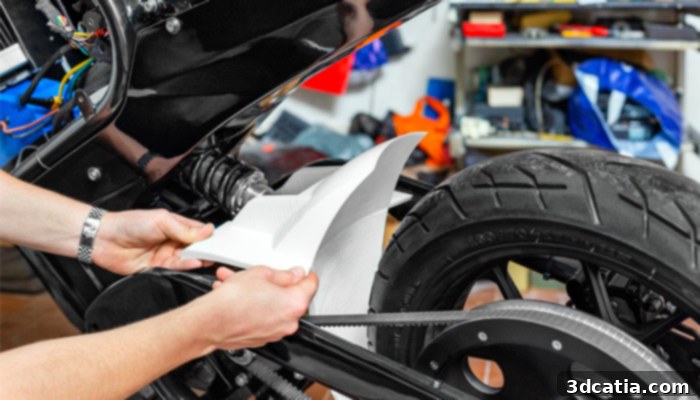
Photo credits: Zortrax
The story of Falectra serves as a compelling case study for how innovative design, coupled with strategic application of advanced manufacturing techniques like 3D printing, can bring disruptive ideas to fruition. It highlights the potential for startups to challenge established norms in industries like automotive by embracing agility, cost-effectiveness, and rapid iteration. As cities worldwide grapple with issues of pollution, traffic congestion, and the urgent need for sustainable solutions, electric motorcycles like the Falectra offer a promising path forward. Piotr Krzyczkowski’s journey, powered by the capabilities of Zortrax’s 3D printing technology, exemplifies the spirit of innovation driving the future of urban e-mobility.
For those interested in delving deeper into the technologies and partnerships that made Falectra a reality, you can find more comprehensive information HERE on Zortrax’s official website.
What are your thoughts on this groundbreaking 3D printed electric bike prototype and its potential to transform urban commuting? We invite you to share your insights and opinions by leaving a comment below, or by engaging with us on our vibrant Facebook and Twitter pages! Don’t forget to sign up for our free weekly Newsletter to ensure you receive all the latest news, updates, and groundbreaking developments in the world of 3D printing delivered directly to your inbox!